How to Conjugate Parapher in French
/pa.ʁa.fe/
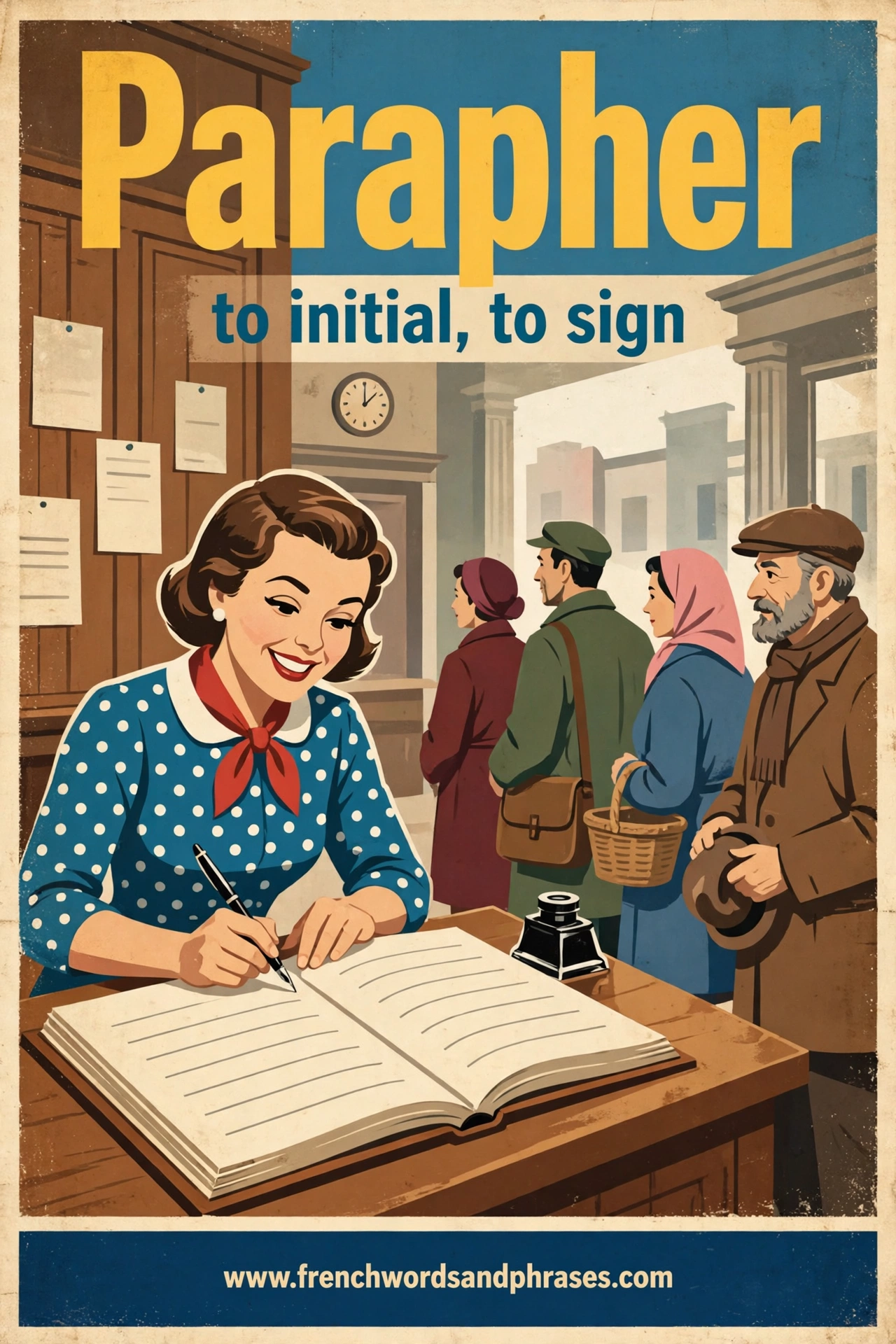
Parapher means to initial, to sign — to mark every page of a document with your paraphe, the little flourish that stands for your name.
Ink, paper and patience: a lawyer’s clerk turning the pages of a deed, a minister’s adviser working through a dossier — parapher is the everyday verb of French administration, the initials in the corner that make each page officially yours.
In this guide, you’ll learn how to conjugate parapher in all the major French tenses and moods. Explore complete conjugation tables, French examples, English translations, and practice quizzes.
Understanding the French Verb Parapher
Parapher is a regular French verb belonging to the first group of verbs, those ending in -er.
It means to initial, to sign. It is the standard verb of offices, law firms and town halls: contracts, deeds, minutes and official letters all get paraphés. In daily life you will hear it whenever paperwork must be approved page by page — and France, which loves its paperwork, gives it plenty of work.
Verb classification: First group (-er)
Auxiliary verb: Avoir
Past participle: paraphé
Present participle: paraphant
English equivalents: To initial, to sign off; parapher un document — to initial a document; parapher un contrat, un acte — to initial a contract, a deed; un paraphe — initials, a signature flourish; parapher et signer — to initial and sign.
One important detail: parapher and its twin parafer are the same verb in two spellings — both regular -er, both meaning to initial page by page — and parapher, with the ph of its Greek ancestor, is the spelling modern French prefers. Do not confuse the initials with the signature: one paraphe (initials) every page and signe (signs) the last one. The noun is un paraphe, masculine.
Experience the Word
Parapher is the verb of approval in small doses — not one grand signature, but a trail of initials proving you passed this way on every page.
Imagine a young lawyer on her first morning. On her desk, a partnership agreement as thick as a novel. Her senior partner shows her the ritual: read, check, parapher — page one, page two, page thirty — until her own quick flourish, learned at law school, sits in every corner like a signature in miniature.
By lunch, her hand aches. But the agreement has been initialled — paraphé — from cover to cover, and it is hers now.
How to Conjugate Parapher: Complete French Conjugation Guide
Let’s explore every major conjugation of parapher, beginning with the indicative mood.
How to Conjugate Parapher in the Indicative Mood
The indicative mood is used to express facts, observations, actions, and events.
How to Conjugate Parapher in the Present Tense (Présent)
Used for actions happening now, habitual actions, and general truths.
| Subject | Conjugation |
|---|---|
| je | paraphe |
| tu | paraphes |
| il / elle | paraphe |
| nous | paraphons |
| vous | paraphez |
| ils / elles | paraphent |
L’avocate paraphe le contrat avant de le signer.
The lawyer initials the contract before signing it.
Complete the sentence:
Nous ______ le contrat page par page.
Reveal the answer
paraphons
Nous paraphons le contrat page par page.
We initial the contract page by page.
How to Conjugate Parapher in the Passé Composé
Used for completed actions in the past. Parapher takes the auxiliary verb avoir.
| Subject | Conjugation |
|---|---|
| j’ | ai paraphé |
| tu | as paraphé |
| il / elle | a paraphé |
| nous | avons paraphé |
| vous | avez paraphé |
| ils / elles | ont paraphé |
Le directeur a paraphé toutes les pages du rapport.
The director initialled every page of the report.
How to Conjugate Parapher in the Imparfait (Imperfect Tense)
Used for habitual past actions, descriptions, and ongoing situations in the past.
| Subject | Conjugation |
|---|---|
| je | paraphais |
| tu | paraphais |
| il / elle | paraphait |
| nous | paraphions |
| vous | paraphiez |
| ils / elles | paraphaient |
Le secrétaire paraphait les lettres avant l’envoi.
The secretary used to initial the letters before they were sent.
Choose the correct form:
He initialled the deed.
Il ______ l’acte. (a paraphé / est paraphé)
Reveal the answer
a paraphé
Il a paraphé l’acte.
Parapher takes avoir.
How to Conjugate Parapher in the Plus-que-parfait
Used to describe an action that had already been completed before another past event.
| Subject | Conjugation |
|---|---|
| j’ | avais paraphé |
| tu | avais paraphé |
| il / elle | avait paraphé |
| nous | avions paraphé |
| vous | aviez paraphé |
| ils / elles | avaient paraphé |
Elle avait paraphé l’acte avant l’arrivée des témoins.
She had initialled the deed before the witnesses arrived.
How to Conjugate Parapher in the Passé Simple
Primarily used in formal writing, literature, and historical narratives. It is rarely used in everyday conversation.
| Subject | Conjugation |
|---|---|
| je | paraphai |
| tu | paraphas |
| il / elle | parapha |
| nous | paraphâmes |
| vous | paraphâtes |
| ils / elles | paraphèrent |
Le président parapha le décret le soir même.
The president initialled the decree that very evening.
How to Conjugate Parapher in the Passé Antérieur
A literary tense used to express an action completed immediately before another past action, generally in the passé simple.
| Subject | Conjugation |
|---|---|
| j’ | eus paraphé |
| tu | eus paraphé |
| il / elle | eut paraphé |
| nous | eûmes paraphé |
| vous | eûtes paraphé |
| ils / elles | eurent paraphé |
Quand il eut paraphé le dossier, il le remit au greffe.
When he had initialled the file, he handed it to the registry.
How to Conjugate Parapher in the Future Tense (Futur Simple)
Used to describe actions that will take place in the future.
| Subject | Conjugation |
|---|---|
| je | parapherai |
| tu | parapheras |
| il / elle | paraphera |
| nous | parapherons |
| vous | parapherez |
| ils / elles | parapheront |
Je parapherai le bail demain matin.
I will initial the lease tomorrow morning.
How to Conjugate Parapher in the Futur Antérieur (Future Perfect)
Used for an action that will have been completed before a particular point in the future.
| Subject | Conjugation |
|---|---|
| j’ | aurai paraphé |
| tu | auras paraphé |
| il / elle | aura paraphé |
| nous | aurons paraphé |
| vous | aurez paraphé |
| ils / elles | auront paraphé |
À la fin de la réunion, ils auront paraphé l’accord.
By the end of the meeting, they will have initialled the agreement.
How to Conjugate Parapher in the Near Future (Futur Proche)
Used to describe something that is going to happen soon. Formed with aller + infinitive.
| Subject | Conjugation |
|---|---|
| je | vais parapher |
| tu | vas parapher |
| il / elle | va parapher |
| nous | allons parapher |
| vous | allez parapher |
| ils / elles | vont parapher |
Tu vas parapher chaque page, n’oublie pas.
You are going to initial every page, do not forget.
How to Conjugate Parapher in the Conditional Mood
The conditional mood expresses what would happen under certain circumstances. It is also frequently used to make polite requests or express wishes.
How to Conjugate Parapher in the Present Conditional
| Subject | Conjugation |
|---|---|
| je | parapherais |
| tu | parapherais |
| il / elle | parapherait |
| nous | parapherions |
| vous | parapheriez |
| ils / elles | parapheraient |
Je parapherais ce texte si tout était en règle.
I would initial this text if everything were in order.
How to Conjugate Parapher in the Past Conditional
| Subject | Conjugation |
|---|---|
| j’ | aurais paraphé |
| tu | aurais paraphé |
| il / elle | aurait paraphé |
| nous | aurions paraphé |
| vous | auriez paraphé |
| ils / elles | auraient paraphé |
Elle aurait paraphé le contrat sans cette clause étrange.
She would have initialled the contract if not for that strange clause.
Parapher in the Literary Past Conditional Form
This less common literary form uses the imperfect subjunctive of avoir.
| Subject | Conjugation |
|---|---|
| j’ | eusse paraphé |
| tu | eusses paraphé |
| il / elle | eût paraphé |
| nous | eussions paraphé |
| vous | eussiez paraphé |
| ils / elles | eussent paraphé |
Le ministre eût paraphé le traité avant la nuit.
The minister would have initialled the treaty before nightfall.
How to Conjugate Parapher in the Subjunctive Mood
The subjunctive is used to express wishes, emotions, doubts, necessity, and uncertainty. It frequently follows expressions such as il faut que (it is necessary that) or bien que (although).
How to Conjugate Parapher in the Present Subjunctive
| Subject | Conjugation |
|---|---|
| que je | paraphe |
| que tu | paraphes |
| qu’il / qu’elle | paraphe |
| que nous | paraphions |
| que vous | paraphiez |
| qu’ils / qu’elles | paraphent |
Il faut que le témoin paraphe aussi cette page.
The witness must also initial this page.
Complete the sentence using the subjunctive:
Il faut que vous ______ cette annexe aussi.
Reveal the answer
paraphiez
Il faut que vous paraphiez cette annexe aussi.
You must initial this appendix too.
How to Conjugate Parapher in the Imperfect Subjunctive
A literary tense, rarely encountered in modern spoken French.
| Subject | Conjugation |
|---|---|
| que je | paraphasse |
| que tu | paraphasses |
| qu’il / qu’elle | paraphât |
| que nous | paraphassions |
| que vous | paraphassiez |
| qu’ils / qu’elles | paraphassent |
Le notaire demanda qu’elle paraphât l’acte entier.
The notary asked her to initial the entire deed.
How to Conjugate Parapher in the Pluperfect Subjunctive
A literary construction used to express an action completed before another past action.
| Subject | Conjugation |
|---|---|
| que j’ | eusse paraphé |
| que tu | eusses paraphé |
| qu’il / qu’elle | eût paraphé |
| que nous | eussions paraphé |
| que vous | eussiez paraphé |
| qu’ils / qu’elles | eussent paraphé |
On vérifia qu’ils eussent paraphé chaque annexe.
They checked that they had initialled every appendix.
How to Conjugate Parapher in the Past Subjunctive
| Subject | Conjugation |
|---|---|
| que j’ | aie paraphé |
| que tu | aies paraphé |
| qu’il / qu’elle | ait paraphé |
| que nous | ayons paraphé |
| que vous | ayez paraphé |
| qu’ils / qu’elles | aient paraphé |
Je suis rassuré qu’il ait paraphé le document.
I am relieved he initialled the document.
How to Conjugate Parapher in the Imperative
The imperative is used to give commands, instructions, invitations, or suggestions. Subject pronouns are omitted.
How to Conjugate Parapher in the Present Imperative
| Person | Conjugation |
|---|---|
| (tu) | paraphe |
| (nous) | paraphons |
| (vous) | paraphez |
Paraphez chaque page et signez à la fin !
Initial every page and sign at the end!
How would you say Initial every page (tu form)?
Reveal the answer
Paraphe chaque page !
French Participles of Parapher
Participles are verb forms that can be used in compound tenses and other grammatical constructions.
Present Participle of Parapher
paraphant
En paraphant le bail, elle relut les conditions.
While initialling the lease, she reread the conditions.
Past Participle of Parapher
paraphé
Paraphé par les deux parties, l’accord devint valable.
Initialled by both parties, the agreement became valid.
Parapher in Everyday French: Real-Life Examples
Now that you know the conjugations, let’s see how parapher appears in everyday French.
L’avocate paraphe le contrat.
The lawyer initials the contract.
Le directeur a paraphé le rapport.
The director initialled the report.
Le secrétaire paraphait les lettres.
The secretary used to initial the letters.
Je parapherai le bail demain.
I will initial the lease tomorrow.
Je parapherais ce texte s’il était complet.
I would initial this text if it were complete.
Paraphe chaque page !
Initial every page!
Beyond Translation: The Meaning of Parapher
The paraphe began as a Greek marginal mark — paragraphos, written beside the text — and became the flourish with which clerks, kings and notaries marked a page as seen and approved.
A signature in miniature, repeated without mercy.
French administration still runs on it: to parapher is to leave your mark so often that the document cannot be altered without your initials betraying the change.
How to Remember the French Verb Parapher
Remember it this way: Parapher is about the lawyer’s flourish appearing in the corner of every page.
- Parapher is the modern spelling; parafer is its older twin — same verb, same meaning: to initial.
- Initials on every page, signature on the last: on paraphe les pages, on signe à la fin.
- Regular -er: je paraphe, nous paraphons, past participle paraphé.
The key idea is the lawyer’s flourish appearing in the corner of every page.
Test Your Knowledge of Parapher
Let’s see how much you’ve learned. Try answering these questions before revealing the answers.
What is a paraphe?
Reveal the answer
Your initials or signature flourish — the small mark you put on each page of a document.
How do you say The lawyer initials the contract in French?
Reveal the answer
L’avocate paraphe le contrat.
Translate: The director initialled every page of the report.
Reveal the answer
Le directeur a paraphé toutes les pages du rapport.
What is the past participle of parapher?
Reveal the answer
Paraphé.
Complete the sentence:
Il faut que le témoin ______ aussi cette page.
Reveal the answer
paraphe
Il faut que le témoin paraphe aussi cette page.
The witness must also initial this page.
Can You Use It?
How would you say this in French?
She initials the last page of the lease, and the flat is almost hers.
Reveal the answer
Elle paraphe la dernière page du bail, et l’appartement est presque à elle.
She initials the last page of the lease, and the flat is almost hers.
LEARN FRENCH ONE WORD AT A TIME