How to Conjugate Panser in French
/pɑ̃.se/
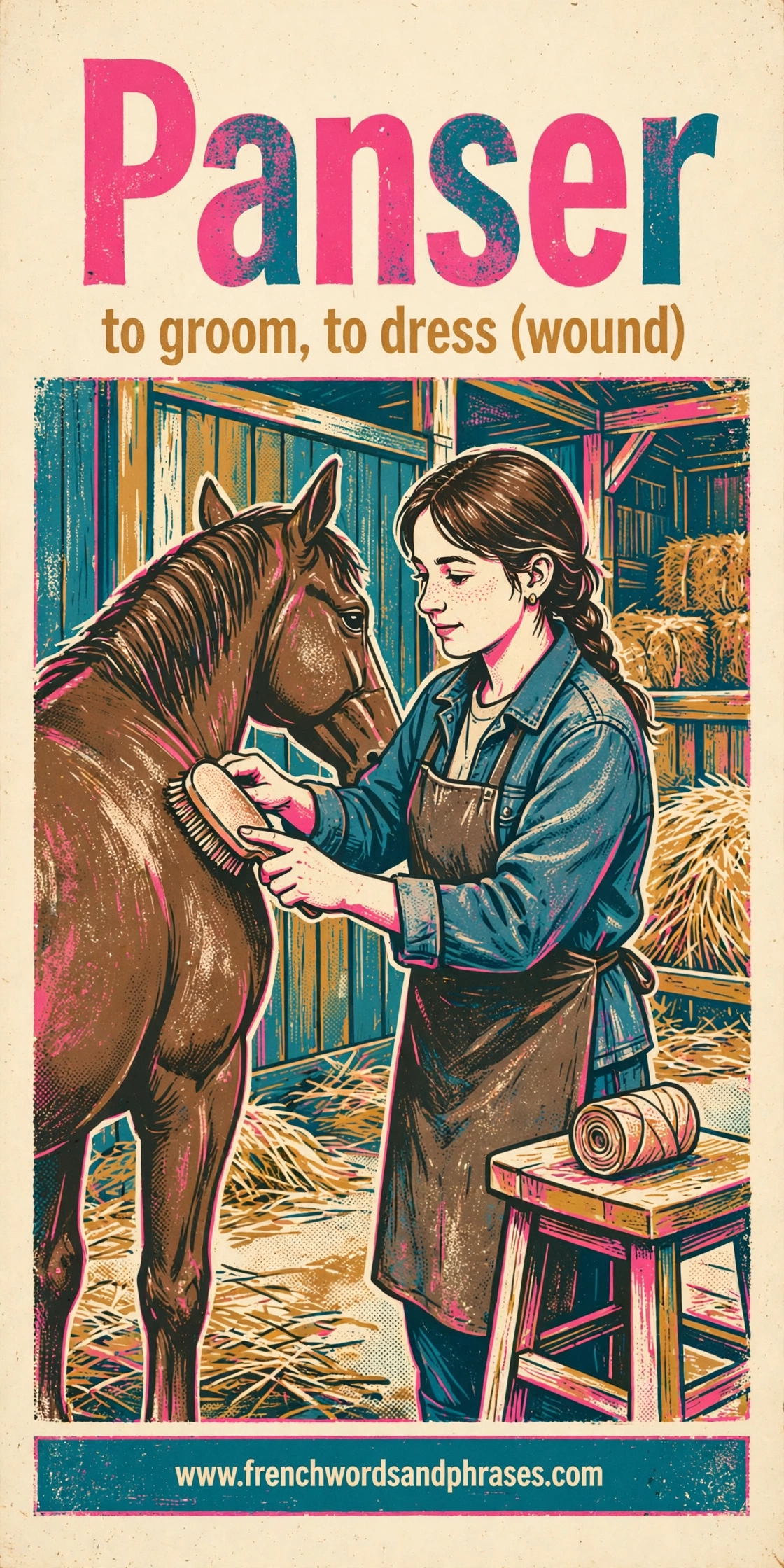
Panser means to groom, to dress (wound) — to tend a horse with brush and currycomb, or to bandage an injury with care.
A stable boy working a brush over a shining coat at dawn, a nurse unwinding a bandage in a quiet ward — panser is the verb of tending: of hands that look after horses and wounds alike.
In this guide, you’ll learn how to conjugate panser in all the major French tenses and moods. Explore complete conjugation tables, French examples, English translations, and practice quizzes.
Understanding the French Verb Panser
Panser is a regular French verb belonging to the first group of verbs, those ending in -er.
It means to groom, to dress (wound). It lives in two worlds that share one idea — care given by hand. In the stable, panser un cheval is the full daily grooming: currycomb, brush, hoof-pick. In medicine, panser une plaie is to clean and dress a wound, and the verb extends tenderly to feelings: le temps panse les blessures, time dresses all wounds.
Verb classification: First group (-er)
Auxiliary verb: Avoir
Past participle: pansé
Present participle: pansant
English equivalents: To groom, to dress a wound; panser un cheval — to groom a horse; panser une plaie — to dress a wound; panser une blessure — to dress an injury; le pansage — grooming; un pansement — a dressing, a bandage.
One important detail — the famous trap: panser sounds exactly like penser, to think (both are /pɑ̃.se/), and learners mix them up constantly. The spelling keeps them apart: pan-ser tends and bandages, pen-ser thinks. Its family confirms the sense: un pansement is a dressing or plaster, and le pansage is the grooming of a horse. Otherwise the verb is a model regular -er: je panse, nous pansons, j’ai pansé.
Experience the Word
Panser is the verb of the caring hand — the same gesture, whether the patient is a horse or a soldier.
Imagine a cavalry stable before sunrise. A young soldier works down his horse’s flank with the brush, talking quietly as he goes; across the yard, in the infirmary window, a nurse panses a bandaged hand with the same unhurried attention.
Brush or bandage, the work is identical. Both are panser — tending, cleaning, putting right.
How to Conjugate Panser: Complete French Conjugation Guide
Let’s explore every major conjugation of panser, beginning with the indicative mood.
How to Conjugate Panser in the Indicative Mood
The indicative mood is used to express facts, observations, actions, and events.
How to Conjugate Panser in the Present Tense (Présent)
Used for actions happening now, habitual actions, and general truths.
| Subject | Conjugation |
|---|---|
| je | panse |
| tu | panses |
| il / elle | panse |
| nous | pansons |
| vous | pansez |
| ils / elles | pansent |
Le palefrenier panse les chevaux chaque matin.
The groom grooms the horses every morning.
Complete the sentence:
Nous ______ les chevaux chaque matin.
Reveal the answer
pansons
Nous pansons les chevaux chaque matin.
We groom the horses every morning.
How to Conjugate Panser in the Passé Composé
Used for completed actions in the past. Panser takes the auxiliary verb avoir.
| Subject | Conjugation |
|---|---|
| j’ | ai pansé |
| tu | as pansé |
| il / elle | a pansé |
| nous | avons pansé |
| vous | avez pansé |
| ils / elles | ont pansé |
L’infirmière a pansé la blessure du soldat.
The nurse dressed the soldier’s wound.
How to Conjugate Panser in the Imparfait (Imperfect Tense)
Used for habitual past actions, descriptions, and ongoing situations in the past.
| Subject | Conjugation |
|---|---|
| je | pansais |
| tu | pansais |
| il / elle | pansait |
| nous | pansions |
| vous | pansiez |
| ils / elles | pansaient |
Il pansait son cheval avant l’aube.
He used to groom his horse before dawn.
Choose the correct form:
The nurse dressed the wound.
L’infirmière ______ la plaie. (a pansé / a pensé)
Reveal the answer
a pansé
L’infirmière a pansé la plaie.
Dressing a wound is panser (with an a); pensé would mean ‘thought’.
How to Conjugate Panser in the Plus-que-parfait
Used to describe an action that had already been completed before another past event.
| Subject | Conjugation |
|---|---|
| j’ | avais pansé |
| tu | avais pansé |
| il / elle | avait pansé |
| nous | avions pansé |
| vous | aviez pansé |
| ils / elles | avaient pansé |
Elle avait pansé la plaie avant l’arrivée du médecin.
She had dressed the wound before the doctor arrived.
How to Conjugate Panser in the Passé Simple
Primarily used in formal writing, literature, and historical narratives. It is rarely used in everyday conversation.
| Subject | Conjugation |
|---|---|
| je | pansai |
| tu | pansas |
| il / elle | pansa |
| nous | pansâmes |
| vous | pansâtes |
| ils / elles | pansèrent |
La sœur pansa les blessés toute la nuit.
The nurse dressed the wounded all night.
How to Conjugate Panser in the Passé Antérieur
A literary tense used to express an action completed immediately before another past action, generally in the passé simple.
| Subject | Conjugation |
|---|---|
| j’ | eus pansé |
| tu | eus pansé |
| il / elle | eut pansé |
| nous | eûmes pansé |
| vous | eûtes pansé |
| ils / elles | eurent pansé |
Quand il eut pansé son cheval, il le mena au pré.
When he had groomed his horse, he led it to the field.
How to Conjugate Panser in the Future Tense (Futur Simple)
Used to describe actions that will take place in the future.
| Subject | Conjugation |
|---|---|
| je | panserai |
| tu | panseras |
| il / elle | pansera |
| nous | panserons |
| vous | panserez |
| ils / elles | panseront |
Demain, tu panseras les chevaux à ma place.
Tomorrow, you will groom the horses in my place.
How to Conjugate Panser in the Futur Antérieur (Future Perfect)
Used for an action that will have been completed before a particular point in the future.
| Subject | Conjugation |
|---|---|
| j’ | aurai pansé |
| tu | auras pansé |
| il / elle | aura pansé |
| nous | aurons pansé |
| vous | aurez pansé |
| ils / elles | auront pansé |
À midi, l’infirmier aura pansé tous les blessés de la salle.
By noon, the nurse will have dressed all the wounded in the ward.
How to Conjugate Panser in the Near Future (Futur Proche)
Used to describe something that is going to happen soon. Formed with aller + infinitive.
| Subject | Conjugation |
|---|---|
| je | vais panser |
| tu | vas panser |
| il / elle | va panser |
| nous | allons panser |
| vous | allez panser |
| ils / elles | vont panser |
Je vais panser cette coupure tout de suite.
I am going to dress this cut right away.
How to Conjugate Panser in the Conditional Mood
The conditional mood expresses what would happen under certain circumstances. It is also frequently used to make polite requests or express wishes.
How to Conjugate Panser in the Present Conditional
| Subject | Conjugation |
|---|---|
| je | panserais |
| tu | panserais |
| il / elle | panserait |
| nous | panserions |
| vous | panseriez |
| ils / elles | panseraient |
Avec plus de temps, je panserais chaque cheval deux fois par jour.
With more time, I would groom each horse twice a day.
How to Conjugate Panser in the Past Conditional
| Subject | Conjugation |
|---|---|
| j’ | aurais pansé |
| tu | aurais pansé |
| il / elle | aurait pansé |
| nous | aurions pansé |
| vous | auriez pansé |
| ils / elles | auraient pansé |
Elle aurait pansé la plaie si elle avait eu des bandages.
She would have dressed the wound if she had had bandages.
Panser in the Literary Past Conditional Form
This less common literary form uses the imperfect subjunctive of avoir.
| Subject | Conjugation |
|---|---|
| j’ | eusse pansé |
| tu | eusses pansé |
| il / elle | eût pansé |
| nous | eussions pansé |
| vous | eussiez pansé |
| ils / elles | eussent pansé |
Il eût pansé son cheval lui-même plutôt que de le confier à un autre.
He would have groomed his horse himself rather than entrust it to another.
How to Conjugate Panser in the Subjunctive Mood
The subjunctive is used to express wishes, emotions, doubts, necessity, and uncertainty. It frequently follows expressions such as il faut que (it is necessary that) or bien que (although).
How to Conjugate Panser in the Present Subjunctive
| Subject | Conjugation |
|---|---|
| que je | panse |
| que tu | panses |
| qu’il / qu’elle | panse |
| que nous | pansions |
| que vous | pansiez |
| qu’ils / qu’elles | pansent |
Il faut que tu panses cette blessure avant ce soir.
You must dress this wound before this evening.
Complete the sentence using the subjunctive:
Le vétérinaire veut que vous ______ le cheval deux fois par jour.
Reveal the answer
pansiez
Le vétérinaire veut que vous pansiez le cheval deux fois par jour.
The vet wants you to groom the horse twice a day.
How to Conjugate Panser in the Imperfect Subjunctive
A literary tense, rarely encountered in modern spoken French.
| Subject | Conjugation |
|---|---|
| que je | pansasse |
| que tu | pansasses |
| qu’il / qu’elle | pansât |
| que nous | pansassions |
| que vous | pansassiez |
| qu’ils / qu’elles | pansassent |
Le vétérinaire voulait que nous pansassions le cheval deux fois par jour.
The vet wanted us to groom the horse twice a day.
How to Conjugate Panser in the Pluperfect Subjunctive
A literary construction used to express an action completed before another past action.
| Subject | Conjugation |
|---|---|
| que j’ | eusse pansé |
| que tu | eusses pansé |
| qu’il / qu’elle | eût pansé |
| que nous | eussions pansé |
| que vous | eussiez pansé |
| qu’ils / qu’elles | eussent pansé |
On admirait qu’elle eût pansé tant de blessés sans se plaindre.
People admired that she had dressed so many wounded without complaining.
How to Conjugate Panser in the Past Subjunctive
| Subject | Conjugation |
|---|---|
| que j’ | aie pansé |
| que tu | aies pansé |
| qu’il / qu’elle | ait pansé |
| que nous | ayons pansé |
| que vous | ayez pansé |
| qu’ils / qu’elles | aient pansé |
Je suis soulagé que tu aies pansé sa patte.
I am relieved that you dressed his paw.
How to Conjugate Panser in the Imperative
The imperative is used to give commands, instructions, invitations, or suggestions. Subject pronouns are omitted.
How to Conjugate Panser in the Present Imperative
| Person | Conjugation |
|---|---|
| (tu) | panse |
| (nous) | pansons |
| (vous) | pansez |
Pansez les chevaux avant de les nourrir !
Groom the horses before feeding them!
How would you say Dress this cut right away (tu form)?
Reveal the answer
Panse cette coupure tout de suite !
French Participles of Panser
Participles are verb forms that can be used in compound tenses and other grammatical constructions.
Present Participle of Panser
pansant
En pansant son cheval, il lui parle doucement.
While grooming his horse, he talks to it softly.
Past Participle of Panser
pansé
Pansée avec soin, la plaie a guéri en une semaine.
Dressed with care, the wound healed in a week.
Panser in Everyday French: Real-Life Examples
Now that you know the conjugations, let’s see how panser appears in everyday French.
Le palefrenier panse les chevaux.
The groom is grooming the horses.
L’infirmière a pansé la blessure.
The nurse dressed the wound.
Il pansait son cheval avant l’aube.
He used to groom his horse before dawn.
Tu panseras les chevaux demain.
You will groom the horses tomorrow.
Je panserais chaque cheval deux fois par jour.
I would groom each horse twice a day.
Panse cette coupure tout de suite !
Dress this cut right away!
Beyond Translation: The Meaning of Panser
Beware the perfect homophone: penser, to think, and panser, to tend, are pronounced identically, and French schoolchildren have confused them in dictations for centuries.
One letter of difference, two worlds.
The noun of panser, un pansement, is the plaster on your finger and the dressing on a wound — and in the loveliest extension of all, le temps panse toutes les blessures: time itself does the dressing.
How to Remember the French Verb Panser
Remember it this way: Panser is about brush for the horse, bandage for the wound — one caring hand.
- Panser (with an a) tends and bandages; penser (with an e) thinks — identical sound, different spelling.
- Two patients, one gesture: panser un cheval (to groom) and panser une plaie (to dress a wound).
- Its noun is un pansement — the plaster or dressing that panser puts on.
The key idea is brush for the horse, bandage for the wound — one caring hand.
Test Your Knowledge of Panser
Let’s see how much you’ve learned. Try answering these questions before revealing the answers.
Panser and penser sound identical. Which one means to think?
Reveal the answer
Penser (with an e) means to think; panser (with an a) means to groom or to dress a wound.
How do you say The nurse dressed the soldier’s wound in French?
Reveal the answer
L’infirmière a pansé la blessure du soldat.
Translate: The groom grooms the horses every morning.
Reveal the answer
Le palefrenier panse les chevaux chaque matin.
What is the past participle of panser?
Reveal the answer
Pansé — une plaie pansée, a dressed wound.
Complete the sentence:
Il faut que tu ______ cette blessure avant ce soir.
Reveal the answer
panses
Il faut que tu panses cette blessure avant ce soir.
You must dress this wound before this evening.
Can You Use It?
How would you say this in French?
He grooms his horse at dusk, and the whole stable breathes the calm of the evening.
Reveal the answer
Il panse son cheval au crépuscule, et l’écurie entière respire le calme du soir.
He grooms his horse at dusk, and the whole stable breathes the calm of the evening.
LEARN FRENCH ONE WORD AT A TIME