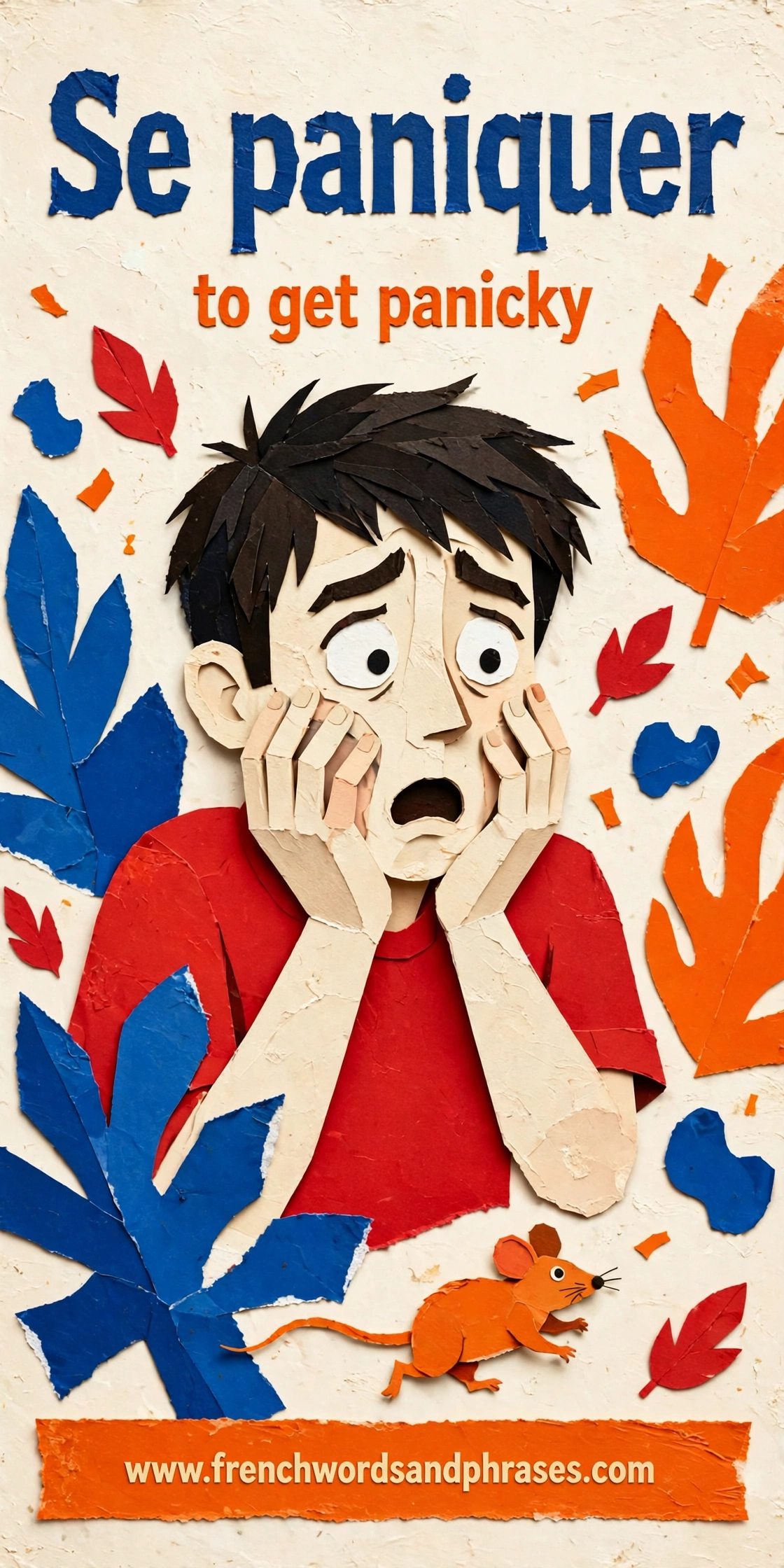
How to Conjugate Se paniquer in French
/sə pa.ni.ke/
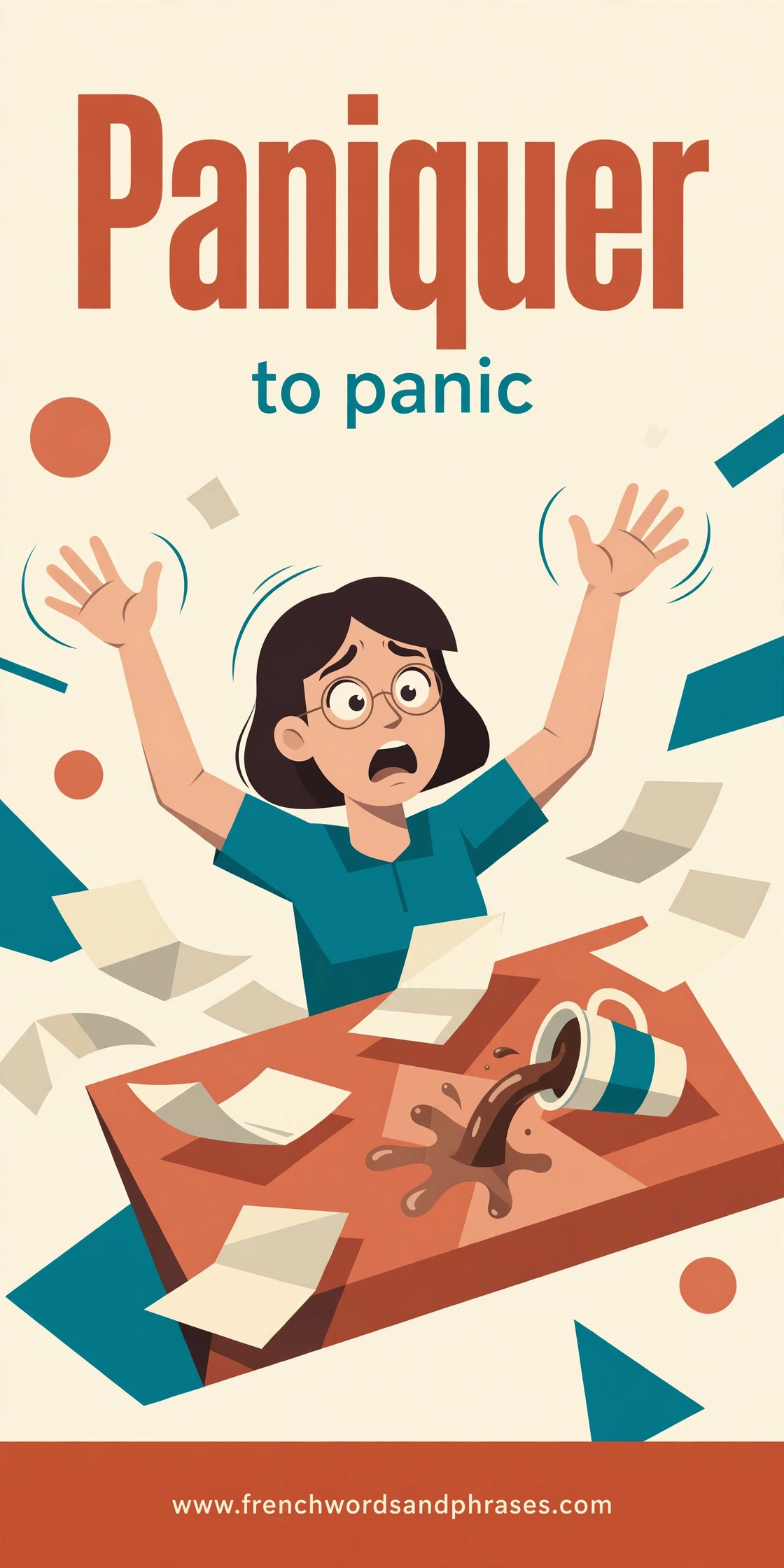
Se paniquer means to get panicky — to work yourself into a fluster over something that usually turns out to be nothing.
A lost passport five minutes before the taxi, a strange noise from the car engine, a text that reads ‘call me’ — se paniquer is the small, everyday panic: your own heart racing while the world stays perfectly calm.
In this guide, you’ll learn how to conjugate se paniquer in all the major French tenses and moods. Explore complete conjugation tables, French examples, English translations, and practice quizzes.
Understanding the French Verb Se paniquer
Se paniquer is a regular French verb belonging to the first group of verbs, those ending in -er.
It means to get panicky. It is the everyday, slightly self-mocking way to describe getting worked up: parents tell children not to se paniquer, friends say it to each other before exams, and people confess it about themselves — je me suis paniqué pour rien, I got into a state over nothing.
Verb classification: First group (-er), reflexive
Auxiliary verb: Être
Past participle: paniqué
Present participle: paniquant
English equivalents: To get panicky, to get into a state, to fluster oneself; se paniquer pour un rien — to get into a panic over nothing; elle se panique vite — she panics easily; ne te panique pas ! — don’t get into a state!
One important detail: se paniquer is reflexive, so it takes être in every compound tense and the past participle agrees with the subject: elle s’est paniquée, ils se sont paniqués. The tu imperative tucks the pronoun behind the verb: panique-toi, and in the negative it steps back in front: ne te panique pas ! — the single most useful sentence on this page. Compare plain paniquer: la foule panique is a crowd stampeding; elle se panique is one person flustering over a lost key.
Experience the Word
Se paniquer is panic at kitchen-table scale — no crowd, no stampede, just you and a racing heart.
Imagine a traveller at the airport who cannot find her passport. Bags emptied onto the floor, pockets turned out, voice rising — elle se panique — while her travelling companion quietly points at the passport, in her hand, where it has been all along.
The disaster lasted ninety seconds. She got panicky — elle s’est paniquée — over a passport she was holding.
How to Conjugate Se paniquer: Complete French Conjugation Guide
Let’s explore every major conjugation of se paniquer, beginning with the indicative mood.
How to Conjugate Se paniquer in the Indicative Mood
The indicative mood is used to express facts, observations, actions, and events.
How to Conjugate Se paniquer in the Present Tense (Présent)
Used for actions happening now, habitual actions, and general truths.
| Subject | Conjugation |
|---|---|
| je | me panique |
| tu | te paniques |
| il / elle | se panique |
| nous | nous paniquons |
| vous | vous paniquez |
| ils / elles | se paniquent |
Elle se panique dès qu’elle ne trouve pas ses clés.
She gets panicky as soon as she cannot find her keys.
Complete the sentence:
Nous nous ______ avant chaque départ.
Reveal the answer
paniquons
Nous nous paniquons avant chaque départ.
We get into a panic before every departure.
How to Conjugate Se paniquer in the Passé Composé
Used for completed actions in the past. Se paniquer takes the auxiliary verb être.
| Subject | Conjugation |
|---|---|
| je | me suis paniqué / me suis paniquée |
| tu | t’es paniqué / t’es paniquée |
| il / elle | s’est paniqué / s’est paniquée |
| nous | nous sommes paniqués / nous sommes paniquées |
| vous | vous êtes paniqués / vous êtes paniquées / vous êtes paniqué / vous êtes paniquée |
| ils / elles | se sont paniqués / se sont paniquées |
Je me suis paniqué pour un rien ce matin.
I got into a panic over nothing this morning.
How to Conjugate Se paniquer in the Imparfait (Imperfect Tense)
Used for habitual past actions, descriptions, and ongoing situations in the past.
| Subject | Conjugation |
|---|---|
| je | me paniquais |
| tu | te paniquais |
| il / elle | se paniquait |
| nous | nous paniquions |
| vous | vous paniquiez |
| ils / elles | se paniquaient |
Enfant, il se paniquait avant chaque contrôle.
As a child, he used to get panicky before every test.
Choose the correct form:
She got into a panic over nothing.
Elle ______ pour un rien. (s’est paniquée / a paniqué)
Reveal the answer
s’est paniquée
Elle s’est paniquée pour un rien.
Se paniquer is reflexive, takes être, and the participle agrees: paniquée.
How to Conjugate Se paniquer in the Plus-que-parfait
Used to describe an action that had already been completed before another past event.
| Subject | Conjugation |
|---|---|
| je | m’étais paniqué / m’étais paniquée |
| tu | t’étais paniqué / t’étais paniquée |
| il / elle | s’était paniqué / s’était paniquée |
| nous | nous étions paniqués / nous étions paniquées |
| vous | vous étiez paniqués / vous étiez paniquées / vous étiez paniqué / vous étiez paniquée |
| ils / elles | s’étaient paniqués / s’étaient paniquées |
Elle s’était paniquée bien avant de connaître le résultat.
She had got into a panic long before knowing the result.
How to Conjugate Se paniquer in the Passé Simple
Primarily used in formal writing, literature, and historical narratives. It is rarely used in everyday conversation.
| Subject | Conjugation |
|---|---|
| je | me paniquai |
| tu | te paniquas |
| il / elle | se paniqua |
| nous | nous paniquâmes |
| vous | vous paniquâtes |
| ils / elles | se paniquèrent |
À l’annonce du retard, les passagers se paniquèrent.
At the announcement of the delay, the passengers got into a panic.
How to Conjugate Se paniquer in the Passé Antérieur
A literary tense used to express an action completed immediately before another past action, generally in the passé simple.
| Subject | Conjugation |
|---|---|
| je | me fus paniqué / me fus paniquée |
| tu | te fus paniqué / te fus paniquée |
| il / elle | se fut paniqué / se fut paniquée |
| nous | nous fûmes paniqués / nous fûmes paniquées |
| vous | vous fûtes paniqués / vous fûtes paniquées / vous fûtes paniqué / vous fûtes paniquée |
| ils / elles | se furent paniqués / se furent paniquées |
Dès qu’elle se fut paniquée, elle appela son frère.
As soon as she had got into a panic, she called her brother.
How to Conjugate Se paniquer in the Future Tense (Futur Simple)
Used to describe actions that will take place in the future.
| Subject | Conjugation |
|---|---|
| je | me paniquerai |
| tu | te paniqueras |
| il / elle | se paniquera |
| nous | nous paniquerons |
| vous | vous paniquerez |
| ils / elles | se paniqueront |
Tu te paniqueras moins avec l’habitude.
You will get panicky less with practice.
How to Conjugate Se paniquer in the Futur Antérieur (Future Perfect)
Used for an action that will have been completed before a particular point in the future.
| Subject | Conjugation |
|---|---|
| je | me serai paniqué / me serai paniquée |
| tu | te seras paniqué / te seras paniquée |
| il / elle | se sera paniqué / se sera paniquée |
| nous | nous serons paniqués / nous serons paniquées |
| vous | vous serez paniqués / vous serez paniquées / vous serez paniqué / vous serez paniquée |
| ils / elles | se seront paniqués / se seront paniquées |
À l’heure de l’examen, ils se seront paniqués cent fois pour rien.
By exam time, they will have got into a panic a hundred times over nothing.
How to Conjugate Se paniquer in the Near Future (Futur Proche)
Used to describe something that is going to happen soon. Formed with aller + infinitive.
| Subject | Conjugation |
|---|---|
| je | vais me paniquer |
| tu | vas te paniquer |
| il / elle | va se paniquer |
| nous | allons nous paniquer |
| vous | allez vous paniquer |
| ils / elles | vont se paniquer |
Calme-toi, tu vas te paniquer pour rien.
Calm down, you are going to get into a state over nothing.
How to Conjugate Se paniquer in the Conditional Mood
The conditional mood expresses what would happen under certain circumstances. It is also frequently used to make polite requests or express wishes.
How to Conjugate Se paniquer in the Present Conditional
| Subject | Conjugation |
|---|---|
| je | me paniquerais |
| tu | te paniquerais |
| il / elle | se paniquerait |
| nous | nous paniquerions |
| vous | vous paniqueriez |
| ils / elles | se paniqueraient |
Elle se paniquerait moins si elle préparait ses affaires la veille.
She would get less panicky if she got her things ready the night before.
How to Conjugate Se paniquer in the Past Conditional
| Subject | Conjugation |
|---|---|
| je | me serais paniqué / me serais paniquée |
| tu | te serais paniqué / te serais paniquée |
| il / elle | se serait paniqué / se serait paniquée |
| nous | nous serions paniqués / nous serions paniquées |
| vous | vous seriez paniqués / vous seriez paniquées / vous seriez paniqué / vous seriez paniquée |
| ils / elles | se seraient paniqués / se seraient paniquées |
Il se serait paniqué sans les conseils de son professeur.
He would have got into a panic without his teacher’s advice.
Se paniquer in the Literary Past Conditional Form
This less common literary form uses the imperfect subjunctive of être.
| Subject | Conjugation |
|---|---|
| je | me fusse paniqué / me fusse paniquée |
| tu | te fusses paniqué / te fusses paniquée |
| il / elle | se fût paniqué / se fût paniquée |
| nous | nous fussions paniqués / nous fussions paniquées |
| vous | vous fussiez paniqués / vous fussiez paniquées / vous fussiez paniqué / vous fussiez paniquée |
| ils / elles | se fussent paniqués / se fussent paniquées |
Elle se fût paniquée sans la présence de sa sœur.
She would have got into a panic without her sister there.
How to Conjugate Se paniquer in the Subjunctive Mood
The subjunctive is used to express wishes, emotions, doubts, necessity, and uncertainty. It frequently follows expressions such as il faut que (it is necessary that) or bien que (although).
How to Conjugate Se paniquer in the Present Subjunctive
| Subject | Conjugation |
|---|---|
| que je | me panique |
| que tu | te paniques |
| qu’il / qu’elle | se panique |
| que nous | nous paniquions |
| que vous | vous paniquiez |
| qu’ils / qu’elles | se paniquent |
Il ne faut pas que tu te paniques pour un examen.
You must not get into a panic over an exam.
Complete the sentence using the subjunctive:
Il ne faut pas que vous vous ______ pour ce retard.
Reveal the answer
paniquiez
Il ne faut pas que vous vous paniquiez pour ce retard.
You must not get into a panic over this delay.
How to Conjugate Se paniquer in the Imperfect Subjunctive
A literary tense, rarely encountered in modern spoken French.
| Subject | Conjugation |
|---|---|
| que je | me paniquasse |
| que tu | te paniquasses |
| qu’il / qu’elle | se paniquât |
| que nous | nous paniquassions |
| que vous | vous paniquassiez |
| qu’ils / qu’elles | se paniquassent |
Sa mère craignait qu’elle se paniquât avant l’entretien.
Her mother feared she might get panicky before the interview.
How to Conjugate Se paniquer in the Pluperfect Subjunctive
A literary construction used to express an action completed before another past action.
| Subject | Conjugation |
|---|---|
| que je | me fusse paniqué / me fusse paniquée |
| que tu | te fusses paniqué / te fusses paniquée |
| qu’il / qu’elle | se fût paniqué / se fût paniquée |
| que nous | nous fussions paniqués / nous fussions paniquées |
| que vous | vous fussiez paniqués / vous fussiez paniquées / vous fussiez paniqué / vous fussiez paniquée |
| qu’ils / qu’elles | se fussent paniqués / se fussent paniquées |
On racontait qu’ils se fussent paniqués pour une simple panne.
People said they had got into a panic over a simple breakdown.
How to Conjugate Se paniquer in the Past Subjunctive
| Subject | Conjugation |
|---|---|
| que je | me sois paniqué / me sois paniquée |
| que tu | te sois paniqué / te sois paniquée |
| qu’il / qu’elle | se soit paniqué / se soit paniquée |
| que nous | nous soyons paniqués / nous soyons paniquées |
| que vous | vous soyez paniqués / vous soyez paniquées / vous soyez paniqué / vous soyez paniquée |
| qu’ils / qu’elles | se soient paniqués / se soient paniquées |
Je suis content que tu ne te sois pas paniqué.
I am glad you did not get into a panic.
How to Conjugate Se paniquer in the Imperative
The imperative is used to give commands, instructions, invitations, or suggestions. Subject pronouns are omitted.
How to Conjugate Se paniquer in the Present Imperative
| Person | Conjugation |
|---|---|
| (tu) | panique-toi |
| (nous) | paniquons-nous |
| (vous) | paniquez-vous |
Ne te panique pas, respire un bon coup !
Don’t get into a state, take a deep breath!
How would you say Don’t get into a panic (tu form)?
Reveal the answer
Ne te panique pas !
French Participles of Se paniquer
Participles are verb forms that can be used in compound tenses and other grammatical constructions.
Present Participle of Se paniquer
paniquant
En se paniquant, il a aggravé la situation.
By getting into a panic, he made the situation worse.
Past Participle of Se paniquer
paniqué
Paniquée par le bruit, elle a appelé les voisins.
Panicked by the noise, she called the neighbours.
Se paniquer in Everyday French: Real-Life Examples
Now that you know the conjugations, let’s see how se paniquer appears in everyday French.
Elle se panique pour un rien.
She gets panicky over nothing.
Je me suis paniqué ce matin.
I got into a panic this morning.
Il se paniquait avant chaque examen.
He used to get panicky before every exam.
Tu te paniqueras moins avec l’habitude.
You will get panicky less with practice.
Elle se paniquerait moins si elle se préparait.
She would get less panicky if she prepared.
Ne te panique pas !
Don’t get into a panic!
Beyond Translation: The Meaning of Se paniquer
French splits panic into two sizes, and se paniquer is the human one.
The crowd panique; the person se panique.
Paniquer belongs to stampedes, markets and headlines, but se paniquer is what you do over a lost key, a missed train or a text message that says only ‘rappelle-moi’ — panic with the volume turned down to domestic.
How to Remember the French Verb Se paniquer
Remember it this way: Se paniquer is about the lost passport — that was in her hand all along.
- Reflexive = être, and the participle agrees: elle s’est paniquée, ils se sont paniqués.
- Its signature sentence is a reassurance: ne te panique pas ! — don’t get into a state!
- Se paniquer is one person flustering (often pour un rien); paniquer is the crowd or the markets.
The key idea is the lost passport — that was in her hand all along.
Test Your Knowledge of Se paniquer
Let’s see how much you’ve learned. Try answering these questions before revealing the answers.
Which auxiliary does se paniquer use, and why?
Reveal the answer
Être — it is a reflexive verb: elle s’est paniquée pour un rien.
How do you say She gets panicky over nothing in French?
Reveal the answer
Elle se panique pour un rien.
Translate: I got into a panic this morning.
Reveal the answer
Je me suis paniqué ce matin.
What is the past participle of se paniquer?
Reveal the answer
Paniqué — agreeing: paniquée, paniqués, paniquées.
Complete the sentence:
Il ne faut pas que tu te ______ pour un examen.
Reveal the answer
paniques
Il ne faut pas que tu te paniques pour un examen.
You must not get into a panic over an exam.
Can You Use It?
How would you say this in French?
She got into a panic over a passport she was holding in her hand, and now she laughs about it.
Reveal the answer
Elle s’est paniquée pour un passeport qu’elle tenait à la main, et maintenant elle en rit.
She got into a panic over a passport she was holding in her hand, and now she laughs about it.
LEARN FRENCH ONE WORD AT A TIME