How to Conjugate Paner in French
/pa.ne/
Paner means to coat with crumbs — to roll food in breadcrumbs before it meets the frying pan.
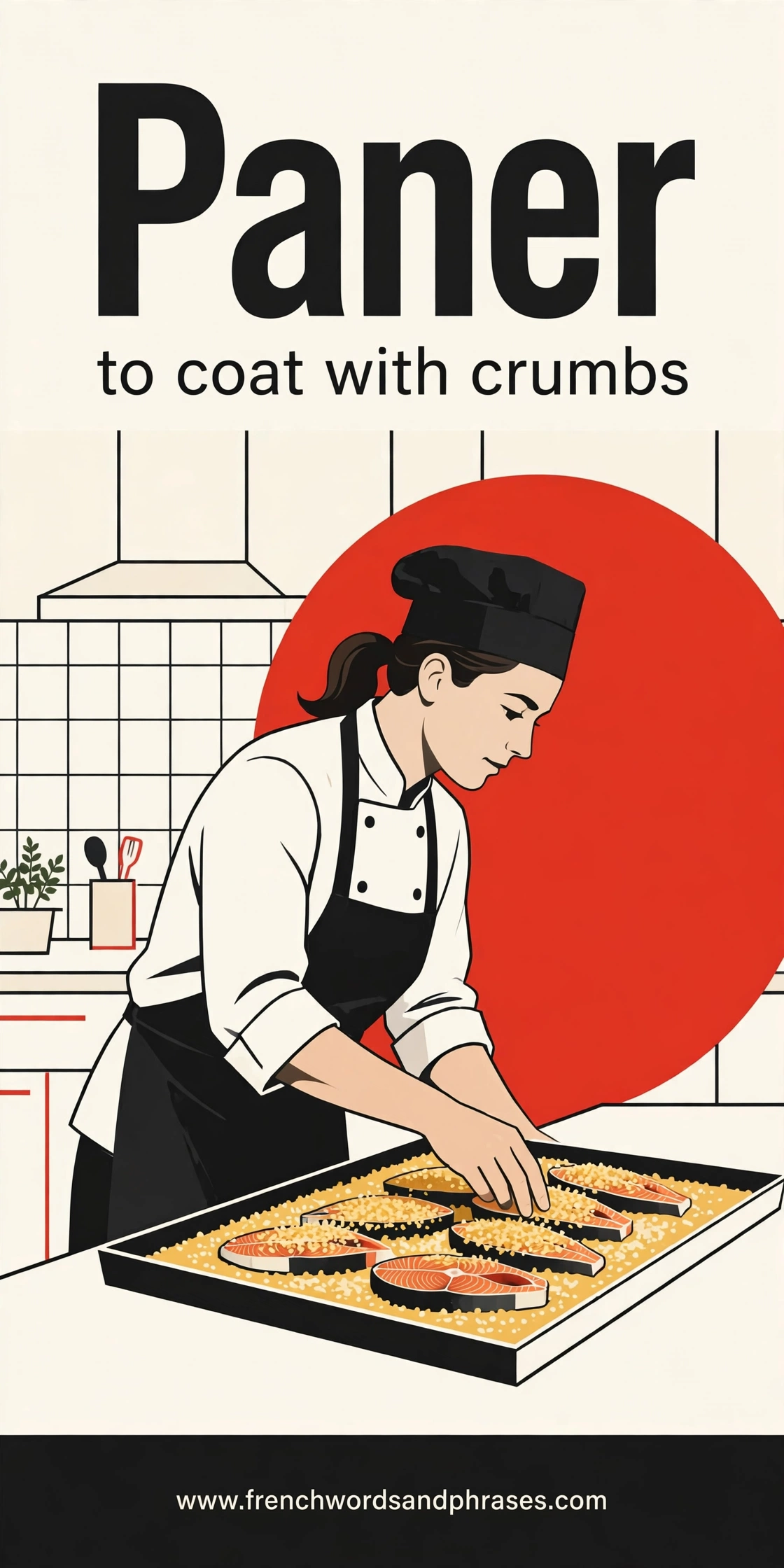
A plate of flour, a beaten egg, a mound of golden breadcrumbs, and a row of cutlets waiting their turn — paner is the cook’s verb for giving food its crisp overcoat before frying.
In this guide, you’ll learn how to conjugate paner in all the major French tenses and moods. Explore complete conjugation tables, French examples, English translations, and practice quizzes.
Understanding the French Verb Paner
Paner is a regular French verb belonging to the first group of verbs, those ending in -er.
It means to coat with crumbs. It belongs entirely to the kitchen: fish, cutlets, chicken, cheese and vegetables are panés before frying or baking, and the three-step ritual — flour, beaten egg, breadcrumbs — is called paner à l’anglaise. Outside cooking the verb is hardly ever heard.
Verb classification: First group (-er)
Auxiliary verb: Avoir
Past participle: pané
Present participle: panant
English equivalents: To coat with breadcrumbs, to bread; paner une escalope — to bread a cutlet; paner du poisson — to coat fish in breadcrumbs; une escalope panée — a breaded cutlet; pané à la milanaise — breaded Milanese-style.
One important detail: paner is a perfectly regular -er verb — je pane, nous panons, j’ai pané — and its past participle pané has a second life as the adjective you read on menus: du poulet pané, une escalope panée, du fromage pané. The word is built on pain, bread, because the crumbs it rolls food in are quite literally grated bread — in the kitchen that crumb coating has its own name, la chapelure.
Experience the Word
Paner is the verb of the crispy overcoat — nothing it touches reaches the pan naked.
Imagine a small Paris kitchen on a Friday evening. Three shallow plates stand in a row; the fish passes from flour to egg to breadcrumbs, and each fillet comes out of the last plate wearing a pale golden coat, ready for the sizzle.
Thirty seconds earlier it was a plain fillet. Now it is pané — coated, crisp-to-be, unrecognisable.
How to Conjugate Paner: Complete French Conjugation Guide
Let’s explore every major conjugation of paner, beginning with the indicative mood.
How to Conjugate Paner in the Indicative Mood
The indicative mood is used to express facts, observations, actions, and events.
How to Conjugate Paner in the Present Tense (Présent)
Used for actions happening now, habitual actions, and general truths.
| Subject | Conjugation |
|---|---|
| je | pane |
| tu | panes |
| il / elle | pane |
| nous | panons |
| vous | panez |
| ils / elles | panent |
Elle pane les escalopes avant de les frire.
She coats the cutlets in breadcrumbs before frying them.
Complete the sentence:
Nous ______ le poisson avec de la chapelure fine.
Reveal the answer
panons
Nous panons le poisson avec de la chapelure fine.
We coat the fish with fine breadcrumbs.
How to Conjugate Paner in the Passé Composé
Used for completed actions in the past. Paner takes the auxiliary verb avoir.
| Subject | Conjugation |
|---|---|
| j’ | ai pané |
| tu | as pané |
| il / elle | a pané |
| nous | avons pané |
| vous | avez pané |
| ils / elles | ont pané |
J’ai pané le poisson avec de la chapelure fine.
I coated the fish with fine breadcrumbs.
How to Conjugate Paner in the Imparfait (Imperfect Tense)
Used for habitual past actions, descriptions, and ongoing situations in the past.
| Subject | Conjugation |
|---|---|
| je | panais |
| tu | panais |
| il / elle | panait |
| nous | panions |
| vous | paniez |
| ils / elles | panaient |
Ma grand-mère panait le poulet chaque dimanche.
My grandmother used to bread the chicken every Sunday.
Choose the correct form:
I breaded the fish.
J’______ le poisson. (ai pané / suis pané)
Reveal the answer
ai pané
J’ai pané le poisson.
Paner takes avoir.
How to Conjugate Paner in the Plus-que-parfait
Used to describe an action that had already been completed before another past event.
| Subject | Conjugation |
|---|---|
| j’ | avais pané |
| tu | avais pané |
| il / elle | avait pané |
| nous | avions pané |
| vous | aviez pané |
| ils / elles | avaient pané |
Il avait déjà pané les légumes quand les invités sont arrivés.
He had already breaded the vegetables when the guests arrived.
How to Conjugate Paner in the Passé Simple
Primarily used in formal writing, literature, and historical narratives. It is rarely used in everyday conversation.
| Subject | Conjugation |
|---|---|
| je | panai |
| tu | panas |
| il / elle | pana |
| nous | panâmes |
| vous | panâtes |
| ils / elles | panèrent |
Le cuisinier pana le poisson en quelques secondes.
The cook breaded the fish in a few seconds.
How to Conjugate Paner in the Passé Antérieur
A literary tense used to express an action completed immediately before another past action, generally in the passé simple.
| Subject | Conjugation |
|---|---|
| j’ | eus pané |
| tu | eus pané |
| il / elle | eut pané |
| nous | eûmes pané |
| vous | eûtes pané |
| ils / elles | eurent pané |
Quand elle eut pané les escalopes, elle chauffa la poêle.
When she had breaded the cutlets, she heated the pan.
How to Conjugate Paner in the Future Tense (Futur Simple)
Used to describe actions that will take place in the future.
| Subject | Conjugation |
|---|---|
| je | panerai |
| tu | paneras |
| il / elle | panera |
| nous | panerons |
| vous | panerez |
| ils / elles | paneront |
Demain, nous panerons des champignons pour l’apéritif.
Tomorrow, we will coat mushrooms in breadcrumbs for the aperitif.
How to Conjugate Paner in the Futur Antérieur (Future Perfect)
Used for an action that will have been completed before a particular point in the future.
| Subject | Conjugation |
|---|---|
| j’ | aurai pané |
| tu | auras pané |
| il / elle | aura pané |
| nous | aurons pané |
| vous | aurez pané |
| ils / elles | auront pané |
Quand tu auras pané le fromage, mets-le au frais.
When you have breaded the cheese, put it in the fridge.
How to Conjugate Paner in the Near Future (Futur Proche)
Used to describe something that is going to happen soon. Formed with aller + infinitive.
| Subject | Conjugation |
|---|---|
| je | vais paner |
| tu | vas paner |
| il / elle | va paner |
| nous | allons paner |
| vous | allez paner |
| ils / elles | vont paner |
Je vais paner ces filets de sole tout de suite.
I am going to bread these sole fillets right away.
How to Conjugate Paner in the Conditional Mood
The conditional mood expresses what would happen under certain circumstances. It is also frequently used to make polite requests or express wishes.
How to Conjugate Paner in the Present Conditional
| Subject | Conjugation |
|---|---|
| je | panerais |
| tu | panerais |
| il / elle | panerait |
| nous | panerions |
| vous | paneriez |
| ils / elles | paneraient |
Sans chapelure, je ne panerais pas ce poisson.
Without breadcrumbs, I would not coat this fish.
How to Conjugate Paner in the Past Conditional
| Subject | Conjugation |
|---|---|
| j’ | aurais pané |
| tu | aurais pané |
| il / elle | aurait pané |
| nous | aurions pané |
| vous | auriez pané |
| ils / elles | auraient pané |
Tu aurais pané le poulet si tu avais eu des œufs.
You would have breaded the chicken if you had had eggs.
Paner in the Literary Past Conditional Form
This less common literary form uses the imperfect subjunctive of avoir.
| Subject | Conjugation |
|---|---|
| j’ | eusse pané |
| tu | eusses pané |
| il / elle | eût pané |
| nous | eussions pané |
| vous | eussiez pané |
| ils / elles | eussent pané |
Il eût pané le poisson lui-même plutôt que de le servir nature.
He would have breaded the fish himself rather than serve it plain.
How to Conjugate Paner in the Subjunctive Mood
The subjunctive is used to express wishes, emotions, doubts, necessity, and uncertainty. It frequently follows expressions such as il faut que (it is necessary that) or bien que (although).
How to Conjugate Paner in the Present Subjunctive
| Subject | Conjugation |
|---|---|
| que je | pane |
| que tu | panes |
| qu’il / qu’elle | pane |
| que nous | panions |
| que vous | paniez |
| qu’ils / qu’elles | panent |
Il faut que tu panes le poulet avant la friture.
You must bread the chicken before frying it.
Complete the sentence using the subjunctive:
Il faut que vous ______ les escalopes avant les invités.
Reveal the answer
paniez
Il faut que vous paniez les escalopes avant les invités.
You must bread the cutlets before the guests arrive.
How to Conjugate Paner in the Imperfect Subjunctive
A literary tense, rarely encountered in modern spoken French.
| Subject | Conjugation |
|---|---|
| que je | panasse |
| que tu | panasses |
| qu’il / qu’elle | panât |
| que nous | panassions |
| que vous | panassiez |
| qu’ils / qu’elles | panassent |
Elle voulait que je panasse les escalopes plus finement.
She wanted me to coat the cutlets more thinly.
How to Conjugate Paner in the Pluperfect Subjunctive
A literary construction used to express an action completed before another past action.
| Subject | Conjugation |
|---|---|
| que j’ | eusse pané |
| que tu | eusses pané |
| qu’il / qu’elle | eût pané |
| que nous | eussions pané |
| que vous | eussiez pané |
| qu’ils / qu’elles | eussent pané |
Il doutait que nous eussions pané assez de légumes.
He doubted that we had breaded enough vegetables.
How to Conjugate Paner in the Past Subjunctive
| Subject | Conjugation |
|---|---|
| que j’ | aie pané |
| que tu | aies pané |
| qu’il / qu’elle | ait pané |
| que nous | ayons pané |
| que vous | ayez pané |
| qu’ils / qu’elles | aient pané |
Je suis content que tu aies pané le poisson toi-même.
I am glad you breaded the fish yourself.
How to Conjugate Paner in the Imperative
The imperative is used to give commands, instructions, invitations, or suggestions. Subject pronouns are omitted.
How to Conjugate Paner in the Present Imperative
| Person | Conjugation |
|---|---|
| (tu) | pane |
| (nous) | panons |
| (vous) | panez |
Pane le poulet et laisse-le reposer dix minutes !
Bread the chicken and let it rest for ten minutes!
How would you say Bread the cutlets (tu form)?
Reveal the answer
Pane les escalopes !
French Participles of Paner
Participles are verb forms that can be used in compound tenses and other grammatical constructions.
Present Participle of Paner
panant
En panant les escalopes, elle écoutait la radio.
While breading the cutlets, she was listening to the radio.
Past Participle of Paner
pané
Panées à la chapelure dorée, les escalopes croustillaient.
Coated in golden breadcrumbs, the cutlets were crisp.
Paner in Everyday French: Real-Life Examples
Now that you know the conjugations, let’s see how paner appears in everyday French.
Elle pane le poulet.
She is breading the chicken.
J’ai pané le poisson.
I breaded the fish.
Nous panions les escalopes le dimanche.
We used to bread the cutlets on Sundays.
Tu paneras les légumes ce soir.
You will bread the vegetables this evening.
Je panerais le fromage s’il restait de la chapelure.
I would bread the cheese if there were any breadcrumbs left.
Pane ces filets, vite !
Bread those fillets, quickly!
Beyond Translation: The Meaning of Paner
English does exactly the same thing with its own word — to bread a cutlet — and French paner is its twin, built on pain, bread.
The participle escaped the kitchen.
Order un poisson pané or du camembert pané in any French bistro and you are using the past participle of this verb as a menu adjective — pané is simply what paner leaves behind.
How to Remember the French Verb Paner
Remember it this way: Paner is about the cutlet’s golden overcoat of breadcrumbs.
- Paner is built on pain (bread): to paner is to give food a coat of bread — breadcrumbs.
- The participle pané is a menu adjective: poulet pané, escalope panée, fromage pané.
- Regular -er: je pane, nous panons, past participle pané; the crumb coating itself is la chapelure.
The key idea is the cutlet’s golden overcoat of breadcrumbs.
Test Your Knowledge of Paner
Let’s see how much you’ve learned. Try answering these questions before revealing the answers.
What is the crumb coating used in paner called in French?
Reveal the answer
La chapelure — the breadcrumbs themselves; paner rolls food in chapelure.
How do you say She is breading the chicken in French?
Reveal the answer
Elle pane le poulet.
Translate: I breaded the fish.
Reveal the answer
J’ai pané le poisson.
What is the past participle of paner?
Reveal the answer
Pané — the same word you see on menus: une escalope panée.
Complete the sentence:
Il faut que tu ______ le poulet avant la friture.
Reveal the answer
panes
Il faut que tu panes le poulet avant la friture.
You must bread the chicken before frying it.
Can You Use It?
How would you say this in French?
She breads the cutlets one by one, and the kitchen already smells of frying.
Reveal the answer
Elle pane les escalopes une à une, et la cuisine embaume déjà la friture.
She breads the cutlets one by one, and the kitchen already smells of frying.
LEARN FRENCH ONE WORD AT A TIME