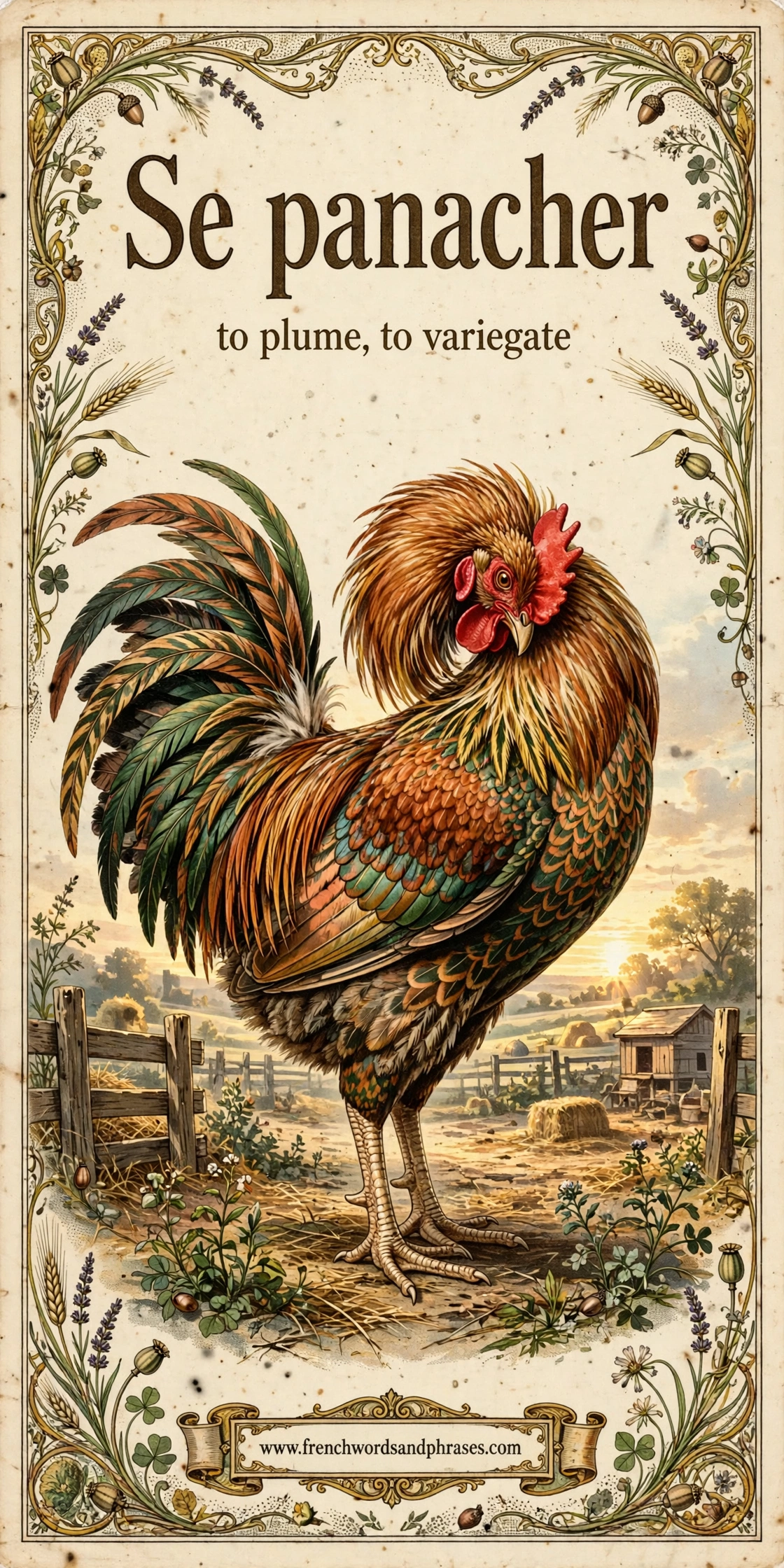
How to Conjugate Se panacher in French
/sə pa.na.ʃe/
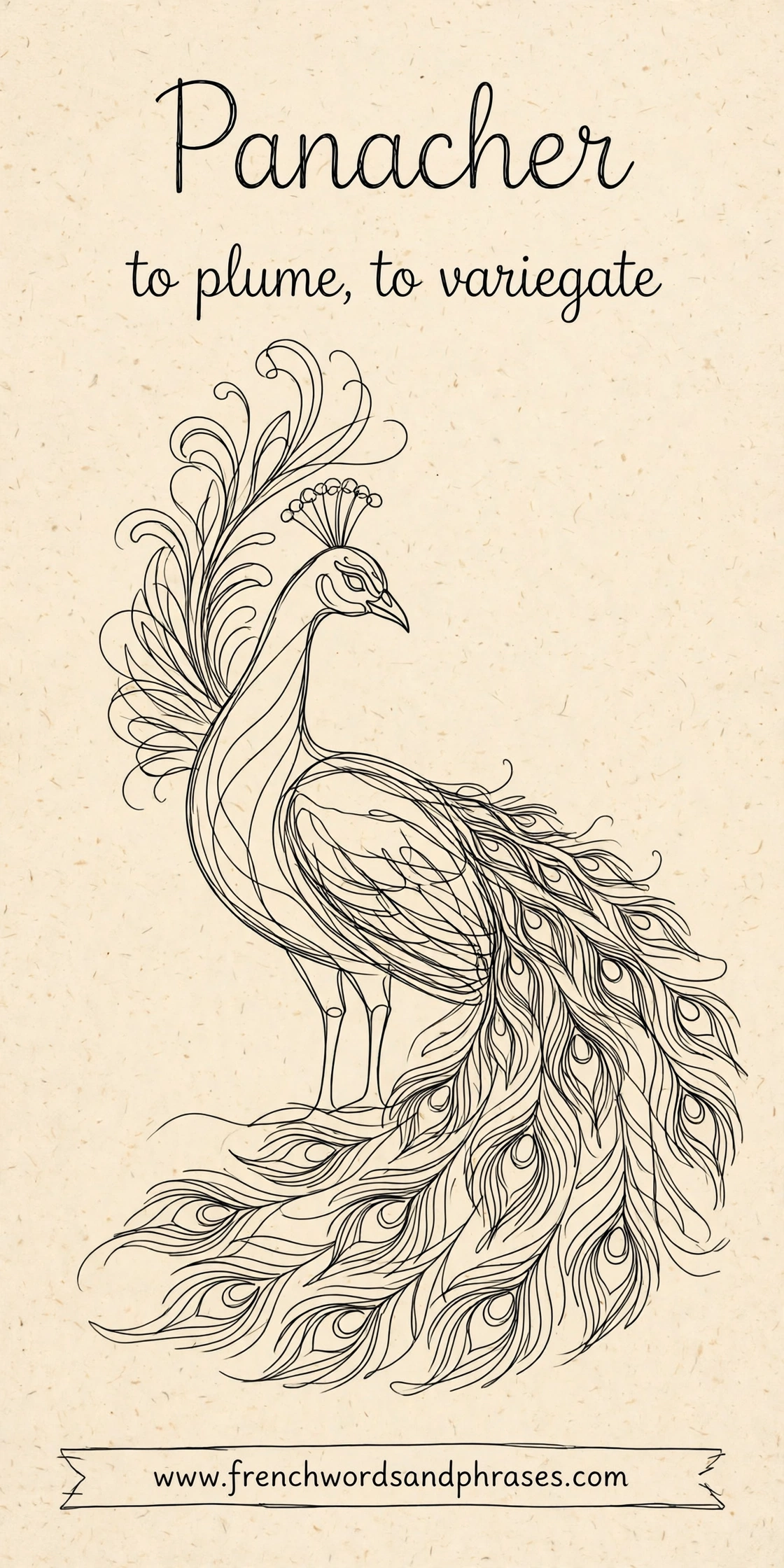
Se panacher means to plume, to variegate — said of a thing that streaks and crests itself with colour, the way a tulip flames or a sky puts on its evening feathers.
At dawn a tulip opens already wearing two colours, red flamed over cream, as if it had dressed itself in the night. Over the port, the evening sky streaks itself pink, grey and gold. Se panacher is the reflexive face of the plume: things that variegate themselves, taking on contrasting colours the way a guardsman takes on his crest — proudly, and for show.
In this guide, you’ll learn how to conjugate se panacher in all the major French tenses and moods. Explore complete conjugation tables, French examples, English translations, and practice quizzes.
Understanding the French Verb Se panacher
Se panacher is a regular French verb belonging to the first group of verbs, those ending in -er.
It means to plume, to variegate. It is a literary, descriptive verb — the one nature writers reach for when colours arrive unbidden: spring foliage variegating, petals flaming, clouds cresting pink over a harbour. You will meet it far more in gardens and poems than in conversation, where plain descriptions (devenir panaché, se colorer) do the everyday work.
Verb classification: First group (-er), reflexive
Auxiliary verb: Être
Past participle: panaché
Present participle: panachant
English equivalents: To plume oneself, to variegate, to become streaked with colour; la tulipe se panache de rouge — the tulip is streaking itself with red; le ciel se panache au couchant — the sky puts on its colours at sunset; se panacher de plumes — to deck oneself with feathers; un feuillage qui se panache — foliage turning variegated.
One important detail: se panacher is the dictionary’s reflexive twin of panacher, and French uses it where the mixture seems to happen by itself — flowers flaming into two colours, skies streaking at sunset, foliage edging itself with cream. Being reflexive, it takes être in compound tenses with the participle agreeing: la tulipe s’est panachée, les feuilles se sont panachées. The colour that arrives is introduced by de: se panacher de rouge, de blanc, de plumes. The plain verb, where a gardener or a cafetier does the mixing, has its own page.
Experience the Word
Se panacher is colour arriving like a decision — the flower, the sky, the leaf deciding to wear two tones at once.
Imagine a Dutch bulb field at first light in April. Row upon row of tulips are opening, and the best of them — the Rembrandts — se panachent before your eyes: cream petals flaming crimson along every edge, each flower crested like a tiny helmet in the sun.
No gardener painted them this morning. They have variegated themselves — panachées — in the night, for the sheer show of it.
How to Conjugate Se panacher: Complete French Conjugation Guide
Let’s explore every major conjugation of se panacher, beginning with the indicative mood.
How to Conjugate Se panacher in the Indicative Mood
The indicative mood is used to express facts, observations, actions, and events.
How to Conjugate Se panacher in the Present Tense (Présent)
Used for actions happening now, habitual actions, and general truths.
| Subject | Conjugation |
|---|---|
| je | me panache |
| tu | te panaches |
| il / elle | se panache |
| nous | nous panachons |
| vous | vous panachez |
| ils / elles | se panachent |
La tulipe se panache de rouge sur fond crème.
The tulip is streaking itself with red on a cream ground.
Complete the sentence:
Les feuilles se ______ de jaune en octobre.
Reveal the answer
panachent
Les feuilles se panachent de jaune en octobre.
The leaves variegate with yellow in October.
How to Conjugate Se panacher in the Passé Composé
Used for completed actions in the past. Se panacher takes the auxiliary verb être.
| Subject | Conjugation |
|---|---|
| je | me suis panaché / me suis panachée |
| tu | t’es panaché / t’es panachée |
| il / elle | s’est panaché / s’est panachée |
| nous | nous sommes panachés / nous sommes panachées |
| vous | vous êtes panachés / vous êtes panachées / vous êtes panaché / vous êtes panachée |
| ils / elles | se sont panachés / se sont panachées |
Le ciel s’est panaché de rose au couchant.
The sky decked itself in pink at sunset.
How to Conjugate Se panacher in the Imparfait (Imperfect Tense)
Used for habitual past actions, descriptions, and ongoing situations in the past.
| Subject | Conjugation |
|---|---|
| je | me panachais |
| tu | te panachais |
| il / elle | se panachait |
| nous | nous panachions |
| vous | vous panachiez |
| ils / elles | se panachaient |
Au printemps, le feuillage se panachait de blanc.
In spring, the foliage used to variegate with white.
Choose the correct form:
The tulip streaked itself with red.
La tulipe ______ de rouge. (s’est panachée / a panaché)
Reveal the answer
s’est panachée
La tulipe s’est panachée de rouge.
Se panacher is reflexive: être, with the participle agreeing.
How to Conjugate Se panacher in the Plus-que-parfait
Used to describe an action that had already been completed before another past event.
| Subject | Conjugation |
|---|---|
| je | m’étais panaché / m’étais panachée |
| tu | t’étais panaché / t’étais panachée |
| il / elle | s’était panaché / s’était panachée |
| nous | nous étions panachés / nous étions panachées |
| vous | vous étiez panachés / vous étiez panachées / vous étiez panaché / vous étiez panachée |
| ils / elles | s’étaient panachés / s’étaient panachées |
Les roses s’étaient panachées avant même la floraison complète.
The roses had streaked themselves before even fully flowering.
How to Conjugate Se panacher in the Passé Simple
Primarily used in formal writing, literature, and historical narratives. It is rarely used in everyday conversation.
| Subject | Conjugation |
|---|---|
| je | me panachai |
| tu | te panachas |
| il / elle | se panacha |
| nous | nous panachâmes |
| vous | vous panachâtes |
| ils / elles | se panachèrent |
Le ciel se panacha de pourpre au-dessus du port.
The sky crested itself with purple above the harbour.
How to Conjugate Se panacher in the Passé Antérieur
A literary tense used to express an action completed immediately before another past action, generally in the passé simple.
| Subject | Conjugation |
|---|---|
| je | me fus panaché / me fus panachée |
| tu | te fus panaché / te fus panachée |
| il / elle | se fut panaché / se fut panachée |
| nous | nous fûmes panachés / nous fûmes panachées |
| vous | vous fûtes panachés / vous fûtes panachées / vous fûtes panaché / vous fûtes panachée |
| ils / elles | se furent panachés / se furent panachées |
Dès que la tulipe se fut panachée, les visiteurs s’arrêtèrent.
As soon as the tulip had streaked itself, the visitors stopped.
How to Conjugate Se panacher in the Future Tense (Futur Simple)
Used to describe actions that will take place in the future.
| Subject | Conjugation |
|---|---|
| je | me panacherai |
| tu | te panacheras |
| il / elle | se panachera |
| nous | nous panacherons |
| vous | vous panacherez |
| ils / elles | se panacheront |
Demain, les feuilles se panacheront de jaune.
Tomorrow, the leaves will variegate with yellow.
How to Conjugate Se panacher in the Futur Antérieur (Future Perfect)
Used for an action that will have been completed before a particular point in the future.
| Subject | Conjugation |
|---|---|
| je | me serai panaché / me serai panachée |
| tu | te seras panaché / te seras panachée |
| il / elle | se sera panaché / se sera panachée |
| nous | nous serons panachés / nous serons panachées |
| vous | vous serez panachés / vous serez panachées / vous serez panaché / vous serez panachée |
| ils / elles | se seront panachés / se seront panachées |
À la fin avril, tout le massif se sera panaché.
By the end of April, the whole flower bed will have variegated.
How to Conjugate Se panacher in the Near Future (Futur Proche)
Used to describe something that is going to happen soon. Formed with aller + infinitive.
| Subject | Conjugation |
|---|---|
| je | vais me panacher |
| tu | vas te panacher |
| il / elle | va se panacher |
| nous | allons nous panacher |
| vous | allez vous panacher |
| ils / elles | vont se panacher |
Regarde, le ciel va se panacher d’orange.
Look, the sky is going to streak itself with orange.
How to Conjugate Se panacher in the Conditional Mood
The conditional mood expresses what would happen under certain circumstances. It is also frequently used to make polite requests or express wishes.
How to Conjugate Se panacher in the Present Conditional
| Subject | Conjugation |
|---|---|
| je | me panacherais |
| tu | te panacherais |
| il / elle | se panacherait |
| nous | nous panacherions |
| vous | vous panacheriez |
| ils / elles | se panacheraient |
Avec plus de soleil, le feuillage se panacherait davantage.
With more sun, the foliage would variegate more.
How to Conjugate Se panacher in the Past Conditional
| Subject | Conjugation |
|---|---|
| je | me serais panaché / me serais panachée |
| tu | te serais panaché / te serais panachée |
| il / elle | se serait panaché / se serait panachée |
| nous | nous serions panachés / nous serions panachées |
| vous | vous seriez panachés / vous seriez panachées / vous seriez panaché / vous seriez panachée |
| ils / elles | se seraient panachés / se seraient panachées |
La tulipe se serait panachée sans cette gelée.
The tulip would have streaked itself but for that frost.
Se panacher in the Literary Past Conditional Form
This less common literary form uses the imperfect subjunctive of être.
| Subject | Conjugation |
|---|---|
| je | me fusse panaché / me fusse panachée |
| tu | te fusses panaché / te fusses panachée |
| il / elle | se fût panaché / se fût panachée |
| nous | nous fussions panachés / nous fussions panachées |
| vous | vous fussiez panachés / vous fussiez panachées / vous fussiez panaché / vous fussiez panachée |
| ils / elles | se fussent panachés / se fussent panachées |
Le ciel se fût panaché de pourpre sans la brume du soir.
The sky would have crested itself with purple, but for the evening mist.
How to Conjugate Se panacher in the Subjunctive Mood
The subjunctive is used to express wishes, emotions, doubts, necessity, and uncertainty. It frequently follows expressions such as il faut que (it is necessary that) or bien que (although).
How to Conjugate Se panacher in the Present Subjunctive
| Subject | Conjugation |
|---|---|
| que je | me panache |
| que tu | te panaches |
| qu’il / qu’elle | se panache |
| que nous | nous panachions |
| que vous | vous panachiez |
| qu’ils / qu’elles | se panachent |
Il est rare que la rose se panache ainsi.
It is rare for the rose to variegate like that.
Complete the sentence using the subjunctive:
Il est rare que vous vous ______ ainsi, mes tulipes.
Reveal the answer
panachiez
Il est rare que vous vous panachiez ainsi, mes tulipes.
It is rare for you to variegate like that, my tulips.
How to Conjugate Se panacher in the Imperfect Subjunctive
A literary tense, rarely encountered in modern spoken French.
| Subject | Conjugation |
|---|---|
| que je | me panachasse |
| que tu | te panachasses |
| qu’il / qu’elle | se panachât |
| que nous | nous panachassions |
| que vous | vous panachassiez |
| qu’ils / qu’elles | se panachassent |
On admirait que le ciel se panachât chaque soir différemment.
People admired that the sky streaked itself differently every evening.
How to Conjugate Se panacher in the Pluperfect Subjunctive
A literary construction used to express an action completed before another past action.
| Subject | Conjugation |
|---|---|
| que je | me fusse panaché / me fusse panachée |
| que tu | te fusses panaché / te fusses panachée |
| qu’il / qu’elle | se fût panaché / se fût panachée |
| que nous | nous fussions panachés / nous fussions panachées |
| que vous | vous fussiez panachés / vous fussiez panachées / vous fussiez panaché / vous fussiez panachée |
| qu’ils / qu’elles | se fussent panachés / se fussent panachées |
Le peintre disait que les nuages se fussent panachés pour lui.
The painter said the clouds had decked themselves in colour for him.
How to Conjugate Se panacher in the Past Subjunctive
| Subject | Conjugation |
|---|---|
| que je | me sois panaché / me sois panachée |
| que tu | te sois panaché / te sois panachée |
| qu’il / qu’elle | se soit panaché / se soit panachée |
| que nous | nous soyons panachés / nous soyons panachées |
| que vous | vous soyez panachés / vous soyez panachées / vous soyez panaché / vous soyez panachée |
| qu’ils / qu’elles | se soient panachés / se soient panachées |
Je suis ému que le vieux rosier se soit panaché encore cette année.
I am touched that the old rose bush has variegated again this year.
How to Conjugate Se panacher in the Imperative
The imperative is used to give commands, instructions, invitations, or suggestions. Subject pronouns are omitted.
How to Conjugate Se panacher in the Present Imperative
| Person | Conjugation |
|---|---|
| (tu) | panache-toi |
| (nous) | panachons-nous |
| (vous) | panachez-vous |
Panache-toi de couleurs, petit jardin, c’est le printemps !
Deck yourself in colours, little garden, it is spring!
How would you say Deck yourself in colours (tu form)?
Reveal the answer
Panache-toi de couleurs !
French Participles of Se panacher
Participles are verb forms that can be used in compound tenses and other grammatical constructions.
Present Participle of Se panacher
panachant
En se panachant de rouge, la tulipe attire les abeilles.
By streaking itself with red, the tulip attracts the bees.
Past Participle of Se panacher
panaché
Panachée de crème et de pourpre, la tulipe ouvre le bal du printemps.
Variegated in cream and purple, the tulip opens the spring ball.
Se panacher in Everyday French: Real-Life Examples
Now that you know the conjugations, let’s see how se panacher appears in everyday French.
La tulipe se panache de rouge.
The tulip is streaking itself with red.
Le ciel s’est panaché de rose.
The sky decked itself in pink.
Le feuillage se panachait de blanc au printemps.
The foliage used to variegate with white in spring.
Les feuilles se panacheront de jaune.
The leaves will variegate with yellow.
Le feuillage se panacherait davantage au soleil.
The foliage would variegate more in the sun.
Panache-toi de couleurs, petit jardin !
Deck yourself in colours, little garden!
Beyond Translation: The Meaning of Se panacher
The plume again — un panache — but worn by nature herself: where panacher mixes, se panacher blooms into mixture on its own.
It is the verb of the Rembrandt tulip.
Those flamed, feathered petals the Dutch once paid fortunes for are des tulipes panachées — flowers that se sont panachées, crested like helmets, coloured like flags, entirely without permission.
How to Remember the French Verb Se panacher
Remember it this way: Se panacher is about the Rembrandt tulip flaming itself crimson in the night.
- Se panacher is colour that arrives by itself: tulips flaming, skies streaking, foliage edging white.
- The colour comes with de: se panacher de rouge, de rose, de plumes.
- Reflexive, so être and agreement: la tulipe s’est panachée, les feuilles se sont panachées.
The key idea is the Rembrandt tulip flaming itself crimson in the night.
Test Your Knowledge of Se panacher
Let’s see how much you’ve learned. Try answering these questions before revealing the answers.
How does se panacher differ from panacher?
Reveal the answer
The mixture happens by itself — se panacher is for flowers, skies and foliage that streak and crest themselves with colour.
How do you say The tulip is streaking itself with red in French?
Reveal the answer
La tulipe se panache de rouge.
Translate: The sky decked itself in pink at sunset.
Reveal the answer
Le ciel s’est panaché de rose au couchant.
What is the past participle of se panacher, and how does it agree?
Reveal the answer
Panaché — with être it agrees with the subject: panachée, panachés, panachées.
Complete the sentence:
Il est rare que la rose se ______ ainsi.
Reveal the answer
panache
Il est rare que la rose se panache ainsi.
It is rare for the rose to variegate like that.
Can You Use It?
How would you say this in French?
At sunset, the sky decks itself in pink and gold, in full dress for the night.
Reveal the answer
Au couchant, le ciel se panache de rose et d’or, en grande tenue pour la nuit.
At sunset, the sky decks itself in pink and gold, in full dress for the night.
LEARN FRENCH ONE WORD AT A TIME