How to Conjugate Pâlir in French
/pa.liʁ/
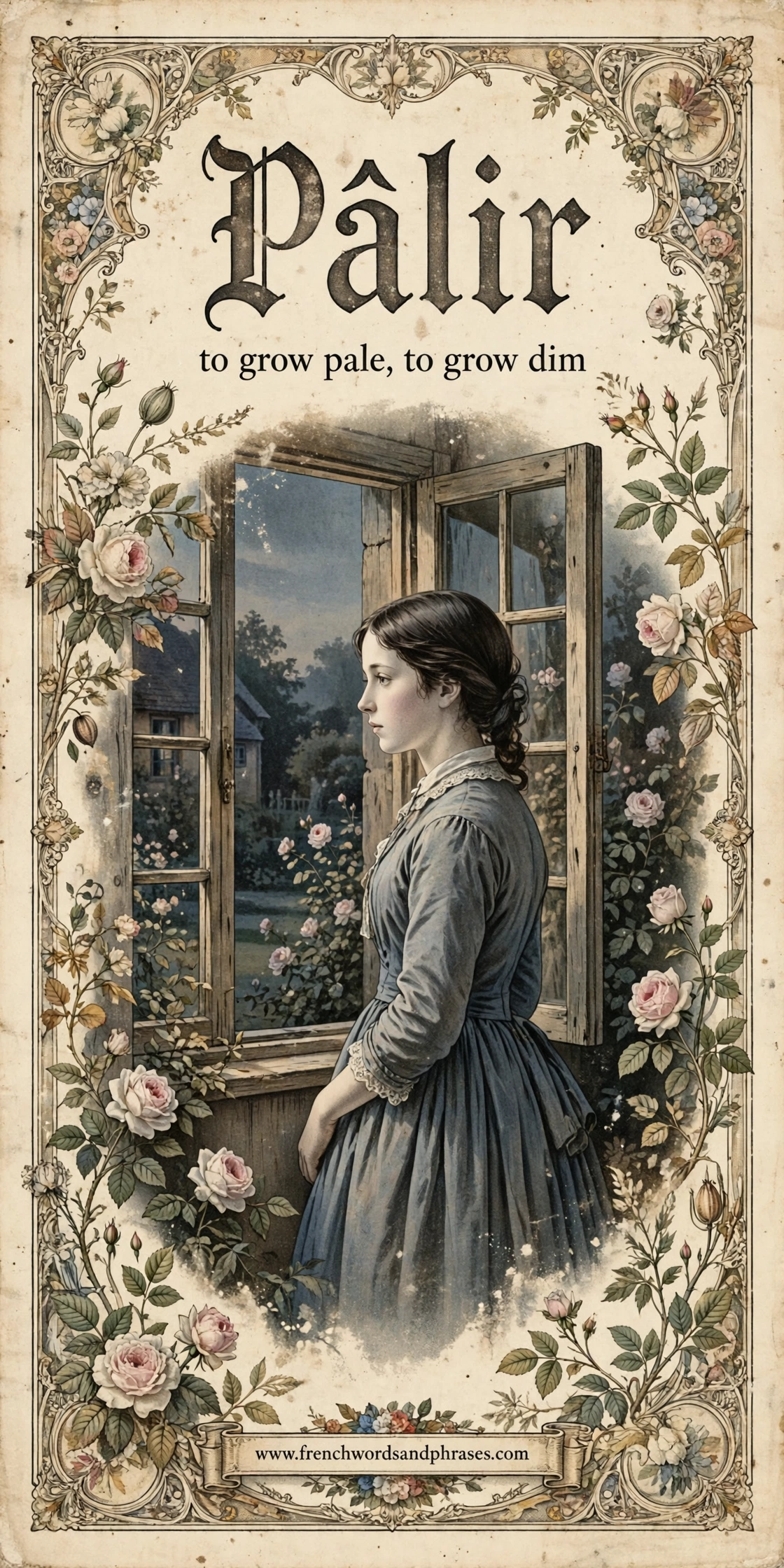
Pâlir means to grow pale, to grow dim — colour draining from a face at bad news, or from the sky, a photograph, a reputation, as the light goes out of it.
A telegram is handed across a desk and the colour leaves a man’s cheeks in a single second. A sunset photograph fades on a wall for thirty summers. Pâlir is the verb of draining colour: faces blanch with shock or illness, lights dim, stars fade before the dawn, and even glory pales beside a greater glory.
In this guide, you’ll learn how to conjugate pâlir in all the major French tenses and moods. Explore complete conjugation tables, French examples, English translations, and practice quizzes.
Understanding the French Verb Pâlir
Pâlir is a regular French verb belonging to the second group of verbs, those ending in -ir.
It means to grow pale, to grow dim. It is used for people turning pale with fear, shock, anger or illness, and then for everything that loses brightness or force: colours fading, lights dimming, stars paling at dawn, and reputations — son étoile pâlit, his star is waning. Beside a stronger rival, anything can pâlir: a performance, a memory, a whole career.
Verb classification: Second group (-ir)
Auxiliary verb: Avoir
Past participle: pâli
Present participle: pâlissant
English equivalents: To grow pale, to turn pale, to grow dim, to fade; pâlir de peur — to go pale with fear; pâlir à cette nouvelle — to turn pale at the news; faire pâlir quelqu’un — to make someone turn pale; pâlir devant quelqu’un — to pale into insignificance beside someone; les étoiles pâlissent — the stars are growing dim.
One important detail: the circumflex on pâlir is a birthmark, not a conjugation trap — it sits on the infinitive (from the old spelling paslir, the lost s still echoes in English pale) and disappears in every conjugated form: je pâlis keeps it in the infinitive’s family only in spelling books; in practice you write il pâlit, nous pâlissons — the accent is kept on the stem in all forms in traditional spelling, and the 1990 reform allows palir throughout. The verb is a perfectly regular second-group -ir verb like finir: je pâlis, nous pâlissons, je pâlissais, past participle pâli, and it takes avoir: elle a pâli.
Experience the Word
Pâlir is the verb of colour leaving — watch a face, a sky or a fame long enough and you will see it happen.
Imagine a hospital corridor at midnight. The doctor comes out, says one quiet sentence, and the young husband against the wall pâlit — not dramatically, not in a faint, just the blood stepping back from his face like the tide going out, all in one second.
He has not moved or spoken. He has simply paled — pâli — and everyone in the corridor knows the news is bad.
How to Conjugate Pâlir: Complete French Conjugation Guide
Let’s explore every major conjugation of pâlir, beginning with the indicative mood.
How to Conjugate Pâlir in the Indicative Mood
The indicative mood is used to express facts, observations, actions, and events.
How to Conjugate Pâlir in the Present Tense (Présent)
Used for actions happening now, habitual actions, and general truths.
| Subject | Conjugation |
|---|---|
| je | pâlis |
| tu | pâlis |
| il / elle | pâlit |
| nous | pâlissons |
| vous | pâlissez |
| ils / elles | pâlissent |
Elle pâlit chaque fois qu’on parle de l’accident.
She turns pale every time the accident is mentioned.
Complete the sentence:
Nous ______ à l’annonce du verdict.
Reveal the answer
pâlissons
Nous pâlissons à l’annonce du verdict.
We are turning pale at the announcement of the verdict.
How to Conjugate Pâlir in the Passé Composé
Used for completed actions in the past. Pâlir takes the auxiliary verb avoir.
| Subject | Conjugation |
|---|---|
| j’ | ai pâli |
| tu | as pâli |
| il / elle | a pâli |
| nous | avons pâli |
| vous | avez pâli |
| ils / elles | ont pâli |
Il a pâli en lisant la lettre du médecin.
He turned pale as he read the doctor’s letter.
How to Conjugate Pâlir in the Imparfait (Imperfect Tense)
Used for habitual past actions, descriptions, and ongoing situations in the past.
| Subject | Conjugation |
|---|---|
| je | pâlissais |
| tu | pâlissais |
| il / elle | pâlissait |
| nous | pâlissions |
| vous | pâlissiez |
| ils / elles | pâlissaient |
Les étoiles pâlissaient à l’approche de l’aube.
The stars were growing dim as dawn approached.
Choose the correct form:
She turned pale with fear.
Elle ______ de peur. (a pâli / est pâlie)
Reveal the answer
a pâli
Elle a pâli de peur.
Pâlir takes avoir.
How to Conjugate Pâlir in the Plus-que-parfait
Used to describe an action that had already been completed before another past event.
| Subject | Conjugation |
|---|---|
| j’ | avais pâli |
| tu | avais pâli |
| il / elle | avait pâli |
| nous | avions pâli |
| vous | aviez pâli |
| ils / elles | avaient pâli |
Son visage avait pâli avant même la nouvelle.
His face had already turned pale before the news.
How to Conjugate Pâlir in the Passé Simple
Primarily used in formal writing, literature, and historical narratives. It is rarely used in everyday conversation.
| Subject | Conjugation |
|---|---|
| je | pâlis |
| tu | pâlis |
| il / elle | pâlit |
| nous | pâlîmes |
| vous | pâlîtes |
| ils / elles | pâlirent |
La jeune femme pâlit et s’appuya au mur.
The young woman turned pale and leaned against the wall.
How to Conjugate Pâlir in the Passé Antérieur
A literary tense used to express an action completed immediately before another past action, generally in the passé simple.
| Subject | Conjugation |
|---|---|
| j’ | eus pâli |
| tu | eus pâli |
| il / elle | eut pâli |
| nous | eûmes pâli |
| vous | eûtes pâli |
| ils / elles | eurent pâli |
Dès qu’il eut pâli, on comprit que le verdict était mauvais.
As soon as he had turned pale, everyone understood the verdict was bad.
How to Conjugate Pâlir in the Future Tense (Futur Simple)
Used to describe actions that will take place in the future.
| Subject | Conjugation |
|---|---|
| je | pâlirai |
| tu | pâliras |
| il / elle | pâlira |
| nous | pâlirons |
| vous | pâlirez |
| ils / elles | pâliront |
Tu pâliras quand tu verras la facture.
You will turn pale when you see the bill.
How to Conjugate Pâlir in the Futur Antérieur (Future Perfect)
Used for an action that will have been completed before a particular point in the future.
| Subject | Conjugation |
|---|---|
| j’ | aurai pâli |
| tu | auras pâli |
| il / elle | aura pâli |
| nous | aurons pâli |
| vous | aurez pâli |
| ils / elles | auront pâli |
À l’aube, les étoiles auront pâli depuis longtemps.
By dawn, the stars will long since have grown dim.
How to Conjugate Pâlir in the Near Future (Futur Proche)
Used to describe something that is going to happen soon. Formed with aller + infinitive.
| Subject | Conjugation |
|---|---|
| je | vais pâlir |
| tu | vas pâlir |
| il / elle | va pâlir |
| nous | allons pâlir |
| vous | allez pâlir |
| ils / elles | vont pâlir |
Regarde-la, elle va pâlir, la nouvelle est terrible.
Watch her, she is going to turn pale, the news is terrible.
How to Conjugate Pâlir in the Conditional Mood
The conditional mood expresses what would happen under certain circumstances. It is also frequently used to make polite requests or express wishes.
How to Conjugate Pâlir in the Present Conditional
| Subject | Conjugation |
|---|---|
| je | pâlirais |
| tu | pâlirais |
| il / elle | pâlirait |
| nous | pâlirions |
| vous | pâliriez |
| ils / elles | pâliraient |
Sans ce maquillage, elle pâlirait devant les caméras.
Without that make-up, she would look pale in front of the cameras.
How to Conjugate Pâlir in the Past Conditional
| Subject | Conjugation |
|---|---|
| j’ | aurais pâli |
| tu | aurais pâli |
| il / elle | aurait pâli |
| nous | aurions pâli |
| vous | auriez pâli |
| ils / elles | auraient pâli |
Il aurait pâli de honte s’il avait entendu ces paroles.
He would have turned pale with shame if he had heard those words.
Pâlir in the Literary Past Conditional Form
This less common literary form uses the imperfect subjunctive of avoir.
| Subject | Conjugation |
|---|---|
| j’ | eusse pâli |
| tu | eusses pâli |
| il / elle | eût pâli |
| nous | eussions pâli |
| vous | eussiez pâli |
| ils / elles | eussent pâli |
Elle eût pâli à ce récit sans sa longue habitude des hôpitaux.
She would have turned pale at that account, but for her long familiarity with hospitals.
How to Conjugate Pâlir in the Subjunctive Mood
The subjunctive is used to express wishes, emotions, doubts, necessity, and uncertainty. It frequently follows expressions such as il faut que (it is necessary that) or bien que (although).
How to Conjugate Pâlir in the Present Subjunctive
| Subject | Conjugation |
|---|---|
| que je | pâlisse |
| que tu | pâlisses |
| qu’il / qu’elle | pâlisse |
| que nous | pâlissions |
| que vous | pâlissiez |
| qu’ils / qu’elles | pâlissent |
Je crains qu’il pâlisse en apprenant la vérité.
I fear he will turn pale when he learns the truth.
Complete the sentence using the subjunctive:
Je crains que vous ______ pendant l’opération.
Reveal the answer
pâlissiez
Je crains que vous pâlissiez pendant l’opération.
I fear you may turn pale during the operation.
How to Conjugate Pâlir in the Imperfect Subjunctive
A literary tense, rarely encountered in modern spoken French.
| Subject | Conjugation |
|---|---|
| que je | pâlisse |
| que tu | pâlisses |
| qu’il / qu’elle | pâlît |
| que nous | pâlissions |
| que vous | pâlissiez |
| qu’ils / qu’elles | pâlissent |
On redoutait qu’elle pâlît pendant la cérémonie.
People dreaded that she might turn pale during the ceremony.
How to Conjugate Pâlir in the Pluperfect Subjunctive
A literary construction used to express an action completed before another past action.
| Subject | Conjugation |
|---|---|
| que j’ | eusse pâli |
| que tu | eusses pâli |
| qu’il / qu’elle | eût pâli |
| que nous | eussions pâli |
| que vous | eussiez pâli |
| qu’ils / qu’elles | eussent pâli |
On racontait qu’il eût pâli devant le roi lui-même.
It was said that he had turned pale before the king himself.
How to Conjugate Pâlir in the Past Subjunctive
| Subject | Conjugation |
|---|---|
| que j’ | aie pâli |
| que tu | aies pâli |
| qu’il / qu’elle | ait pâli |
| que nous | ayons pâli |
| que vous | ayez pâli |
| qu’ils / qu’elles | aient pâli |
Je suis étonné qu’elle ait pâli pour si peu.
I am surprised she turned pale over so little.
How to Conjugate Pâlir in the Imperative
The imperative is used to give commands, instructions, invitations, or suggestions. Subject pronouns are omitted.
How to Conjugate Pâlir in the Present Imperative
| Person | Conjugation |
|---|---|
| (tu) | pâlis |
| (nous) | pâlissons |
| (vous) | pâlissez |
Ne pâlis pas devant eux, garde ton sang-froid !
Do not turn pale in front of them, keep your nerve!
How would you say Do not turn pale (tu form)?
Reveal the answer
Ne pâlis pas !
French Participles of Pâlir
Participles are verb forms that can be used in compound tenses and other grammatical constructions.
Present Participle of Pâlir
pâlissant
En pâlissant à vue d’œil, il a inquiété toute la famille.
By visibly turning paler and paler, he worried the whole family.
Past Participle of Pâlir
pâli
Pâlie par la fièvre, l’enfant dormait enfin.
Grown pale with fever, the child was finally asleep.
Pâlir in Everyday French: Real-Life Examples
Now that you know the conjugations, let’s see how pâlir appears in everyday French.
Elle pâlit à cette nouvelle.
She turns pale at this news.
Il a pâli en lisant la lettre.
He turned pale as he read the letter.
Les étoiles pâlissaient à l’aube.
The stars were growing dim at dawn.
Tu pâliras devant la facture.
You will turn pale at the bill.
Il pâlirait de honte en entendant cela.
He would turn pale with shame on hearing that.
Ne pâlis pas, ce n’est rien !
Do not turn pale, it is nothing!
Beyond Translation: The Meaning of Pâlir
English pale and French pâle are the same word twice — the circumflex in pâlir marks the spot where an s once stood, in the old form pasle.
French also lets glory pâlir.
Son étoile pâlit — his star is paling — is the standard way to say a reputation is fading, and beside a greater talent, even a great one pâlit: the verb runs from the sickroom to the history books without changing its step.
How to Remember the French Verb Pâlir
Remember it this way: Pâlir is about colour draining from a face — and from the dawn sky.
- A face losing colour, stars losing light, a star losing fame — pâlir covers all three drains.
- Regular second-group -ir like finir: je pâlis, nous pâlissons, past participle pâli, with avoir.
- The circumflex lives on the infinitive pâlir; everyday forms keep the stem pâl-: il pâlit, elle a pâli.
The key idea is colour draining from a face — and from the dawn sky.
Test Your Knowledge of Pâlir
Let’s see how much you’ve learned. Try answering these questions before revealing the answers.
Which group does pâlir belong to, and what is its model?
Reveal the answer
The second group (-ir) — it conjugates exactly like finir: je pâlis, nous pâlissons.
How do you say He turned pale as he read the letter in French?
Reveal the answer
Il a pâli en lisant la lettre.
Translate: The stars were growing dim at dawn.
Reveal the answer
Les étoiles pâlissaient à l’aube.
What is the past participle of pâlir?
Reveal the answer
Pâli.
Complete the sentence:
Je crains qu’il ______ en apprenant la vérité.
Reveal the answer
pâlisse
Je crains qu’il pâlisse en apprenant la vérité.
I fear he will turn pale when he learns the truth.
Can You Use It?
How would you say this in French?
The stars grow dim, the sky brightens, and the night lays down its arms in silence.
Reveal the answer
Les étoiles pâlissent, le ciel s’éclaire, et la nuit rend les armes sans bruit.
The stars grow dim, the sky brightens, and the night lays down its arms in silence.
LEARN FRENCH ONE WORD AT A TIME