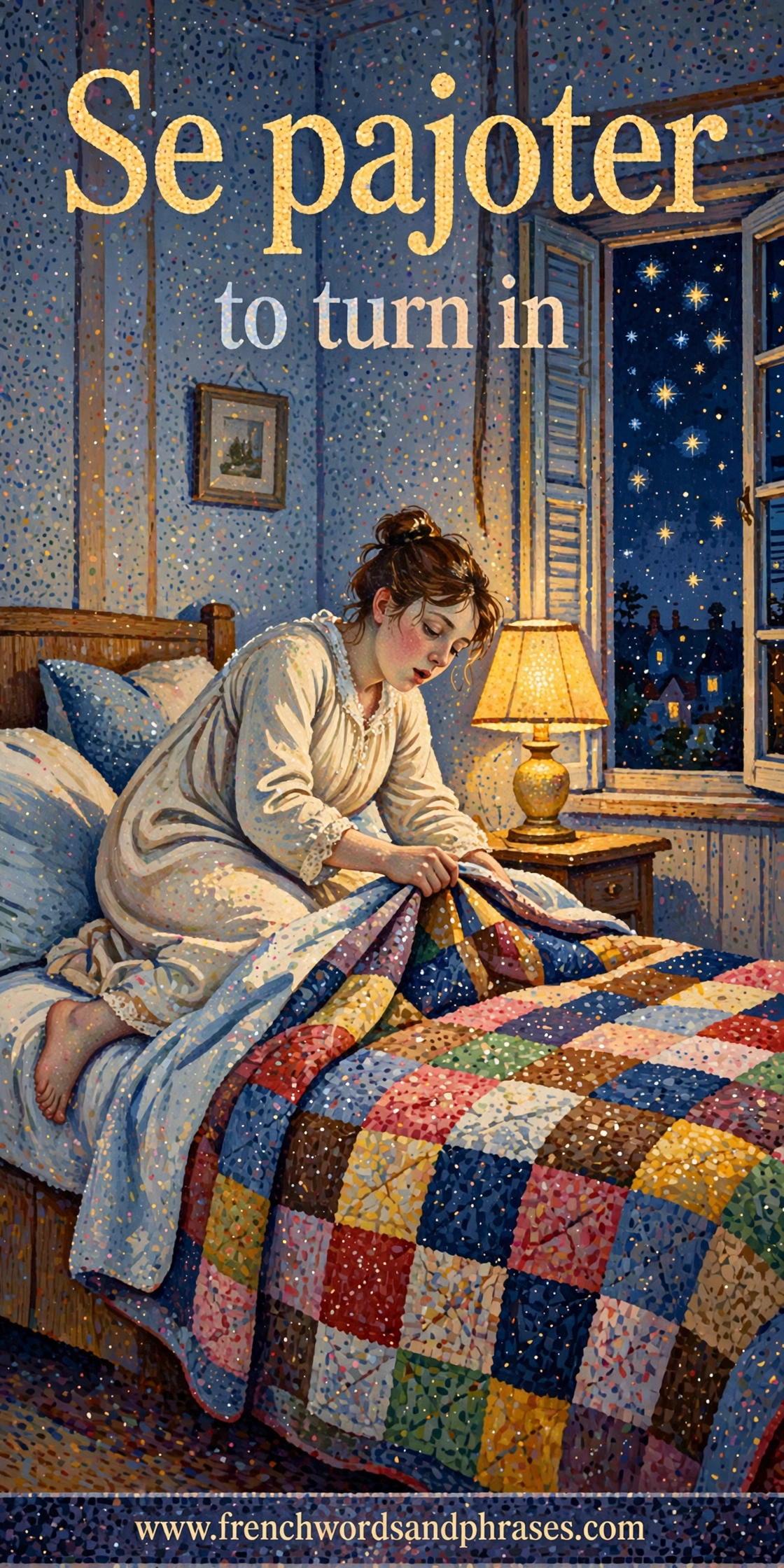
How to Conjugate Se pajoter in French
/sə pa.ʒɔ.te/
Se pajoter means to turn in — to slip into your bunk and be done with the day, in cheerful slang.
A night train rocking through the dark, a dormitory of snoring schoolchildren, a sailor’s hammock below deck — se pajoter is the familiar verb for turning in wherever your bed happens to be: bunk, berth or hammock, you climb in and the day is over.
In this guide, you’ll learn how to conjugate se pajoter in all the major French tenses and moods. Explore complete conjugation tables, French examples, English translations, and practice quizzes.
Understanding the French Verb Se pajoter
Se pajoter is a regular French verb belonging to the first group of verbs, those ending in -er.
It means to turn in. Like se pageoter, it names the moment of getting into bed — turning in — rather than sleeping itself. It belongs to spoken, friendly French: night trains, boarding schools, barracks and boats, anywhere beds are bunks and bedtime is a small daily victory.
Verb classification: First group (-er), reflexive
Auxiliary verb: Être
Past participle: pajoté
Present participle: pajotant
English equivalents: To turn in, to hit the sack (familiar); se pajoter de bonne heure — to turn in early; aller se pajoter — to go off to bed; une couchette où se pajoter — a berth to turn in to; je vais me pajoter — I am off to bed.
One important detail: se pajoter is the twin of se pageoter — the same barracks-and-dormitory slang for turning in, from the same argot family (un pajot, like un pageot, is a bed or bunk in slang), with the same meaning and the same familiar grin. In polite French, say se coucher. Being reflexive, it takes être and the participle agrees: elle s’est pajotée, ils se sont pajotés. The tu imperative tucks the pronoun behind: pajote-toi ! Underneath, a regular -er: je me pajote, nous nous pajotons.
Experience the Word
Se pajoter is the verb of the bunk at last — shoes off, blanket up, and the rocking of the train or the dormitory’s silence doing the rest.
Imagine the night train to Lyon. The corridor lights dim, doors click shut one after another, and in every couchette a traveller se pajote with a sigh — by the time the train crosses the river, the whole carriage is asleep.
Six bunks, six strangers, one rhythm. Everyone has turned in — pajoté — and the train rocks them all towards morning.
How to Conjugate Se pajoter: Complete French Conjugation Guide
Let’s explore every major conjugation of se pajoter, beginning with the indicative mood.
How to Conjugate Se pajoter in the Indicative Mood
The indicative mood is used to express facts, observations, actions, and events.
How to Conjugate Se pajoter in the Present Tense (Présent)
Used for actions happening now, habitual actions, and general truths.
| Subject | Conjugation |
|---|---|
| je | me pajote |
| tu | te pajotes |
| il / elle | se pajote |
| nous | nous pajotons |
| vous | vous pajotez |
| ils / elles | se pajotent |
À la caserne, tout le monde se pajote à dix heures.
In barracks, everyone turns in at ten o’clock.
Complete the sentence:
Nous nous ______ à dix heures à la caserne.
Reveal the answer
pajotons
Nous nous pajotons à dix heures à la caserne.
We turn in at ten o’clock in barracks.
How to Conjugate Se pajoter in the Passé Composé
Used for completed actions in the past. Se pajoter takes the auxiliary verb être.
| Subject | Conjugation |
|---|---|
| je | me suis pajoté / me suis pajotée |
| tu | t’es pajoté / t’es pajotée |
| il / elle | s’est pajoté / s’est pajotée |
| nous | nous sommes pajotés / nous sommes pajotées |
| vous | vous êtes pajotés / vous êtes pajotées / vous êtes pajoté / vous êtes pajotée |
| ils / elles | se sont pajotés / se sont pajotées |
Il s’est pajoté sans même se déshabiller.
He turned in without even undressing.
How to Conjugate Se pajoter in the Imparfait (Imperfect Tense)
Used for habitual past actions, descriptions, and ongoing situations in the past.
| Subject | Conjugation |
|---|---|
| je | me pajotais |
| tu | te pajotais |
| il / elle | se pajotait |
| nous | nous pajotions |
| vous | vous pajotiez |
| ils / elles | se pajotaient |
En colonie, les enfants se pajotaient après l’extinction des feux.
At summer camp, the children used to turn in after lights-out.
Choose the correct form:
He turned in without undressing.
Il ______ sans se déshabiller. (s’est pajoté / a pajoté)
Reveal the answer
s’est pajoté
Il s’est pajoté sans se déshabiller.
Se pajoter is reflexive and takes être.
How to Conjugate Se pajoter in the Plus-que-parfait
Used to describe an action that had already been completed before another past event.
| Subject | Conjugation |
|---|---|
| je | m’étais pajoté / m’étais pajotée |
| tu | t’étais pajoté / t’étais pajotée |
| il / elle | s’était pajoté / s’était pajotée |
| nous | nous étions pajotés / nous étions pajotées |
| vous | vous étiez pajotés / vous étiez pajotées / vous étiez pajoté / vous étiez pajotée |
| ils / elles | s’étaient pajotés / s’étaient pajotées |
Ils s’étaient pajotés tôt pour le train du matin.
They had turned in early for the morning train.
How to Conjugate Se pajoter in the Passé Simple
Primarily used in formal writing, literature, and historical narratives. It is rarely used in everyday conversation.
| Subject | Conjugation |
|---|---|
| je | me pajotai |
| tu | te pajotas |
| il / elle | se pajota |
| nous | nous pajotâmes |
| vous | vous pajotâtes |
| ils / elles | se pajotèrent |
Le voyageur se pajota dans sa couchette.
The traveller turned in to his berth.
How to Conjugate Se pajoter in the Passé Antérieur
A literary tense used to express an action completed immediately before another past action, generally in the passé simple.
| Subject | Conjugation |
|---|---|
| je | me fus pajoté / me fus pajotée |
| tu | te fus pajoté / te fus pajotée |
| il / elle | se fut pajoté / se fut pajotée |
| nous | nous fûmes pajotés / nous fûmes pajotées |
| vous | vous fûtes pajotés / vous fûtes pajotées / vous fûtes pajoté / vous fûtes pajotée |
| ils / elles | se furent pajotés / se furent pajotées |
Dès qu’elle se fut pajotée, la chambrée s’endormit.
As soon as she had turned in, the dormitory fell asleep.
How to Conjugate Se pajoter in the Future Tense (Futur Simple)
Used to describe actions that will take place in the future.
| Subject | Conjugation |
|---|---|
| je | me pajoterai |
| tu | te pajoteras |
| il / elle | se pajotera |
| nous | nous pajoterons |
| vous | vous pajoterez |
| ils / elles | se pajoteront |
Ce soir, je me pajoterai dès le retour.
Tonight, I will turn in as soon as I get back.
How to Conjugate Se pajoter in the Futur Antérieur (Future Perfect)
Used for an action that will have been completed before a particular point in the future.
| Subject | Conjugation |
|---|---|
| je | me serai pajoté / me serai pajotée |
| tu | te seras pajoté / te seras pajotée |
| il / elle | se sera pajoté / se sera pajotée |
| nous | nous serons pajotés / nous serons pajotées |
| vous | vous serez pajotés / vous serez pajotées / vous serez pajoté / vous serez pajotée |
| ils / elles | se seront pajotés / se seront pajotées |
À onze heures, tout le dortoir se sera pajoté.
By eleven o’clock, the whole dormitory will have turned in.
How to Conjugate Se pajoter in the Near Future (Futur Proche)
Used to describe something that is going to happen soon. Formed with aller + infinitive.
| Subject | Conjugation |
|---|---|
| je | vais me pajoter |
| tu | vas te pajoter |
| il / elle | va se pajoter |
| nous | allons nous pajoter |
| vous | allez vous pajoter |
| ils / elles | vont se pajoter |
Allez, je vais me pajoter, je n’en peux plus.
Right, I am going to turn in, I have had it.
How to Conjugate Se pajoter in the Conditional Mood
The conditional mood expresses what would happen under certain circumstances. It is also frequently used to make polite requests or express wishes.
How to Conjugate Se pajoter in the Present Conditional
| Subject | Conjugation |
|---|---|
| je | me pajoterais |
| tu | te pajoterais |
| il / elle | se pajoterait |
| nous | nous pajoterions |
| vous | vous pajoteriez |
| ils / elles | se pajoteraient |
Je me pajoterais bien dès maintenant.
I would gladly turn in right now.
How to Conjugate Se pajoter in the Past Conditional
| Subject | Conjugation |
|---|---|
| je | me serais pajoté / me serais pajotée |
| tu | te serais pajoté / te serais pajotée |
| il / elle | se serait pajoté / se serait pajotée |
| nous | nous serions pajotés / nous serions pajotées |
| vous | vous seriez pajotés / vous seriez pajotées / vous seriez pajoté / vous seriez pajotée |
| ils / elles | se seraient pajotés / se seraient pajotées |
Elle se serait pajotée plus tôt sans le bruit.
She would have turned in earlier if not for the noise.
Se pajoter in the Literary Past Conditional Form
This less common literary form uses the imperfect subjunctive of être.
| Subject | Conjugation |
|---|---|
| je | me fusse pajoté / me fusse pajotée |
| tu | te fusses pajoté / te fusses pajotée |
| il / elle | se fût pajoté / se fût pajotée |
| nous | nous fussions pajotés / nous fussions pajotées |
| vous | vous fussiez pajotés / vous fussiez pajotées / vous fussiez pajoté / vous fussiez pajotée |
| ils / elles | se fussent pajotés / se fussent pajotées |
Il se fût pajoté sur place sans la ronde de nuit.
He would have turned in on the spot if not for the night round.
How to Conjugate Se pajoter in the Subjunctive Mood
The subjunctive is used to express wishes, emotions, doubts, necessity, and uncertainty. It frequently follows expressions such as il faut que (it is necessary that) or bien que (although).
How to Conjugate Se pajoter in the Present Subjunctive
| Subject | Conjugation |
|---|---|
| que je | me pajote |
| que tu | te pajotes |
| qu’il / qu’elle | se pajote |
| que nous | nous pajotions |
| que vous | vous pajotiez |
| qu’ils / qu’elles | se pajotent |
Il est l’heure que les enfants se pajotent.
It is time the children turned in.
Complete the sentence using the subjunctive:
Il est l’heure que tu te ______.
Reveal the answer
pajotes
Il est l’heure que tu te pajotes.
It is time you turned in.
How to Conjugate Se pajoter in the Imperfect Subjunctive
A literary tense, rarely encountered in modern spoken French.
| Subject | Conjugation |
|---|---|
| que je | me pajotasse |
| que tu | te pajotasses |
| qu’il / qu’elle | se pajotât |
| que nous | nous pajotassions |
| que vous | vous pajotassiez |
| qu’ils / qu’elles | se pajotassent |
Le moniteur exigeait que tout le monde se pajotât à l’heure fixe.
The camp leader demanded that everyone turn in at the fixed hour.
How to Conjugate Se pajoter in the Pluperfect Subjunctive
A literary construction used to express an action completed before another past action.
| Subject | Conjugation |
|---|---|
| que je | me fusse pajoté / me fusse pajotée |
| que tu | te fusses pajoté / te fusses pajotée |
| qu’il / qu’elle | se fût pajoté / se fût pajotée |
| que nous | nous fussions pajotés / nous fussions pajotées |
| que vous | vous fussiez pajotés / vous fussiez pajotées / vous fussiez pajoté / vous fussiez pajotée |
| qu’ils / qu’elles | se fussent pajotés / se fussent pajotées |
On disait qu’ils se fussent pajotés avant la veillée.
It was said they had turned in before the evening gathering.
How to Conjugate Se pajoter in the Past Subjunctive
| Subject | Conjugation |
|---|---|
| que je | me sois pajoté / me sois pajotée |
| que tu | te sois pajoté / te sois pajotée |
| qu’il / qu’elle | se soit pajoté / se soit pajotée |
| que nous | nous soyons pajotés / nous soyons pajotées |
| que vous | vous soyez pajotés / vous soyez pajotées / vous soyez pajoté / vous soyez pajotée |
| qu’ils / qu’elles | se soient pajotés / se soient pajotées |
Je m’étonne qu’il se soit pajoté si tôt.
I am surprised he turned in so early.
How to Conjugate Se pajoter in the Imperative
The imperative is used to give commands, instructions, invitations, or suggestions. Subject pronouns are omitted.
How to Conjugate Se pajoter in the Present Imperative
| Person | Conjugation |
|---|---|
| (tu) | pajote-toi |
| (nous) | pajotons-nous |
| (vous) | pajotez-vous |
Pajote-toi vite, le train part à l’aube !
Turn in quickly, the train leaves at dawn!
How would you say Turn in quickly (tu form)?
Reveal the answer
Pajote-toi vite !
French Participles of Se pajoter
Participles are verb forms that can be used in compound tenses and other grammatical constructions.
Present Participle of Se pajoter
pajotant
En se pajotant tôt, on affronte mieux la journée.
By turning in early, you face the day better.
Past Participle of Se pajoter
pajoté
Pajotée dans sa couchette, elle a dormi jusqu’à Lyon.
Tucked up in her berth, she slept all the way to Lyon.
Se pajoter in Everyday French: Real-Life Examples
Now that you know the conjugations, let’s see how se pajoter appears in everyday French.
Tout le monde se pajote à dix heures.
Everyone turns in at ten o’clock.
Il s’est pajoté sans se déshabiller.
He turned in without undressing.
Les enfants se pajotaient après l’extinction des feux.
The children used to turn in after lights-out.
Je me pajoterai dès le retour.
I will turn in as soon as I get back.
Je me pajoterais bien dès maintenant.
I would gladly turn in right now.
Pajote-toi vite !
Turn in quickly!
Beyond Translation: The Meaning of Se pajoter
Se pajoter and se pageoter are one word in two spellings — the argot of bunks and barracks never cared much for orthography, and both come from the slang word for a bed, un pajot or un pageot.
Both mean the same small happiness.
Wherever French speakers sleep in rows — trains, dormitories, barracks, boats — bedtime gets a verb with a smile in it, and se pajoter is the version this dictionary prints: to climb into your bunk and let the day go.
How to Remember the French Verb Se pajoter
Remember it this way: Se pajoter is about the night-train couchette — everyone tucked in and rocking to sleep.
- Twin of se pageoter: same slang, same meaning — turning in; polite French says se coucher.
- Always reflexive with être: elle s’est pajotée, ils se sont pajotés — the participle agrees.
- Regular -er underneath: je me pajote, nous nous pajotons, past participle pajoté.
The key idea is the night-train couchette — everyone tucked in and rocking to sleep.
Test Your Knowledge of Se pajoter
Let’s see how much you’ve learned. Try answering these questions before revealing the answers.
Which auxiliary does se pajoter use, and why?
Reveal the answer
Être — it is a reflexive verb: elle s’est pajotée de bonne heure.
How do you say He turned in without even undressing in French?
Reveal the answer
Il s’est pajoté sans même se déshabiller.
Translate: I am going to turn in, I have had it.
Reveal the answer
Je vais me pajoter, je n’en peux plus.
What is the past participle of se pajoter?
Reveal the answer
Pajoté — agreeing: pajotée, pajotés, pajotées.
Complete the sentence:
Il est l’heure que les enfants se ______.
Reveal the answer
pajotent
Il est l’heure que les enfants se pajotent.
It is time the children turned in.
Can You Use It?
How would you say this in French?
She turns in to her berth, and the train rocks her sleep until morning.
Reveal the answer
Elle se pajote dans sa couchette, et le train berce son sommeil jusqu’au matin.
She turns in to her berth, and the train rocks her sleep until morning.
LEARN FRENCH ONE WORD AT A TIME