A French Word to Live By
How to Conjugate Pisser in French
/pi.se/
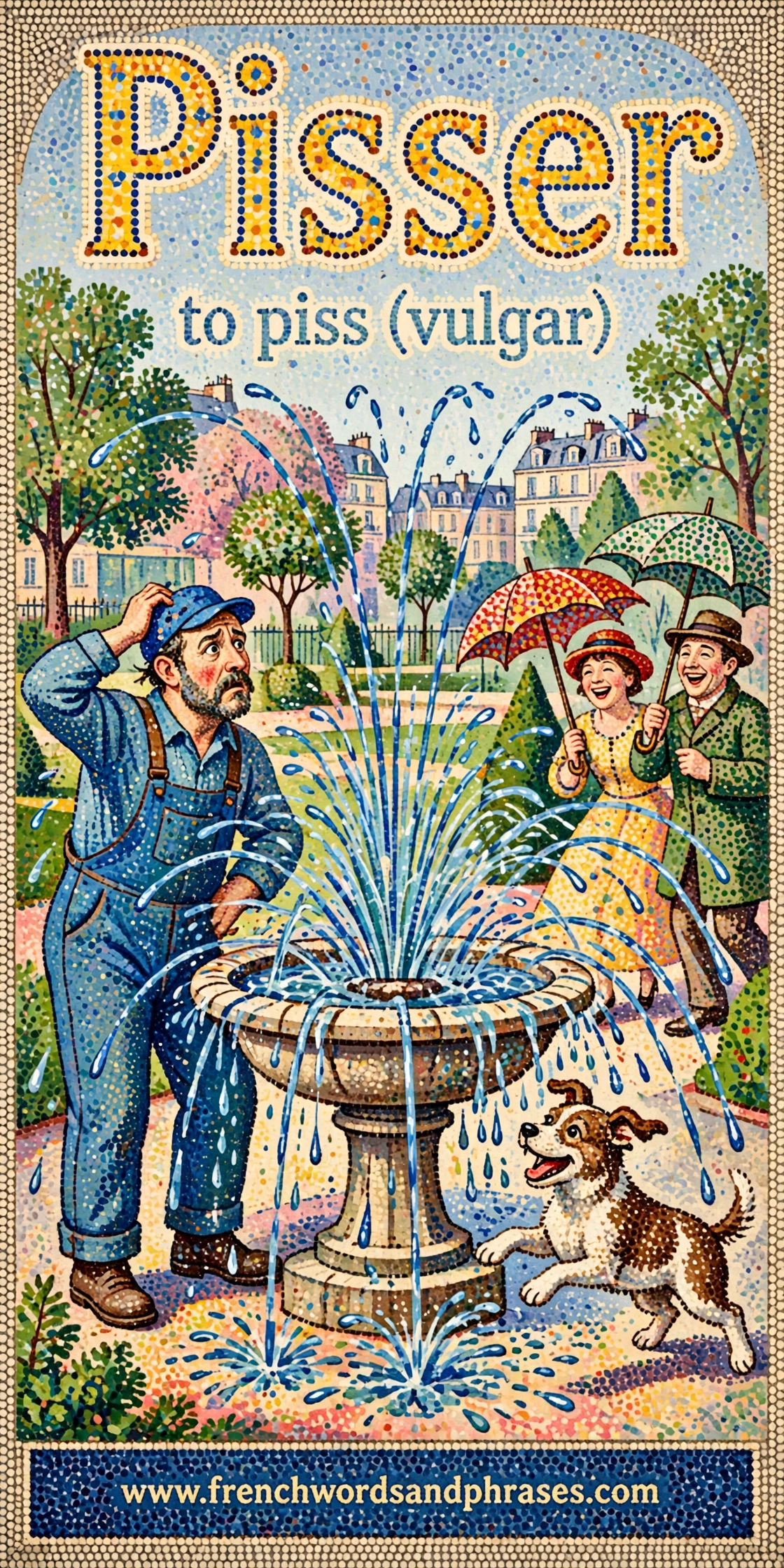
Pisser means to piss (vulgar) — the blunt, slang word for urinating, which French also lends, with a grin, to leaking taps, spurting hoses and teapots that dribble.
Let us be honest from the first line: pisser is the vulgar word for having a pee, and no polite French conversation wants it. But taps, hoses, fountains and teapots pisser too in everyday slang — spurting, leaking and dribbling — and it is in that wet, comic company that this page will mostly keep it.
In this guide, you’ll learn how to conjugate pisser in all the major French tenses and moods. Explore complete conjugation tables, French examples, English translations, and practice quizzes.
Understanding the French Verb Pisser
Pisser is a regular French verb belonging to the first group of verbs, those ending in-er.
It means to piss (vulgar). Beyond the plumbing, pisser lives in a handful of famous idioms: pisser dans un violon, to waste your breath entirely (the idiom this page grows from); pleuvoir comme vache qui pisse, the farmyard version of raining cats and dogs; and pisser de rire, to wet oneself laughing — the only one of the family you will hear in quite cheerful company. Its noun, la pisse, is as vulgar as the verb; keep both for the tap, the hose and the joke, never for the dinner table.
Verb classification: First group (-er)
Auxiliary verb: Avoir
Past participle: pissé
Present participle: pissant
English equivalents: To piss (vulgar), to pee (blunt slang); (of a tap, hose, pipe) to leak, to spurt, to dribble; pisser dans un violon — to piss into a violin, i.e. to waste one’s effort completely; il pleut comme vache qui pisse — it is raining cats and dogs (lit. like a cow peeing); le Manneken Pis — the little peeing boy of Brussels.
One important detail — of register, this time: pisser is a perfectly regular -er verb (je pisse, nous pissons, past participle pissé), but it is frankly vulgar for its main sense, and the polite words are uriner and faire pipi. What keeps pisser respectable on this page is its second life: in familiar speech, anything that spurts or leaks liquid can pisser — le robinet pisse, la durite pisse, la théière pisse sur la nappe — and that sense is slangy rather than shocking. Say it of a tap in front of anyone; say it of a person only among friends.
Experience the Word
Pisser is the verb French keeps in the toolbox and the barracks, not the drawing room — blunt for bodies, and irresistibly funny for anything that leaks.
Imagine a plumber under a farmhouse sink, torch in his teeth, while the joint above him pisser goutte à goutte — drip, drip, drip — straight down his collar. He does not say ‘the joint is leaking’. Nobody in France, lying in a puddle with a wet neck, has ever said anything but « ça pisse ».
The joint is not urinating, of course. It is leaking — ça pisse — and the vulgar little verb fits the vulgar little job exactly.
How to Conjugate Pisser: Complete French Conjugation Guide
Let’s explore every major conjugation of pisser, beginning with the indicative mood.
How to Conjugate Pisser in the Indicative Mood
The indicative mood is used to express facts, observations, actions, and events.
How to Conjugate Pisser in the Present Tense (Présent)
Used for actions happening now, habitual actions, and general truths.
| Subject | Conjugation |
|---|---|
| je | pisse |
| tu | pisses |
| il / elle | pisse |
| nous | pissons |
| vous | pissez |
| ils / elles | pissent |
Example
À Bruxelles, le Manneken Pis pisse devant des centaines de touristes.
In Brussels, the Manneken Pis pees in front of hundreds of tourists.
Quick Quiz 1
Complete the sentence:
Nous avons un robinet qui ______ depuis ce matin.
Reveal the answer
pisse
Nous avons un robinet qui pisse depuis ce matin.
We have a tap that has been leaking since this morning.
How to Conjugate Pisser in the Passé Composé
Used for completed actions in the past. Pisser takes the auxiliary verb avoir.
| Subject | Conjugation |
|---|---|
| j’ | ai pissé |
| tu | as pissé |
| il / elle | a pissé |
| nous | avons pissé |
| vous | avez pissé |
| ils / elles | ont pissé |
Example
Le robinet a pissé toute la nuit et a inondé la cuisine.
The tap leaked all night and flooded the kitchen.
How to Conjugate Pisser in the Imparfait (Imperfect Tense)
Used for habitual past actions, descriptions, and ongoing situations in the past.
| Subject | Conjugation |
|---|---|
| je | pissais |
| tu | pissais |
| il / elle | pissait |
| nous | pissions |
| vous | pissiez |
| ils / elles | pissaient |
Example
La vieille fontaine pissait sans arrêt au milieu de la place.
The old fountain spurted away without stopping in the middle of the square.
Quick Quiz 2
Choose the correct form:
The tap leaked all night.
Le robinet ______ toute la nuit. (a pissé / est pissé)
Reveal the answer
a pissé
Le robinet a pissé toute la nuit.
Pisser takes avoir.
How to Conjugate Pisser in the Plus-que-parfait
Used to describe an action that had already been completed before another past event.
| Subject | Conjugation |
|---|---|
| j’ | avais pissé |
| tu | avais pissé |
| il / elle | avait pissé |
| nous | avions pissé |
| vous | aviez pissé |
| ils / elles | avaient pissé |
Example
Le tuyau avait pissé des litres d’eau avant notre arrivée.
The pipe had leaked litres of water before we arrived.
How to Conjugate Pisser in the Passé Simple
Primarily used in formal writing, literature, and historical narratives. It is rarely used in everyday conversation.
| Subject | Conjugation |
|---|---|
| je | pissai |
| tu | pissas |
| il / elle | pissa |
| nous | pissâmes |
| vous | pissâtes |
| ils / elles | pissèrent |
Example
Soudain, la bonde lâcha et l’eau pissa dans toute la cave.
Suddenly, the bung gave way and the water spurted all over the cellar.
How to Conjugate Pisser in the Passé Antérieur
A literary tense used to express an action completed immediately before another past action, generally in the passé simple.
| Subject | Conjugation |
|---|---|
| j’ | eus pissé |
| tu | eus pissé |
| il / elle | eut pissé |
| nous | eûmes pissé |
| vous | eûtes pissé |
| ils / elles | eurent pissé |
Example
Quand la durite eut pissé tout son liquide, le moteur s’arrêta.
When the hose had leaked out all its fluid, the engine stopped.
How to Conjugate Pisser in the Future Tense (Futur Simple)
Used to describe actions that will take place in the future.
| Subject | Conjugation |
|---|---|
| je | pisserai |
| tu | pisseras |
| il / elle | pissera |
| nous | pisserons |
| vous | pisserez |
| ils / elles | pisseront |
Example
Si tu ne répares pas ce joint, il pissera encore demain.
If you do not fix that joint, it will still be leaking tomorrow.
How to Conjugate Pisser in the Futur Antérieur (Future Perfect)
Used for an action that will have been completed before a particular point in the future.
| Subject | Conjugation |
|---|---|
| j’ | aurai pissé |
| tu | auras pissé |
| il / elle | aura pissé |
| nous | aurons pissé |
| vous | aurez pissé |
| ils / elles | auront pissé |
Example
À ce rythme, le tonneau aura pissé la moitié du vin avant la fête.
At this rate, the barrel will have leaked half the wine before the festival.
How to Conjugate Pisser in the Near Future (Futur Proche)
Used to describe something that is going to happen soon. Formed with aller + infinitive.
| Subject | Conjugation |
|---|---|
| je | vais pisser |
| tu | vas pisser |
| il / elle | va pisser |
| nous | allons pisser |
| vous | allez pisser |
| ils / elles | vont pisser |
Example
Attention, la théière va pisser sur la nappe !
Careful, the teapot is going to dribble on the tablecloth!
How to Conjugate Pisser in the Conditional Mood
The conditional mood expresses what would happen under certain circumstances. It is also frequently used to make polite requests or express wishes.
How to Conjugate Pisser in the Present Conditional
| Subject | Conjugation |
|---|---|
| je | pisserais |
| tu | pisserais |
| il / elle | pisserait |
| nous | pisserions |
| vous | pisseriez |
| ils / elles | pisseraient |
Example
Sans ce joint neuf, le robinet pisserait encore.
Without this new joint, the tap would still be leaking.
How to Conjugate Pisser in the Past Conditional
| Subject | Conjugation |
|---|---|
| j’ | aurais pissé |
| tu | aurais pissé |
| il / elle | aurait pissé |
| nous | aurions pissé |
| vous | auriez pissé |
| ils / elles | auraient pissé |
Example
Le réservoir aurait pissé tout l’hiver sans la réparation.
The tank would have leaked all winter without the repair.
Pisser in the Literary Past Conditional Form
This less common literary form uses the imperfect subjunctive of avoir.
| Subject | Conjugation |
|---|---|
| j’ | eusse pissé |
| tu | eusses pissé |
| il / elle | eût pissé |
| nous | eussions pissé |
| vous | eussiez pissé |
| ils / elles | eussent pissé |
Example
La fontaine eût pissé jour et nuit sans le gel de janvier.
The fountain would have spurted day and night without the January frost.
How to Conjugate Pisser in the Subjunctive Mood
The subjunctive is used to express wishes, emotions, doubts, necessity, and uncertainty. It frequently follows expressions such as il faut que (it is necessary that) or bien que (although).
How to Conjugate Pisser in the Present Subjunctive
| Subject | Conjugation |
|---|---|
| que je | pisse |
| que tu | pisses |
| qu’il / qu’elle | pisse |
| que nous | pissions |
| que vous | pissiez |
| qu’ils / qu’elles | pissent |
Example
Je ne veux pas que le robinet pisse sur mes chaussures.
I do not want the tap leaking on my shoes.
Quick Quiz 3
Complete the sentence using the subjunctive:
Le plombier craint que le joint ______ de nouveau.
Reveal the answer
pisse
Le plombier craint que le joint pisse de nouveau.
The plumber fears the joint might leak again.
How to Conjugate Pisser in the Imperfect Subjunctive
A literary tense, rarely encountered in modern spoken French.
| Subject | Conjugation |
|---|---|
| que je | pissasse |
| que tu | pissasses |
| qu’il / qu’elle | pissât |
| que nous | pissassions |
| que vous | pissassiez |
| qu’ils / qu’elles | pissassent |
Example
Le plombier craignait que le joint pissât de nouveau.
The plumber feared the joint might leak again.
How to Conjugate Pisser in the Pluperfect Subjunctive
A literary construction used to express an action completed before another past action.
| Subject | Conjugation |
|---|---|
| que j’ | eusse pissé |
| que tu | eusses pissé |
| qu’il / qu’elle | eût pissé |
| que nous | eussions pissé |
| que vous | eussiez pissé |
| qu’ils / qu’elles | eussent pissé |
Example
On racontait que la fontaine eût pissé du vin le jour de la fête.
People said the fountain had spouted wine on the day of the festival.
How to Conjugate Pisser in the Past Subjunctive
| Subject | Conjugation |
|---|---|
| que j’ | aie pissé |
| que tu | aies pissé |
| qu’il / qu’elle | ait pissé |
| que nous | ayons pissé |
| que vous | ayez pissé |
| qu’ils / qu’elles | aient pissé |
Example
Je suis étonné que la théière ait pissé sur la belle nappe.
I am surprised the teapot dribbled on the nice tablecloth.
How to Conjugate Pisser in the Imperative
The imperative is used to give commands, instructions, invitations, or suggestions. Subject pronouns are omitted.
How to Conjugate Pisser in the Present Imperative
| Person | Conjugation |
|---|---|
| (tu) | pisse |
| (nous) | pissons |
| (vous) | pissez |
Example
Ne pisse pas contre le vent, crois-moi !
Do not pee against the wind, believe me!
Quick Quiz 4
How would you say Do not pee against the wind (tu form)?
Reveal the answer
Ne pisse pas contre le vent !
French Participles of Pisser
Participles are verb forms that can be used in compound tenses and other grammatical constructions.
Present Participle of Pisser
pissant
En pissant de travers, le tuyau arrosait tout le jardin.
Spurting sideways, the pipe was watering the whole garden.
Past Participle of Pisser
pissé
Après avoir pissé contre le vieux mur, le petit chien rentra tout fier.
After peeing against the old wall, the little dog came back in looking very proud.
Pisser in Everyday French: Real-Life Examples
Now that you know the conjugations, let’s see how pisser appears in everyday French.
Example 1 — Present
Le Manneken Pis pisse devant les touristes.
The Manneken Pis pees in front of the tourists.
Example 2 — Passé composé
Le robinet a pissé toute la nuit.
The tap leaked all night.
Example 3 — Imparfait
La vieille fontaine pissait sans arrêt.
The old fountain spurted away without stopping.
Example 4 — Future
Ce joint pissera encore demain si tu ne le répares pas.
That joint will still be leaking tomorrow if you do not fix it.
Example 5 — Conditional
Le robinet pisserait encore sans ce joint neuf.
The tap would still be leaking without this new joint.
Example 6 — Imperative
Ne pisse pas contre le vent !
Do not pee against the wind!
Beyond Translation: The Meaning of Pisser
Pisser is old, earthy and probably imitative — the sound is in the word, as in English piss, its blunt cousin.
Its masterpiece is a violin.
Pisser dans un violon — to piss into a violin — is the great French image of wasted effort: you can play, argue and explain all day, and the result is exactly what a violin full of water would give you. Around it cluster the cow of the rainstorm (pleuvoir comme vache qui pisse) and the little bronze boy of Brussels, who has been pisser in public, to general delight, since 1619.
How to Remember the French Verb Pisser
Remember it this way: Pisser is about the dripping tap, the proud little dog, and the violin that answers nothing.
- Regular -er: je pisse, nous pissons, past participle pissé — the grammar is innocent; the register is not.
- Of people it is vulgar — polite French says uriner or faire pipi; of taps, hoses and teapots it is everyday slang for leaking and spurting.
- Pisser dans un violon: the violin stays silent — total wasted effort.
The key idea is the dripping tap, the proud little dog, and the violin that answers nothing.
Test Your Knowledge of Pisser
Let’s see how much you’ve learned. Try answering these questions before revealing the answers.
Question 1
What are the polite French verbs for the main sense of pisser?
Reveal the answer
Uriner and faire pipi — pisser itself is vulgar for people, and only slangy-funny for leaks.
Question 2
How do you say The tap leaked all night in French?
Reveal the answer
Le robinet a pissé toute la nuit.
Question 3
Translate: Careful, the teapot is going to dribble on the tablecloth!
Reveal the answer
Attention, la théière va pisser sur la nappe !
Question 4
What is the past participle of pisser?
Reveal the answer
Pissé.
Question 5
Complete the sentence:
Je ne veux pas que le robinet ______ sur mes chaussures.
Reveal the answer
pisse
Je ne veux pas que le robinet pisse sur mes chaussures.
I do not want the tap leaking on my shoes.
Your Final Challenge
Can You Use It?
How would you say this in French?
The tap leaks, the teapot dribbles, and the plumber gives a wry smile.
Reveal the answer
Le robinet pisse, la théière pisse, et le plombier, lui, rit jaune.
The tap leaks, the teapot dribbles, and the plumber gives a wry smile.
A little French. A little curiosity. A richer everyday life.
LEARN FRENCH ONE WORD AT A TIME