A French Word to Live By
How to Conjugate Amasser in French
/a.ma.se/
Amasser means to gather — to heap things up little by little into a pile: nuts for the winter, coins in a drawer, memories in a heart.
A squirrel burying hazelnuts all autumn, an old miser counting coins by candlelight, ants ferrying crumbs to the nest — amasser is the verb of the growing pile: nothing arrives all at once, everything is gathered, one small load at a time.
In this guide, you’ll learn how to conjugate amasser in all the major French tenses and moods. Explore complete conjugation tables, French examples, English translations, and practice quizzes.
Understanding the French Verb Amasser
Amasser is a regular French verb belonging to the first group of verbs, those ending in-er.
It means to gather. It is used of animals laying in winter stores, of savers and misers building fortunes sou par sou, of crowds and clouds gathering (les nuages s’amassent — with the reflexive for things that pile up by themselves), and of humble clutter: papers, books and souvenirs amassés over a lifetime. The famous proverb cuts both ways — in French, pierre qui roule n’amasse pas mousse, the rolling stone gathers no moss, and moss, in the proverb, is wealth: the stone that never settles never gets rich.
Verb classification: First group (-er)
Auxiliary verb: Avoir
Past participle: amassé
Present participle: amassant
English equivalents: To gather, to amass, to heap up; amasser des provisions — to lay in stores; amasser une fortune — to amass a fortune; amasser sou par sou — to save penny by penny; pierre qui roule n’amasse pas mousse — a rolling stone gathers no moss; une masse — a mass, a heap.
One important detail: amasser is a regular -er verb wearing its meaning on its face — it is masse, a heap, with a verb built around it: to amasser is to make a masse grow. The conjugation never surprises: j’amasse, nous amassons, ils amassent, past participle amassé. Its natural partners are slow, patient accumulations — amasser des provisions, amasser de l’argent, amasser des souvenirs — and its tempo is always little by little: nobody amasse anything in a single afternoon, except perhaps dust.
Experience the Word
Amasser is the verb of patience with a pile at the end of it — every fortune, every store and every memory in it was gathered one small piece at a time.
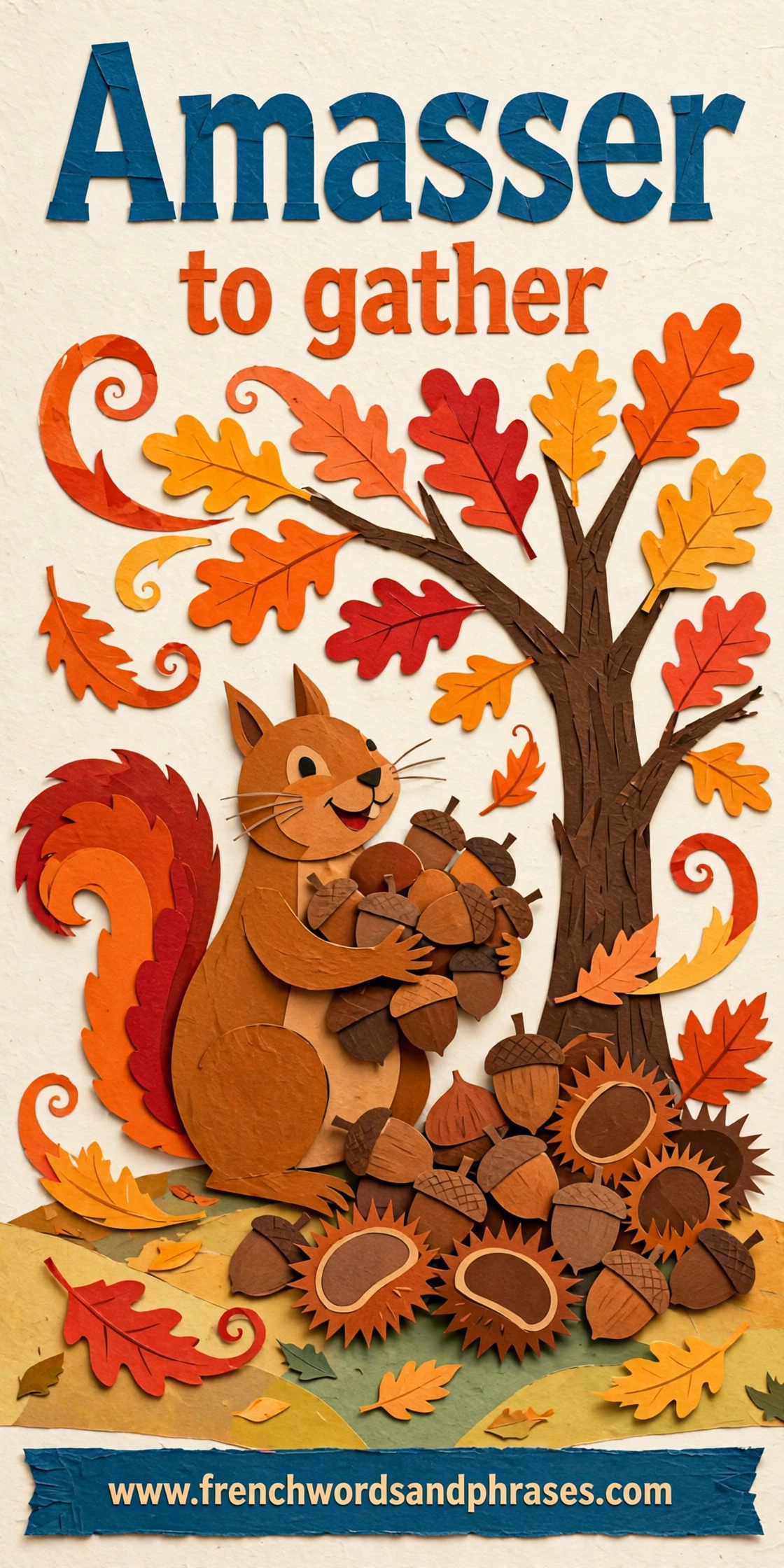
Imagine an oak wood in October. All day, a squirrel runs the same route — down the trunk, across the leaves, one hazelnut at a time — il amasse, il cache, il oublie la moitié — building, nut by nut, the invisible pantry that will feed him in February.
No single trip matters. He has gathered — il a amassé — and the pile, not the journey, is the point.
How to Conjugate Amasser: Complete French Conjugation Guide
Let’s explore every major conjugation of amasser, beginning with the indicative mood.
How to Conjugate Amasser in the Indicative Mood
The indicative mood is used to express facts, observations, actions, and events.
How to Conjugate Amasser in the Present Tense (Présent)
Used for actions happening now, habitual actions, and general truths.
| Subject | Conjugation |
|---|---|
| je | amasse |
| tu | amasses |
| il / elle | amasse |
| nous | amassons |
| vous | amassez |
| ils / elles | amassent |
Example
L’écureuil amasse des noisettes pour l’hiver.
The squirrel gathers hazelnuts for the winter.
Quick Quiz 1
Complete the sentence:
Nous ______ des provisions pour le voyage.
Reveal the answer
amassons
Nous amassons des provisions pour le voyage.
We are gathering provisions for the journey.
How to Conjugate Amasser in the Passé Composé
Used for completed actions in the past. Amasser takes the auxiliary verb avoir.
| Subject | Conjugation |
|---|---|
| j’ | ai amassé |
| tu | as amassé |
| il / elle | a amassé |
| nous | avons amassé |
| vous | avez amassé |
| ils / elles | ont amassé |
Example
En vingt ans, il a amassé une belle fortune.
In twenty years, he amassed a fine fortune.
How to Conjugate Amasser in the Imparfait (Imperfect Tense)
Used for habitual past actions, descriptions, and ongoing situations in the past.
| Subject | Conjugation |
|---|---|
| je | amassais |
| tu | amassais |
| il / elle | amassait |
| nous | amassions |
| vous | amassiez |
| ils / elles | amassaient |
Example
Les fourmis amassaient des provisions tout l’été.
The ants used to gather provisions all summer long.
Quick Quiz 2
Choose the correct form:
He amassed a fine fortune.
Il ______ une belle fortune. (a amassé / est amassé)
Reveal the answer
a amassé
Il a amassé une belle fortune.
Amasser takes avoir.
How to Conjugate Amasser in the Plus-que-parfait
Used to describe an action that had already been completed before another past event.
| Subject | Conjugation |
|---|---|
| j’ | avais amassé |
| tu | avais amassé |
| il / elle | avait amassé |
| nous | avions amassé |
| vous | aviez amassé |
| ils / elles | avaient amassé |
Example
Elle avait amassé assez d’argent pour ouvrir sa boutique.
She had saved up enough money to open her shop.
How to Conjugate Amasser in the Passé Simple
Primarily used in formal writing, literature, and historical narratives. It is rarely used in everyday conversation.
| Subject | Conjugation |
|---|---|
| je | amassai |
| tu | amassas |
| il / elle | amassa |
| nous | amassâmes |
| vous | amassâtes |
| ils / elles | amassèrent |
Example
Le vieil avare amassa des pièces d’or toute sa vie.
The old miser amassed gold coins all his life.
How to Conjugate Amasser in the Passé Antérieur
A literary tense used to express an action completed immediately before another past action, generally in the passé simple.
| Subject | Conjugation |
|---|---|
| j’ | eus amassé |
| tu | eus amassé |
| il / elle | eut amassé |
| nous | eûmes amassé |
| vous | eûtes amassé |
| ils / elles | eurent amassé |
Example
Quand il eut amassé mille francs, il acheta sa première vigne.
When he had gathered a thousand francs, he bought his first vineyard.
How to Conjugate Amasser in the Future Tense (Futur Simple)
Used to describe actions that will take place in the future.
| Subject | Conjugation |
|---|---|
| je | amasserai |
| tu | amasseras |
| il / elle | amassera |
| nous | amasserons |
| vous | amasserez |
| ils / elles | amasseront |
Example
Tu amasseras des souvenirs plein la tête pendant ce voyage.
You will gather a head full of memories on this trip.
How to Conjugate Amasser in the Futur Antérieur (Future Perfect)
Used for an action that will have been completed before a particular point in the future.
| Subject | Conjugation |
|---|---|
| j’ | aurai amassé |
| tu | auras amassé |
| il / elle | aura amassé |
| nous | aurons amassé |
| vous | aurez amassé |
| ils / elles | auront amassé |
Example
À l’automne, les écureuils auront amassé leurs provisions.
By autumn, the squirrels will have gathered their stores.
How to Conjugate Amasser in the Near Future (Futur Proche)
Used to describe something that is going to happen soon. Formed with aller + infinitive.
| Subject | Conjugation |
|---|---|
| je | vais amasser |
| tu | vas amasser |
| il / elle | va amasser |
| nous | allons amasser |
| vous | allez amasser |
| ils / elles | vont amasser |
Example
Il va encore amasser des papiers sur son bureau !
He is going to pile up yet more papers on his desk!
How to Conjugate Amasser in the Conditional Mood
The conditional mood expresses what would happen under certain circumstances. It is also frequently used to make polite requests or express wishes.
How to Conjugate Amasser in the Present Conditional
| Subject | Conjugation |
|---|---|
| je | amasserais |
| tu | amasserais |
| il / elle | amasserait |
| nous | amasserions |
| vous | amasseriez |
| ils / elles | amasseraient |
Example
Sans ses dépenses, elle amasserait une petite fortune.
Without her spending, she would amass a small fortune.
How to Conjugate Amasser in the Past Conditional
| Subject | Conjugation |
|---|---|
| j’ | aurais amassé |
| tu | aurais amassé |
| il / elle | aurait amassé |
| nous | aurions amassé |
| vous | auriez amassé |
| ils / elles | auraient amassé |
Example
Ils auraient amassé plus d’argent avec un meilleur métier.
They would have gathered more money with a better trade.
Amasser in the Literary Past Conditional Form
This less common literary form uses the imperfect subjunctive of avoir.
| Subject | Conjugation |
|---|---|
| j’ | eusse amassé |
| tu | eusses amassé |
| il / elle | eût amassé |
| nous | eussions amassé |
| vous | eussiez amassé |
| ils / elles | eussent amassé |
Example
Il eût amassé des trésors sans sa générosité.
He would have amassed treasures without his generosity.
How to Conjugate Amasser in the Subjunctive Mood
The subjunctive is used to express wishes, emotions, doubts, necessity, and uncertainty. It frequently follows expressions such as il faut que (it is necessary that) or bien que (although).
How to Conjugate Amasser in the Present Subjunctive
| Subject | Conjugation |
|---|---|
| que je | amasse |
| que tu | amasses |
| qu’il / qu’elle | amasse |
| que nous | amassions |
| que vous | amassiez |
| qu’ils / qu’elles | amassent |
Example
Il faut que tu amasses assez de bois avant l’hiver.
You must gather enough wood before winter.
Quick Quiz 3
Complete the sentence using the subjunctive:
Il faut que vous ______ assez de bois.
Reveal the answer
amassiez
Il faut que vous amassiez assez de bois.
You must gather enough wood.
How to Conjugate Amasser in the Imperfect Subjunctive
A literary tense, rarely encountered in modern spoken French.
| Subject | Conjugation |
|---|---|
| que je | amassasse |
| que tu | amassasses |
| qu’il / qu’elle | amassât |
| que nous | amassassions |
| que vous | amassassiez |
| qu’ils / qu’elles | amassassent |
Example
Je ne pensais pas qu’il amassât tant de richesses.
I did not think he amassed so many riches.
How to Conjugate Amasser in the Pluperfect Subjunctive
A literary construction used to express an action completed before another past action.
| Subject | Conjugation |
|---|---|
| que j’ | eusse amassé |
| que tu | eusses amassé |
| qu’il / qu’elle | eût amassé |
| que nous | eussions amassé |
| que vous | eussiez amassé |
| qu’ils / qu’elles | eussent amassé |
Example
On disait qu’il eût amassé des fortunes en Amérique.
People said he had amassed fortunes in America.
How to Conjugate Amasser in the Past Subjunctive
| Subject | Conjugation |
|---|---|
| que j’ | aie amassé |
| que tu | aies amassé |
| qu’il / qu’elle | ait amassé |
| que nous | ayons amassé |
| que vous | ayez amassé |
| qu’ils / qu’elles | aient amassé |
Example
Je suis étonné qu’elle ait amassé autant de livres.
I am amazed she has gathered so many books.
How to Conjugate Amasser in the Imperative
The imperative is used to give commands, instructions, invitations, or suggestions. Subject pronouns are omitted.
How to Conjugate Amasser in the Present Imperative
| Person | Conjugation |
|---|---|
| (tu) | amasse |
| (nous) | amassons |
| (vous) | amassez |
Example
Amassons des provisions pour le voyage !
Let us gather provisions for the journey!
Quick Quiz 4
How would you say Gather provisions for the winter (tu form)?
Reveal the answer
Amasse des provisions pour l’hiver !
French Participles of Amasser
Participles are verb forms that can be used in compound tenses and other grammatical constructions.
Present Participle of Amasser
amassant
En amassant sou par sou, elle a payé sa maison.
By saving penny by penny, she paid for her house.
Past Participle of Amasser
amassé
Amassées pendant des années, ces pièces valaient une fortune.
Gathered over years, these coins were worth a fortune.
Amasser in Everyday French: Real-Life Examples
Now that you know the conjugations, let’s see how amasser appears in everyday French.
Example 1 — Present
L’écureuil amasse des noisettes.
The squirrel gathers hazelnuts.
Example 2 — Passé composé
Il a amassé une belle fortune.
He amassed a fine fortune.
Example 3 — Imparfait
Les fourmis amassaient des provisions.
The ants used to gather provisions.
Example 4 — Future
Tu amasseras des souvenirs plein la tête.
You will gather a head full of memories.
Example 5 — Conditional
Elle amasserait une petite fortune sans ses dépenses.
She would amass a small fortune without her spending.
Example 6 — Imperative
Amasse assez de bois avant l’hiver !
Gather enough wood before winter!
Beyond Translation: The Meaning of Amasser
Amasser is masse turned into an action — the heap itself became a verb, and English amass borrowed it whole.
Its proverb is a trap for translators.
Pierre qui roule n’amasse pas mousse — a rolling stone gathers no moss — sounds like the English proverb, but French hears the moss as money: the restless stone stays poor, while the settled one quietly amasses. It is the idiom this page grows from, and it praises exactly what amasser does best: staying, and gathering.
How to Remember the French Verb Amasser
Remember it this way: Amasser is about the squirrel’s hazelnuts, the miser’s coins, the pile that grows sou par sou.
- Une masse is a heap; amasser is making one grow — j’amasse des noisettes.
- Regular -er: j’amasse, nous amassons, past participle amassé; its tempo is always little by little.
- Pierre qui roule n’amasse pas mousse: in French, the moss is money — settle down and gather.
The key idea is the squirrel’s hazelnuts, the miser’s coins, the pile that grows sou par sou.
Test Your Knowledge of Amasser
Let’s see how much you’ve learned. Try answering these questions before revealing the answers.
Question 1
In the proverb pierre qui roule n’amasse pas mousse, what does the moss stand for?
Reveal the answer
Wealth — the rolling stone stays poor; the settled stone quietly amasses.
Question 2
How do you say The squirrel gathers hazelnuts for the winter in French?
Reveal the answer
L’écureuil amasse des noisettes pour l’hiver.
Question 3
Translate: In twenty years, he amassed a fine fortune.
Reveal the answer
En vingt ans, il a amassé une belle fortune.
Question 4
What is the past participle of amasser?
Reveal the answer
Amassé.
Question 5
Complete the sentence:
Il faut que tu ______ assez de bois avant l’hiver.
Reveal the answer
amasses
Il faut que tu amasses assez de bois avant l’hiver.
You must gather enough wood before winter.
Your Final Challenge
Can You Use It?
How would you say this in French?
Penny by penny, hazelnut by hazelnut, we gather enough to get through the winter.
Reveal the answer
Sou par sou, noisette par noisette, on amasse de quoi traverser l’hiver.
Penny by penny, hazelnut by hazelnut, we gather enough to get through the winter.
A little French. A little curiosity. A richer everyday life.
LEARN FRENCH ONE WORD AT A TIME