
A French Word to Live By
How to Conjugate Flâner in French
/flɑ.ne/
Flâner means to wander, stroll, or walk without a particular destination.
Not every journey needs a plan. Sometimes the best way to discover a place is to slow down, look around, and simply enjoy being there.
In this guide, you’ll learn how to conjugate flâner in all the major French tenses and moods. Explore complete conjugation tables, French examples, English translations, pronunciation links, and practice quizzes.
Understanding the French Verb Flâner
Flâner is a regular French verb belonging to the first group of verbs, those ending in -er.
It means to wander, stroll, or spend time walking without a particular destination. It often suggests an unhurried enjoyment of one’s surroundings.
Verb classification: First group (-er)
Auxiliary verb: Avoir
Past participle: flâné
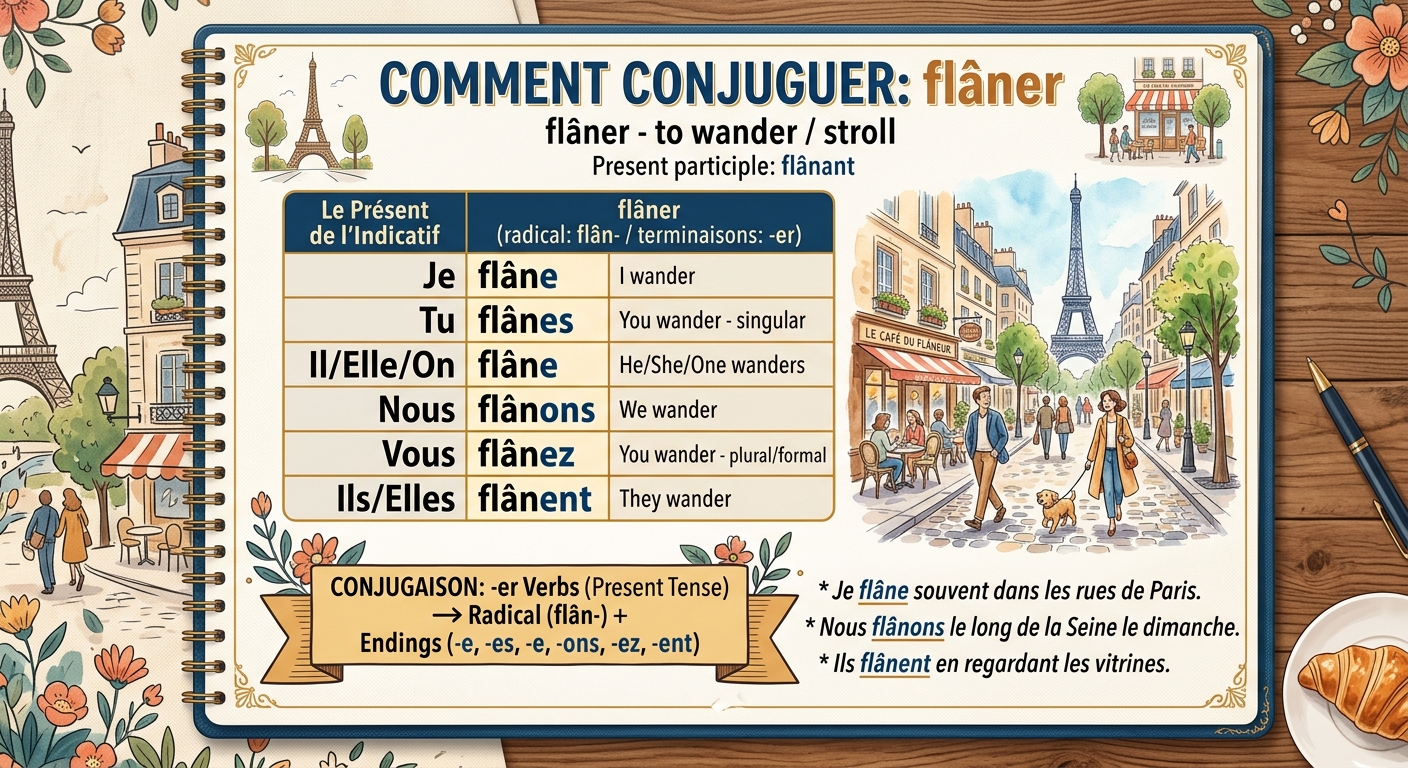
Present participle: flânant
English equivalents: To wander, to stroll, to meander.
One small spelling detail: the accent circumflex on the â remains throughout the conjugation.
Experience the Word
Flâner is more than walking. It is the art of wandering at an unhurried pace, without a fixed destination or a pressing reason to arrive.
Imagine strolling along a quiet Parisian street, stopping to admire a bookstore, watching people at a café, or following an interesting little lane just to see where it leads.
You are not trying to get somewhere. The experience itself is the destination.
How to Conjugate Flâner: Complete French Conjugation Guide
Let’s explore every major conjugation of flâner, beginning with the indicative mood.
How to Conjugate Flâner in the Indicative Mood
The indicative mood is used to express facts, observations, actions, and events.
How to Conjugate Flâner in the Present Tense (Présent)
Used for actions happening now, habitual actions, and general truths.
| Subject | Conjugation |
|---|---|
| je | flâne |
| tu | flânes |
| il / elle | flâne |
| nous | flânons |
| vous | flânez |
| ils / elles | flânent |
Example
Je flâne dans les rues de Paris.
I wander through the streets of Paris.
Quick Quiz 1
Complete the sentence:
Nous ______ au bord de la rivière.
Reveal the answer
flânons
Nous flânons au bord de la rivière.
We stroll along the river.
How to Conjugate Flâner in the Passé Composé
Used for completed actions in the past. Flâner takes the auxiliary verb avoir.
| Subject | Conjugation |
|---|---|
| j’ | ai flâné |
| tu | as flâné |
| il / elle | a flâné |
| nous | avons flâné |
| vous | avez flâné |
| ils / elles | ont flâné |
Example
Hier, j’ai flâné dans le vieux quartier.
Yesterday, I wandered through the old neighborhood.
How to Conjugate Flâner in the Imparfait (Imperfect Tense)
Used for habitual past actions, descriptions, and ongoing situations in the past.
| Subject | Conjugation |
|---|---|
| je | flânais |
| tu | flânais |
| il / elle | flânait |
| nous | flânions |
| vous | flâniez |
| ils / elles | flânaient |
Example
Quand j’étais jeune, je flânais souvent dans ce parc.
When I was young, I often wandered through this park.
Quick Quiz 2
Choose the correct form:
When we were children, we used to wander around the village.
Quand nous étions enfants, nous ______ dans le village.
Reveal the answer
flânions
Quand nous étions enfants, nous flânions dans le village.
How to Conjugate Flâner in the Plus-que-parfait
Used to describe an action that had already been completed before another past event.
| Subject | Conjugation |
|---|---|
| j’ | avais flâné |
| tu | avais flâné |
| il / elle | avait flâné |
| nous | avions flâné |
| vous | aviez flâné |
| ils / elles | avaient flâné |
Example
J’avais déjà flâné dans ce quartier avant de déménager.
I had already wandered around this neighborhood before moving.
How to Conjugate Flâner in the Passé Simple
Primarily used in formal writing, literature, and historical narratives. It is rarely used in everyday conversation.
| Subject | Conjugation |
|---|---|
| je | flânai |
| tu | flânas |
| il / elle | flâna |
| nous | flânâmes |
| vous | flânâtes |
| ils / elles | flânèrent |
Example
Il flâna longtemps dans les jardins du château.
He wandered for a long time through the castle gardens.
How to Conjugate Flâner in the Passé Antérieur
A literary tense used to express an action completed immediately before another past action, generally in the passé simple.
| Subject | Conjugation |
|---|---|
| j’ | eus flâné |
| tu | eus flâné |
| il / elle | eut flâné |
| nous | eûmes flâné |
| vous | eûtes flâné |
| ils / elles | eurent flâné |
Example
Dès qu’il eut flâné dans les rues, il rentra chez lui.
As soon as he had wandered through the streets, he returned home.
How to Conjugate Flâner in the Future Tense (Futur Simple)
Used to describe actions that will take place in the future.
| Subject | Conjugation |
|---|---|
| je | flânerai |
| tu | flâneras |
| il / elle | flânera |
| nous | flânerons |
| vous | flânerez |
| ils / elles | flâneront |
Example
Demain, nous flânerons dans le centre-ville.
Tomorrow, we will wander around downtown.
How to Conjugate Flâner in the Futur Antérieur (Future Perfect)
Used for an action that will have been completed before a particular point in the future.
| Subject | Conjugation |
|---|---|
| j’ | aurai flâné |
| tu | auras flâné |
| il / elle | aura flâné |
| nous | aurons flâné |
| vous | aurez flâné |
| ils / elles | auront flâné |
Example
À midi, nous aurons déjà flâné dans le vieux port.
By noon, we will already have wandered around the old harbor.
How to Conjugate Flâner in the Near Future (Futur Proche)
Used to describe something that is going to happen soon. Formed with aller + infinitive.
| Subject | Conjugation |
|---|---|
| je | vais flâner |
| tu | vas flâner |
| il / elle | va flâner |
| nous | allons flâner |
| vous | allez flâner |
| ils / elles | vont flâner |
Example
Je vais flâner un peu avant le dîner.
I’m going to wander around a little before dinner.
How to Conjugate Flâner in the Conditional Mood
The conditional mood expresses what would happen under certain circumstances. It is also frequently used to make polite requests or express wishes.
How to Conjugate Flâner in the Present Conditional
| Subject | Conjugation |
|---|---|
| je | flânerais |
| tu | flânerais |
| il / elle | flânerait |
| nous | flânerions |
| vous | flâneriez |
| ils / elles | flâneraient |
Example
Je flânerais volontiers dans les rues de Lyon.
I would gladly wander through the streets of Lyon.
How to Conjugate Flâner in the Past Conditional
| Subject | Conjugation |
|---|---|
| j’ | aurais flâné |
| tu | aurais flâné |
| il / elle | aurait flâné |
| nous | aurions flâné |
| vous | auriez flâné |
| ils / elles | auraient flâné |
Example
J’aurais flâné plus longtemps si j’avais eu le temps.
I would have wandered longer if I had had the time.
Flâner in the Literary Past Conditional Form
This less common literary form uses the imperfect subjunctive of avoir.
| Subject | Conjugation |
|---|---|
| j’ | eusse flâné |
| tu | eusses flâné |
| il / elle | eût flâné |
| nous | eussions flâné |
| vous | eussiez flâné |
| ils / elles | eussent flâné |
Example
Il eût flâné davantage s’il en avait eu l’occasion.
He would have wandered more had he had the opportunity.
How to Conjugate Flâner in the Subjunctive Mood
The subjunctive is used to express wishes, emotions, doubts, necessity, and uncertainty. It frequently follows expressions such as il faut que (it is necessary that) or bien que (although).
How to Conjugate Flâner in the Present Subjunctive
| Subject | Conjugation |
|---|---|
| que je | flâne |
| que tu | flânes |
| qu’il / qu’elle | flâne |
| que nous | flânions |
| que vous | flâniez |
| qu’ils / qu’elles | flânent |
Example
Il faut que je flâne un peu pour me détendre.
I need to wander around a little to relax.
Quick Quiz 3
Complete the sentence using the subjunctive:
Il faut que nous ______ dans le jardin.
Reveal the answer
flânions
Il faut que nous flânions dans le jardin.
We need to wander around in the garden.
How to Conjugate Flâner in the Imperfect Subjunctive
A literary tense, rarely encountered in modern spoken French.
| Subject | Conjugation |
|---|---|
| que je | flânasse |
| que tu | flânasses |
| qu’il / qu’elle | flânât |
| que nous | flânassions |
| que vous | flânassiez |
| qu’ils / qu’elles | flânassent |
Example
Il souhaitait qu’elle flânât davantage.
He wished that she would wander more.
How to Conjugate Flâner in the Pluperfect Subjunctive
A literary construction used to express an action completed before another past action.
| Subject | Conjugation |
|---|---|
| que j’ | eusse flâné |
| que tu | eusses flâné |
| qu’il / qu’elle | eût flâné |
| que nous | eussions flâné |
| que vous | eussiez flâné |
| qu’ils / qu’elles | eussent flâné |
Example
Il regrettait que nous eussions flâné si longtemps.
He regretted that we had wandered for so long.
How to Conjugate Flâner in the Past Subjunctive
| Subject | Conjugation |
|---|---|
| que j’ | aie flâné |
| que tu | aies flâné |
| qu’il / qu’elle | ait flâné |
| que nous | ayons flâné |
| que vous | ayez flâné |
| qu’ils / qu’elles | aient flâné |
Example
Je suis heureux que tu aies flâné avec nous.
I’m happy that you wandered around with us.
How to Conjugate Flâner in the Imperative
The imperative is used to give commands, instructions, invitations, or suggestions. Subject pronouns are omitted.
How to Conjugate Flâner in the Present Imperative
| Person | Conjugation |
|---|---|
| (tu) | flâne |
| (nous) | flânons |
| (vous) | flânez |
Example
Flânons un peu dans le quartier !
Let’s wander around the neighborhood a little!
Quick Quiz 4
How would you say “Let’s stroll in the park”?
Reveal the answer
Flânons dans le parc !
French Participles of Flâner
Participles are verb forms that can be used in compound tenses and other grammatical constructions.
Present Participle of Flâner
flânant
En flânant, j’ai découvert une petite librairie.
While wandering, I discovered a little bookstore.
Past Participle of Flâner
flâné
Nous avons flâné toute la matinée.
We wandered all morning.
Flâner in Everyday French: Real-Life Examples
Now that you know the conjugations, let’s see how flâner appears in everyday French.
Example 1 — Present
J’aime flâner dans les rues de Paris.
I love wandering through the streets of Paris.
Example 2 — Passé composé
Nous avons flâné au marché dimanche dernier.
We wandered around the market last Sunday.
Example 3 — Imparfait
Elle flânait souvent près de la Seine.
She often wandered near the Seine.
Example 4 — Future
Ils flâneront dans le centre historique demain.
They will wander through the historic center tomorrow.
Example 5 — Conditional
Je flânerais toute la journée si je le pouvais.
I would wander all day if I could.
Example 6 — Subjunctive
Bien que nous flânions, nous devons rentrer avant la nuit.
Although we are wandering, we must return before nightfall.
Beyond Translation: The Meaning of Flâner
English has words such as wander, roam, and stroll. Each captures part of the meaning of flâner, but the French word often suggests a particular attitude toward life.
The beauty of doing nothing in particular.
To flâner is to give yourself permission to be curious, notice small details, and let the day unfold without rushing toward the next task.
The word is closely associated with the French cultural ideal of the flâneur — a person who wanders through city streets, observing everyday life.
It evokes a slower, more attentive way of experiencing the world.
How to Remember the French Verb Flâner
Remember it this way: Flâner is what you do when you leave home for a walk with no particular place to go.
- You wander through a neighborhood you have never explored.
- You pause at a shop window simply because something catches your eye.
- You take the longer route home because the weather is lovely.
The key idea is unhurried enjoyment, rather than simply getting from one place to another.
Test Your Knowledge of Flâner
Let’s see how much you’ve learned. Try answering these questions before revealing the answers.
Question 1
What auxiliary verb is used with flâner in compound tenses?
Reveal the answer
Avoir
Question 2
How do you say “I will wander” in French?
Reveal the answer
Je flânerai.
Question 3
Translate: “We have wandered through the city.”
Reveal the answer
Nous avons flâné dans la ville.
Question 4
What is the present participle of flâner?
Reveal the answer
Flânant.
Question 5
Complete the sentence:
Si j’avais du temps, je ______ dans les rues de Bordeaux.
Reveal the answer
flânerais
Si j’avais du temps, je flânerais dans les rues de Bordeaux.
If I had time, I would wander through the streets of Bordeaux.
Your Final Challenge
Can You Use It?
How would you say this in French?
“Tomorrow, I want to wander around the old town.”
Reveal the answer
Demain, je veux flâner dans la vieille ville.
Tomorrow, I want to wander around the old town.
A little French. A little curiosity. A richer everyday life.
LEARN FRENCH ONE WORD AT A TIME