A French Word to Live By
Translate Intention to English
/ɛ̃.tɑ̃.sjɔ̃/
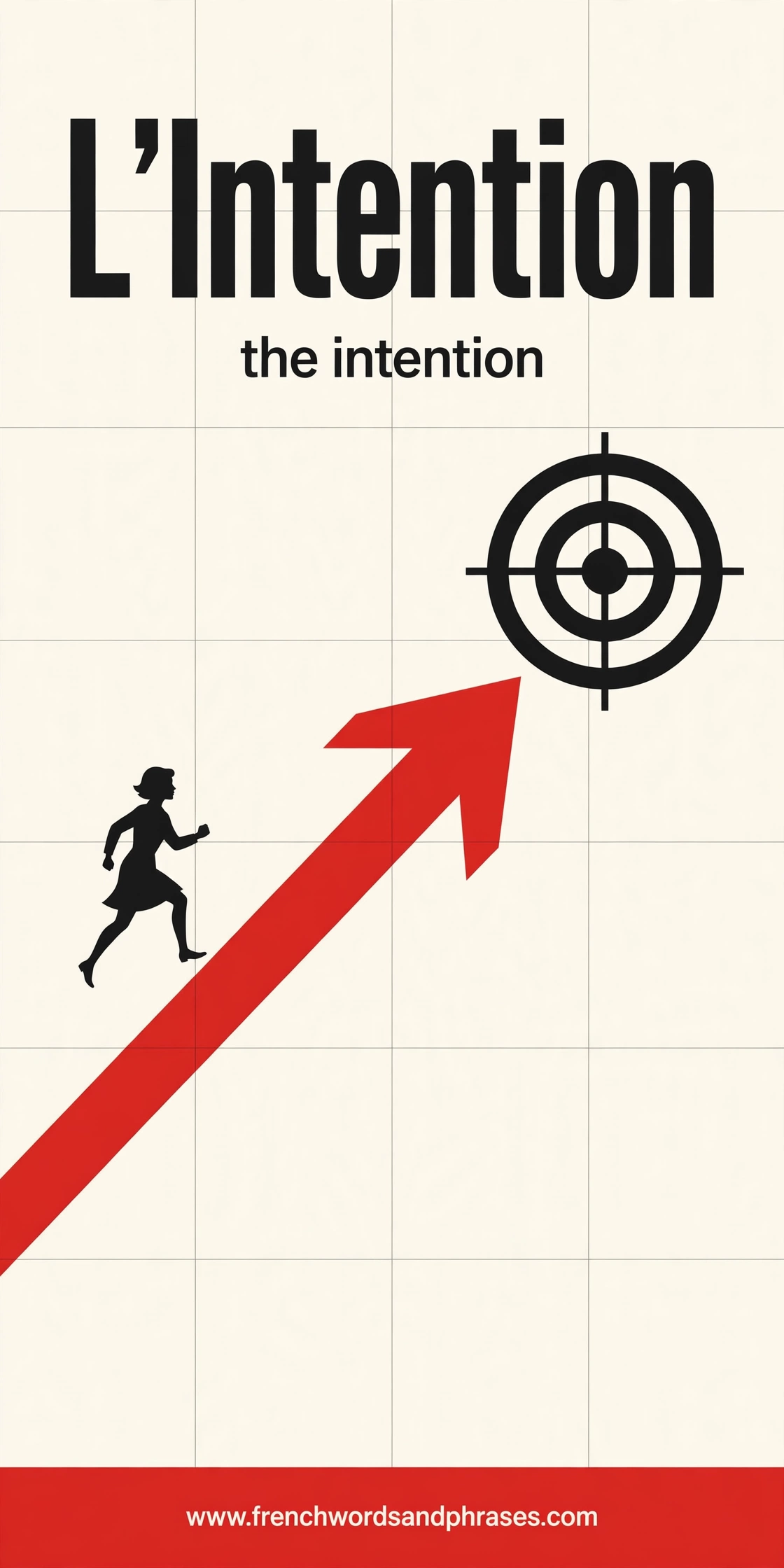
L’Intention means the intention.
He bought the flowers on Tuesday, rehearsed the sentence all week, and rang her doorbell on Friday with the best of plans: it was l’intention that counted — even if the words came out backwards.
In this guide, you’ll learn what intention means in English, how to use it with its articles, how to form its plural, and how it appears in everyday French. Explore French examples, English translations, and practice quizzes.
Understanding the French Noun Intention
Intention is a feminine French noun. Because it begins with a vowel, the article shrinks: l’intention; with the indefinite article the feminine appears: une intention. Like most nouns ending in -tion, it is feminine — a reliable pattern worth learning with it.
It means the intention — what you mean to do, the plan behind the action. French uses it in the key construction avoir l’intention de + infinitive: j’ai l’intention de partir, I intend to leave. Intentions can be good or bad — de bonnes intentions, une mauvaise intention — and the proverb warns that hell itself is paved with the good ones.
Gender: Feminine — like nearly all nouns in -tion
Definite article: l’ — l’intention (the intention)
Indefinite article: une — une intention (an intention)
Plural: les intentions
The key phrase: avoir l’intention de — to intend to
Good and bad: de bonnes intentions / une mauvaise intention
One important usage detail: à l’intention de means « for, in honour of » — un concert à l’intention des enfants, a concert for children. And vowel first, so the possessives smooth themselves out: mon intention, not « ma intention », even though the word is feminine.
Experience the Word
Intention is more than a plan. It is the invisible half of every action — the part judges weigh, friends forgive, and proverbs warn us never to trust on its own.
Imagine the birthday cake baked at midnight, slightly lopsided, slightly burnt: nobody minds, because everyone can taste the intention inside it.
You have not just meant well. You have declared a direction — une intention, la première moitié du chemin.
How to Use Intention in French: Complete Guide
Let’s explore how intention works in French, beginning with its articles — feminine, vowel first: l’intention, une intention, mon intention.
Intention with the Definite Article (L’, Les)
Intention begins with a vowel, so la shrinks to l’ — l’intention, the intention behind the act.
| Form | French |
|---|---|
| Feminine singular | l’intention |
| Plural | les intentions |
Example
L’intention était bonne, mais le résultat est un désastre.
The intention was good, but the result is a disaster.
Intention with the Indefinite Article (Une, Des)
Used for an intention in general — and here the feminine shows: une intention.
| Form | French |
|---|---|
| Feminine singular | une intention |
| Plural | des intentions |
Example
C’était une intention généreuse de sa part.
It was a generous intention on his part.
Intention with the Partitive and Quantities (Des, De bonnes…)
Intentions are abstract, so French counts and qualifies them rather than serving « some » — good ones, bad ones, plenty of them.
| Quantity | French |
|---|---|
| some intentions | des intentions |
| good intentions | de bonnes intentions |
| many intentions | beaucoup d’intentions |
| a single intention | une seule intention |
| no intention at all | aucune intention |
Example
Il est plein de bonnes intentions, mais il ne termine jamais rien.
He is full of good intentions, but he never finishes anything.
Quick Quiz 1
Complete the sentence:
J’ai ______ de vous aider, vraiment. (the intention)
Reveal the answer
l’intention
J’ai l’intention de vous aider, vraiment.
I intend to help you, truly — avoir l’intention de, the classic construction.
The Plural of Intention
Intention adds an -s in the plural — les intentions, and the l’ opens out into les.
| Number | French |
|---|---|
| Singular | l’intention |
| Plural | les intentions |
Example
Ses intentions sont claires : elle veut changer de métier.
Her intentions are clear: she wants to change career.
Intention with Possessive Adjectives (Mon, Ton, Son…)
The vowel rule again: intention is feminine but begins with a vowel, so it takes mon, ton, son — never « ma intention ».
| Owner | French |
|---|---|
| my | mon intention |
| your (tu) | ton intention |
| his / her | son intention |
| our | notre intention |
| your (vous) | votre intention |
| their | leur intention |
Example
Mon intention n’était pas de te blesser, je suis désolé.
My intention was not to hurt you, I’m sorry.
Quick Quiz 2
Complete the sentence:
______ intention est de partir tôt demain. (His)
Reveal the answer
Son
Son intention est de partir tôt demain.
His intention is to leave early tomorrow — son, not sa, because intention begins with a vowel.
Intention with Demonstrative Adjectives (Cette, Ces)
Used to point: cette intention, this intention — cette works normally before the vowel.
| Form | French |
|---|---|
| Feminine singular | cette intention |
| Plural | ces intentions |
Example
Cette intention de déménager surprend toute la famille.
This intention of moving house surprises the whole family.
Intention with Adjectives
Adjectives agree with intention and take the feminine -e: bonne, mauvaise, ferme.
| Adjective | With Intention |
|---|---|
| bonne (good) | une bonne intention |
| mauvaise (bad) | une mauvaise intention |
| ferme (firm) | une intention ferme |
| vraie (real, true) | sa vraie intention |
| secrète (secret) | une intention secrète |
Example
Derrière son sourire, on devine une intention secrète.
Behind her smile, you can guess a secret intention.
Quick Quiz 3
Complete the sentence:
C’est une ______ intention, mais elle arrive trop tard. (good)
Reveal the answer
bonne
C’est une bonne intention, mais elle arrive trop tard.
It’s a good intention, but it comes too late — bonne, feminine, to agree with intention.
Everyday Expressions with Intention
Plans, dedications and paved roads to hell — the intention phrases of daily life.
| Expression | In English |
|---|---|
| avoir l’intention de | to intend to, to mean to |
| de bonnes intentions | good intentions |
| à l’intention de | for, in honour of (a dedication) |
| sans intention de nuire | with no intention of harming |
| l’enfer est pavé de bonnes intentions | the road to hell is paved with good intentions |
| intentionnellement | intentionally, on purpose |
Example
J’ai l’intention de visiter la Bretagne cet été.
I intend to visit Brittany this summer.
Words from the Same Family as Intention
Purpose, attention and meaning well — the words that travel with intention.
| French | In English |
|---|---|
| intentionnel | intentional, deliberate |
| bien intentionné | well-meaning, well-intentioned |
| le projet | the plan, the project |
| le but | the aim, the goal |
| prémédité | premeditated |
| l’attention | attention (a look-alike: different word!) |
Example
Ce n’était pas intentionnel, c’était un accident.
It wasn’t intentional, it was an accident.
Quick Quiz 4
How do you say « I intend to leave » in French?
Reveal the answer
J’ai l’intention de partir — avoir l’intention de followed by the infinitive.
Nous avons l’intention de rester une semaine.
We intend to stay for a week.
Intention in Everyday French: Real-Life Examples
Now that you know the word, let’s see how intention appears in everyday French.
Example 1 — Making plans
J’ai l’intention de changer de travail cette année.
I intend to change jobs this year.
Example 2 — An apology
Ce n’était pas mon intention de te vexer.
It wasn’t my intention to upset you.
Example 3 — A dedication
Ce concert est organisé à l’intention des enfants malades.
This concert is organised for sick children.
Example 4 — Suspicion
Je me demande quelle est sa vraie intention.
I wonder what his real intention is.
Example 5 — Good intentions
L’enfer est pavé de bonnes intentions, dit le proverbe.
The road to hell is paved with good intentions, as the proverb says.
Example 6 — A firm plan
Leur intention est ferme : ils partent en juin.
Their intention is firm: they are leaving in June.
Beyond Translation: The Meaning of Intention
Intention is where French philosophy and French law shake hands: in court, l’intention separates the accident from the crime, and in everyday speech it separates the friend from the enemy. The proverb about hell’s paving is quoted so often in France that « pavé de bonnes intentions » has become a complete sentence of gentle reproach.
To say intention is to name the invisible plan behind every visible act.
It evokes rehearsed speeches and midnight cakes, dedications in books, and all the good resolutions of January the first.
How to Remember the French Noun Intention
Remember it this way: Intention is feminine and starts with a vowel — l’intention, une intention, mon intention — and avoir l’intention de means to intend to.
- You state a plan — j’ai l’intention de partir, de rester, de changer.
- You judge a gesture — une bonne intention, une mauvaise intention.
- You remember the vowel — mon intention, jamais « ma intention ».
The key idea is l’intention — avoir l’intention de + infinitive.
Test Your Knowledge of Intention
Let’s see how much you’ve learned. Try answering these questions before revealing the answers.
Question 1
Is intention masculine or feminine?
Reveal the answer
Feminine — like almost all nouns ending in -tion: une intention, but l’intention.
Question 2
Why do we say mon intention and not ma intention?
Reveal the answer
Because intention begins with a vowel — feminine nouns starting with a vowel take mon, ton, son.
Question 3
Translate: We intend to visit Brittany.
Reveal the answer
Nous avons l’intention de visiter la Bretagne.
Question 4
What does à l’intention de mean?
Reveal the answer
For, in honour of — a dedication: un livre à l’intention des enfants, a book for children.
Question 5
Complete the sentence:
Elle a ______ de s’excuser ce soir.
Reveal the answer
l’intention
Elle a l’intention de s’excuser ce soir.
She intends to apologise this evening.
Your Final Challenge
Can You Use It?
How would you say this in French?
“I intend to learn French this year.”
Reveal the answer
J’ai l’intention d’apprendre le français cette année.
I intend to learn French this year.
A little French. A little curiosity. A richer everyday life.
LEARN FRENCH ONE WORD AT A TIME