A French Word to Live By
Translate Crâne to English
/kʁɑn/
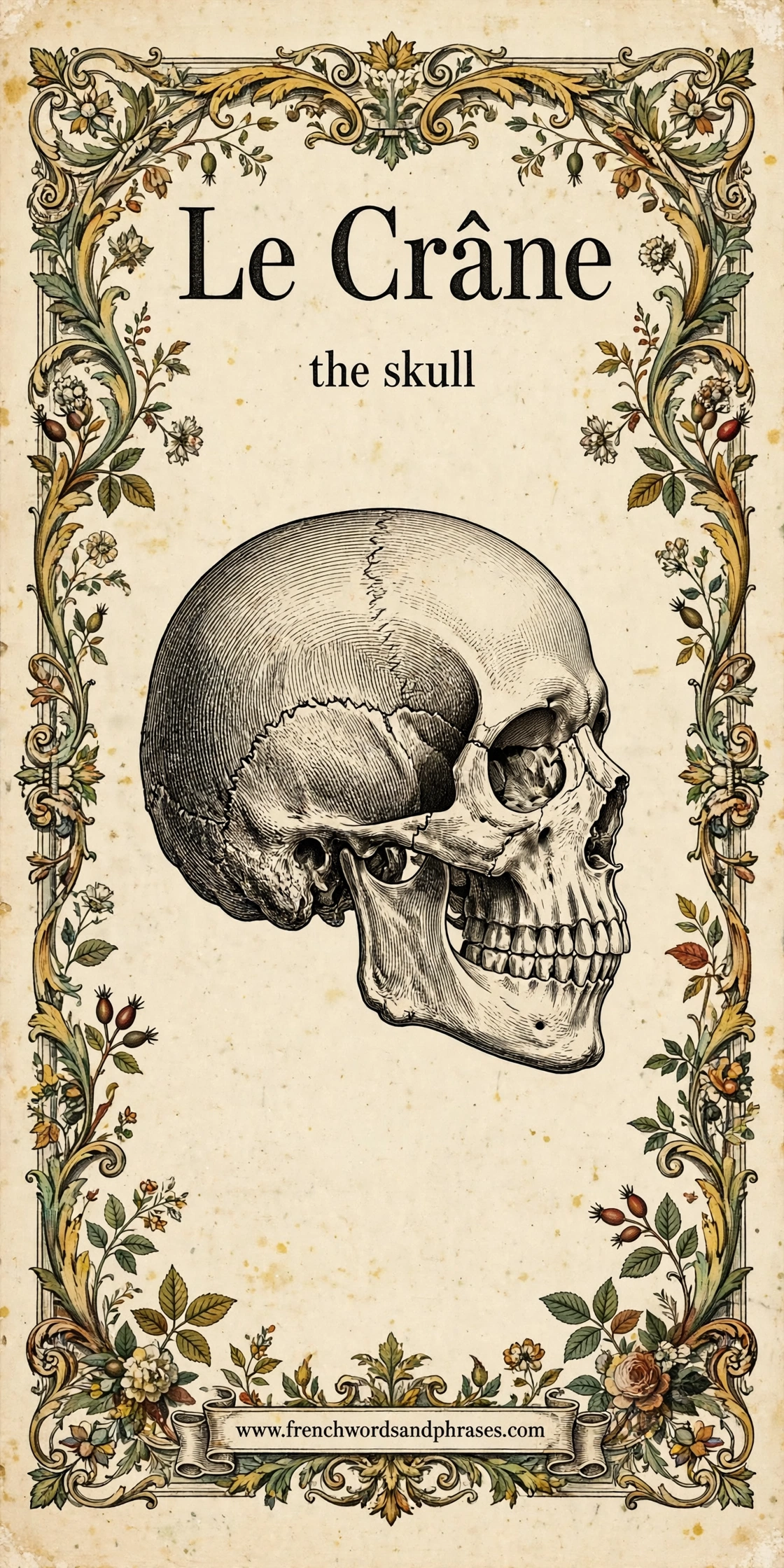
Le crâne means the skull.
The science classroom smells of chalk and old wood. On the teacher’s desk sits a white skull, grinning at the class while the teacher taps it gently with a ruler: « Voici le crâne — il protège le cerveau. » Every head in the room suddenly feels very precious.
In this guide, you’ll learn what crâne means in English, how to use it with its articles, how to form its plural, and how it appears in everyday French. Explore French examples, English translations, and practice quizzes.
Understanding the French Noun Crâne
Crâne is a masculine French noun, learned with its article: le crâne, un crâne. It names the bony case that protects the brain. The same word also appears in the famous idiom bourrer le crâne — to stuff someone’s skull, that is, to brainwash them or fill their head with propaganda.
It means the skull — the bones of the head that form a protective helmet around the brain. Anatomists use it for the whole bony structure; in everyday speech it can also mean the head itself, especially a bald one: un crâne chauve is a bald head, and se casser le crâne is a vivid way of saying to rack your brains over a problem.
Gender: Masculine — le crâne, un crâne
Plural: les crânes — a regular -s plural
Definite article: le — le crâne (the skull)
Indefinite article: un — un crâne (a skull)
Famous idiom: bourrer le crâne à quelqu’un — to brainwash someone, to stuff their head with ideas
English equivalents: The skull; the cranium (anatomical); the head (informal)
One important usage detail: crâne is the bone, not the whole head — the everyday word for head is la tête. Use crâne for anatomy, skulls in museums, Halloween decorations, and the idioms built on it. It is also an adjective in the phrase un crâne d’œuf — a bald head smooth as an egg.
Experience the Word
Le crâne is one of those words French speakers meet first in a museum or a biology lesson — the pale skull behind glass, labelled and numbered, reminding everyone that under the hair and the face there is architecture.
The word carries a cheerful shiver in French culture: pirates fly it on flags, Halloween shops fill their windows with it, and the expression bourrer le crâne survives from the First World War, when soldiers felt their heads were being stuffed with official propaganda.
For learners, crâne is a gift of an idiom word: once you know the skull, a whole family of expressions opens up — racking your brains, bald heads, and heads stuffed with nonsense.
How to Use Crâne in French: Complete Guide
Let’s explore how crâne works in French, beginning with its articles — and watch how this one masculine noun behaves with quantities, plurals and adjectives.
Crâne with the Definite Article (Le, Les)
The definite article for a masculine noun is le in the singular, les in the plural.
| Form | French | English |
|---|---|---|
| Masculine singular | le crâne | the skull |
| Plural | les crânes | the skulls |
| In a sentence | Le crâne protège le cerveau. | The skull protects the brain. |
Example
Le crâne de ce squelette est très ancien.
The skull of this skeleton is very old.
Crâne with the Indefinite Article (Un, Des)
Use un for one skull, des for some skulls.
| Form | French | English |
|---|---|---|
| Masculine singular | un crâne | a skull |
| Plural | des crânes | some skulls |
| In a sentence | Il a dessiné un crâne. | He drew a skull. |
Example
Un crâne humain peut raconter beaucoup de choses aux archéologues.
A human skull can tell archaeologists a great deal.
Crâne with Partitives and Quantities
Crâne is countable, so it pairs with numbers and quantity words rather than the partitive du.
| Quantity | French | English |
|---|---|---|
| One | un crâne | one skull |
| Two | deux crânes | two skulls |
| Several | plusieurs crânes | several skulls |
| A whole collection | une collection de crânes | a collection of skulls |
Example
Le musée expose plusieurs crânes préhistoriques.
The museum displays several prehistoric skulls.
Quick Quiz 1
Complete the sentence:
______ crâne protège le cerveau.
Reveal the answer
Le
Le crâne protège le cerveau.
The skull protects the brain — crâne is masculine, so the definite article is le.
The Plural of Crâne
Crâne forms its plural the regular way: add an -s.
| Number | French | English |
|---|---|---|
| Singular | le crâne | the skull |
| Plural | les crânes | the skulls |
| With an adjective | des crânes anciens | ancient skulls |
Example
Ces crânes datent de plusieurs milliers d’années.
These skulls date back several thousand years.
Crâne with Possessive Adjectives (Mon, Ton, Son…)
Possessives agree with the thing possessed: crâne is masculine, so use mon, ton, son in the singular.
| Owner | French | English |
|---|---|---|
| My | mon crâne | my skull |
| Your | ton crâne | your skull |
| His / her | son crâne | his / her skull |
| Our (plural) | nos crânes | our skulls |
Example
Il s’est cogné le crâne contre la porte basse.
He bumped his skull against the low door.
Quick Quiz 2
What is the plural of le crâne?
Reveal the answer
Les crânes — crâne takes a regular -s plural: un crâne, des crânes.
Crâne with Demonstrative Adjectives (Ce, Ces)
For a masculine noun, this is ce in the singular and ces in the plural.
| Form | French | English |
|---|---|---|
| Singular | ce crâne | this skull |
| Plural | ces crânes | these skulls |
| In a sentence | Ce crâne est fascinant. | This skull is fascinating. |
Example
Regarde ce crâne : il a encore toutes ses dents.
Look at this skull: it still has all its teeth.
Crâne with Adjectives: Agreement
Adjectives agree with crâne: masculine forms in the singular, -s added in the plural.
| Adjective | French | English |
|---|---|---|
| Bald (of a head) | un crâne chauve | a bald head |
| Ancient | un crâne ancien | an ancient skull |
| Plural | des crânes anciens | ancient skulls |
| Hard | un crâne dur | a hard skull |
Example
Son crâne chauve brille sous le soleil.
His bald head shines in the sun.
Quick Quiz 3
Translate: this skull
Reveal the answer
Ce crâne — crâne is masculine, so the demonstrative is ce (ces in the plural).
Everyday Expressions with Crâne
Crâne lives in several vivid idioms — the head as a box to fill, crack or rack.
| Expression | Meaning |
|---|---|
| bourrer le crâne à quelqu’un | to brainwash someone, to stuff their head with propaganda |
| se casser le crâne | to rack your brains over something |
| un crâne d’œuf | a completely bald head |
| avoir le crâne dur | to be stubborn, thick-skulled |
Example
Arrête de me bourrer le crâne avec tes théories !
Stop stuffing my head with your theories!
Words from the Same Family as Crâne
The family of crâne stays close to the head and what protects it.
| Word | Meaning |
|---|---|
| le crânien (adjective) | cranial — nerf crânien, cranial nerve |
| la craniologie | craniology, the study of skulls |
| le casque | the helmet — the skull’s modern stand-in |
| la tête | the head — the everyday word |
Example
Les nerfs crâniens partent directement du cerveau.
The cranial nerves start directly from the brain.
Quick Quiz 4
What does « bourrer le crâne à quelqu’un » mean?
Reveal the answer
To brainwash someone — literally to stuff their skull, filling their head with propaganda or nonsense until they believe it.
Crâne in Everyday French: Real-Life Examples
Now that you know the word, let’s see how crâne appears in everyday French.
Example 1 — At the museum
Ce crâne de mammouth impressionne tous les visiteurs.
This mammoth skull impresses all the visitors.
Example 2 — In class
Le professeur montre un crâne humain aux élèves.
The teacher shows a human skull to the pupils.
Example 3 — A bump
Il s’est cogné le crâne et il a une belle bosse.
He bumped his skull and he has a fine bump.
Example 4 — Halloween
Elle a acheté un crâne en plastique pour décorer la maison.
She bought a plastic skull to decorate the house.
Example 5 — Thinking hard
Je me casse le crâne sur ce problème depuis une heure.
I have been racking my brains over this problem for an hour.
Example 6 — At the doctor’s
La radio du crâne ne montre aucune fracture.
The skull X-ray shows no fracture.
Beyond Translation: The Meaning of Crâne
The crâne has a double life in French: solemn in the anatomy lab, mischievous in the street. The idiom bourrer le crâne was born in the trenches of 1914–18, when soldiers joked that the newspapers and the brass were stuffing their skulls with lies — bourrage de crâne became the French word for propaganda itself. A century later, the phrase is gentler: parents, advertisers and influencers can all be accused of it, usually with a smile.
How to Remember the French Noun Crâne
Remember it this way: Crâne is the skull — the hard case your brain travels in. Think of the idiom bourrer le crâne: ideas being stuffed into that case until it is full.
- Masculine — le crâne, un crâne, and a regular plural: les crânes.
- The bone, not the whole head — the everyday word for head is la tête.
- Picture the propaganda poster: bourrer le crâne, stuffing a skull with slogans.
The key idea is le crâne — the bony case of the brain.
Test Your Knowledge of Crâne
Let’s see how much you’ve learned. Try answering these questions before revealing the answers.
Question 1
Is crâne masculine or feminine?
Reveal the answer
Masculine — le crâne, un crâne.
Question 2
How do you say the skulls?
Reveal the answer
Les crânes — a regular -s plural.
Question 3
What does bourrer le crâne à quelqu’un mean?
Reveal the answer
To brainwash someone — to stuff their skull with propaganda or nonsense.
Question 4
What is the everyday French word for the head?
Reveal the answer
La tête — crâne is the bone, the skull itself.
Question 5
Complete the sentence:
Il s’est cogné ______ crâne contre la poutre.
Reveal the answer
le
Il s’est cogné le crâne contre la poutre.
He bumped his skull against the beam — body parts take the definite article in French.
Your Final Challenge
Can You Use It?
How would you say this in French?
“The skull protects the brain.”
Reveal the answer
Le crâne protège le cerveau.
The skull protects the brain.
A little French. A little curiosity. A richer everyday life.
LEARN FRENCH ONE WORD AT A TIME