A French Word to Live By
Translate Vent to English
/vɑ̃/
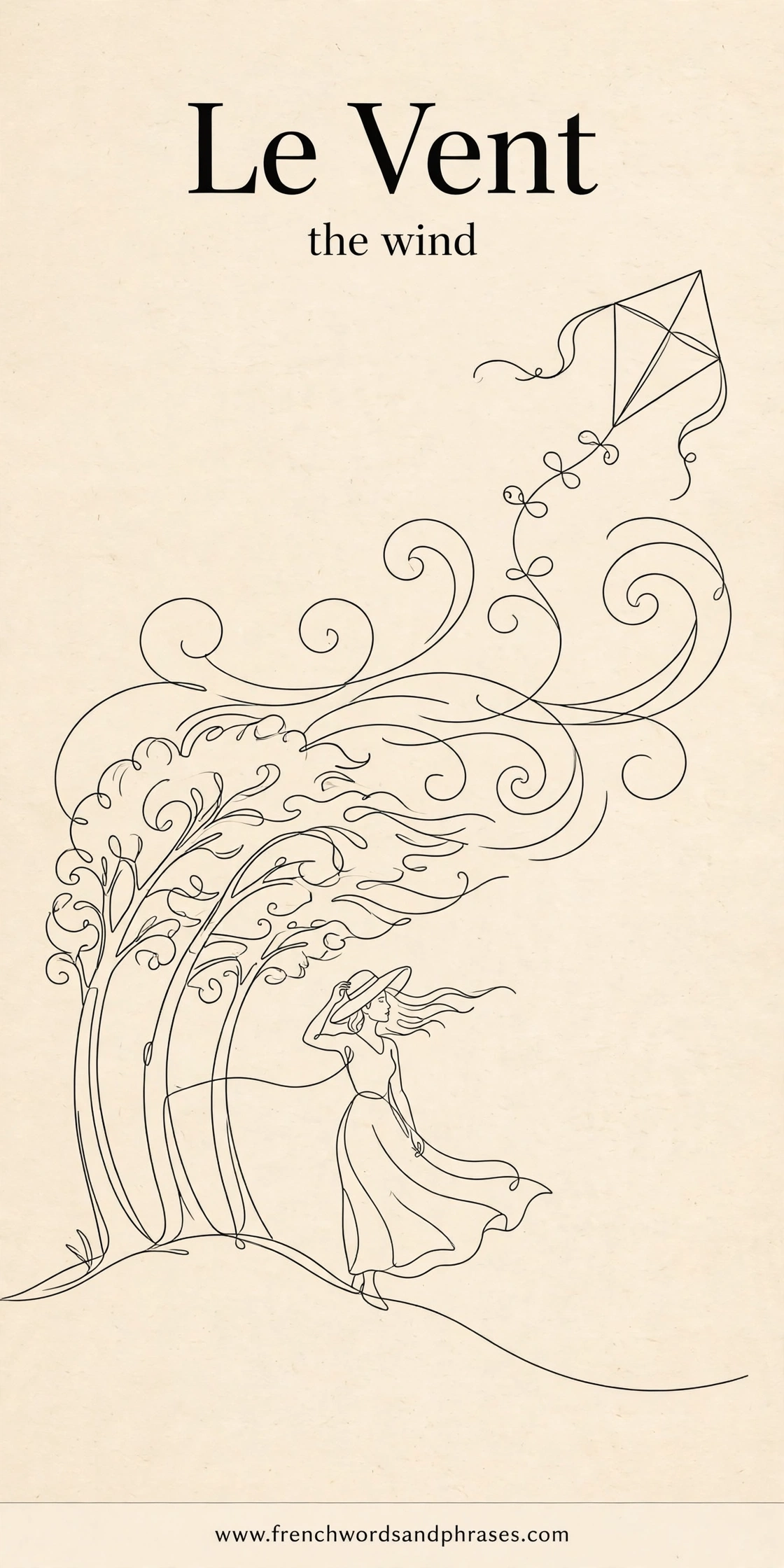
Le vent means the wind.
The shutters bang, the washing dances on the line, and the old fisherman looks at the harbour flags snapping straight out. « Le vent se lève, » he says. « Pas de sortie aujourd’hui. » When le vent rises, the whole town obeys.
In this guide, you’ll learn what vent means in English, how to use it with its articles, how to form its plural, and how it appears in everyday French. Explore French examples, English translations, and practice quizzes.
Understanding the French Noun Vent
Vent is a masculine French noun, learned with its article: le vent, un vent. It is the wind — moving air, from a gentle breeze to a storm — and French loads it with expressions about luck, fashion and empty talk. The plural is regular: les vents.
It means the wind — le vent souffle, the wind blows. Regional winds have famous names: le mistral in Provence, la tramontane in the south-west. And the word travels far beyond weather: bon vent ! can wish someone fair winds — or, with a shrug, good riddance.
Gender: Masculine
Definite article: le — le vent (the wind)
Indefinite article: un — un vent (a wind)
Plural: les vents
Famous winds: le mistral, la tramontane
Famous phrases: bon vent ! — fair winds! / good riddance!; dans le vent — trendy
One important usage detail: tone decides what bon vent means. Said warmly to a sailor, it wishes a good journey; said to someone leaving in a huff, it means good riddance — and French speakers enjoy the ambiguity. Note also du vent as an insult for empty promises: ce ne sont que du vent — it’s all hot air.
Experience the Word
Vent is the invisible force every French landscape knows by name. The mistral scours Provence clean and drives painters half-mad; the Atlantic winds bend the pines of the Landes; sailors read the wind the way city people read the news.
Because the wind carries things away, French made it the carrier of reputations too: être dans le vent is to be carried by the moment — fashionable, up to date — while yesterday’s celebrity n’est plus dans le vent, no longer in the wind.
And because the wind is all movement and no substance, it became the word for empty talk: a politician’s promises can be du vent, a boastful plan vend du vent — sells wind. The same air that fills sails fills balloons of hot air.
How to Use Vent in French: Complete Guide
Let’s explore how vent works in French, beginning with its articles — the wind that moves ships, fashions and conversations.
Vent with the Definite Article (Le, Les)
The noun never changes; the article does the work.
| Form | French |
|---|---|
| Singular | le vent |
| Plural | les vents |
Example
Le vent souffle fort sur la côte ce soir.
The wind is blowing hard on the coast this evening.
Vent with the Indefinite Article (Un, Des)
Use un for one wind, des for winds in general.
| Form | French |
|---|---|
| Singular | un vent |
| Plural | des vents |
Example
Un vent froid arrive du nord.
A cold wind is coming from the north.
Vent with the Partitive and Quantities
As a force of nature, wind takes the partitive du — and du vent can mean hot air.
| Expression | French |
|---|---|
| some wind | du vent |
| a lot of wind | beaucoup de vent |
| a gust of wind | un coup de vent |
| no wind | pas de vent |
Example
Il y a beaucoup de vent sur la plage aujourd’hui.
There is a lot of wind on the beach today.
Quick Quiz 1
Complete the sentence:
______ vent a renversé les chaises du jardin. (the)
Reveal the answer
Le
Le vent a renversé les chaises du jardin.
The wind knocked over the garden chairs — le, because vent is masculine.
The Plural of Vent
Vent adds a simple -s in the plural.
| Number | French |
|---|---|
| Singular | le vent |
| Plural | les vents |
Example
Les vents d’ouest apportent la pluie.
The west winds bring the rain.
Vent with Possessive Adjectives (Mon, Ton, Son…)
Vent is masculine, so the singular possessives are mon, ton, son.
| Owner | French |
|---|---|
| my | mon vent |
| your (tu) | ton vent |
| his / her | son vent |
| our | notre vent |
| your (vous) | votre vent |
| their | leur vent |
Example
Le marin attend son vent pour partir.
The sailor waits for his wind to set off.
Quick Quiz 2
Complete the sentence:
Ses promesses, ce n’est que ______ vent ! (some — hot air)
Reveal the answer
du
Ses promesses, ce n’est que du vent !
His promises are just hot air — du vent, the partitive turned into an insult.
Vent with Demonstrative Adjectives (Ce, Ces)
Ce points to one wind, ces to several.
| Form | French |
|---|---|
| Singular | ce vent |
| Plural | ces vents |
Example
Ce vent glacial traverse tous les manteaux.
This icy wind goes through every coat.
Vent with Adjectives
Adjectives agree: masculine singular with vent, and most come after the noun.
| Adjective | With Vent |
|---|---|
| fort (strong) | un vent fort |
| froid (cold) | un vent froid |
| violent (violent) | un vent violent |
| léger (light) | un vent léger |
Example
Un vent violent a cassé plusieurs branches.
A violent wind broke several branches.
Quick Quiz 3
True or false?
« Être dans le vent » means to be caught outside in bad weather.
Reveal the answer
False
It means to be trendy, up to date — carried by the wind of the moment.
Everyday Expressions with Vent
Vent blows through some of French’s liveliest expressions.
| Expression | In English |
|---|---|
| bon vent ! | fair winds! — or good riddance! |
| être dans le vent | to be trendy, up to date |
| avoir le vent en poupe | to have the wind in one’s sails, to be on a roll |
| vendre du vent | to sell hot air, to make empty promises |
Example
Depuis son succès, l’entreprise a le vent en poupe.
Since its success, the company has the wind in its sails.
Words from the Same Family as Vent
Words that share the wind’s moving air.
| French | In English |
|---|---|
| la brise | the breeze |
| la tempête | the storm |
| venteux | windy |
Example
Une brise légère rafraîchit la terrasse.
A light breeze cools the terrace.
Quick Quiz 4
Complete the sentence:
Il est parti fâché, et tout le monde a dit : « Bon ______ ! » (wind)
Reveal the answer
vent
Il est parti fâché, et tout le monde a dit : « Bon vent ! »
He left in a temper, and everyone said: ‘Good riddance!’
Vent in Everyday French: Real-Life Examples
Now that you know the word, let’s see how vent appears in everyday French.
Example 1 — Checking the weather
Il y a du vent aujourd’hui, prends une veste.
It’s windy today, take a jacket.
Example 2 — At the harbour
Le vent se lève, les bateaux restent au port.
The wind is rising, the boats are staying in harbour.
Example 3 — Saying goodbye
Bon vent, et écris-nous vite !
Fair winds, and write to us soon!
Example 4 — Talking fashion
Cette chanteuse n’est plus vraiment dans le vent.
That singer isn’t really trendy any more.
Example 5 — On a roll
Notre équipe a le vent en poupe cette saison.
Our team has the wind in its sails this season.
Example 6 — Seeing through a talker
Ne l’écoute pas, il ne vend que du vent.
Don’t listen to him, he only sells hot air.
Beyond Translation: The Meaning of Vent
France names its winds the way other countries name wines: the mistral that Van Gogh painted as it tore through Provence, the tramontane, the autan, the marin. Each has a character, a season and a reputation for what it does to people’s tempers — Provençal law once even treated the mistral as an excuse for bad behaviour. No wonder the word vent wandered so far into the language: a force that can fill a sail, ruin a harvest and excuse a crime was bound to end up meaning luck, fashion and empty talk as well.
How to Remember the French Noun Vent
Remember it this way: Vent is the wind — masculine, invisible and everywhere: in the sails, in the fashion of the moment, and in empty promises.
- You feel it — le vent that bends the trees and fills the sails.
- You ride it — le vent en poupe, everything going your way.
- You see through it — du vent, hot air and nothing more.
The key idea is le vent — weather, luck and hot air in one word.
Test Your Knowledge of Vent
Let’s see how much you’ve learned. Try answering these questions before revealing the answers.
Question 1
Is vent masculine or feminine?
Reveal the answer
Masculine — le vent, un vent.
Question 2
What are the two meanings of « bon vent ! »?
Reveal the answer
Fair winds! to a traveller — and good riddance! to someone you are glad to see leave.
Question 3
What does « être dans le vent » mean?
Reveal the answer
To be trendy — fashionable, carried by the moment.
Question 4
What is the plural of vent?
Reveal the answer
Les vents — a simple added -s.
Question 5
How do you say ‘a strong wind’?
Reveal the answer
Un vent fort — the adjective comes after the noun.
Your Final Challenge
Can You Use It?
How would you say this in French?
“The wind is blowing hard today.”
Reveal the answer
Le vent souffle fort aujourd’hui.
The wind is blowing hard today.
A little French. A little curiosity. A richer everyday life.
LEARN FRENCH ONE WORD AT A TIME