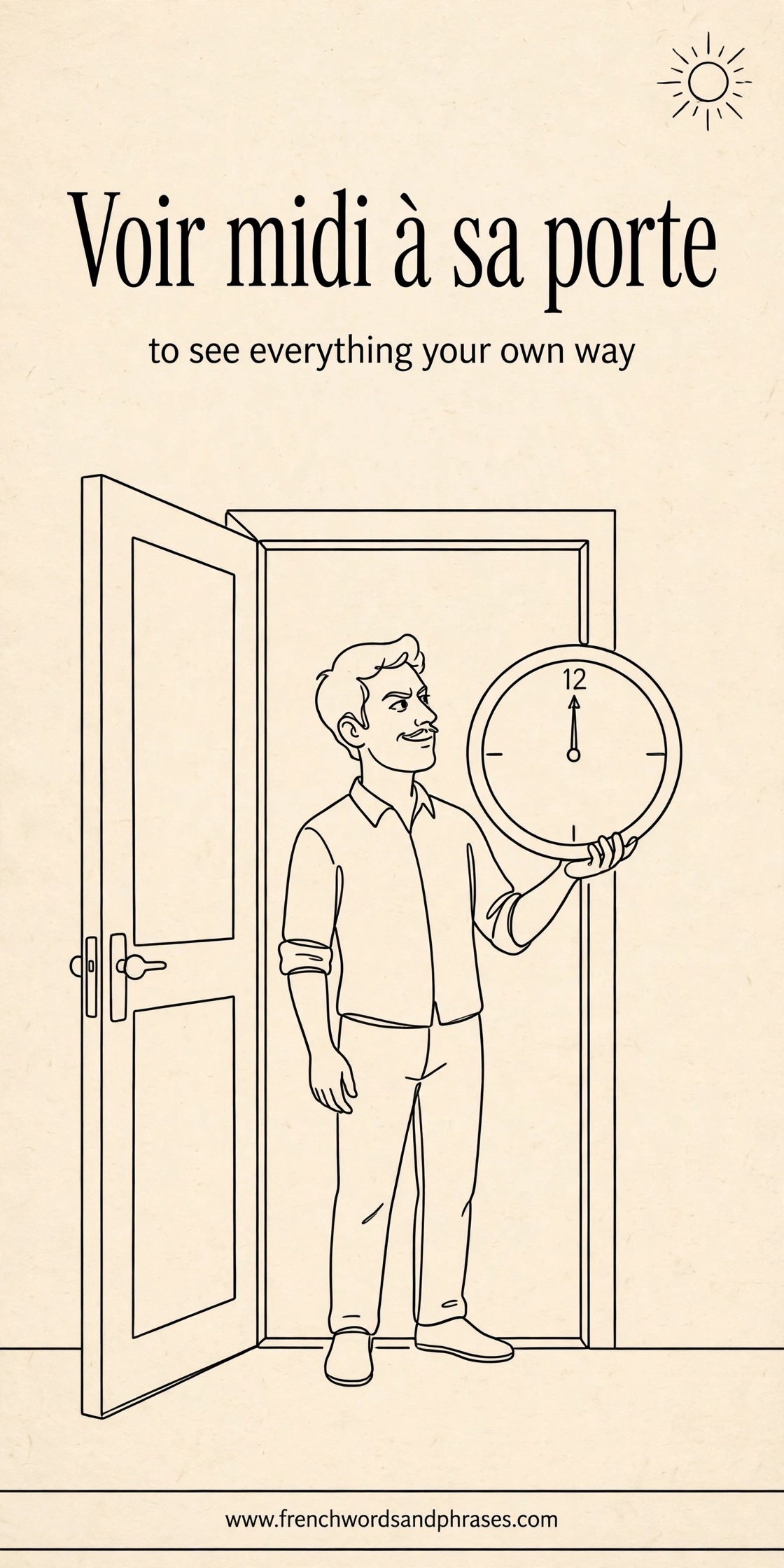
A French Word to Live By
Translate Voir midi à sa porte to English
/vwaʁ mi.di a sa pɔʁt/
Voir midi à sa porte means to see everything from your own point of view — to judge the world by your own doorstep.
The village meeting has run for two hours. The road, the school, the new car park — every question is settled the same way by old Monsieur Fabre: by what it means for his house, his lane, his view. His neighbour leans over and whispers the old verdict: « Il voit midi à sa porte. »
Let’s explore how voir midi à sa porte works in French, beginning with the whole phrase on one card.
Understanding the French Phrase Voir midi à sa porte
Voir midi à sa porte is a French idiomatic expression built from voir (to see), midi (noon, midday) and à sa porte (at one’s door). At noon the sun stands at its highest — and every villager sees it from his own doorstep. The phrase turns that simple fact into a judgement: each of us sees the world from where we happen to stand.
It means to judge everything from your own point of view — to measure every question by your own situation, your own interests, your own street. Nobody is looking at a clock: midi is the moment the sun is highest, and sa porte is the spot you watch it from. The reproach is gentle but clear: the world is bigger than your doorstep, and the person who voit midi à sa porte never quite looks past it.
Type: Idiomatic expression — point of view (voir + noun phrase)
Answers the need: Saying someone judges everything by their own situation and interests
Register: Neutral, slightly traditional — at home in conversation and in print
Strength: A gentle reproach — self-centred, short-sighted, never stupid
One important usage detail: the door belongs to whoever is doing the seeing, so the possessive moves with the person — je vois midi à ma porte, tu vois midi à ta porte, ils voient midi à leur porte. The phrase is almost always a comment about someone else, delivered with a smile or a sigh, rather than a confession about yourself.
Experience the Word
Voir midi à sa porte is the philosophy of the doorstep — the whole sky, judged from one door.
Imagine the sun at noon over a village of a hundred houses. It is the same sun, the same hour, for everyone — yet each door frames it differently, between different roofs, over different hills. The phrase is built on that quiet truth: your noon is real, but it is not the only noon there is.
French chose a beautiful picture for a very human fault. We all stand somewhere; the fault is forgetting that we do.
How to Use Voir midi à sa porte in French: Complete Guide
Let’s explore how voir midi à sa porte works in French, beginning with the whole phrase on one card.
Voir midi à sa porte at a Glance
The Whole Phrase on One Card
Real meaning, literal picture, English twin and register — voir midi à sa porte in five lines.
| Point | Voir midi à sa porte |
|---|---|
| What it really means | to judge everything from your own point of view and interests |
| Word for word | to see noon at one’s door — the sun at its height, watched from your own doorstep |
| English equivalent | to see everything your own way / to judge everything by your own yardstick |
| Register | neutral, a little traditional — a knowing comment, not an insult |
| Use it for | the neighbour, colleague or politician who measures every question by his own street |
Example
Ne lui demande pas son avis sur le projet : il voit midi à sa porte.
Don’t ask him what he thinks of the project: he sees everything from his own doorstep.
Word by Word: Building the Doorstep
Four small pieces — take them one by one and the whole village appears.
| Word | Literal meaning | Its job in the phrase |
|---|---|---|
| voir | to see | the verb of viewpoint — how the world looks to you |
| midi | noon, midday | the sun at its highest — the same hour for the whole village |
| à | at | the little word that plants the sun in one exact spot |
| sa porte | his/her door | the doorstep you stand on — your house, your street, your interests |
Example
Chacun voit midi à sa porte, c’est humain.
Everyone sees noon at his own door — it’s only human.
Why midi — why does the phrase use noon?
Reveal the answer
Because at noon the sun is at its highest and everyone sees it at once — yet each person sees it from his own door. The shared hour, the private viewpoint.
À midi, tout le village voit le même soleil, mais chacun à sa porte.
At noon, the whole village sees the same sun, but each at his own door.
When You Say It: The Doorstep Moments
Voir midi à sa porte fires at moments like these — a decision is being judged, and someone’s own street is doing the judging.
| Situation | Example |
|---|---|
| At a village meeting | il ne pense qu’à sa rue : il voit midi à sa porte — he only thinks of his own street: he sees noon at his door |
| About a colleague | elle juge le budget à sa porte — she judges the budget from her own doorstep |
| About politics | chaque région voit midi à sa porte — every region sees noon at its own door |
| As a gentle warning | attention, tu vois midi à ta porte — careful, you’re seeing noon at your own door |
| As a shrug of wisdom | chacun voit midi à sa porte — everyone sees noon at his own door |
Example
Les élus voient midi à leur porte, et le village attend toujours sa route.
The councillors see noon at their own door, and the village is still waiting for its road.
Make It Yours: A Door for Every Person
The possessive moves with the viewer — ma porte, ta porte, leur porte.
| Form | French | In English |
|---|---|---|
| About him/her | il voit midi à sa porte | he sees everything his own way |
| About them | ils voient midi à leur porte | they judge everything by their own interests |
| To someone’s face | tu vois midi à ta porte | you’re seeing noon at your own door |
| Including yourself | nous voyons tous midi à notre porte | we all see noon at our own door |
| The proverb form | chacun voit midi à sa porte | everyone sees things from his own doorstep |
| Past verdict | il a toujours vu midi à sa porte | he always saw everything his own way |
Example
Nous voyons tous midi à notre porte, il faut juste le savoir.
We all see noon at our own door — you just have to know it.
You are talking about a group of councillors. Is it à sa porte or à leur porte?
Reveal the answer
À leur porte — the door belongs to the viewers, so the possessive follows them: ils voient midi à leur porte.
Ces élus voient midi à leur porte.
These councillors see everything their own way.
Everyday Expressions: Building on the Doorstep
Voir midi à sa porte slots into these everyday frames — each one ready to use as it stands.
| Frame | In English |
|---|---|
| chacun voit midi à sa porte | everyone sees things from his own doorstep |
| voir midi à sa porte | to judge everything by your own situation |
| il ne voit pas plus loin que sa porte | he can’t see beyond his own doorstep — a plainer cousin |
| ramener tout à sa porte | to bring everything back to your own door — to make it all about you |
| élargir son horizon | to widen your horizon — the opposite move |
Example
Avant de juger, essaie d’élargir ton horizon : tu vois midi à ta porte.
Before judging, try to widen your horizon: you’re seeing noon at your own door.
Close Cousins: The Other Narrow Views
French has a whole shelf of viewpoint phrases — midi à sa porte is the doorstep one; its cousins narrow the eyes in other ways.
| Expression | The difference |
|---|---|
| voir midi à sa porte | to judge everything from your own point of view — the doorstep picture |
| avoir des œillères | to wear blinkers — to refuse to look sideways at all |
| ne voir que son intérêt | to see only your own interest — the plain, direct version |
| avoir l’esprit de clocher | parish-pump spirit — village-level thinking, nothing beyond the church tower |
| prendre du recul | to step back and gain perspective — the cure, not the fault |
Example
Avec ses œillères, il voit midi à sa porte et rien d’autre.
With his blinkers on, he sees noon at his own door and nothing else.
Which cousin pictures a horse that cannot look sideways — œillères or clocher?
Reveal the answer
Œillères — blinkers: the horse sees only what is straight ahead. L’esprit de clocher is the village version: nothing exists beyond the church tower.
Enlève tes œillères et regarde autour de toi.
Take off your blinkers and look around you.
Voir midi à sa porte and Its Neighbours
The viewpoint shelf around the phrase — doors, suns and horizons.
| French | In English |
|---|---|
| le pas de la porte | the doorstep |
| le soleil de midi | the midday sun |
| un point de vue | a point of view |
| l’esprit de clocher | parish-pump thinking |
| prendre du recul | to step back, gain perspective |
| voir plus loin que le bout de son nez | to see further than the end of your nose — the opposite fault cured |
Example
Qui voit plus loin que le bout de son nez ne voit pas midi qu’à sa porte.
Whoever sees further than the end of his nose does not see noon only at his own door.
Watch Out: The Traps Around Voir midi à sa porte
The traps: a clock that is not a clock, a possessive that must move, and a reproach that is gentler than it sounds.
| Trap | The truth |
|---|---|
| midi is not an appointment | the phrase is not about meeting at noon — midi is the sun at its height, a picture of viewpoint |
| the possessive must follow the viewer | ils voient midi à leur porte, not à sa porte — the door belongs to whoever is seeing |
| it is a sigh, not an attack | the phrase comments with a smile or a shrug; for a real accusation of selfishness, French says ne penser qu’à soi |
| door, not gate | sa porte is his door — the doorstep of his house, the smallest unit of ‘where I stand’ |
Example
Il voit midi à sa porte, ce n’est pas un égoïste, juste un voisin.
He sees noon at his own door — he’s not selfish, just a neighbour.
True or false: voir midi à sa porte means to have a lunch appointment at home.
Reveal the answer
False — midi is the midday sun and la porte is your doorstep: the phrase means judging everything from your own point of view.
Ce n’est pas l’heure qui compte, c’est la porte d’où l’on regarde.
It is not the hour that matters, it is the door you look from.
Voir midi à sa porte in Everyday French: Real-Life Examples
Now that you know the word, let’s see how voir midi à sa porte appears in everyday French.
Example 1 — At the village meeting
Il voit midi à sa porte et refuse la route pour les autres.
He sees noon at his own door and refuses the road for everyone else.
Example 2 — About a colleague
Elle voit midi à sa porte : seul son service compte.
She sees noon at her own door: only her department matters.
Example 3 — A wise shrug
Chacun voit midi à sa porte, ne t’énerve pas.
Everyone sees noon at his own door — don’t get worked up.
Example 4 — A gentle warning
Attention, tu vois midi à ta porte sur cette question.
Careful, you’re seeing noon at your own door on this question.
Example 5 — In politics
Chaque région voit midi à sa porte quand l’argent arrive.
Every region sees noon at its own door when the money arrives.
Example 6 — About oneself
Je vois midi à ma porte, comme tout le monde, j’essaie de le savoir.
I see noon at my own door, like everyone — I just try to know it.
Beyond Translation: The Meaning of Voir midi à sa porte
English judges by yardsticks and thinks outside boxes — measures and containers. French simply steps out of the house at noon and looks up. The sun is one, the doors are many, and every verdict ever given was delivered from a doorstep.
To voir midi à sa porte is to mistake your doorway for the whole sky.
The phrase forgives as it accuses: it admits the sun really is there, above your door. It only asks you to remember the other doors.
How to Remember the French Phrase Voir midi à sa porte
Remember it this way: Voir midi à sa porte is the noon sun over a village — the same sun for everyone, seen from a hundred different doors.
- You picture the doorstep — midi is the sun at its highest, and sa porte is the one spot you watch it from.
- You move the door with the person — à ma porte, à ta porte, à leur porte: the possessive follows the viewer.
- You keep the tone gentle — it is a knowing sigh about human nature, not an accusation of selfishness.
The key idea is voir midi à sa porte means to judge everything from your own point of view — noon seen from your own doorstep.
Test Your Knowledge of Voir midi à sa porte
Let’s see how much you’ve learned. Try answering these questions before revealing the answers.
Question 1
What does voir midi à sa porte mean?
Reveal the answer
To judge everything from your own point of view — to measure every question by your own situation and interests.
Question 2
What is the literal, word-for-word meaning?
Reveal the answer
To see noon at one’s door — midi is midday, when the sun is highest, and the door is the doorstep you stand on.
Question 3
How do you say ‘they see everything their own way’ with this phrase?
Reveal the answer
Ils voient midi à leur porte — the possessive follows the viewers: leur porte, their door.
Question 4
How strong is the reproach in this phrase?
Reveal the answer
Gentle — a smile or a sigh about a short-sighted viewpoint, not an accusation of selfishness.
Question 5
Complete the sentence:
Chacun voit ______ à sa porte. (Everyone sees noon at his own door.)
Reveal the answer
midi
Chacun voit midi à sa porte.
Everyone sees noon at his own door.
Can You Use It?
How would you say this in French?
“Everyone sees things from his own doorstep.”
Reveal the answer
Chacun voit midi à sa porte.
Everyone sees things from his own doorstep.
A little French. A little curiosity. A richer everyday life.
LEARN FRENCH ONE WORD AT A TIME