A French Word to Live By
Translate Toucher du bois to English
/tu.ʃe dy bwa/
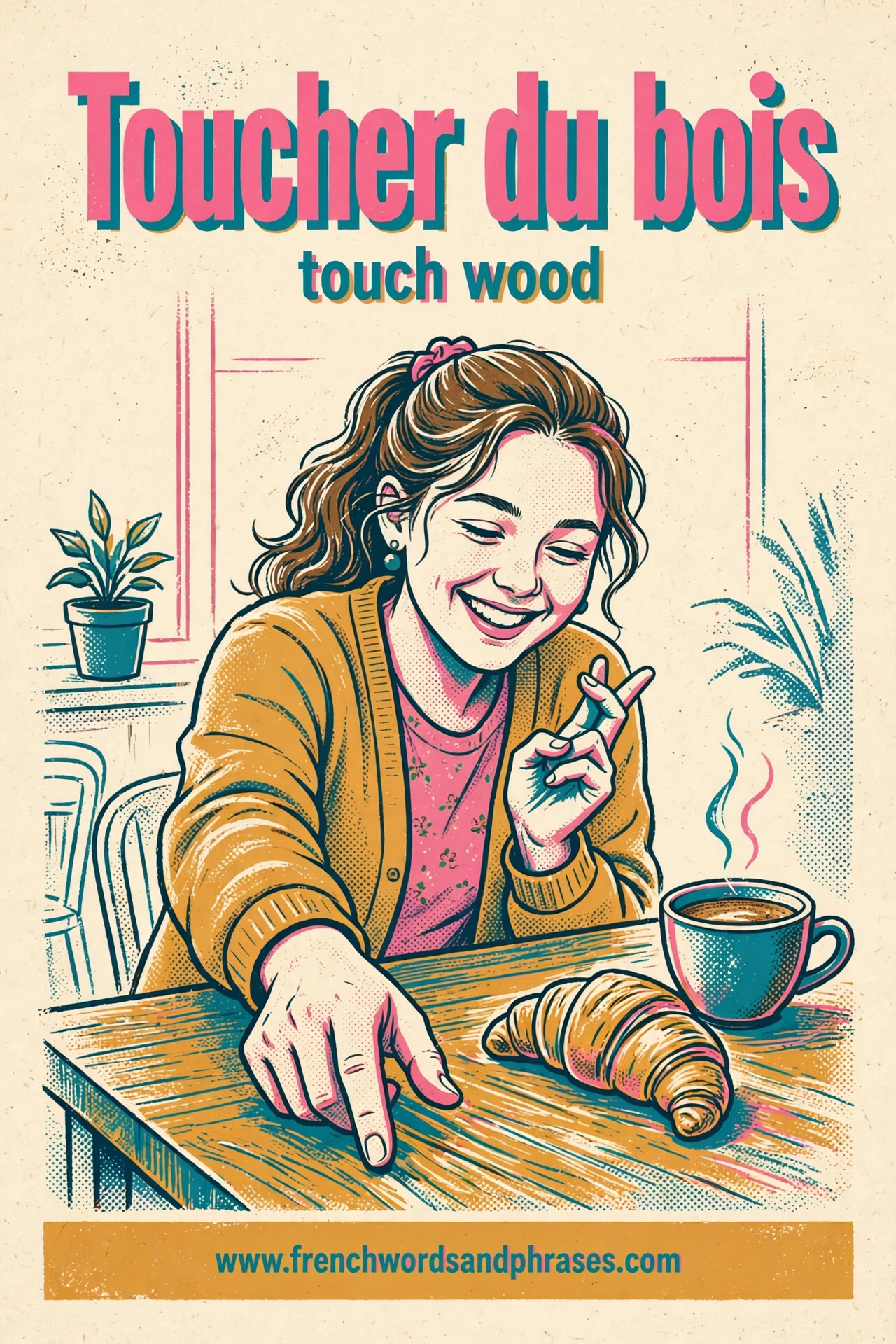
Toucher du bois means touch wood — the little ritual phrase for warding off bad luck.
« Mon fils n’a pas été malade de tout l’hiver — je touche du bois ! » and down goes the hand, flat on the wooden table, as if the sentence itself were dangerous until it has been nailed to something solid. You have just watched one of the oldest gestures in Europe, and French has kept its instruction manual as a phrase.
Let’s explore how toucher du bois works in French, beginning with the whole phrase on one card.
Understanding the French Phrase Toucher du bois
Toucher du bois is a French idiomatic expression built from toucher (to touch) and du bois (some wood). It is both an action and a formula: you say it while touching something wooden, to protect a piece of good luck you have just mentioned out loud — because saying it, everyone quietly agrees, is exactly how you lose it.
It means ‘touch wood’ (British) or ‘knock on wood’ (American): the words you add after tempting fate — after saying that things are going well, that you have never been ill, that the car has never broken down. The superstition is ancient, probably older than France itself: wood was once believed to house protective spirits, and a hand on a tree — later, on a table — asked them politely to keep the luck going.
Type: Idiomatic expression — luck ritual (verb + material)
Answers the need: Protecting good luck you have just dared to mention
Register: Everyday, warm — everyone says it, at every age
Gesture: A flat hand on wood — table, door, desk; a head-scratch jokingly counts if no wood is near
One important usage detail: the phrase is most often conjugated in the first person, as a live performance — « Je touche du bois ! » — said while doing it. It also appears as a wish for others: « Touchons du bois pour demain. » English speakers knock; the French simply touch, palm down, no knocking required. When no wood is available, joking French speakers touch their own head — implying, with a smile, that it is made of the same material.
Experience the Word
Toucher du bois is the verb of the almost-jinx — the sentence you catch in mid-air, before fate hears it and takes notes.
Imagine a grandmother at a kitchen table in Provence. Her grandson has passed his exams, the roof does not leak, the cat is twenty years old and still stealing ham. She says none of this carelessly. Each piece of news lands on the table with a small flat hand beside it — toc, toc — je touche du bois — as if good fortune were a bird that startles easily.
She does not really believe the table is magic. She believes in not boasting in front of the universe — and the hand on the wood is how politeness to fate looks.
How to Use Toucher du bois in French: Complete Guide
Let’s explore how toucher du bois works in French, beginning with the whole phrase on one card.
Toucher du bois at a Glance
The Whole Phrase on One Card
Real meaning, literal picture, English twin and register — toucher du bois in five lines.
| Point | Toucher du bois |
|---|---|
| What it really means | touch wood — said to keep good luck safe after mentioning it |
| Word for word | to touch some wood |
| English equivalent | touch wood (UK) / knock on wood (US) |
| Register | everyday and universal — no one is too grand for it |
| Use it for | good health, good weather, unbroken cars, passed exams |
Example
Je n’ai jamais eu d’accident — je touche du bois !
I’ve never had an accident — touch wood!
Word by Word: Building the Ritual
A touch and a material — the smallest spell in the French language.
| Word | Literal meaning | Its job in the phrase |
|---|---|---|
| toucher | to touch | the gesture itself — hand flat on the wood |
| du | some (partitive) | any wood will do — the phrase never specifies which |
| bois | wood | the protective material — tables, doors, trees |
| je touche du bois | I touch wood | the living form — said while doing it |
Example
Touche du bois avant de dire que tout va bien !
Touch wood before you say everything is fine!
Quick Quiz 1
When do French speakers say je touche du bois?
Reveal the answer
Right after mentioning good luck out loud — to stop the boast from tempting fate.
Elle n’a pas plu un seul jour pendant nos vacances — je touche du bois !
It didn’t rain a single day of our holiday — touch wood!
When You Say It: The Lucky Moments
The phrase belongs to one precise second — just after the risky sentence.
| Situation | Example |
|---|---|
| Health holding up | À quatre-vingt-dix ans, elle jardine encore — touchons du bois. |
| A lucky streak | Le train n’a jamais de retard le vendredi… je touche du bois. |
| A plan going well | Pour l’instant, le mariage s’organise sans drame. Je touche du bois. |
| Protecting someone else | Que ton entretien se passe bien — je touche du bois pour toi. |
Example
Depuis que nous avons cette voiture, zéro panne. Je touche du bois.
Since we’ve had this car, zero breakdowns. Touch wood.
Make It Yours: The Touch for Every Person
Toucher is a regular -er verb — the ritual in its working forms.
| Form | French | In English |
|---|---|---|
| Live formula | je touche du bois ! | touch wood! (said while touching) |
| Shared wish | touchons du bois | let’s touch wood |
| Imperative | touche du bois ! | touch wood! |
| Reported | elle a touché du bois | she touched wood |
| Joking substitute | je touche ma tête, c’est du bois aussi | I’ll touch my head, it’s wood too |
Example
Touchons du bois : demain, il fera beau pour la fête.
Let’s touch wood: tomorrow will be fine for the party.
Quick Quiz 2
Do the French knock on the wood, like Americans?
Reveal the answer
No — they simply touch it, palm flat. The knocking is the American version; the French gesture is a quiet hand on the table.
Pas besoin de frapper : en France, on touche du bois, on ne cogne pas dessus.
No need to knock: in France, you touch wood, you don’t bang on it.
Everyday Expressions: Building on the Luck
Frames from the same family of fate-management.
| Frame | In English |
|---|---|
| je touche du bois | touch wood (the live formula) |
| croiser les doigts | to cross your fingers — for a hoped-for result |
| porter bonheur | to bring luck |
| un porte-bonheur | a lucky charm |
| ne tente pas le diable | don’t tempt fate (literally: don’t tempt the devil) |
Example
Je croise les doigts pour ton examen de demain.
I’m crossing my fingers for your exam tomorrow.
Close Cousins: The Other Luck Rituals
Neighbours in the same trade — keeping fate polite.
| Expression | The difference |
|---|---|
| croiser les doigts | fingers crossed — before a result you hope for, not after luck mentioned |
| toucher du bois | after the boast — protecting luck already in hand |
| avoir de la chance | to be lucky — the state, with no ritual attached |
| conjurer le sort | to ward off fate — the formal, almost magical version |
Example
Elle a eu de la chance ; elle le sait, et elle touche du bois.
She has been lucky; she knows it, and she touches wood.
Quick Quiz 3
What do joking French speakers touch when there is no wood nearby?
Reveal the answer
Their own head — with the implication that it is made of wood too.
Pas de bois dans la voiture ? Il s’est touché la tête en riant.
No wood in the car? He touched his head, laughing.
Toucher du bois and Its Neighbours
The phrase in the wild, beside its luck-family relations.
| French | In English |
|---|---|
| Je touche du bois, mais le toit ne fuit plus. | Touch wood, but the roof doesn’t leak any more. |
| Croise les doigts pour moi demain matin. | Cross your fingers for me tomorrow morning. |
| Ce bracelet, c’est mon porte-bonheur. | This bracelet is my lucky charm. |
| Ne tente pas le diable : ferme la maison à clé. | Don’t tempt fate: lock the house. |
Example
Pourvu que ça dure — je touche du bois.
Long may it last — touch wood.
Watch Out: The Traps Around Toucher du bois
The ritual is simple; the traps are in the translation.
| Trap | The truth |
|---|---|
| Translating ‘knock on wood’ with frapper | French touches, it does not knock — toucher du bois, never *frapper du bois |
| Dropping the du | it is toucher DU bois (some wood, any wood) — the partitive is part of the phrase |
| Using it before an exam result | before a hoped-for result, croiser les doigts fits better; toucher du bois protects luck already mentioned |
| Saying it without any luck at stake | the phrase needs a boast or a blessing to protect — it is a reaction, not a greeting |
Example
On dit « je touche du bois », pas « je frappe du bois ».
You say ‘je touche du bois’, not ‘je frappe du bois’.
Quick Quiz 4
Complete the ritual sentence: « Mon train n’a jamais de retard, je ______ du bois ! »
Reveal the answer
Touche — je touche du bois, said with a hand on the nearest table.
Mon train n’a jamais de retard, je touche du bois !
My train is never late, touch wood!
Toucher du bois in Everyday French: Real-Life Examples
Now that you know the word, let’s see how toucher du bois appears in everyday French.
Example 1 — At the table
Ma fille n’a pas eu un seul rhume cet hiver — je touche du bois !
My daughter hasn’t had a single cold this winter — touch wood!
Example 2 — At work
L’ordinateur n’a pas planté depuis un mois. Touche du bois, vite.
The computer hasn’t crashed for a month. Touch wood, quick.
Example 3 — Before a trip
Pourvu qu’il fasse beau samedi — je touche du bois.
Let’s hope the weather is fine on Saturday — touch wood.
Example 4 — About a car
Deux cent mille kilomètres et jamais une panne. Elle touche du bois à chaque fois qu’elle le dit.
Two hundred thousand kilometres and never a breakdown. She touches wood every time she says it.
Example 5 — In the garden
Les tomates n’ont pas eu de maladie cette année, touchons du bois.
The tomatoes haven’t had any disease this year, let’s touch wood.
Example 6 — With humour
Pas de bois dans cette voiture moderne… alors il s’est touché la tête : « Ça fera l’affaire ! »
No wood in this modern car… so he touched his head: ‘That’ll do!’
Beyond Translation: The Meaning of Toucher du bois
English knocks, America raps its knuckles like a door that luck might open. France lays a flat hand down, quietly, the way you would calm a horse — no noise, no demand, just contact.
To toucher du bois is to apologise to fate for a happy sentence — a palm pressed to the nearest tree-descendant, asking that the luck be allowed to stay.
That is why the gesture survived cars, offices and plastic dashboards: wherever a French speaker says life is good, a hand starts looking for wood.
How to Remember the French Phrase Toucher du bois
Remember it this way: Toucher du bois is the flat hand on the kitchen table — the small apology you make to fate after saying life is good.
- You picture the hand, not a knock — palm flat on wood, the French way.
- You keep the du — toucher DU bois, some wood, any wood: a table, a door, a tree.
- You say it after the boast — luck mentioned out loud is luck that needs protecting.
The key idea is toucher du bois means touch wood — protecting good luck the moment you mention it.
Test Your Knowledge of Toucher du bois
Let’s see how much you’ve learned. Try answering these questions before revealing the answers.
Question 1
What does toucher du bois mean?
Reveal the answer
Touch wood — the ritual phrase for warding off bad luck after mentioning good fortune.
Question 2
When is the phrase said?
Reveal the answer
Right after mentioning good luck out loud — health, weather, a reliable car — to stop the boast tempting fate.
Question 3
How do you say ‘Let’s touch wood’ in French?
Reveal the answer
Touchons du bois.
Question 4
What is the difference between toucher du bois and croiser les doigts?
Reveal the answer
Toucher du bois protects luck already mentioned; croiser les doigts hopes for a result still to come.
Question 5
Why is it toucher DU bois and not toucher le bois?
Reveal the answer
Because any wood will do — du is the partitive ‘some’: the ritual never names a particular piece of wood.
Your Final Challenge
Can You Use It?
How would you say this in French?
“My grandfather is ninety and still gardens every day — touch wood.”
Reveal the answer
Mon grand-père a quatre-vingt-dix ans et jardine encore tous les jours — je touche du bois.
My grandfather is ninety and still gardens every day — touch wood.
A little French. A little curiosity. A richer everyday life.
LEARN FRENCH ONE WORD AT A TIME