A French Word to Live By
Translate Tomber de Charybde en Scylla to English
/tɔ̃.be də ka.ʁibd ɑ̃ si.la/
Tomber de Charybde en Scylla means out of the frying pan into the fire — escaping one danger only to land in a worse one.
You quit the job with the shouting boss — and start Monday at a company where the boss shouts, the coffee is worse, and the shouting boss’s brother runs your team. The Greeks had a strait for this, between a whirlpool and a monster, and French kept their names for the moment a rescue turns out to be a trap.
Let’s explore how tomber de Charybde en Scylla works in French, beginning with the whole phrase on one card.
Understanding the French Phrase Tomber de Charybde en Scylla
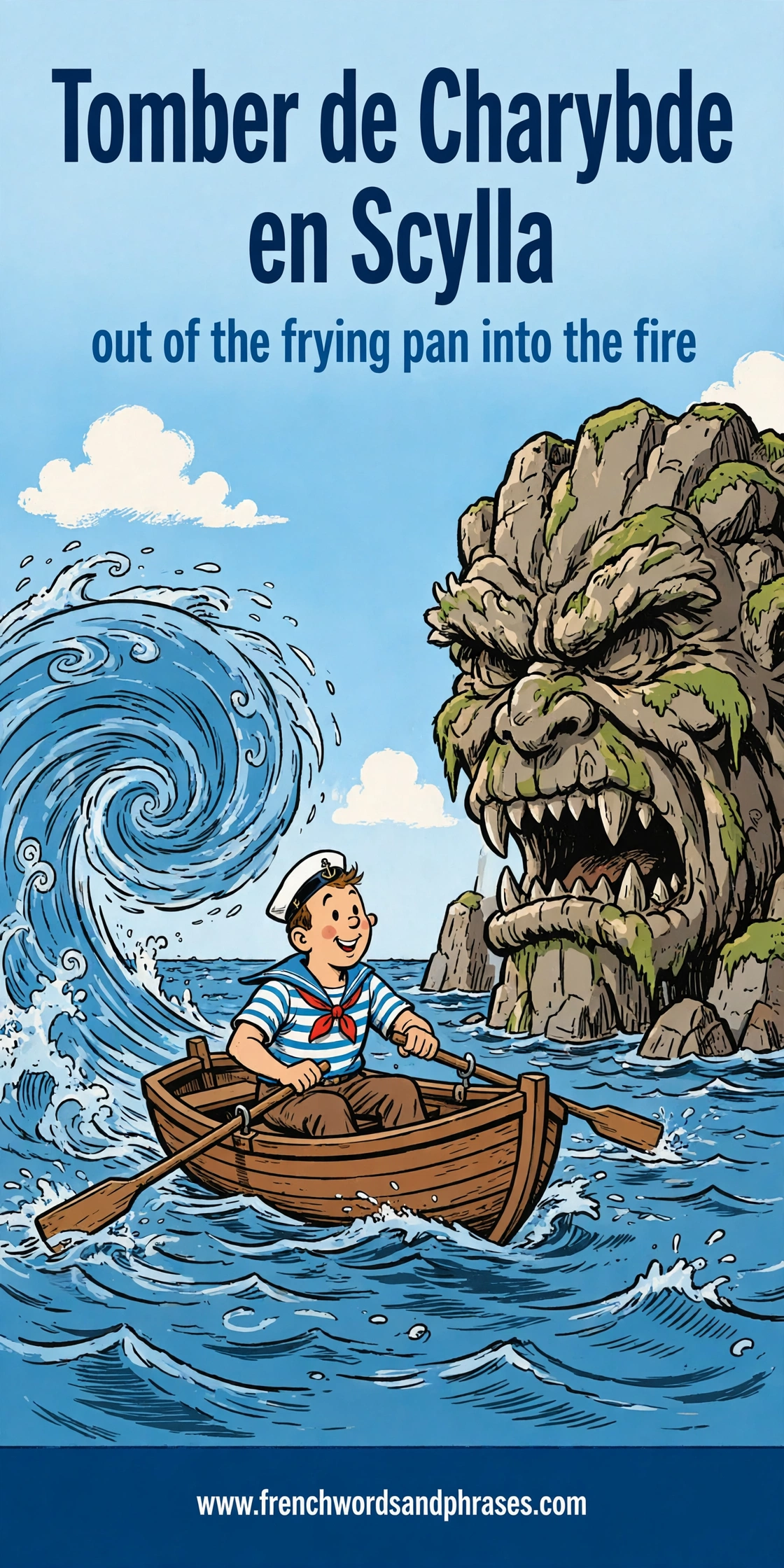
Tomber de Charybde en Scylla is a learned French idiomatic expression built from tomber (to fall) and two monsters of Greek myth: Charybde (Charybdis), a whirlpool that swallowed ships, and Scylla, a six-headed monster on the rocks opposite. In Homer’s Odyssey they guard the two sides of one narrow strait — sail away from one, and you sail straight into the other.
It means to go from bad to worse — to escape one danger, problem or unpleasant situation only by falling into another that is just as bad or worse. It is the exact French twin of ‘out of the frying pan into the fire’, but dressed in classical robes: the phrase belongs to educated, slightly literary French, and using it always carries a small, knowing smile — the speaker is showing off the classics while complaining about life.
Type: Idiomatic expression — misfortune (mythological)
Answers the need: Saying an escape or a change made things worse, not better
Register: Literary, learned — often playful or ironic in speech
English twin: Out of the frying pan into the fire
One important usage detail: the names are proper nouns and keep their capitals — Charybde, Scylla. The phrase is usually a comment on a whole situation rather than a command or a question: « En changeant de fournisseur, ils sont tombés de Charybde en Scylla. » For everyday speech, French more often says aller de mal en pis (to go from bad to worse); Charybde en Scylla is the version for essays, editorials and dinner parties.
Experience the Word
Tomber de Charybde en Scylla is the verb of the bad swap — the new flat with the leaking ceiling traded for the flat with the drumming neighbour, the shortcut that ends at a closed road.
Imagine Odysseus at the helm, three thousand years ago, staring at the strait. On the left, a whirlpool big enough to drink his ship. On the right, a monster with six heads, each one hungry. There is no third option and no going back: the sea itself has arranged for every escape to be an arrival somewhere worse.
He chose the monster, lost six men, and sailed on. Every French speaker who quotes him is doing the same arithmetic — which disaster is smaller, and can I live with the price?
How to Use Tomber de Charybde en Scylla in French: Complete Guide
Let’s explore how tomber de Charybde en Scylla works in French, beginning with the whole phrase on one card.
Tomber de Charybde en Scylla at a Glance
The Whole Phrase on One Card
Real meaning, literal picture, English twin and register — tomber de Charybde en Scylla in five lines.
| Point | Tomber de Charybde en Scylla |
|---|---|
| What it really means | to go from bad to worse — escaping one danger into a bigger one |
| Word for word | to fall from Charybdis into Scylla |
| English equivalent | out of the frying pan into the fire |
| Register | literary, learned — playful in speech |
| Use it for | bad swaps, failed rescues, reforms that backfire |
Example
En fuyant la pluie, ils sont tombés de Charybde en Scylla : la grêle les attendait.
Fleeing the rain, they went from bad to worse: hail was waiting for them.
Word by Word: Building the Strait
A fall, a whirlpool and a monster — the three pieces of the trap.
| Word | Literal meaning | Its job in the phrase |
|---|---|---|
| tomber | to fall | the movement — you do not choose the second danger, you land in it |
| Charybde | Charybdis, the whirlpool | the first danger, on one side of the strait |
| en | into | the crossing — straight from one peril to the other |
| Scylla | the six-headed monster | the second danger, waiting on the opposite rocks |
Example
Le navire évite Charybde et tombe sur Scylla.
The ship avoids Charybdis and falls upon Scylla.
Quick Quiz 1
Who were Charybde and Scylla?
Reveal the answer
Two monsters of Greek myth — a ship-swallowing whirlpool and a six-headed monster, facing each other across a narrow strait in Homer’s Odyssey.
Ulysse devait passer entre Charybde et Scylla.
Odysseus had to sail between Charybdis and Scylla.
When You Say It: The Bad-Swap Moments
The phrase comments on a whole situation — here are the moments it was built for.
| Situation | Example |
|---|---|
| A job change backfires | Il a quitté un patron tyrannique pour un pire : de Charybde en Scylla. |
| A repair makes it worse | Le plombier a réparé la fuite et inondé la cuisine — de Charybde en Scylla. |
| A policy backfires | La nouvelle loi devait simplifier les impôts ; elle les a compliqués. Charybde, Scylla. |
| An escape fails | Ils ont fui la ville pour la campagne… et les embouteillages les ont suivis. |
Example
En changeant d’appartement, nous sommes tombés de Charybde en Scylla.
By moving flats, we went out of the frying pan into the fire.
Make It Yours: The Fall for Every Tense
Tomber conjugates with être in compound tenses — the phrase in its working forms.
| Form | French | In English |
|---|---|---|
| Present (commentary) | on tombe de Charybde en Scylla | you go from bad to worse |
| Past | ils sont tombés de Charybde en Scylla | they went from bad to worse |
| Future warning | tu vas tomber de Charybde en Scylla | you’ll jump out of the frying pan into the fire |
| Short form | de Charybde en Scylla | from bad to worse (as a sigh, on its own) |
Example
Attention : en démissionnant maintenant, tu risques de tomber de Charybde en Scylla.
Careful: by resigning now, you risk jumping out of the frying pan into the fire.
Quick Quiz 2
What is the everyday, non-literary way to say ‘from bad to worse’ in French?
Reveal the answer
De mal en pis — aller de mal en pis is the plain version; Charybde en Scylla is its classical costume.
Depuis janvier, la situation va de mal en pis.
Since January, the situation has been going from bad to worse.
Everyday Expressions: Building on the Fall
Frames that grow from the same idea — trouble traded for trouble.
| Frame | In English |
|---|---|
| tomber de Charybde en Scylla | to go out of the frying pan into the fire |
| aller de mal en pis | to go from bad to worse |
| éviter un mal pour un pire | to avoid one evil by choosing a worse one |
| entre deux maux, choisir le moindre | to choose the lesser of two evils |
Example
Entre deux maux, il faut choisir le moindre.
Between two evils, you must choose the lesser.
Close Cousins: The Other Ways Downhill
Neighbours that share the slope but not the mythology.
| Expression | The difference |
|---|---|
| aller de mal en pis | the plain everyday version — no monsters required |
| tomber de haut | to fall from a height — a rude awakening, not a swap of dangers |
| sauter de la poêle dans le feu | a word-for-word borrowing of the English image — understood, rarely used |
| être entre le marteau et l’enclume | between the hammer and the anvil — squeezed from both sides at once |
Example
Il croyait avoir tout compris ; il est tombé de haut.
He thought he had understood everything; he had a rude awakening.
Quick Quiz 3
True or false: Charybde and Scylla are common French first names.
Reveal the answer
False — they are mythological monsters, and the capitals stay on: Charybde, Scylla.
Personne ne s’appelle Charybde, sauf dans les mythes.
Nobody is named Charybdis, except in myths.
Tomber de Charybde en Scylla and Its Neighbours
The phrase in the wild, beside the expressions it travels with.
| French | In English |
|---|---|
| Fuir la réunion pour tomber sur le directeur : de Charybde en Scylla. | To flee the meeting only to run into the director: out of the frying pan into the fire. |
| La situation va de mal en pis depuis mars. | The situation has gone from bad to worse since March. |
| Entre le marteau et l’enclume, il a choisi de se taire. | Between the hammer and the anvil, he chose to stay silent. |
| Mieux vaut un petit mal qu’un voyage chez Scylla. | Better a small trouble than a trip to Scylla’s rocks. |
Example
Elle a vendu sa voiture en panne… et acheté un vélo sous la pluie. De Charybde en Scylla.
She sold her broken-down car… and bought a bicycle, in the rain. Out of the frying pan into the fire.
Watch Out: The Traps Around Tomber de Charybde en Scylla
Classical phrases carry classical traps — spelling, register and capitals.
| Trap | The truth |
|---|---|
| Dropping the capitals | Charybde and Scylla are proper names — always capitalised |
| Misspelling Charybde | it is Charybde (from Greek Charybdis), not *Charibde |
| Using it for any small annoyance | the phrase needs a real swap of dangers — escaping one thing into something worse |
| Using it in casual slang contexts | it is learned and literary; among friends, de mal en pis sounds more natural |
Example
Un café froid n’est pas Scylla ; un café froid après un incendie, peut-être.
A cold coffee is not Scylla; a cold coffee after a fire, perhaps.
Quick Quiz 4
Complete the phrase: tomber de ______ en ______.
Reveal the answer
Charybde, Scylla — from the whirlpool to the monster.
En fuyant son ancien travail, il est tombé de Charybde en Scylla.
By fleeing his old job, he jumped out of the frying pan into the fire.
Tomber de Charybde en Scylla in Everyday French: Real-Life Examples
Now that you know the word, let’s see how tomber de Charybde en Scylla appears in everyday French.
Example 1 — At work
Il a changé de service pour échapper aux réunions… et son nouveau service en fait deux fois plus. De Charybde en Scylla.
He changed departments to escape the meetings… and his new department holds twice as many. Out of the frying pan into the fire.
Example 2 — At home
Nous avons fui l’appartement bruyant ; le nouveau est au-dessus d’un bar. Tomber de Charybde en Scylla, version immobilier.
We fled the noisy flat; the new one is above a bar. Out of the frying pan into the fire, property edition.
Example 3 — In politics
Le journal titre : « La réforme des retraites, ou comment tomber de Charybde en Scylla. »
The newspaper headlines: ‘The pension reform, or how to go from bad to worse.’
Example 4 — On holiday
Pour éviter la pluie en Bretagne, ils sont partis en Écosse. De Charybde en Scylla.
To avoid the rain in Brittany, they went to Scotland. Out of the frying pan into the fire.
Example 5 — With technology
J’ai changé de téléphone pour une meilleure batterie ; le nouveau n’a plus de réseau. Charybde, Scylla, et zéro barre.
I changed phones for a better battery; the new one has no signal. Charybdis, Scylla, and zero bars.
Example 6 — In the kitchen
Le four était en panne, alors elle a tout mis au micro-ondes : de Charybde en Scylla, le dîner était perdu.
The oven was broken, so she put everything in the microwave: out of the frying pan into the fire, dinner was lost.
Beyond Translation: The Meaning of Tomber de Charybde en Scylla
English jumps out of a frying pan — kitchen equipment, a cook’s disaster, over in a second. French sails a strait in the Odyssey — three thousand years old, with a hero at the helm doing sums about which monster costs less.
To tomber de Charybde en Scylla is to discover that the map of troubles has no safe water — only narrower and wider dangers.
That is why the phrase is always half a joke. Nobody quotes Homer for a parking ticket; you quote him when the swap was so perfectly bad that only mythology is big enough to hold it.
How to Remember the French Phrase Tomber de Charybde en Scylla
Remember it this way: Tomber de Charybde en Scylla is Odysseus’s strait — a whirlpool on one side, a monster on the other, and every escape route leading to the opposite rock.
- You picture the strait — Charybde drinks ships on the left, Scylla snatches sailors on the right.
- You keep the capitals — both are proper names from Greek myth, never common nouns.
- You save it for real swaps — one danger escaped, a worse one gained; for plain decline, de mal en pis.
The key idea is tomber de Charybde en Scylla means out of the frying pan into the fire — one danger traded for a worse one.
Test Your Knowledge of Tomber de Charybde en Scylla
Let’s see how much you’ve learned. Try answering these questions before revealing the answers.
Question 1
What does tomber de Charybde en Scylla mean?
Reveal the answer
To go out of the frying pan into the fire — escaping one danger only to land in a worse one.
Question 2
Who was Charybde?
Reveal the answer
A whirlpool monster of Greek myth that swallowed ships, facing Scylla across a narrow strait.
Question 3
What is the plain everyday French equivalent?
Reveal the answer
Aller de mal en pis — to go from bad to worse.
Question 4
What register does the phrase belong to?
Reveal the answer
Literary and learned — often used playfully or ironically in speech.
Question 5
How do you say ‘By moving, they went from bad to worse’ in French?
Reveal the answer
En déménageant, ils sont tombés de Charybde en Scylla.
Your Final Challenge
Can You Use It?
How would you say this in French?
“He left his noisy neighbours and moved next to a nightclub: out of the frying pan into the fire.”
Reveal the answer
Il a quitté ses voisins bruyants et emménagé à côté d’une boîte de nuit : de Charybde en Scylla.
He left his noisy neighbours and moved next to a nightclub: out of the frying pan into the fire.
A little French. A little curiosity. A richer everyday life.
LEARN FRENCH ONE WORD AT A TIME