A French Word to Live By
Translate Sans sou ni maille to English
/sɑ̃ su ni maj/
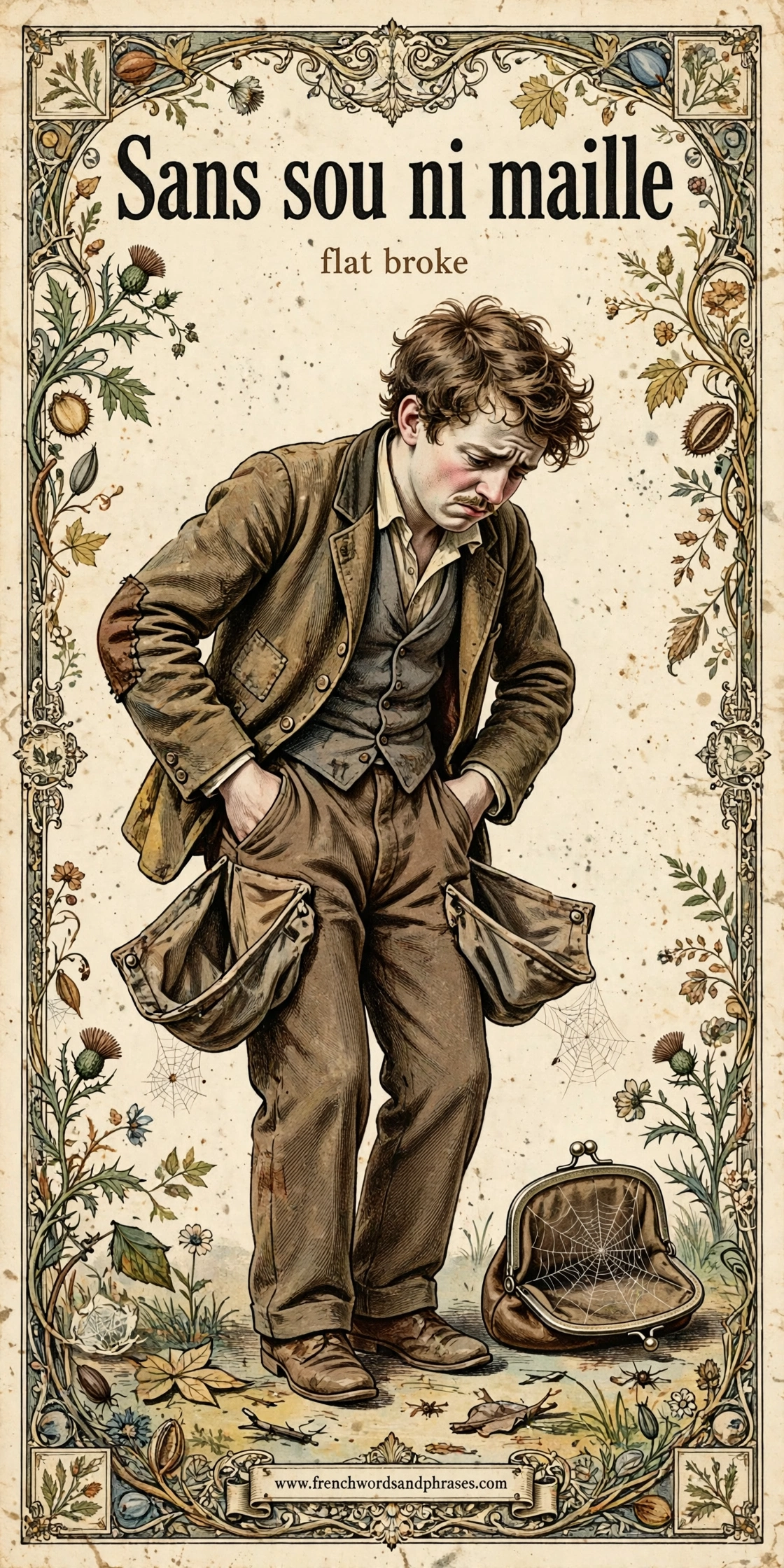
Sans sou ni maille means flat broke — without a single penny, down to the last tiny coin you do not have.
Two coins so small that history nearly forgot them: the sou, which French people still name when they have nothing, and the maille, worth half a denier, a coin for buying almost nothing at all. To have neither — « être sans sou ni maille » — is to be broke past the bottom of the purse, in a phrase that smells of old markets and older poverty.
Let’s explore how sans sou ni maille works in French, beginning with the whole phrase on one card.
Understanding the French Phrase Sans sou ni maille
Sans sou ni maille is an idiomatic expression built from sans (without) and two dead coins: the sou, the small coin whose name outlived it by centuries, and the maille, a medieval mite worth half a denier. Joined by ni… ni (neither… nor), the two smallest amounts of money in old France add up to the most complete form of having nothing.
It means flat broke — completely without money, down to the last imaginary coin. Today the phrase carries an old-fashioned, almost literary colour: people use it with a smile, about students after rent day, travellers at the end of a long trip, or themselves at the end of a long month. The coins are gone; the emptiness of the purse is eternal.
Type: Idiomatic expression — money (sans + two old coins)
Answers the need: Saying you are completely broke, with period charm
Register: Old-fashioned and humorous — a literary flavour in modern speech
Strength: Total — not short of money, but without the smallest coin that ever existed
One important usage detail: the phrase lives inside a small family — être sans sou ni maille (to be flat broke), rester sans sou ni maille (to be left penniless), and its shorter modern cousin sans un sou. The sou survives everywhere in money talk: ne pas avoir un sou, un sou est un sou (every penny counts), and the famous cents of other centuries.
Experience the Word
Sans sou ni maille is poverty with antiques in it — two coins nobody has held for five hundred years, still doing duty as the measure of nothing.
Imagine a student in a garret in 1890, turning out his pockets over a café table: a button, a stamp, and the clear evidence of neither sou nor maille. The waiter has seen the gesture before. Some phrases survive because the situation does, and the turned-out pocket is one of humanity’s permanent inventions.
The old words soften the fact. To be sans sou ni maille is to be broke in period costume.
How to Use Sans sou ni maille in French: Complete Guide
Let’s explore how sans sou ni maille works in French, beginning with the whole phrase on one card.
Sans sou ni maille at a Glance
The Whole Phrase on One Card
Real meaning, literal picture, English twin and register — sans sou ni maille in five lines.
| Point | Sans sou ni maille |
|---|---|
| What it really means | flat broke — completely without money |
| The literal picture | without a sou and without a maille — the two tiniest coins of old France |
| Word for word | sans = without; sou = a small coin; ni… ni = neither… nor; maille = a mite of a coin |
| The English twin | without a penny to one’s name; flat broke; stony broke |
| Register | old-fashioned and humorous — period colour, said with a smile |
Example
Après ce voyage, je suis sans sou ni maille.
After this trip, I’m flat broke.
Word by Word: Building the Empty Purse
Two dead coins and the grammar of having nothing.
| Word | Literal meaning | Its job in the phrase |
|---|---|---|
| sans | without | the word of absence — everything after it is missing |
| sou | a small coin (a penny, roughly) | the first nothing: even the everyday coin is gone |
| ni | nor, neither | the hinge of the double negation — ni… ni |
| maille | a tiny medieval coin, half a denier | the second nothing: even the coin for almost-nothing is gone |
| (être / rester) | to be / to be left | the verbs that carry the phrase into sentences |
Example
Il est resté sans sou ni maille après les travaux.
He was left flat broke after the building work.
Quick Quiz 1
What was a maille?
Reveal the answer
A tiny medieval coin worth half a denier — the smallest money of its age. To lack even a maille is to lack everything.
Sans sou ni maille, il a traversé la France à pied.
Flat broke, he crossed France on foot.
When You Say It: The Empty-Pocket Moments
The phrase appears at the end of trips, months and adventures.
| Situation | Example |
|---|---|
| After a long trip | Au retour, ils étaient sans sou ni maille. |
| A student at month’s end | Le 25 du mois, je suis sans sou ni maille. |
| After repairs | La voiture réparée, nous voilà sans sou ni maille. |
| A gambler’s summary | Il a tout perdu, il est sans sou ni maille. |
| Cheerfully, about yourself | Sans sou ni maille, mais riche en amis ! |
Example
Elle est sans sou ni maille, mais elle garde le sourire.
She’s flat broke, but she keeps smiling.
Make It Yours: The Broke in Every Shape
The phrase is frozen — the verbs around it do the moving.
| Form | French | In English |
|---|---|---|
| Present state | être sans sou ni maille | to be flat broke |
| Result | rester sans sou ni maille | to be left penniless |
| Becoming | se retrouver sans sou ni maille | to find yourself broke |
| Shorter cousin | sans un sou | without a penny |
| With a time frame | sans sou ni maille jusqu’à la paie | broke until payday |
| Exaggerated | sans sou ni maille ni rien | broke, with absolutely nothing |
Example
Nous nous sommes retrouvés sans sou ni maille à minuit.
We found ourselves flat broke at midnight.
Quick Quiz 2
Complete the sentence:
Après les fêtes, il est sans ______ ni maille.
Reveal the answer
sou
Après les fêtes, il est sans sou ni maille.
After the holidays, he’s flat broke.
Everyday Expressions: Building on the Coins
Frames that carry the phrase, and its sou-family, through conversation.
| Frame | In English |
|---|---|
| être sans sou ni maille | to be flat broke |
| rester sans sou ni maille | to be left without a penny |
| ne pas avoir un sou | to not have a penny |
| un sou est un sou | every penny counts |
| ne pas valoir un sou | to not be worth a penny |
Example
Un sou est un sou, surtout quand on est sans sou ni maille.
Every penny counts, especially when you’re flat broke.
Close Cousins: The Other Ways to Be Broke
French empties its pockets in several styles — here are the neighbours.
| Expression | The difference |
|---|---|
| sans sou ni maille | the period version — dead coins, literary smile |
| être fauché | to be broke — the everyday modern word, literally ‘mown down’ |
| être à sec | to be dry — no money and no resources, like an empty well |
| ne pas avoir un radis | to not have a radish — familiar slang for penniless |
| tirer le diable par la queue | to live hand to mouth — the long struggle, not just the empty moment |
Example
Je suis fauché jusqu’à vendredi.
I’m broke until Friday.
Quick Quiz 3
Which phrase would a student today most naturally use for the same idea?
Reveal the answer
Être fauché — the everyday modern word. Sans sou ni maille is its charming, old-fashioned grandparent.
Je suis fauché, comme tous les fins de mois.
I’m broke, like every end of the month.
Sans sou ni maille and Its Neighbours
The phrase at work in full sentences.
| French | In English |
|---|---|
| Après le loyer, elle est sans sou ni maille. | After the rent, she’s flat broke. |
| Ils sont revenus de vacances sans sou ni maille. | They came back from holiday without a penny. |
| Le jeune peintre était sans sou ni maille, mais libre. | The young painter was penniless, but free. |
| Sans sou ni maille, il a refusé de demander de l’aide. | Flat broke, he refused to ask for help. |
| Nous étions sans sou ni maille et parfaitement heureux. | We were penniless and perfectly happy. |
| Elle restera sans sou ni maille si elle continue ainsi. | She’ll end up broke if she goes on like this. |
Example
Sans sou ni maille, il a marché jusqu’à la mer.
Without a penny, he walked all the way to the sea.
Watch Out: The Traps Around Sans sou ni maille
Four misunderstandings to leave behind.
| Trap | The truth |
|---|---|
| Hunting for the coins today | sou and maille are history — the phrase is their afterlife, not a currency |
| Confusing maille with mesh | maille also means a stitch or a mesh, but here it is the little coin |
| Using it for a temporary shortage | the phrase means total emptiness; for a tight week, être à sec or fauché is enough |
| Dropping the ni | it is ni… ni — sans sou ni maille, never ‘sans sou ou maille’ |
Example
Sans sou ni maille, il a quand même payé le café — en chansons.
Flat broke, he still paid for the coffee — in songs.
Quick Quiz 4
True or false: sans sou ni maille is the phrase a banker would use in a report.
Reveal the answer
False — it is old-fashioned, humorous speech. A report would say sans ressources or sans un euro.
Sans sou ni maille, dit-il en riant.
Flat broke, he said, laughing.
Sans sou ni maille in Everyday French: Real-Life Examples
Now that you know the word, let’s see how sans sou ni maille appears in everyday French.
Example 1 — After the rent
Le loyer payé, je suis sans sou ni maille jusqu’au 15.
Rent paid, I’m flat broke until the 15th.
Example 2 — The traveller
Ils sont rentrés d’Italie sans sou ni maille.
They came back from Italy without a penny.
Example 3 — The student
Sans sou ni maille, elle mange des pâtes et elle rit.
Flat broke, she eats pasta and laughs.
Example 4 — After the car
La voiture réparée, nous sommes sans sou ni maille.
With the car repaired, we’re flat broke.
Example 5 — A young artist
Sans sou ni maille, il peignait la nuit et dormait le jour.
Penniless, he painted at night and slept by day.
Example 6 — Cheerful poverty
Sans sou ni maille, mais jamais sans amis.
Without a penny, but never without friends.
Beyond Translation: The Meaning of Sans sou ni maille
English keeps its poverty plain — broke, penniless, stony broke. French sends it to a museum: two coins so small that kings stopped minting them half a millennium ago, still standing guard over the empty pocket. The archaism is the kindness of the phrase — it dresses a hard fact in history, and lets you smile while you say it.
To be sans sou ni maille is to be broke with ancestors.
And the sou refuses to die entirely: it still circulates in a dozen phrases, the ghost currency of the French language.
How to Remember the French Phrase Sans sou ni maille
Remember it this way: Sans sou ni maille is the pocket turned inside out over a café table — not even the sou, the everyday penny, and not even the maille, the coin worth half of almost nothing.
- You picture the two coins — the sou, small; the maille, smaller; you have neither.
- You keep the double hinge — sans… ni… ni, neither one nor the other.
- You hear the period charm — the phrase is old-fashioned on purpose, and said with a smile.
The key idea is sans sou ni maille means flat broke — without even the two tiniest coins of old France.
Test Your Knowledge of Sans sou ni maille
Let’s see how much you’ve learned. Try answering these questions before revealing the answers.
Question 1
What does sans sou ni maille mean?
Reveal the answer
Flat broke — completely without money, down to the smallest coin that ever existed.
Question 2
What were the sou and the maille?
Reveal the answer
Two tiny old coins — the sou, a small everyday coin, and the maille, worth half a denier.
Question 3
How do you say ‘They came back flat broke’?
Reveal the answer
Ils sont revenus sans sou ni maille — the phrase itself never changes.
Question 4
What is the everyday modern equivalent?
Reveal the answer
Être fauché — to be broke. Sans sou ni maille is the old-fashioned, literary version.
Question 5
Complete the sentence:
Après ce mois difficile, elle est sans sou ni ______. (After this hard month, she’s flat broke.)
Reveal the answer
maille
Après ce mois difficile, elle est sans sou ni maille.
After this hard month, she’s flat broke.
Your Final Challenge
Can You Use It?
How would you say this in French?
“After the trip, he was flat broke.”
Reveal the answer
Après le voyage, il était sans sou ni maille.
After the trip, he was flat broke.
A little French. A little curiosity. A richer everyday life.
LEARN FRENCH ONE WORD AT A TIME