A French Word to Live By
Translate Sortir de ses gonds to English
/sɔʁ.tiʁ də se ɡɔ̃/
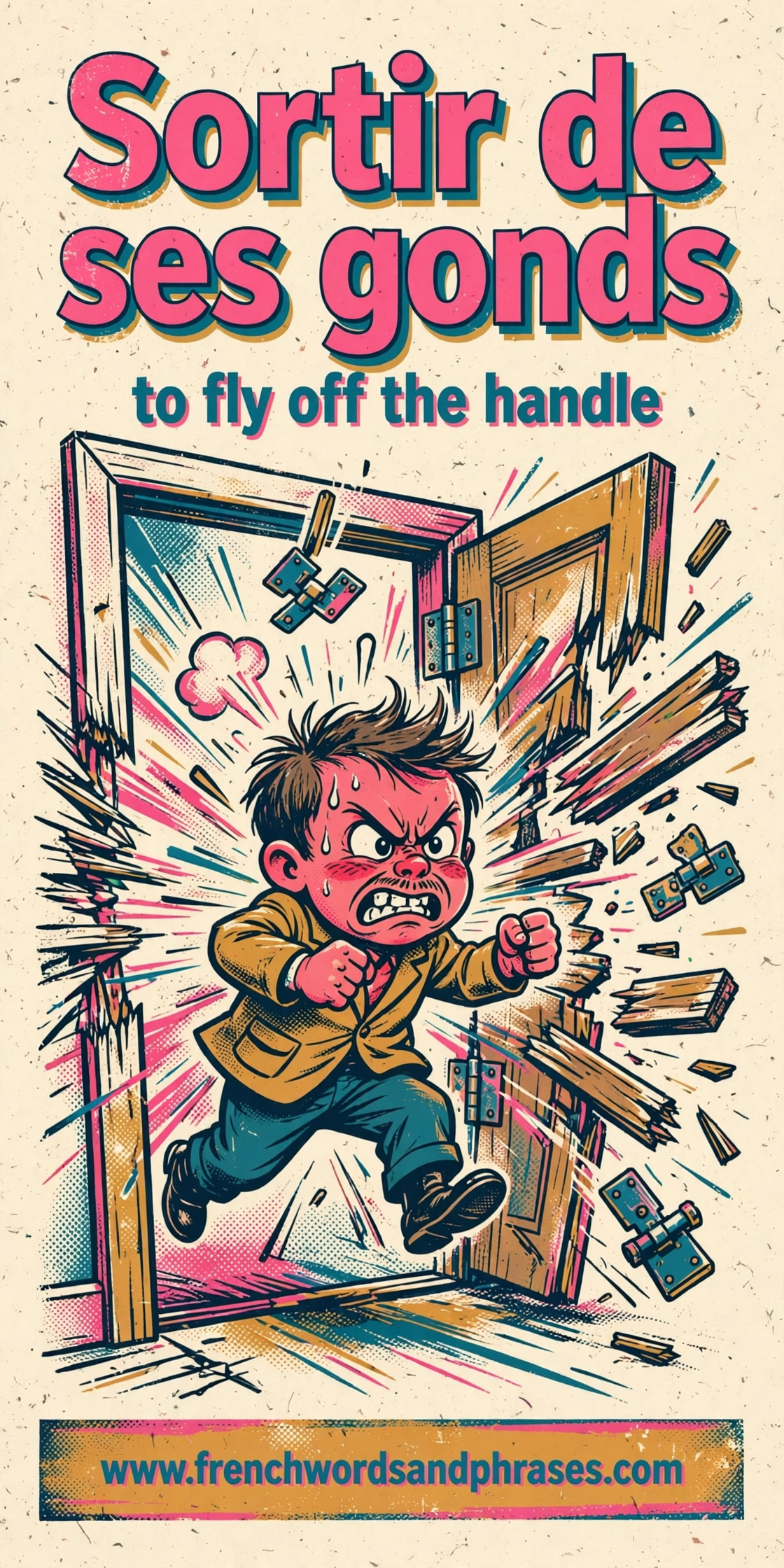
Sortir de ses gonds means to fly off the handle — to lose your temper suddenly, loudly and completely.
A door hangs on its hinges all day, opening and closing without a word of complaint — until one push too many tears it clean off the frame, and it crashes to the floor, useless and thunderous. That is exactly what happens when the mildest man in the office reads one email too many: « Il est sorti de ses gonds » — he came off his hinges, and the whole floor heard it.
Let’s explore how sortir de ses gonds works in French, beginning with the whole phrase on one card.
Understanding the French Phrase Sortir de ses gonds
Sortir de ses gonds is an idiomatic expression built from sortir (to come out, to leave) and les gonds — the hinges a door hangs on. A door off its hinges cannot open, cannot close, and makes a tremendous noise falling. The phrase keeps all three features for a human temper: sudden, total, and very loud. It is also used literally, of real doors, which keeps the picture honest.
It means to fly off the handle — to lose your temper in one sudden explosion, usually provoked by one remark too many. Unlike être soupe au lait, which names a lifelong trait, sortir de ses gonds names the event: the moment the door leaves the frame. Something, or someone, always pushes it there.
Type: Idiomatic expression — anger (sortir + door hardware)
Answers the need: Describing one sudden, total explosion of temper
Register: Neutral to familiar — safe in most speech, vivid in writing
Strength: Maximum — the door is off, not merely creaking
One important usage detail: the phrase has a causative twin — faire sortir quelqu’un de ses gonds, to make someone fly off the handle. Ask « Qu’est-ce qui l’a fait sortir de ses gonds ? » (what made him blow up?) and you have the two halves of every office explosion: the door, and the push.
Experience the Word
Sortir de ses gonds is anger with carpentry in it — hinges, a frame, and a door on the floor.
Imagine a joiner, famous in his village for patience, fitting a door for a client who changes the measurements every day for a week. On Friday, the client changes them once more, and the village hears about it from two streets away. The joiner did not merely get angry. He came off his hinges, professionally and personally, in front of a door that stayed perfectly calm on its own.
The picture explains the aftermath too. A door off its hinges cannot simply be closed — someone has to pick it up and hang it again.
How to Use Sortir de ses gonds in French: Complete Guide
Let’s explore how sortir de ses gonds works in French, beginning with the whole phrase on one card.
Sortir de ses gonds at a Glance
The Whole Phrase on One Card
Real meaning, literal picture, English twin and register — sortir de ses gonds in five lines.
| Point | Sortir de ses gonds |
|---|---|
| What it really means | to fly off the handle — one sudden, total loss of temper |
| The literal picture | a door torn off its hinges, crashing to the floor |
| Word for word | sortir = to come out; gonds = hinges |
| The English twin | to fly off the handle; to blow one’s top |
| Register | neutral to familiar — vivid but respectable |
Example
Quand il a vu la facture, il est sorti de ses gonds.
When he saw the bill, he flew off the handle.
Word by Word: Building the Hinges
Door hardware, repurposed for human beings.
| Word | Literal meaning | Its job in the phrase |
|---|---|---|
| sortir | to go out, to come out | the verb of departure — you leave your hinges |
| de | from, out of | marks the exit from the frame |
| ses | his, her, one’s | the hinges are your own — each temper has its pair |
| gonds | hinges | the pivots a door hangs on; lose them and everything falls |
| (faire sortir) | to make someone come out | the causative twin: someone else supplies the push |
Example
Elle est sortie de ses gonds devant tout le bureau.
She flew off the handle in front of the whole office.
Quick Quiz 1
What is a gond?
Reveal the answer
A hinge — the metal pivot a door hangs and swings on. Off its hinges, a door (or a temper) cannot work at all.
La porte est sortie de ses gonds pendant l’orage.
The door came off its hinges during the storm.
When You Say It: The Explosion Moments
The phrase appears at the exact second patience runs out.
| Situation | Example |
|---|---|
| One remark too many | À la troisième remarque, il est sorti de ses gonds. |
| A shocking bill | Elle est sortie de ses gonds en voyant les frais. |
| A provoked father | Les enfants l’ont fait sortir de ses gonds. |
| In a meeting | Le directeur est sorti de ses gonds, la réunion s’est arrêtée. |
| Asking what happened | Qu’est-ce qui t’a fait sortir de tes gonds ? |
Example
Il est sorti de ses gonds pour une simple question.
He flew off the handle over a simple question.
Make It Yours: The Door in Every Tense
Sortir takes être in the past — here are the shapes that matter.
| Form | French | In English |
|---|---|---|
| Present | il sort de ses gonds | he flies off the handle |
| Past | elle est sortie de ses gonds | she flew off the handle |
| Causative | faire sortir quelqu’un de ses gonds | to make someone fly off the handle |
| Future warning | il va sortir de ses gonds | he’s going to blow up |
| Barely contained | prêt à sortir de ses gonds | ready to fly off the handle |
| Habitual | il sort de ses gonds pour un rien | he flies off the handle at nothing |
Example
Ce retard l’a fait sortir de ses gonds.
This delay made him fly off the handle.
Quick Quiz 2
Complete the sentence:
En lisant le message, elle est ______ de ses gonds.
Reveal the answer
sortie
En lisant le message, elle est sortie de ses gonds.
Reading the message, she flew off the handle.
Everyday Expressions: Building on the Hinges
Frames that carry the phrase in daily talk.
| Frame | In English |
|---|---|
| sortir de ses gonds | to fly off the handle |
| faire sortir quelqu’un de ses gonds | to make someone fly off the handle |
| sortir de ses gonds pour un rien | to blow up over nothing |
| sortir de ses gonds devant tout le monde | to blow up in front of everyone |
| être sorti de ses gonds | to have blown one’s top (the state after) |
Example
Il sort de ses gonds pour un rien, ces temps-ci.
He flies off the handle at nothing these days.
Close Cousins: The Other Explosions of French
French has a full workshop of anger — here are the neighbours.
| Expression | The difference |
|---|---|
| sortir de ses gonds | the door off its hinges — one sudden, total explosion |
| être soupe au lait | the trait behind it — quick-tempered by character, every day |
| péter les plombs | to blow a fuse — the electrical cousin, more familiar and modern |
| exploser | to explode — the plain verb, no hardware required |
| monter sur ses grands chevaux | to get on your high horse — indignation, not pure temper |
Example
Il a pété les plombs en voyant sa voiture rayée.
He blew a fuse when he saw his car scratched.
Quick Quiz 3
What is the difference between être soupe au lait and sortir de ses gonds?
Reveal the answer
Trait versus event — soupe au lait is the quick-tempered character; sortir de ses gonds is the single moment the door leaves its hinges.
Soupe au lait depuis toujours, il est sorti de ses gonds mardi.
Quick-tempered all his life, he flew off the handle on Tuesday.
Sortir de ses gonds and Its Neighbours
The phrase at work in full sentences.
| French | In English |
|---|---|
| Le maire est sorti de ses gonds pendant le conseil. | The mayor flew off the handle during the council meeting. |
| Elle est sortie de ses gonds, puis elle s’est excusée. | She blew up, then she apologised. |
| Tu vas me faire sortir de mes gonds. | You’re going to make me fly off the handle. |
| Il est sorti de ses gonds pour une place de parking. | He blew his top over a parking space. |
| Après sa sortie de ses gonds, plus un bruit dans la pièce. | After he flew off the handle, not a sound in the room. |
| On l’a rarement vu sortir de ses gonds. | People have rarely seen him lose his temper like that. |
Example
Le client est sorti de ses gonds au comptoir.
The customer flew off the handle at the counter.
Watch Out: The Traps Around Sortir de ses gonds
Four misunderstandings to leave behind.
| Trap | The truth |
|---|---|
| Forgetting the past-tense agreement | sortir takes être: elle est sortie, ils sont sortis de leurs gonds |
| Confusing it with the trait | one explosion is sortir de ses gonds; a lifetime of them is être soupe au lait |
| Dropping the possessive | it is ses gonds, mes gonds, tes gonds — the hinges belong to the angry person |
| Thinking it is only figurative | real doors also sortent de leurs gonds — context tells you which door fell |
Example
Ils sont sortis de leurs gonds en même temps.
They flew off the handle at the same time.
Quick Quiz 4
True or false: faire sortir quelqu’un de ses gonds means to calm someone down.
Reveal the answer
False — it means the opposite: to provoke someone into flying off the handle.
Ses remarques l’ont fait sortir de ses gonds.
His remarks made him fly off the handle.
Sortir de ses gonds in Everyday French: Real-Life Examples
Now that you know the word, let’s see how sortir de ses gonds appears in everyday French.
Example 1 — At the office
Le patron est sorti de ses gonds en découvrant l’erreur.
The boss flew off the handle when he discovered the mistake.
Example 2 — A family row
Papa est sorti de ses gonds, puis il est allé jardiner.
Dad blew his top, then went off to garden.
Example 3 — Provoked
Tu l’as fait sortir de ses gonds avec ta remarque.
You made him fly off the handle with that remark.
Example 4 — A parking space
Il est sorti de ses gonds pour une place de parking, incroyable.
He blew up over a parking space, unbelievable.
Example 5 — An apology after
Elle est sortie de ses gonds, elle regrette déjà.
She flew off the handle — she already regrets it.
Example 6 — A warning
Ne le pousse pas, il va sortir de ses gonds.
Don’t push him, he’s going to blow up.
Beyond Translation: The Meaning of Sortir de ses gonds
English unhinges people too — an unhinged door swings wild and useless, and the metaphor crossed the Channel in both directions. French keeps the hardware precise: not the handle, not the lock, but the gonds, the pivots themselves. Lose the pivot and the whole door is on the floor.
To sortir de ses gonds is to lose your pivot, not just your patience.
And everyone who has hung a door knows the sequel: the explosion is quick, but somebody patient has to lift the door back on.
How to Remember the French Phrase Sortir de ses gonds
Remember it this way: Sortir de ses gonds is the door torn off its hinges — one push too many, a crash, and a door that cannot close until someone hangs it again.
- You picture the hardware — les gonds are hinges, and off them, nothing works.
- You keep the pair — trait and event: être soupe au lait is the character, sortir de ses gonds is the explosion.
- You add the pusher — faire sortir quelqu’un de ses gonds names whoever supplied the final push.
The key idea is sortir de ses gonds means to fly off the handle — the door torn off its hinges.
Test Your Knowledge of Sortir de ses gonds
Let’s see how much you’ve learned. Try answering these questions before revealing the answers.
Question 1
What does sortir de ses gonds mean?
Reveal the answer
To fly off the handle — to lose your temper in one sudden, total explosion.
Question 2
What is a gond?
Reveal the answer
A hinge — the pivot a door hangs on; the phrase imagines the door torn clean off them.
Question 3
How do you say ‘She flew off the handle’?
Reveal the answer
Elle est sortie de ses gonds — sortir takes être, and the participle agrees.
Question 4
How do you say ‘You made him fly off the handle’?
Reveal the answer
Tu l’as fait sortir de ses gonds — the causative twin uses faire sortir.
Question 5
Complete the sentence:
En voyant la casse, il est sorti de ses ______. (Seeing the damage, he flew off the handle.)
Reveal the answer
gonds
En voyant la casse, il est sorti de ses gonds.
Seeing the damage, he flew off the handle.
Your Final Challenge
Can You Use It?
How would you say this in French?
“When he heard the news, he flew off the handle.”
Reveal the answer
Quand il a appris la nouvelle, il est sorti de ses gonds.
When he heard the news, he flew off the handle.
A little French. A little curiosity. A richer everyday life.
LEARN FRENCH ONE WORD AT A TIME