A French Word to Live By
Translate Par monts et par vaux to English
/paʁ mɔ̃ e paʁ vo/
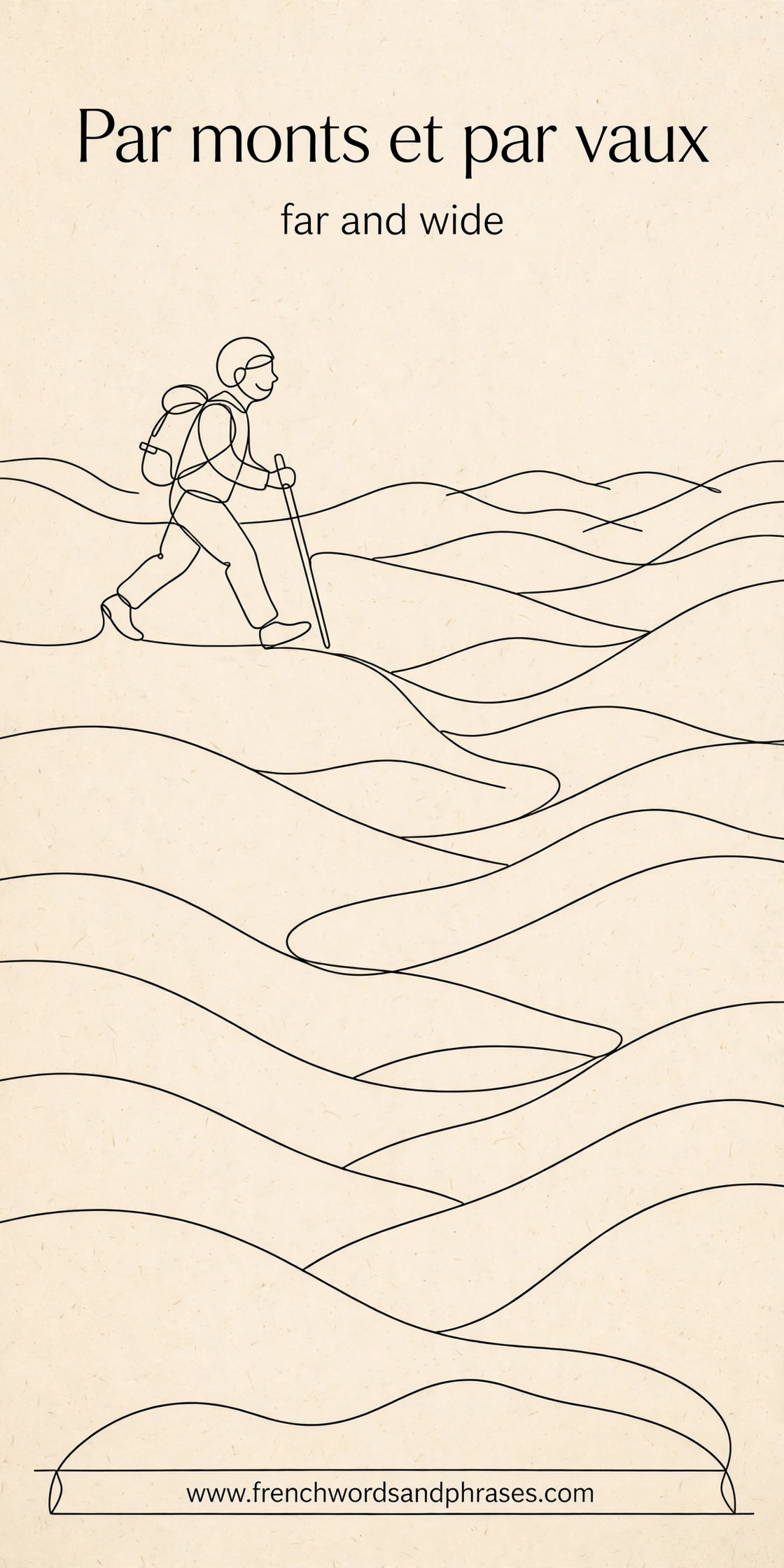
Par monts et par vaux means far and wide — travelling everywhere, over hill and dale, never settling in one place.
The old travelling salesman has closed his sample case for the last time. Fifty years of trains, villages, mountain roads and river valleys — if you ask him where he has been, he just laughs: « J’ai couru par monts et par vaux. » Everywhere. That is the whole answer.
Let’s explore how par monts et par vaux works in French, beginning with the whole phrase on one card.
Understanding the French Phrase Par monts et par vaux
Par monts et par vaux is an old adverbial phrase built from two landscape words: les monts (mountains) and les vaux (valleys — the old plural of val). Joined by par… et par, it paints a traveller crossing every kind of country there is.
It means far and wide, all over the place — travelling or searching across the whole landscape without stopping anywhere for long. A mont is a mountain and a val is a valley, so the traveller in the phrase crosses the high ground and the low ground alike: there is nowhere the journey does not reach. You will meet it after verbs of moving and hunting — voyager, courir, chercher par monts et par vaux.
Type: Adverbial idiom — journeying (par + landscape nouns)
Answers the need: Saying someone went, searched or wandered absolutely everywhere
Register: Literary and a little old-fashioned — understood by everyone, charming in speech
Literal picture: Over mountains and through valleys — every terrain there is
One important usage detail: vaux is the irregular old plural of val (a valley), a word modern French keeps almost only inside this phrase and in place names like Vaux-sur-Mer. The phrase usually completes a verb — il a cherché par monts et par vaux, elle voyage par monts et par vaux — and it always suggests a long, restless journey rather than a quick trip across town.
Experience the Word
Par monts et par vaux is the traveller’s whole life folded into six words — every road, every weather, every horizon.
Imagine a shepherd of the old school, following his flock to the high pastures in June and down to the valley farms in October. Ask him in his nineties where he has lived, and he cannot name a village. He has lived on the way — par monts et par vaux.
French keeps a few phrases that smell of dust and boot leather. This is one of them: the landscape itself becomes the address.
How to Use Par monts et par vaux in French: Complete Guide
Let’s explore how par monts et par vaux works in French, beginning with the whole phrase on one card.
Par monts et par vaux at a Glance
The Whole Phrase on One Card
Real meaning, literal picture, English twin and register — par monts et par vaux in five lines.
| Point | Par monts et par vaux |
|---|---|
| What it really means | far and wide — everywhere, across the whole country |
| Word for word | over mountains and over valleys |
| English equivalent | far and wide / over hill and dale / the length and breadth of the land |
| Register | literary, slightly old-fashioned — a storyteller’s phrase |
| Use it for | long journeys, wide searches, a life spent on the road |
Example
Il a cherché son frère par monts et par vaux.
He searched for his brother far and wide.
Word by Word: Building the Journey
Four pieces, two of them repeated — the repetition is the engine of the phrase.
| Word | Literal meaning | Its job in the phrase |
|---|---|---|
| par | through, over, by way of | the road word — it puts you in motion across the land |
| monts | mountains | the high ground — the hard half of the journey |
| et | and | the hinge that promises a second landscape |
| vaux | valleys | the low ground — vaux is the old plural of val, a valley |
Example
Elle connaît la région par monts et par vaux.
She knows the region far and wide.
Quick Quiz 1
What is a val, whose old plural vaux appears in the phrase?
Reveal the answer
A valley — the low ground between hills, answering the monts, the mountains.
Le berger descendait dans les vaux à l’automne.
The shepherd came down into the valleys in autumn.
When You Say It: The Travelling Moments
Par monts et par vaux belongs to journeys and searches like these.
| Situation | Example |
|---|---|
| A long search | ils ont cherché le chien perdu par monts et par vaux — they searched far and wide for the lost dog |
| A travelling job | il court par monts et par vaux pour son travail — his work takes him all over the place |
| A restless life | elle a voyagé par monts et par vaux avant de s’installer — she travelled far and wide before settling down |
| Telling old stories | dans ma jeunesse, je marchais par monts et par vaux — in my youth I wandered over hill and dale |
Example
Le facteur rural passait par monts et par vaux, par tous les temps.
The country postman travelled far and wide, in all weathers.
Make It Yours: The Verbs That Carry It
The phrase rides behind a verb of movement or searching — pick the verb, the landscape follows.
| Form | French | In English |
|---|---|---|
| Searching | chercher par monts et par vaux | to search far and wide |
| Travelling | voyager par monts et par vaux | to travel the length and breadth of the land |
| Hurrying about | courir par monts et par vaux | to rush all over the place |
| Wandering | errer par monts et par vaux | to wander far and wide |
| Knowing a region | connaître un pays par monts et par vaux | to know a country inside out, every corner of it |
Example
Nous avons couru par monts et par vaux pour trouver cette maison.
We rushed all over the place to find this house.
Quick Quiz 2
Does par monts et par vaux describe a short trip to one place, or travel everywhere?
Reveal the answer
Travel everywhere — mountains and valleys together stand for the whole landscape, so the journey covers everything.
Il a roulé par monts et par vaux pendant vingt ans.
He drove far and wide for twenty years.
Everyday Expressions: Building on the Journey
Par monts et par vaux slots into these everyday frames — each one ready to use as it stands.
| Frame | In English |
|---|---|
| chercher quelqu’un par monts et par vaux | to search high and low for someone |
| partir par monts et par vaux | to set off across the whole country |
| par monts et par vaux, il a tout vu | he has seen it all, everywhere he went |
| une vie par monts et par vaux | a life spent on the road |
Example
On l’a cherché par monts et par vaux, ce fameux papier.
We searched high and low for that wretched document.
Close Cousins: The Other Everywhere Phrases
French has several ways to say ‘everywhere’ — this one is the traveller’s; its cousins stay closer to home.
| Expression | The difference |
|---|---|
| par monts et par vaux | far and wide — a long journey across real landscape, literary colouring |
| partout | everywhere — the plain, everyday word, no picture attached |
| aux quatre coins du pays | to the four corners of the country — wide coverage, more modern and neutral |
| par mer et par terre | by sea and by land — every route, often for sending or travelling |
| de ville en ville | from town to town — the journey broken into stops |
Example
Il a vendu ses fromages aux quatre coins du pays, par monts et par vaux.
He sold his cheeses to the four corners of the country, far and wide.
Quick Quiz 3
Which cousin of the phrase means ‘by sea and by land’?
Reveal the answer
Par mer et par terre — every route there is, on water or on ground.
Les marchandises arrivaient par mer et par terre.
The goods arrived by sea and by land.
Par monts et par vaux and Its Neighbours
The traveller’s shelf around the phrase — the words of roads, heights and hollows.
| French | In English |
|---|---|
| un mont | a mountain, a high hill |
| un val / une vallée | a valley |
| un chemin | a path, a way |
| la plaine | the plain — the flat country |
| un col | a mountain pass |
| le pays | the country, the region |
Example
Par monts et par vaux, le chemin finit toujours par redescendre.
Over hill and dale, the path always comes down again in the end.
Watch Out: The Traps Around Par monts et par vaux
The traps: a plural that breaks the rules, and a phrase too grand for the corner shop.
| Trap | The truth |
|---|---|
| the plural of val | val makes vaux in this old phrase, not ‘vals’ — the modern everyday word for valley is une vallée |
| mont is not montagne | un mont is a poetic, compact word for a mountain; la montagne is the everyday word — the phrase keeps the old short forms |
| too big for small trips | the phrase promises an epic sweep — for a trip to the bakery, partout or juste à côté will do |
| word order is fixed | monts always comes before vaux: par monts et par vaux, never the other way round |
Example
Il ne va pas par monts et par vaux, il va juste au village.
He is not going far and wide, he is only going to the village.
Quick Quiz 4
True or false: vaux is the ordinary modern plural you would use for any valleys.
Reveal the answer
False — vaux survives in this phrase and in place names; in everyday French a valley is une vallée.
La vallée était verte après la pluie.
The valley was green after the rain.
Par monts et par vaux in Everyday French: Real-Life Examples
Now that you know the word, let’s see how par monts et par vaux appears in everyday French.
Example 1 — The lost dog
Toute la famille a cherché le chien par monts et par vaux.
The whole family searched far and wide for the dog.
Example 2 — A travelling job
Son travail l’envoie par monts et par vaux.
His job sends him all over the place.
Example 3 — Grandfather’s stories
Grand-père a couru par monts et par vaux dans sa jeunesse.
Grandfather roamed far and wide in his youth.
Example 4 — The search for a house
Nous avons visité des maisons par monts et par vaux avant de choisir.
We viewed houses far and wide before choosing.
Example 5 — The wandering cat
Ce chat passe ses nuits par monts et par vaux.
That cat spends its nights roaming far and wide.
Example 6 — At retirement
Après quarante ans par monts et par vaux, le représentant a posé sa valise.
After forty years on the road, the sales rep set down his suitcase.
Beyond Translation: The Meaning of Par monts et par vaux
English says ‘over hill and dale’ and means a pleasant ramble. The French phrase is heavier: monts and vaux are the vocabulary of pilgrims, shepherds and pedlars, people whose whole lives were measured in climbs and descents.
To go par monts et par vaux is to accept the whole landscape as your home — the hard ascents and the easy valleys alike.
That is why the phrase suits a life story better than a day trip: it is the geography of someone who never quite arrived, and was glad of it.
How to Remember the French Phrase Par monts et par vaux
Remember it this way: Par monts et par vaux is the whole map in one breath — the mountains first, the valleys after, and you crossing both.
- You picture the pair — monts for the climbs, vaux for the descents; together they mean everywhere.
- You let a verb pull it — chercher, courir, voyager par monts et par vaux.
- You keep vaux frozen — it is the old plural of val, kept alive by this one phrase.
The key idea is par monts et par vaux means far and wide — over mountains and valleys, everywhere.
Test Your Knowledge of Par monts et par vaux
Let’s see how much you’ve learned. Try answering these questions before revealing the answers.
Question 1
What does par monts et par vaux mean?
Reveal the answer
Far and wide — travelling or searching everywhere, across the whole landscape.
Question 2
What is the literal, word-for-word meaning?
Reveal the answer
Over mountains and through valleys — par (through, over) + monts (mountains) + vaux (valleys).
Question 3
How do you say ‘We searched for him far and wide’?
Reveal the answer
Nous l’avons cherché par monts et par vaux — the phrase rides behind the verb chercher.
Question 4
What is unusual about the word vaux?
Reveal the answer
It is the old irregular plural of val (a valley) — modern French usually says une vallée; vaux survives in this phrase and in place names.
Question 5
Complete the sentence:
Le berger marchait ______ avec ses moutons. (The shepherd walked far and wide with his sheep.)
Reveal the answer
par monts et par vaux
Le berger marchait par monts et par vaux avec ses moutons.
The shepherd walked far and wide with his sheep.
Your Final Challenge
Can You Use It?
How would you say this in French?
“For years, the old doctor travelled far and wide to visit his patients.”
Reveal the answer
Pendant des années, le vieux médecin a voyagé par monts et par vaux pour visiter ses malades.
For years, the old doctor travelled far and wide to visit his patients.
A little French. A little curiosity. A richer everyday life.
LEARN FRENCH ONE WORD AT A TIME