A French Word to Live By
Translate N’avoir ni queue ni tête to English
/na.vwaʁ ni kø ni tɛt/
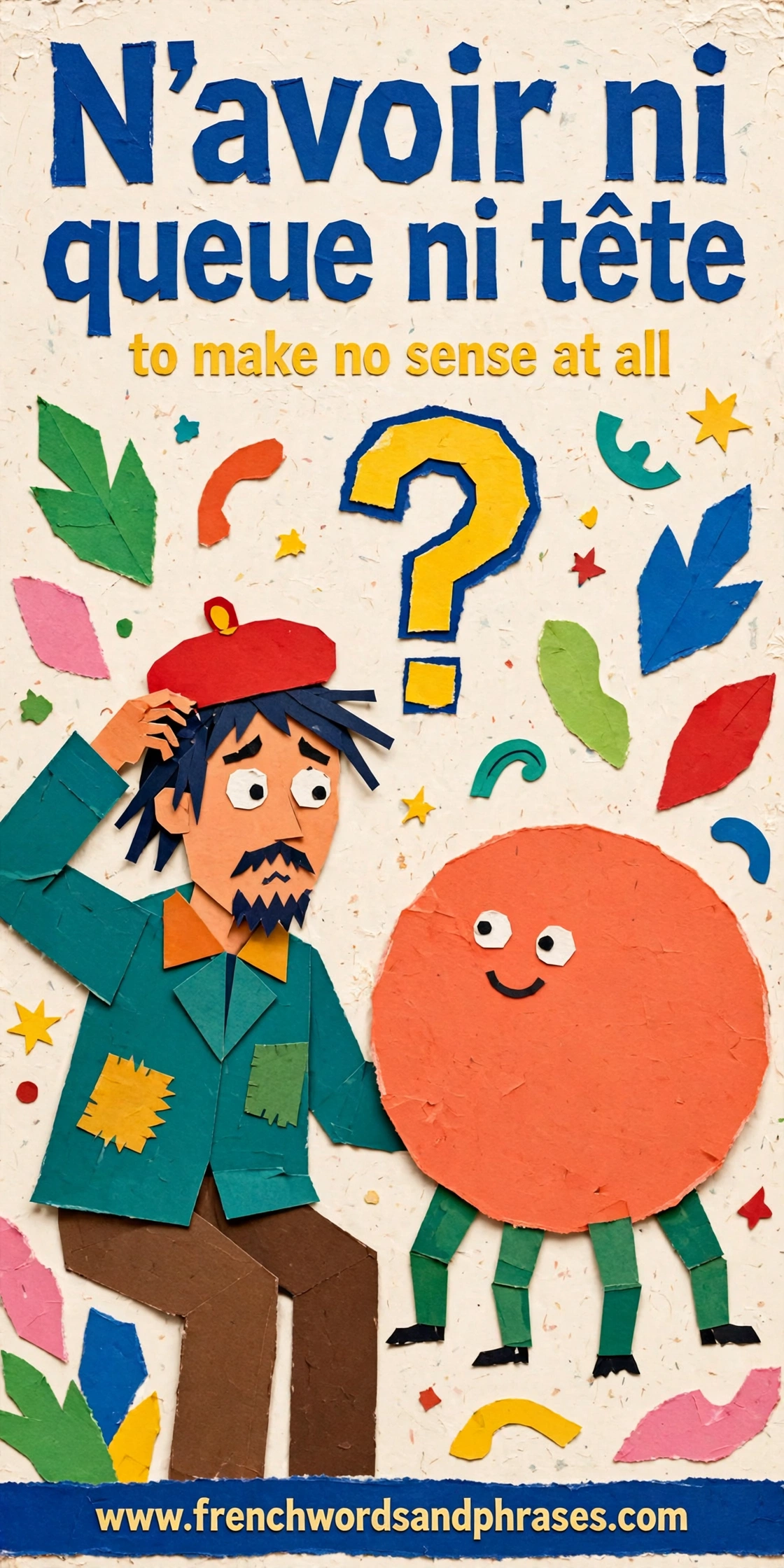
N’avoir ni queue ni tête means to make no sense at all — to have neither beginning nor end, neither head nor tail.
The new colleague explains the filing system for the third time — something about colours, a cupboard that is not a cupboard, and a list that refers to another list. You nod bravely, then turn to your neighbour: « Je n’y comprends rien : ça n’a ni queue ni tête. »
Let’s explore how n’avoir ni queue ni tête works in French, beginning with the whole phrase on one card.
Understanding the French Phrase N’avoir ni queue ni tête
N’avoir ni queue ni tête is a French idiomatic expression built from avoir (to have), ni… ni (neither… nor), la queue (the tail) and la tête (the head). Said of a story, an explanation, a speech or a plan, it declares the thing shapeless: you cannot find where it begins or where it ends.
It means to make no sense at all — to be completely incoherent. A normal story has a head, its beginning, and a tail, its end; this one has neither. French reaches for the animal body to judge discourse: no head, no tail, no creature — just a middle, wandering.
Type: Idiomatic expression — incoherence (avoir + ni… ni + body parts)
Answers the need: Saying a story, explanation or plan is utterly senseless
Register: Neutral to familiar — everyday speech, safe almost everywhere
Strength: Total — not ‘unclear in places’, but senseless from end to missing end
One important usage detail: the subject is nearly always the thing judged — ça n’a ni queue ni tête, son explication n’a ni queue ni tête, ce discours n’a ni queue ni tête. The phrase judges stories, plans, speeches and systems; said of a person, it would sound like a strange insult about their body, which is not its job.
Experience the Word
N’avoir ni queue ni tête is the verdict every listener has whispered when a story loses its own thread.
Imagine the family anecdote that starts in the middle, visits three cousins, two wars and a recipe, and stops — not ends, stops — while everyone waits for the point. The point is not coming. The story had no head when it started and grows no tail as it goes.
French judges speech the way it judges animals: by its shape. A discourse with neither head nor tail is not a creature at all — it cannot walk anywhere, least of all to a conclusion.
How to Use N’avoir ni queue ni tête in French: Complete Guide
Let’s explore how n’avoir ni queue ni tête works in French, beginning with the whole phrase on one card.
N’avoir ni queue ni tête at a Glance
The Whole Phrase on One Card
Real meaning, literal picture, English twin and register — ni queue ni tête in five lines.
| Point | N’avoir ni queue ni tête |
|---|---|
| What it really means | to make no sense at all — no beginning, no end, no thread |
| Word for word | to have neither tail nor head |
| English equivalent | to have neither head nor tail — the same animal, borrowed whole |
| Register | neutral to familiar — everyday verdict on stories and speeches |
| Use it for | rambling explanations, absurd rules, stories without a point |
Example
Son histoire n’a ni queue ni tête, personne n’a rien compris.
His story makes no sense at all; nobody understood a thing.
Word by Word: Building the Shapeless Thing
Four pieces — a verb of having, a double negation, and the two ends of an animal that are both missing.
| Word | Literal meaning | Its job in the phrase |
|---|---|---|
| avoir | to have | the verb of possession — here, of everything the thing lacks |
| ni… ni | neither… nor | the double negation that removes both ends at once |
| queue | tail | the end of the animal — and the end of the story |
| tête | head | the front of the animal — and the beginning, the sense, of the story |
Example
Cette règle n’a ni queue ni tête : qui l’a inventée ?
This rule makes no sense at all: who invented it?
Quick Quiz 1
In the picture, what do the head and the tail of a story stand for?
Reveal the answer
Its beginning and its end — a senseless story has neither: it starts nowhere and arrives nowhere.
Un récit sans queue ni tête ne va nulle part.
A story with neither tail nor head goes nowhere.
When You Say It: The Senseless Moments
The phrase fires at moments like these — when a listener gives up looking for the thread.
| Situation | Example |
|---|---|
| A rambling story | son anecdote n’a ni queue ni tête — his anecdote makes no sense at all |
| An absurd rule | ce règlement n’a ni queue ni tête — this rulebook is senseless |
| A confused explanation | ton explication n’a ni queue ni tête, recommence — your explanation makes no sense, start again |
| A strange film | le film n’avait ni queue ni tête — the film had neither head nor tail |
| About a plan | leur projet n’a ni queue ni tête — their plan is completely incoherent |
Example
Recommence doucement : là, ça n’a ni queue ni tête.
Start again slowly: as it stands, it makes no sense at all.
Make It Yours: The Verdict for Every Nonsense
The phrase hangs on avoir — conjugate the verb, keep ni… ni and the two missing ends.
| Form | French | In English |
|---|---|---|
| Present verdict | ça n’a ni queue ni tête | it makes no sense at all |
| About a speech | son discours n’a ni queue ni tête | his speech is incoherent |
| Past | ça n’avait ni queue ni tête | it made no sense at all |
| Question | ça a une queue ou une tête, cette histoire ? | does this story have a head or a tail? (teasing) |
| First person verdict | je trouve que ça n’a ni queue ni tête | I think it makes no sense at all |
Example
Je trouve que ce mode d’emploi n’a ni queue ni tête.
I think this instruction manual makes no sense at all.
Quick Quiz 2
Which pair does the phrase use — ni queue ni tête or ni pieds ni tête?
Reveal the answer
Ni queue ni tête — tail and head, the two ends of the animal. Feet belong to other phrases.
Ni queue ni tête : impossible de le suivre.
Neither head nor tail: impossible to follow it.
Everyday Expressions: Building on the Missing Ends
N’avoir ni queue ni tête slots into these everyday frames — each one ready to use as it stands.
| Frame | In English |
|---|---|
| ça n’a ni queue ni tête | it makes no sense at all |
| une histoire ni queue ni tête | a story with neither head nor tail — the phrase as an adjective, without avoir |
| n’avoir ni commencement ni fin | to have neither beginning nor end — the same verdict, without the animal |
| perdre le fil | to lose the thread — what the speaker did, halfway through |
| partir dans tous les sens | to go off in every direction — the story’s bad behaviour |
Example
Il a perdu le fil, et son histoire est partie dans tous les sens.
He lost the thread, and his story went off in every direction.
Close Cousins: The Other Verdicts of Nonsense
French condemns nonsense in several styles — ni queue ni tête is the shapeless one; its cousins complain about threads, logic and plain clarity.
| Expression | The difference |
|---|---|
| n’avoir ni queue ni tête | to make no sense at all — no beginning, no end, no shape |
| ça ne tient pas debout | it doesn’t hold up — the argument collapses under its own weight |
| c’est du grand n’importe quoi | it’s complete nonsense — stronger, familiar, the modern verdict |
| je n’y comprends rien | I understand nothing of it — the listener’s confession, humbler than a verdict |
| c’est tiré par les cheveux | it’s far-fetched — the reasoning is dragged in by force, but a thread exists |
Example
Ça ne tient pas debout, c’est du grand n’importe quoi, ni queue ni tête.
It doesn’t hold up, it’s complete nonsense, neither head nor tail.
Quick Quiz 3
A theory is clever but forced — you can follow it, yet it feels dragged in. Which cousin fits?
Reveal the answer
C’est tiré par les cheveux — far-fetched: a thread exists, but it was pulled hard. Ni queue ni tête is for when there is no thread at all.
Ton explication est tirée par les cheveux, mais elle se tient.
Your explanation is far-fetched, but it holds together.
N’avoir ni queue ni tête and Its Neighbours
The story shelf around the phrase — beginnings, ends and the threads between them.
| French | In English |
|---|---|
| un récit | a story, an account |
| le fil | the thread — of a story, le fil de l’histoire |
| le début | the beginning |
| la fin | the end |
| la logique | logic |
| un discours | a speech |
Example
Sans début et sans fin, le récit perd son fil et ses auditeurs.
With no beginning and no end, the story loses its thread and its listeners.
Watch Out: The Traps Around Ni queue ni tête
The traps: a queue with a second life, a person who should not receive the verdict, and a double negation to keep whole.
| Trap | The truth |
|---|---|
| queue’s other life | une queue is also a line of people waiting — faire la queue, to queue; in the phrase, it is the animal’s tail |
| judge things, not people | the phrase condemns stories, speeches, rules and plans — aimed at a person it sounds like a bizarre insult about their body |
| keep ni… ni whole | the double negation is the skeleton: ni queue NI tête — dropping one ni breaks the phrase |
| tête is also sense | la tête is the head and the mind — perdre la tête is to lose your head; the phrase borrows the body’s map for a story’s shape |
Example
Ce n’est pas lui, c’est son plan qui n’a ni queue ni tête.
It’s not him, it’s his plan that makes no sense at all.
Quick Quiz 4
True or false: English has the same animal — ‘neither head nor tail’.
Reveal the answer
True — English says ‘I can’t make head nor tail of it’, the same missing ends, in the same order of despair.
Les Anglais aussi cherchent la tête et la queue.
The English look for the head and the tail too.
N’avoir ni queue ni tête in Everyday French: Real-Life Examples
Now that you know the word, let’s see how n’avoir ni queue ni tête appears in everyday French.
Example 1 — The filing system
Ce classement n’a ni queue ni tête, personne ne retrouve rien.
This filing system makes no sense at all; nobody can find anything.
Example 2 — The rambling anecdote
Son histoire de pêche n’avait ni queue ni tête.
His fishing story had neither head nor tail.
Example 3 — The instruction manual
Ce mode d’emploi n’a ni queue ni tête, je laisse tomber.
This manual makes no sense at all, I give up.
Example 4 — The new rule
La nouvelle règle n’a ni queue ni tête, même le chef le dit.
The new rule makes no sense at all; even the boss says so.
Example 5 — The strange film
Le film était beau, mais l’histoire n’avait ni queue ni tête.
The film was beautiful, but the story had neither head nor tail.
Example 6 — Asking for a restart
Attends, ça n’a ni queue ni tête : reprends depuis le début.
Wait, that makes no sense at all: start again from the beginning.
Beyond Translation: The Meaning of N’avoir ni queue ni tête
Two languages looked at a senseless story and reached for the same animal: French says it has ni queue ni tête, English can make neither head nor tail of it. The agreement is a small marvel — discourse, in both imaginations, is a creature that must be able to walk: head first, tail last, sense in between.
A story with neither end cannot even be wrong — it can only be abandoned, mid-sentence, by merciful listeners.
That is the phrase’s mercy and its severity: it does not argue with the nonsense. It simply notes the missing anatomy, and stops listening.
How to Remember the French Phrase N’avoir ni queue ni tête
Remember it this way: N’avoir ni queue ni tête is a story judged like an animal — no head to start with, no tail to finish with, no creature at all.
- You picture the animal — tête is the beginning, queue is the end; a story missing both goes nowhere.
- You keep the double lock — ni… ni removes the two ends in one gesture; never drop a ni.
- You judge the work, not the worker — stories, speeches, plans and rules receive this verdict, not people.
The key idea is n’avoir ni queue ni tête means to make no sense at all — a story with neither beginning nor end.
Test Your Knowledge of N’avoir ni queue ni tête
Let’s see how much you’ve learned. Try answering these questions before revealing the answers.
Question 1
What does n’avoir ni queue ni tête mean?
Reveal the answer
To make no sense at all — to have neither beginning nor end, no thread to follow.
Question 2
What do the head and the tail stand for?
Reveal the answer
The beginning and the end of a story, an explanation or a plan — both missing.
Question 3
How do you say ‘his speech makes no sense at all’?
Reveal the answer
Son discours n’a ni queue ni tête — the thing judged is the subject.
Question 4
What does perdre le fil mean?
Reveal the answer
To lose the thread — what a speaker does halfway through a story that ends up with neither head nor tail.
Question 5
Complete the phrase:
Ça n’a ni ______ ni tête. (It has neither ___ nor head.)
Reveal the answer
queue
Ça n’a ni queue ni tête.
It makes no sense at all.
Your Final Challenge
Can You Use It?
How would you say this in French?
“His explanation makes no sense at all: start again from the beginning.”
Reveal the answer
Son explication n’a ni queue ni tête : recommence depuis le début.
His explanation makes no sense at all: start again from the beginning.
A little French. A little curiosity. A richer everyday life.
LEARN FRENCH ONE WORD AT A TIME