A French Word to Live By
Translate Manger comme un chancre to English
/mɑ̃.ʒe kɔm œ̃ ʃɑ̃kʁ/
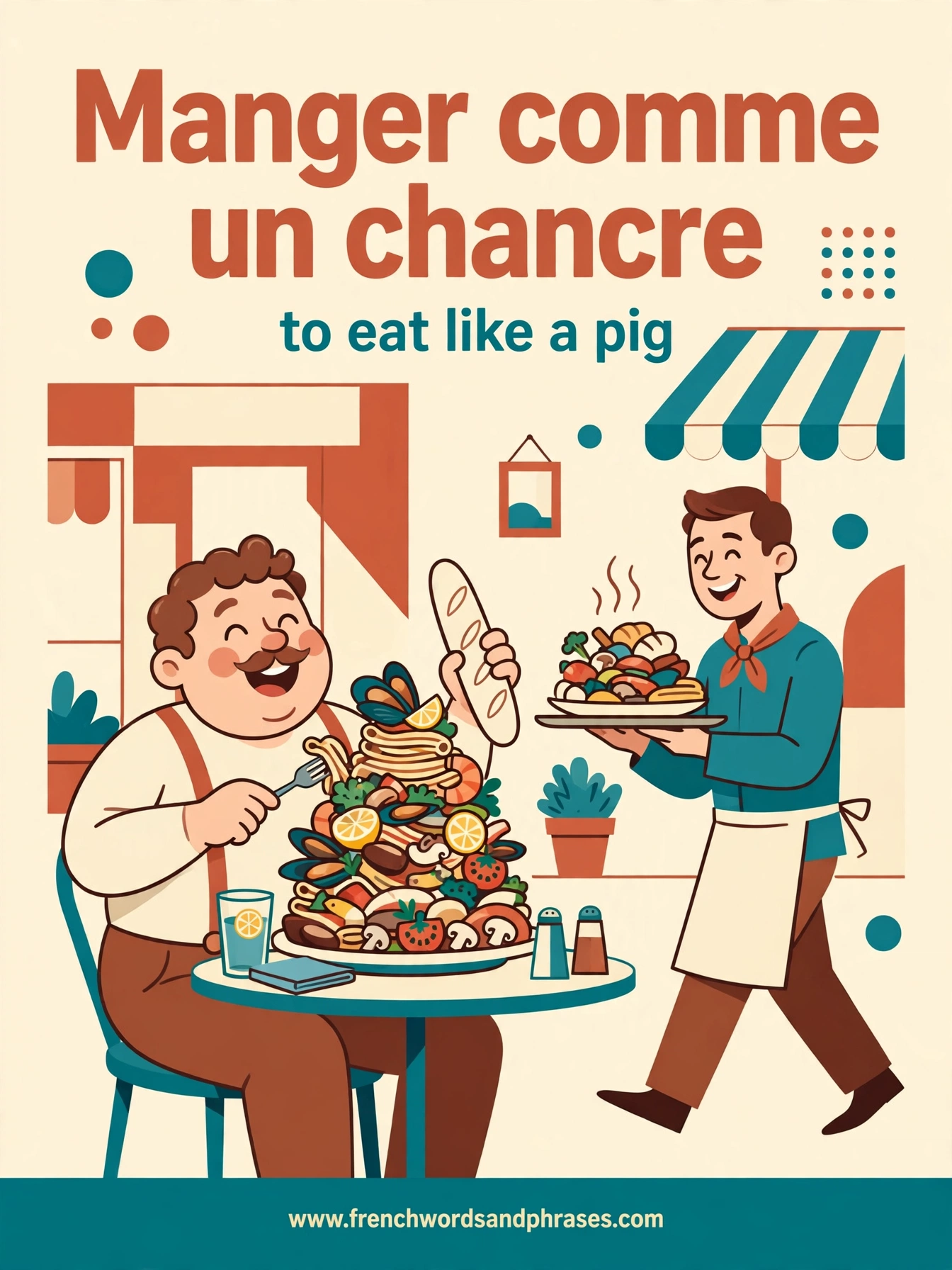
Manger comme un chancre means to eat like a pig — to devour greedily and enormously, the way a canker eats flesh.
Sunday lunch at grandmother’s, and the teenage grandson is on his fourth helping of gratin, reaching for the cheese before the plates are cleared. His grandfather watches the performance with awe and delivers the old verdict: « Ce garçon mange comme un chancre. »
Let’s explore how manger comme un chancre works in French, beginning with the whole phrase on one card.
Understanding the French Phrase Manger comme un chancre
Manger comme un chancre is a French idiomatic expression built from manger (to eat) and un chancre — a canker, an ulcer that eats into flesh. The comparison is vivid and a little grim: a canker never stops eating and is never full, and neither, says the phrase, is the person at the table.
It means to eat like a pig — greedily, enormously, without pause or shame. The picture is old and slightly medical: the chancre ‘eats’ the body the way this eater eats dinner, steadily and without limit. Today the phrase survives as a humorous, old-fashioned exaggeration, usually aimed at teenagers, hungry workers and champions of the Sunday lunch.
Type: Idiomatic expression — appetite (verb + comme + noun)
Answers the need: Teasing someone who eats enormously and greedily
Register: Familiar, humorous and old-fashioned — a grandfather’s phrase
Strength: Strong teasing — an appetite compared to a flesh-eating ulcer
One important usage detail: the phrase describes appetite, not table manners — il mange comme un chancre praises (or mocks) the quantity and the relentlessness, not the mess. Its rough modern twin is bouffer comme un chancre, with bouffer, the slang verb for eating; manger comme un chancre is the older, milder dress.
Experience the Word
Manger comme un chancre is the sound of a family watching a legendary appetite at work — half horror, half pride.
Imagine the farm lunch after the harvest: the youngest worker sits down to his third plate while the others are still on their first, and the table does not scold him — it honours him with the old comparison, the way you name a storm after a god.
The picture is grim in the dictionary and affectionate at the table. French teasing often works like that: the worse the image, the warmer the laugh around it.
How to Use Manger comme un chancre in French: Complete Guide
Let’s explore how manger comme un chancre works in French, beginning with the whole phrase on one card.
Manger comme un chancre at a Glance
The Whole Phrase on One Card
Real meaning, literal picture, English twin and register — manger comme un chancre in five lines.
| Point | Manger comme un chancre |
|---|---|
| What it really means | to eat greedily and enormously, without ever seeming full |
| Word for word | to eat like a canker — the ulcer that eats flesh and never stops |
| English equivalent | to eat like a pig / to eat like a horse |
| Register | familiar, humorous, old-fashioned |
| Use it for | teenagers at Sunday lunch, harvest appetites, fourth helpings |
Example
À seize ans, il mange comme un chancre et il reste mince.
At sixteen, he eats like a pig and stays thin.
Word by Word: Building the Appetite
Three pieces — an honest verb, a comparison, and a very hungry ulcer.
| Word | Literal meaning | Its job in the phrase |
|---|---|---|
| manger | to eat | the honest verb — no slang here, the comparison does the damage |
| comme | like, as | the hinge of every French comparison |
| un chancre | a canker, an eating ulcer | the thing that eats flesh steadily and is never satisfied |
Example
Elle mange comme un chancre les jours de marché.
She eats like a horse on market days.
Quick Quiz 1
What is a chancre, and why is it compared to an eater?
Reveal the answer
A canker — an ulcer that eats into flesh. It ‘eats’ without stopping and is never full, which is exactly the appetite the phrase describes.
Le chancre mange la chair ; lui, il mange le gratin.
The canker eats flesh; he eats the gratin.
When You Say It: The Great-Appetite Moments
The phrase fires at moments like these — when a plate empties at a speed the table cannot ignore.
| Situation | Example |
|---|---|
| The teenager | à quinze ans, il mange comme un chancre — at fifteen, he eats like a pig |
| After sport | après le match, ils mangent comme des chancres — after the match, they eat like horses |
| Sunday lunch | chez mamie, tout le monde mange comme un chancre — at granny’s, everyone eats enormously |
| Self-mockery | excuse-moi, je mange comme un chancre aujourd’hui — sorry, I’m eating like a pig today |
| The compliment in disguise | il mange comme un chancre : au moins, il apprécie ta cuisine — he eats like a pig: at least he appreciates your cooking |
Example
Après la randonnée, nous avons mangé comme des chancres.
After the hike, we ate like horses.
Make It Yours: The Chancre for Every Eater
Manger conjugates as usual — the chancre simply follows the eater around the tenses.
| Form | French | In English |
|---|---|---|
| Present | il mange comme un chancre | he eats like a pig |
| Plural | ils mangent comme des chancres | they eat like pigs |
| Past | il a mangé comme un chancre | he ate like a pig |
| Slang twin | il bouffe comme un chancre | he scoffs like a pig (slang) |
| Future tease | ce soir, tu vas manger comme un chancre | tonight you’ll eat like a horse |
Example
Ils ont bouffé comme des chancres après le chantier.
They ate like pigs after the work on site.
Quick Quiz 2
What changes in the plural — ils mangent comme un chancre or comme des chancres?
Reveal the answer
Comme des chancres — the comparison pluralises with its eaters: one eater, one canker; several eaters, several cankers.
Les enfants mangent comme des chancres le dimanche.
The children eat like pigs on Sundays.
Everyday Expressions: Building on the Chancre
Manger comme un chancre slots into these everyday frames — each one ready to use as it stands.
| Frame | In English |
|---|---|
| manger comme un chancre | to eat like a pig |
| bouffer comme un chancre | to scoff like a pig — the slang twin |
| avoir un appétit d’ogre | to have an ogre’s appetite — huge, and a shade more polite |
| dévorer | to devour — one strong verb, no comparison needed |
| se resservir trois fois | to take three more helpings — the evidence, stated plainly |
Example
Il dévore, il se ressert trois fois : un appétit d’ogre, un vrai chancre.
He devours, he takes three helpings: an ogre’s appetite, a real canker.
Close Cousins: The Other Great Appetites
French compares big eaters to many things — the chancre is the grim, old one; its cousins graze, stuff and devour at other temperatures.
| Expression | The difference |
|---|---|
| manger comme un chancre | to eat like a canker — enormous, relentless, old-fashioned and grim-humorous |
| manger comme un ogre | to eat like an ogre — the fairy-tale version, fonder of children |
| manger comme un cochon | to eat like a pig — focuses on messy manners as much as quantity |
| avoir les yeux plus gros que le ventre | to have eyes bigger than your stomach — you served yourself more than you can finish; the opposite problem |
| manger à sa faim | to eat one’s fill — the quiet, satisfied ending every appetite wants |
Example
Il mange comme un ogre, mais il finit toujours son assiette, lui.
He eats like an ogre, but he always finishes his plate.
Quick Quiz 3
A child serves himself a mountain of pasta and abandons half. Chancre, or yeux plus gros que le ventre?
Reveal the answer
Les yeux plus gros que le ventre — eyes bigger than his stomach. The chancre finishes everything, and asks for more.
Tu as les yeux plus gros que le ventre, mon petit.
Your eyes are bigger than your stomach, little one.
Manger comme un chancre and Its Neighbours
The appetite shelf around the phrase — the eaters, the plates and the verdicts.
| French | In English |
|---|---|
| un appétit | an appetite |
| la faim | hunger |
| une part | a portion, a helping |
| se resservir | to take another helping |
| un festin | a feast |
| être rassasié | to be full, satisfied |
Example
Même après le festin, il n’était pas rassasié.
Even after the feast, he wasn’t full.
Watch Out: The Traps Around Manger comme un chancre
The traps: an old-fashioned phrase, a quantity that is not a mess, and a comparison to aim with affection.
| Trap | The truth |
|---|---|
| it is old-fashioned | young French more often says manger comme un cochon or dévorer — the chancre belongs to grandparents and humorous writing |
| quantity, not manners | the chancre eats MUCH, not badly; for sauce on the chin and noise at the table, say manger comme un cochon |
| aim it warmly | it is teasing for family and friends — said coldly to a stranger, the ulcer in the picture turns it into an insult |
| chancre is not cancer | the words are cousins in sound only: un chancre is a canker or ulcer; cancer is le cancer |
Example
Chez mamie, manger comme un chancre, c’est un compliment.
At granny’s, eating like a pig is a compliment.
Quick Quiz 4
True or false: manger comme un chancre accuses someone of eating messily.
Reveal the answer
False — it accuses them of eating enormously and endlessly. Messy manners are the pig’s department: manger comme un cochon.
Il mange comme un chancre, mais avec de très bonnes manières.
He eats like a horse, but with very good manners.
Manger comme un chancre in Everyday French: Real-Life Examples
Now that you know the word, let’s see how manger comme un chancre appears in everyday French.
Example 1 — Sunday lunch
Chez mamie, mon frère mange comme un chancre.
At granny’s, my brother eats like a pig.
Example 2 — After the match
Après le match, toute l’équipe a mangé comme des chancres.
After the match, the whole team ate like horses.
Example 3 — The proud cook
Il mange comme un chancre : c’est bon signe pour ma cuisine.
He eats like a pig: it’s a good sign for my cooking.
Example 4 — Self-mockery
Pardon, je mange comme un chancre, je n’ai rien avalé depuis hier.
Sorry, I’m eating like a pig — I’ve had nothing since yesterday.
Example 5 — The teenager
À son âge, il mange comme un chancre et il grandit d’un centimètre par mois.
At his age, he eats like a horse and grows a centimetre a month.
Example 6 — The harvest table
Après la moisson, les ouvriers mangent comme des chancres, et mamie est ravie.
After the harvest, the workers eat like pigs, and granny is delighted.
Beyond Translation: The Meaning of Manger comme un chancre
English eats like a pig or a horse — farm animals, chosen for size and enthusiasm. Old French chose a disease: the ulcer that eats flesh and never sends back the plate. The comparison is darker, and it tells you the phrase is old — from centuries when a chancre was a familiar horror and an appetite like one was a spectacle worth a proverb.
At the modern table the grimness has faded and only the laugh remains: to manger comme un chancre is to be teased by people who are secretly proud to feed you.
Cooks understand this best. Nobody says it of an eater who takes two polite forkfuls — the chancre is the compliment disguised as a diagnosis.
How to Remember the French Phrase Manger comme un chancre
Remember it this way: Manger comme un chancre is the appetite that behaves like the old ulcer — it eats, and eats, and is never, ever full.
- You picture the canker — a chancre eats flesh steadily and without limit; so does this eater, at the table.
- You aim at quantity — much, not messy: the mess belongs to manger comme un cochon.
- You pluralise the pair — ils mangent comme des chancres; and the slang twin swaps in bouffer.
The key idea is manger comme un chancre means to eat like a pig — greedily, enormously, and never full.
Test Your Knowledge of Manger comme un chancre
Let’s see how much you’ve learned. Try answering these questions before revealing the answers.
Question 1
What does manger comme un chancre mean?
Reveal the answer
To eat like a pig — greedily, enormously, without ever seeming full.
Question 2
What is un chancre?
Reveal the answer
A canker — an ulcer that eats into flesh, steadily and without limit: the picture of the appetite.
Question 3
How do you say ‘they eat like pigs’ with this phrase?
Reveal the answer
Ils mangent comme des chancres — the comparison pluralises with the eaters.
Question 4
What is the difference with manger comme un cochon?
Reveal the answer
The cochon is about manners — messy, noisy eating. The chancre is about quantity — enormous and endless.
Question 5
Complete the sentence:
À seize ans, il mange comme un ______. (At sixteen, he eats like a pig.)
Reveal the answer
chancre
À seize ans, il mange comme un chancre.
At sixteen, he eats like a pig.
Your Final Challenge
Can You Use It?
How would you say this in French?
“After the hike, the whole team ate like pigs.”
Reveal the answer
Après la randonnée, toute l’équipe a mangé comme des chancres.
After the hike, the whole team ate like pigs.
A little French. A little curiosity. A richer everyday life.
LEARN FRENCH ONE WORD AT A TIME