A French Word to Live By
Translate Lécher les bottes to English
/le.ʃe le bɔt/
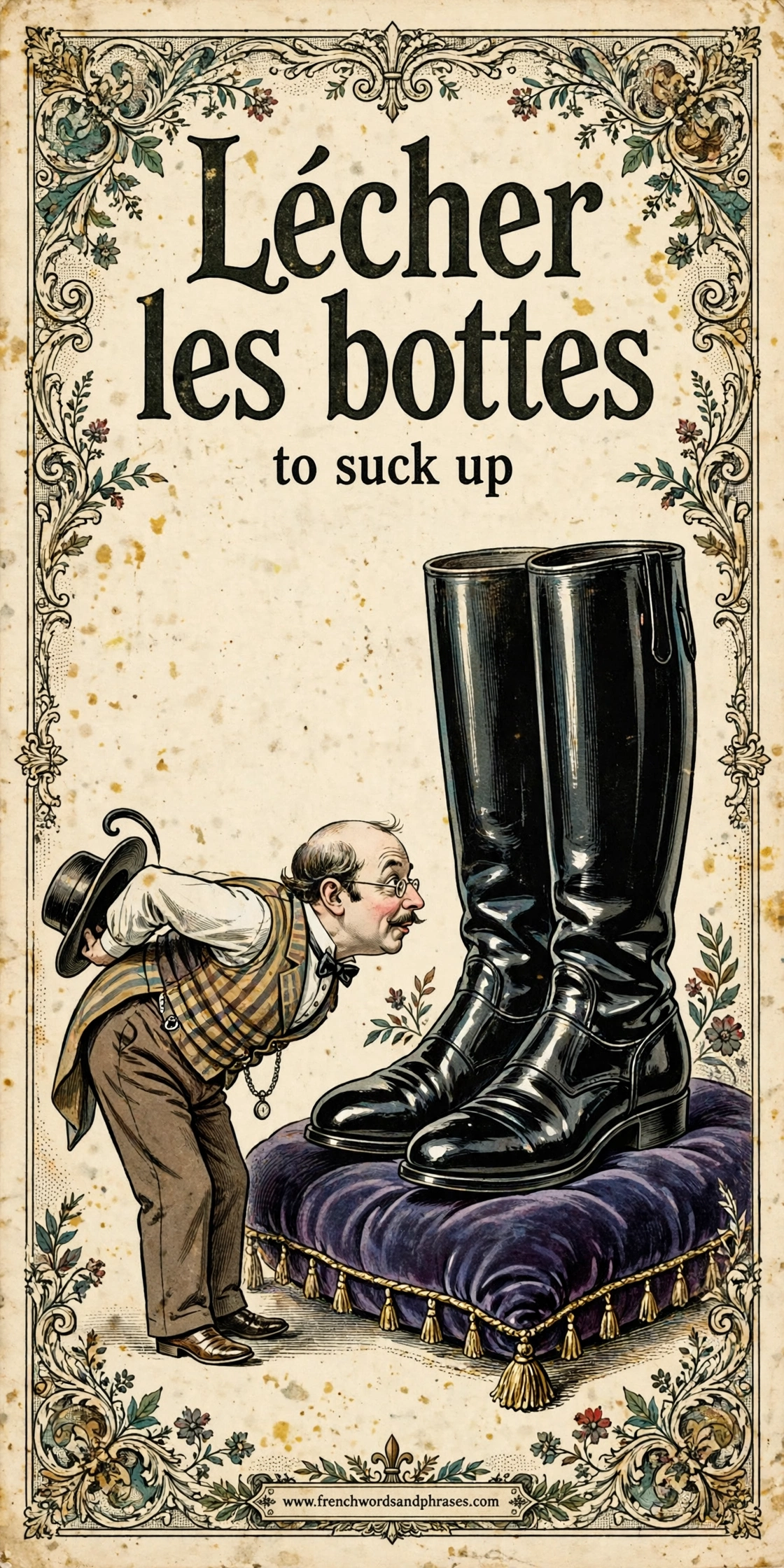
Lécher les bottes means to suck up — to flatter someone shamelessly in order to win their favour.
New term at the office, and one colleague has already complimented the director’s tie, her car, her dog and her holiday photos — before nine o’clock. Behind his hand, the old accountant murmurs to you: « Celui-là, il sait lécher les bottes. »
Let’s explore how lécher les bottes works in French, beginning with the whole phrase on one card.
Understanding the French Phrase Lécher les bottes
Lécher les bottes is a French idiomatic expression built from lécher (to lick) and les bottes (the boots). Full form: lécher les bottes à quelqu’un — to lick someone’s boots. It is the classic French picture of the flatterer: head bowed to the floor, dignity traded for favour.
It means to suck up to someone — to flatter them servilely, hoping for protection, promotion or a kind word from above. Nobody is near any real boots: the picture puts the flatterer’s face at the level of the powerful person’s feet, which is exactly where the speakers of French think flattery lives.
Type: Idiomatic expression — flattery (verb + noun, often + à quelqu’un)
Answers the need: Mocking someone who flatters the powerful to get ahead
Register: Informal, mocking — everyday speech; never a compliment
Strength: Contemptuous — it accuses the flatterer of having no dignity at all
One important usage detail: the boots belong to someone — lécher les bottes au directeur, à la cheffe. The flatterer himself has a noun form: un lèche-bottes, a bootlicker, which never changes in the plural. A softer, smellier cousin exists too: cirer les pompes, to polish someone’s shoes — same bowed head, wax instead of tongue.
Experience the Word
Lécher les bottes is office politics drawn as a cartoon — one pair of boots, one bowed head, and a whole corridor watching.
Imagine the meeting where the new project is, everyone agrees, a disaster — except for one voice praising its genius in three paragraphs. The room does not argue. The room simply pictures the boots, and the argument is over.
French draws the line of dignity at the ankle. Compliments stand upright; flattery, in this phrase, is something done on your knees.
How to Use Lécher les bottes in French: Complete Guide
Let’s explore how lécher les bottes works in French, beginning with the whole phrase on one card.
Lécher les bottes at a Glance
The Whole Phrase on One Card
Real meaning, literal picture, English twin and register — lécher les bottes in five lines.
| Point | Lécher les bottes |
|---|---|
| What it really means | to suck up — to flatter the powerful servilely, for favour |
| Word for word | to lick the boots |
| English equivalent | to lick someone’s boots / to suck up / to brown-nose |
| Register | informal and mocking — an accusation, never praise |
| Use it for | office flatterers, teacher’s pets, courtiers of every kind |
Example
Il passe son temps à lécher les bottes du directeur.
He spends his time sucking up to the director.
Word by Word: Building the Flattery
Three small pieces — a tongue, and the footwear of power.
| Word | Literal meaning | Its job in the phrase |
|---|---|---|
| lécher | to lick | the tongue at work — flattery as something done with the mouth, at floor level |
| les | the | the boots in question — a specific powerful person’s pair |
| bottes | boots | the footwear of the boss, the general, the person whose favour is wanted |
Example
À force de lécher les bottes, il a eu le bureau près de la fenêtre.
By sucking up so much, he got the office by the window.
Quick Quiz 1
Is lécher les bottes ever a compliment?
Reveal the answer
Never — it is an accusation of servile flattery, said about someone, usually behind their back.
Tout le monde voit qu’il lèche les bottes du chef.
Everyone can see he sucks up to the boss.
When You Say It: The Flattery Moments
The phrase fires at moments like these — whenever praise starts smelling of strategy.
| Situation | Example |
|---|---|
| At the office | il lèche les bottes de la directrice depuis janvier — he has been sucking up to the director since January |
| At school | le premier de la classe ? non, un lèche-bottes — top of the class? no, a bootlicker |
| In politics | les courtisans lèchent les bottes du ministre — the courtiers suck up to the minister |
| A warning to a friend | arrête de lécher les bottes, sois toi-même — stop sucking up, be yourself |
| The result | à force de lécher les bottes, il a été promu — by sucking up so hard, he got promoted |
Example
Elle ne lèche les bottes de personne, et tout le monde la respecte.
She sucks up to nobody, and everyone respects her.
Make It Yours: The Boots for Every Flatterer
The boots take an owner — à plus the person whose favour is hunted.
| Form | French | In English |
|---|---|---|
| The activity | lécher les bottes | to suck up, to lick boots |
| With the owner | lécher les bottes au directeur | to suck up to the director |
| The person | un lèche-bottes | a bootlicker, a suck-up |
| Ongoing | passer son temps à lécher les bottes | to spend one’s time sucking up |
| Refusal | ne lécher les bottes de personne | to suck up to nobody |
| Result | à force de lécher les bottes | by dint of sucking up |
Example
Un vrai lèche-bottes : il rit à toutes les blagues du patron.
A real bootlicker: he laughs at all the boss’s jokes.
Quick Quiz 2
How do you name the person — the bootlicker himself?
Reveal the answer
Un lèche-bottes — one word family, hyphens included, and it never changes in the plural: des lèche-bottes.
La réunion était pleine de lèche-bottes.
The meeting was full of bootlickers.
Everyday Expressions: Building on the Boots
Lécher les bottes slots into these everyday frames — each one ready to use as it stands.
| Frame | In English |
|---|---|
| lécher les bottes à quelqu’un | to suck up to someone |
| un lèche-bottes | a bootlicker |
| cirer les pompes à quelqu’un | to polish someone’s shoes — the twin phrase, wax instead of tongue |
| passer de la pommade | to butter someone up — literally ‘to pass the ointment’ |
| être aux petits soins pour quelqu’un | to wait on someone hand and foot — attentive, but it can stay innocent |
Example
Il lui cire les pompes et lui passe de la pommade : un vrai lèche-bottes.
He polishes her shoes and butters her up: a real bootlicker.
Close Cousins: The Other Flatteries
French has a whole shelf of flattery phrases — the boots are the most contemptuous; its cousins soften the bow to various depths.
| Expression | The difference |
|---|---|
| lécher les bottes | to suck up — servile, contemptuous, at floor level |
| cirer les pompes | to polish the shoes — the same servility, told with wax; equally mocking |
| passer de la pommade à quelqu’un | to butter someone up — flattery as ointment, a shade gentler |
| flatter l’ego de quelqu’un | to flatter someone’s ego — neutral description, no picture, no boots |
| faire des compliments | to pay compliments — the innocent act itself; only the motive makes it boot-licking |
Example
Un compliment sincère se fait debout ; les bottes, c’est autre chose.
A sincere compliment is made standing up; boots are another matter.
Quick Quiz 3
Your colleague sincerely admires the boss’s presentation and says so once, clearly. Boot-licking?
Reveal the answer
No — lécher les bottes accuses servility and strategy: repeated, excessive flattery aimed at favour. One honest compliment stands upright.
Elle a fait un compliment sincère, sans lécher les bottes de personne.
She paid a sincere compliment, without sucking up to anyone.
Lécher les bottes and Its Neighbours
The flattery shelf around the phrase — the boots, the wax and the ointment.
| French | In English |
|---|---|
| des bottes | boots |
| des pompes | shoes (slang) |
| la pommade | ointment — and flattery, in the cousin phrase |
| un compliment | a compliment |
| la faveur | favour — what the flatterer is hunting |
| la dignité | dignity — what the flatterer is spending |
Example
Il a dépensé sa dignité pour acheter une faveur.
He spent his dignity to buy a favour.
Watch Out: The Traps Around Lécher les bottes
The traps: real boots, a missing owner, and a compliment mistaken for a crime.
| Trap | The truth |
|---|---|
| the dog trap | a dog can lécher les bottes literally after a muddy walk — the idiom needs a human flatterer and a human ‘boss’ |
| the owner matters | bare lécher les bottes works, but the phrase bites hardest with its owner: lécher les bottes AU directeur |
| never say it to their face kindly | it is an accusation — said to someone’s face, it starts an argument, not a laugh |
| lèche-bottes spelling | the noun keeps its hyphens and its s in all numbers: un lèche-bottes, des lèche-bottes |
Example
Le chien lèche les bottes du facteur ; le stagiaire, celles du directeur.
The dog licks the postman’s boots; the intern, the director’s.
Quick Quiz 4
True or false: cirer les pompes is the polite, respectful version of the phrase.
Reveal the answer
False — it is the twin, not the polite version: polishing the boss’s shoes is the same bowed head, with wax. Both accuse servility.
Lécher les bottes ou cirer les pompes, c’est le même métier.
Licking boots or polishing shoes, it’s the same trade.
Lécher les bottes in Everyday French: Real-Life Examples
Now that you know the word, let’s see how lécher les bottes appears in everyday French.
Example 1 — At the office
Il lèche les bottes du directeur depuis le premier jour.
He has been sucking up to the director since day one.
Example 2 — The staffroom joke
Notre lèche-bottes préféré a encore complimenté la cravate du chef.
Our favourite bootlicker has complimented the boss’s tie again.
Example 3 — A friend’s warning
Arrête de lécher les bottes, elle voit clair dans ton jeu.
Stop sucking up, she can see right through your game.
Example 4 — Standing tall
Elle a eu le poste sans lécher les bottes de personne.
She got the job without sucking up to anyone.
Example 5 — In politics
Les courtisans lèchent les bottes du ministre à longueur de journée.
The courtiers suck up to the minister all day long.
Example 6 — The promotion
À force de lécher les bottes, il est devenu chef de service.
By sucking up so persistently, he became head of department.
Beyond Translation: The Meaning of Lécher les bottes
English keeps the same picture — bootlicker is a word-for-word twin, proof that the bowed head needs no translation. French adds a wardrobe: the same flatterer can cirer les pompes with wax or passer de la pommade with ointment, a whole shoe-shine stand of servility.
All the French versions agree on the geometry: flattery happens below the ankle, dignity above it.
That is the phrase’s real use in an office — not cruelty, but cartography. It tells everyone exactly where a person has chosen to stand: upright, or at the boots.
How to Remember the French Phrase Lécher les bottes
Remember it this way: Lécher les bottes is flattery drawn at floor level — a tongue, a pair of boots, and a dignity quietly left at the door.
- You picture the geometry — compliments are made standing; lécher les bottes happens on your knees, at the boss’s feet.
- You give the boots an owner — lécher les bottes au directeur, and the flatterer himself is un lèche-bottes.
- You remember the wardrobe — cirer les pompes and passer de la pommade are the same servility with different tools.
The key idea is lécher les bottes means to suck up — to flatter the powerful servilely, at floor level.
Test Your Knowledge of Lécher les bottes
Let’s see how much you’ve learned. Try answering these questions before revealing the answers.
Question 1
What does lécher les bottes mean?
Reveal the answer
To suck up — to flatter someone powerful servilely, hoping for favour.
Question 2
How do you say ‘a bootlicker’ in French?
Reveal the answer
Un lèche-bottes — hyphenated, and unchanged in the plural.
Question 3
How do you say ‘to suck up to the director’?
Reveal the answer
Lécher les bottes au directeur — the boots always belong to someone.
Question 4
What does cirer les pompes mean?
Reveal the answer
To polish someone’s shoes — the twin phrase for sucking up, wax instead of tongue, and just as mocking.
Question 5
Complete the sentence:
Il passe ses journées à lécher les ______ du ministre. (He spends his days sucking up to the minister.)
Reveal the answer
bottes
Il passe ses journées à lécher les bottes du ministre.
He spends his days licking the minister’s boots.
Your Final Challenge
Can You Use It?
How would you say this in French?
“He spends his days sucking up to the director.”
Reveal the answer
Il passe ses journées à lécher les bottes du directeur.
He spends his days sucking up to the director.
A little French. A little curiosity. A richer everyday life.
LEARN FRENCH ONE WORD AT A TIME