A French Word to Live By
Translate Avoir du blé to English
/a.vwaʁ dy ble/
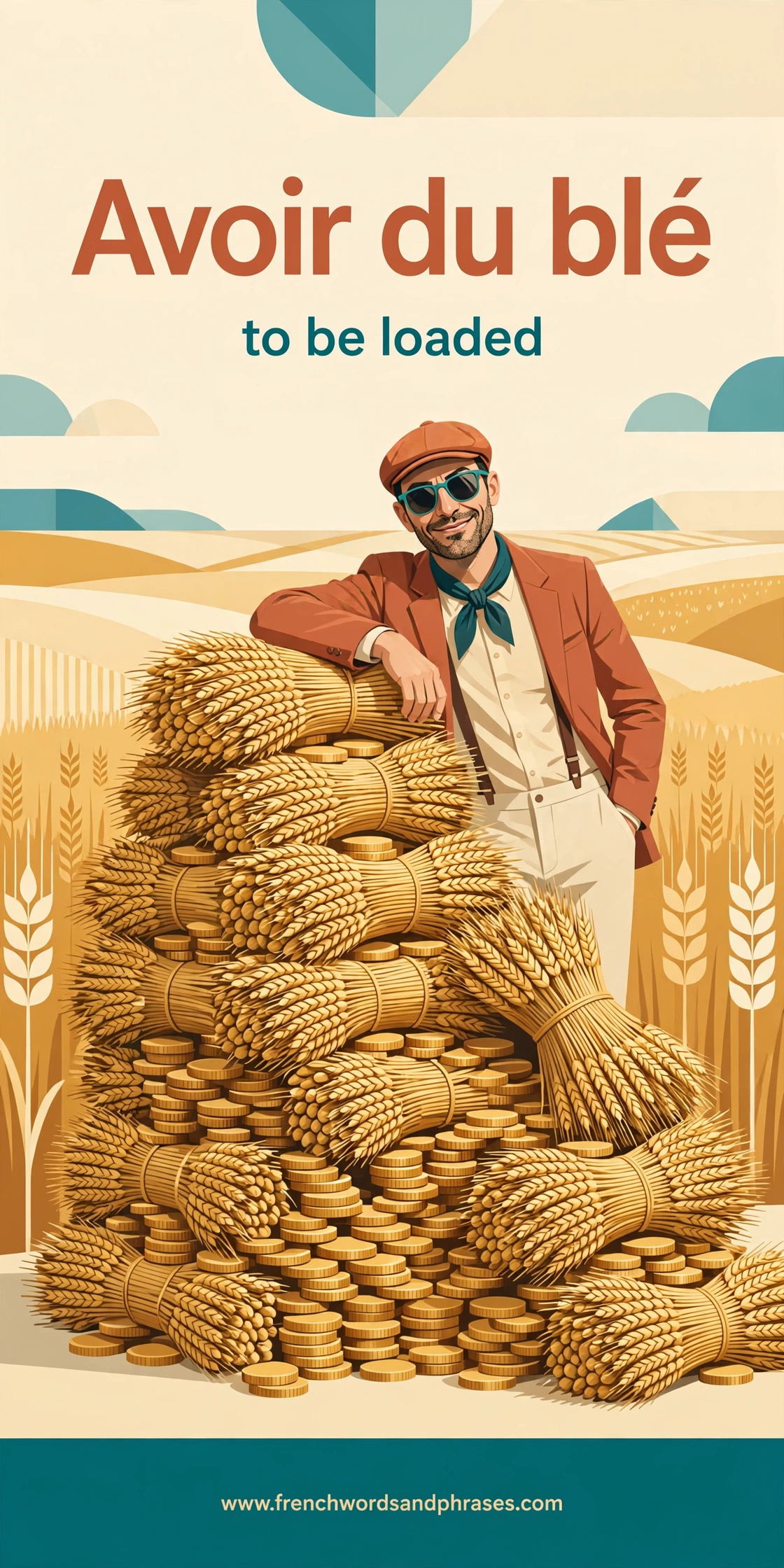
Avoir du blé means to have money — wheat in the barn, cash in the pocket.
The antique dealer has not haggled. He has not even blinked. He has simply opened a wallet thick enough to need its own chair, while the whole market watches. The stallholder next door leans over and delivers the oldest diagnosis in French slang, grinning: « Celui-là, il a du blé. »
Let’s explore how avoir du blé works in French, beginning with the whole phrase on one card.
Understanding the French Phrase Avoir du blé
Avoir du blé is a French slang expression built from avoir (to have) and du blé (some wheat). Wheat was wealth for centuries — the full barn meant survival and the empty one meant hunger — so blé became one of the classic French slang words for money, the exact cousin of English ‘dough’.
It means to have money — comfortably, noticeably, sometimes enviably. Avoir du blé does not count coins; it describes a state: the wallet is full, the barn is stocked, life is funded. Said of others it can carry admiration, teasing or a touch of envy; said of yourself, it is a cheerful confession that things are going well.
Type: Slang expression — money (avoir + du blé, wheat)
Answers the need: Saying someone has plenty of money, in slang
Register: Informal — classic French slang (argot), understood by everyone
Strength: Comfortable — well-off and funded, not necessarily a millionaire
One important usage detail: blé for money never takes a plural here and keeps its partitive — avoir du blé, gagner du blé, avoir plein de blé. The literal wheat has not retired, though: un champ de blé is a wheat field, and only the company of money-verbs (avoir, gagner, perdre) tells you which harvest is meant.
Experience the Word
Avoir du blé is a farming metaphor that survived the city — money you can almost smell, like a barn in August.
Imagine the great-grandfather at the market in 1900, selling his wheat at a good price, coins heavy in a leather purse. For him the sentence was not slang at all; it was the year’s result. His great-grandchildren say the same words about salaries and startups, and the old barn still stands inside the phrase, full and golden.
Slang is history that refused to sit down. Every time a Parisian says blé for money, a harvest is being counted.
How to Use Avoir du blé in French: Complete Guide
Let’s explore how avoir du blé works in French, beginning with the whole phrase on one card.
Avoir du blé at a Glance
The Whole Phrase on One Card
Real meaning, literal picture, English twin and register — avoir du blé in five lines.
| Point | Avoir du blé |
|---|---|
| What it really means | to have plenty of money — to be well-off, loaded |
| Word for word | to have some wheat — the full barn of the farming centuries |
| English equivalent | to have dough / to be loaded / to have plenty of cash |
| Register | informal — classic slang, understood everywhere in France |
| Use it for | full wallets, good salaries, lucky uncles and funded plans |
Example
Avec son nouveau travail, elle a du blé.
With her new job, she’s got money.
Word by Word: Building the Fortune
Three small pieces — take them one by one and the barn fills up.
| Word | Literal meaning | Its job in the phrase |
|---|---|---|
| avoir | to have | the verb of the stocked barn and the full wallet alike |
| du | some | the partitive of plenty — an uncounted, comfortable amount |
| blé | wheat | the harvest that was wealth itself for a thousand years |
Example
Le blé se récolte en été ; le blé des salaires, toute l’année.
Wheat is harvested in summer; salary-wheat, all year round.
Quick Quiz 1
Why does blé, wheat, mean money in French slang?
Reveal the answer
Because wheat was wealth — a full barn meant a family would eat and trade; the harvest became the fortune.
Autrefois, avoir du blé, c’était être riche pour de vrai.
In the old days, having wheat meant being truly rich.
When You Say It: The Full-Wallet Moments
Avoir du blé fires at moments like these — the wallet opens, and the room does the arithmetic.
| Situation | Example |
|---|---|
| The generous uncle | mon oncle a du blé, il invite tout le monde — my uncle has money, he’s treating everyone |
| A good salary | elle gagne du blé avec son cabinet — she earns good money with her practice |
| Teasing a friend | toi, tu as du blé, tu peux bien payer le café — you’ve got money, you can pay for the coffee |
| A funded project | ils ont du blé pour ouvrir le restaurant — they have the money to open the restaurant |
| Envy, lightly worn | il a du blé, une belle maison, et jamais un souci — he has money, a fine house, and never a worry |
Example
Depuis sa promotion, il a du blé et il en profite.
Since his promotion, he’s got money and he’s enjoying it.
Make It Yours: The Fortune for Every Owner
Avoir conjugates through the harvests — the wheat itself never changes.
| Form | French | In English |
|---|---|---|
| He has money | il a du blé | he’s got money |
| To earn money | gagner du blé | to earn good money |
| Plenty of it | avoir plein de blé | to have loads of money |
| In the past | il avait du blé autrefois | he used to have money |
| To lose it | perdre son blé | to lose your money — at cards, classically |
Example
Elle gagne du blé et elle le met de côté.
She earns good money and she puts it aside.
Quick Quiz 2
Is avoir du blé polite enough for a bank meeting?
Reveal the answer
No — it is cheerful slang. At the bank, say avoir de l’argent or disposer de fonds.
Entre amis : « Tu as du blé ? » À la banque : « Je dispose de fonds. »
Between friends: ‘Got money?’ At the bank: ‘I have funds available.’
Everyday Expressions: Building on the Wheat
Avoir du blé slots into these everyday frames — each one ready to use as it stands.
| Frame | In English |
|---|---|
| avoir du blé | to have money, to be loaded |
| gagner du blé | to earn money |
| plein de blé | loads of money |
| se faire du blé | to make yourself money — informal and pleased about it |
| un champ de blé | a wheat field — the literal harvest, still alive and well |
Example
Il s’est fait du blé en vendant sa première entreprise.
He made good money selling his first company.
Close Cousins: The Other Money Slang
French has a whole shelf of money slang — blé is the golden classic; its cousins are coins, dough and banknotes.
| Expression | The difference |
|---|---|
| avoir du blé | to have money — the harvest classic, warm and understood by all |
| avoir de l’oseille | to have money — oseille is sorrel, another green plant turned cash |
| avoir du fric | to have cash — fric is the blunt, modern everyday slang word |
| être plein aux as | to be loaded — rich to the seams, stronger than blé |
| avoir un rond | to have a penny — usually negative: ne pas avoir un rond, to not have a bean |
Example
Du blé, du fric, de l’oseille : en France, l’argent pousse partout.
Wheat, cash, sorrel: in France, money grows everywhere.
Quick Quiz 3
Which cousin means flat broke — plein de blé or ne pas avoir un rond?
Reveal the answer
Ne pas avoir un rond — not to have a single round coin. Plein de blé is the opposite shore.
En fin de mois, il n’a plus un rond.
At the end of the month, he hasn’t got a bean.
Avoir du blé and Its Neighbours
The money shelf around the phrase — harvests, coins and empty pockets.
| French | In English |
|---|---|
| le blé | wheat — and money, in slang |
| l’argent | money — the neutral word, also silver |
| le fric | cash (slang) |
| gagner | to earn, to win |
| un rond | a round coin — in ne pas avoir un rond, a penny |
| fauché | skint, broke — the empty-barn state |
Example
Hier fauché, aujourd’hui plein de blé : la roue tourne.
Skint yesterday, loaded today: the wheel turns.
Watch Out: The Traps Around Avoir du blé
The traps: real wheat, real banks, and a harvest that never pluralises.
| Trap | The truth |
|---|---|
| the field trap | un champ de blé is agriculture, not finance — money-verbs (avoir, gagner, perdre) switch the word to slang |
| slang stays informal | blé is for friends and markets; contracts, banks and bosses get argent or fonds |
| no plural, no counting | money-blé is a mass: du blé, plein de blé — you never count blés in a wallet |
| not always envy | said warmly it congratulates; the same words with a curled lip can accuse — the tone farms the meaning |
Example
Il a du blé, dit-elle avec un sourire, pas avec envie.
He’s got money, she said with a smile, not with envy.
Quick Quiz 4
True or false: blé for money can be counted — trois blés in your pocket.
Reveal the answer
False — as money, blé is an uncountable mass, like the English ‘dough’: du blé, plein de blé.
Il a du blé, beaucoup de blé, mais jamais « des blés ».
He has money, lots of money, but never ‘moneys’.
Avoir du blé in Everyday French: Real-Life Examples
Now that you know the word, let’s see how avoir du blé appears in everyday French.
Example 1 — The uncle
Mon oncle a du blé : c’est lui qui offre le restaurant.
My uncle has money: he’s the one treating us to the restaurant.
Example 2 — The salary
Avec son nouveau poste, elle gagne du blé.
With her new job, she earns good money.
Example 3 — The tease
Tu as du blé, toi — le café est pour toi !
You’ve got money — the coffee’s on you!
Example 4 — The project
Ils ont enfin du blé pour rénover la maison.
They finally have the money to renovate the house.
Example 5 — The cards
Il a perdu tout son blé au poker.
He lost all his money at poker.
Example 6 — The good years
À l’époque, l’entreprise avait du blé et des commandes partout.
Back then, the company had money and orders everywhere.
Beyond Translation: The Meaning of Avoir du blé
English speakers will feel at home here: dough means money in English slang for exactly the same reason — bread is wealth before it is food. Two farming peoples, two languages, one metaphor: what feeds you is what enriches you, and the grain in the barn became the coin in the purse without changing its name.
Avoir du blé keeps a thousand harvests inside a modern wallet.
It is slang, yes — but slang with a pedigree, older than banks, and it will probably outlive a few more.
How to Remember the French Phrase Avoir du blé
Remember it this way: Avoir du blé is the full barn of slang — for a thousand years, wheat in the loft was money in the hand.
- You picture the harvest — blé is wheat, and a full barn was the original fortune.
- You hear its English twin — dough: two languages, one bread-money metaphor.
- You keep it uncountable and informal — du blé, plein de blé, for friends; argent for the bank.
The key idea is avoir du blé means to have money — wheat, the harvest that was wealth itself.
Test Your Knowledge of Avoir du blé
Let’s see how much you’ve learned. Try answering these questions before revealing the answers.
Question 1
What does avoir du blé mean?
Reveal the answer
To have money — to be well-off, comfortably funded, loaded.
Question 2
Why does blé mean money?
Reveal the answer
Because wheat was wealth — for centuries a full barn of wheat was a family’s fortune and food at once.
Question 3
How do you say ‘she earns good money’?
Reveal the answer
Elle gagne du blé — gagner replaces avoir when the money is being earned.
Question 4
What is the English slang twin of blé?
Reveal the answer
Dough — English made money out of bread-stuff in exactly the same way.
Question 5
Complete the sentence:
Depuis sa promotion, il a du ______. (Since his promotion, he’s got money.)
Reveal the answer
blé
Depuis sa promotion, il a du blé.
Since his promotion, he’s got money.
Your Final Challenge
Can You Use It?
How would you say this in French?
“With his new restaurant, he finally has money.”
Reveal the answer
Avec son nouveau restaurant, il a enfin du blé.
With his new restaurant, he finally has money.
A little French. A little curiosity. A richer everyday life.
LEARN FRENCH ONE WORD AT A TIME