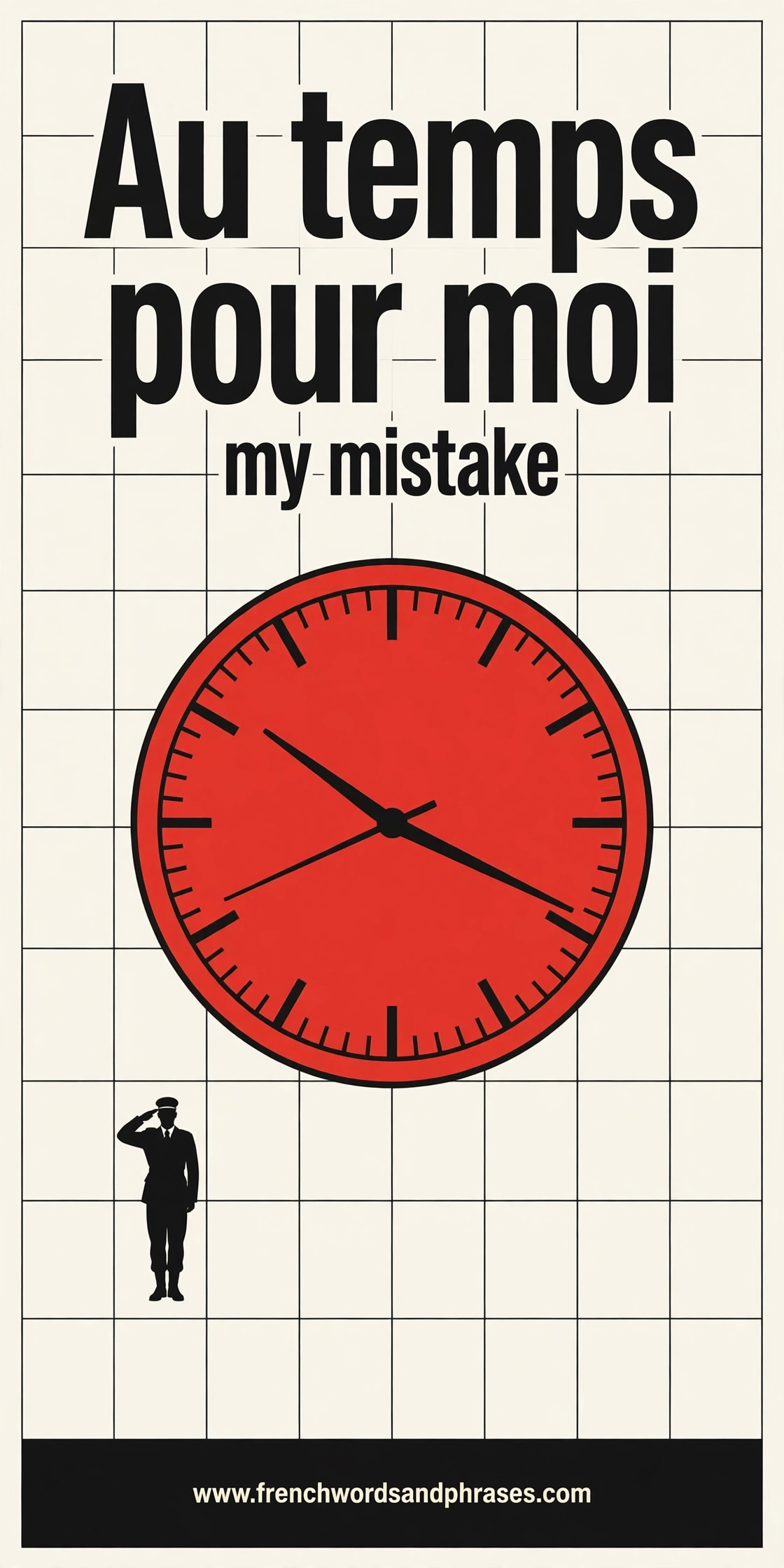
A French Word to Live By
Translate Au temps pour moi to English
/o tɑ̃ puʁ mwa/
Au temps pour moi means my mistake — a neat, honest way to admit you got it wrong.
The guide has been explaining, with great confidence, that the cathedral was built in 1340. A small voice from the front row points at the plaque: 1430. The guide reads it twice, smiles like a soldier caught out of step, and gives the army’s own confession: « Au temps pour moi ! » The whole group laughs — error admitted, honour intact.
Let’s explore how au temps pour moi works in French, beginning with the whole phrase on one card.
Understanding the French Phrase Au temps pour moi
Au temps pour moi is a French expression built from au temps (in time, on the beat) and pour moi (for me). It comes from the parade ground: « au temps ! » was the drill command to restart a movement in step, and the soldier who had marched out of time owned up with au temps pour moi — back on the beat, for me.
It means my mistake — I was wrong, fair enough, let me correct that. It is the elegant French way to admit an error without drama: no excuses, no blaming the plaque, just a clean step back into line. You will hear it from teachers, presenters, officials and friends — anyone who would rather be accurate than proud.
Type: Set expression — admitting an error (from military drill: au temps, in time)
Answers the need: Saying ‘my mistake, I was wrong’ cleanly and without excuses
Register: Neutral to slightly formal — polished speech and writing; friendlier than a bare pardon
Strength: Complete but light — a full admission that keeps everyone’s dignity
One important usage detail: you will constantly see it written « autant pour moi ». That spelling is everywhere, but the drill-ground origin gives au temps — the soldier returns to the beat (le temps), he does not say ‘as much for me’. Careful writers keep au temps; the phrase you speak sounds identical either way, which is exactly how the confusion was born.
Experience the Word
Au temps pour moi is an apology with its chin up — the error is admitted in uniform, at attention, and then the march continues.
Imagine the recruit on the parade ground, half a step ahead of the whole regiment, hearing the sergeant’s « au temps ! » ring across the square. He does not argue with the drum. He steps back into the beat and owns it: au temps pour moi. Two hundred years later, professors and prime ministers use the same words to step back into line.
French turns even being wrong into a drill movement. Admit, realign, march on — the phrase does all three in four words.
How to Use Au temps pour moi in French: Complete Guide
Let’s explore how au temps pour moi works in French, beginning with the whole phrase on one card.
Au temps pour moi at a Glance
The Whole Phrase on One Card
Real meaning, literal picture, English twin and register — au temps pour moi in five lines.
| Point | Au temps pour moi |
|---|---|
| What it really means | my mistake — I was wrong, let me correct that |
| Word for word | in time, for me — back on the beat, for my part |
| English equivalent | my mistake / my bad / fair enough, I was wrong |
| Register | neutral to polished — classrooms, studios, speeches and dinner tables |
| Use it for | wrong dates, wrong names, wrong turns — any clean admission of error |
Example
Le train part à huit heures, pas à neuf. Au temps pour moi !
The train leaves at eight, not nine. My mistake!
Word by Word: Building the Confession
Four small pieces — take them one by one and the soldier steps back into line.
| Word | Literal meaning | Its job in the phrase |
|---|---|---|
| au | to the, in the | the movement word — back to the position named next |
| temps | time, the beat | the drill beat of the parade ground; to march au temps is to march in step |
| pour | for | assigns the fault — it lands on the speaker |
| moi | me | the volunteer: the error is mine, says the one who made it |
Example
Marcher au temps, c’est marcher ensemble ; se tromper, c’est parfois marcher seul.
To march in time is to march together; to be wrong is sometimes to march alone.
Quick Quiz 1
Where does au temps pour moi come from?
Reveal the answer
From military drill — « au temps ! » ordered soldiers to restart a movement in step; the one out of step answered au temps pour moi.
Le soldat s’est trompé de pas : « Au temps pour moi ! »
The soldier missed his step: ‘My mistake!’
When You Say It: The Owning-Up Moments
Au temps pour moi fires at moments like these — the date was wrong, the name was wrong, and everyone knows it.
| Situation | Example |
|---|---|
| A wrong date | c’est mardi, pas lundi — au temps pour moi ! — it’s Tuesday, not Monday — my mistake! |
| A wrong name | elle s’appelle Claire, au temps pour moi — her name is Claire, my mistake |
| Correcting yourself mid-sentence | le musée est à gauche… non, à droite. Au temps pour moi — the museum is on the left… no, the right. My mistake |
| In a meeting | mes chiffres étaient faux, au temps pour moi — my figures were wrong, my mistake |
| Gracefully, in writing | je corrige : au temps pour moi, la réunion est à dix heures — I correct myself: my mistake, the meeting is at ten |
Example
J’ai dit le contraire tout à l’heure : au temps pour moi.
I said the opposite just now: my mistake.
Make It Yours: The Admission for Every Error
The phrase is a complete sentence of surrender — it needs nothing but the correction after it.
| Form | French | In English |
|---|---|---|
| Alone | au temps pour moi ! | my mistake! |
| With the correction | au temps pour moi, c’est demain | my mistake, it’s tomorrow |
| Doubled down, humbly | au temps pour moi, je me suis trompé | my mistake, I got it wrong |
| The common spelling | autant pour moi | the widespread written variant — same sound, debated spelling |
| Question to a friend | au temps pour toi ? | your mistake? — handing the confession over, with a smile |
Example
Au temps pour moi, je me suis trompé de rue.
My mistake, I took the wrong street.
Quick Quiz 2
Which spelling matches the drill-ground origin — au temps or autant?
Reveal the answer
Au temps — the soldier returns to the beat (le temps). Autant pour moi is the very common spelling the sound has produced.
On écrit « au temps pour moi » quand on pense au tambour.
You write ‘au temps pour moi’ when you think of the drum.
Everyday Expressions: Building on the Admission
Au temps pour moi slots into these everyday frames — each one ready to use as it stands.
| Frame | In English |
|---|---|
| au temps pour moi | my mistake |
| je me suis trompé | I was wrong, I made a mistake — the plain admission |
| je corrige | let me correct that — the presenter’s move |
| c’est de ma faute | it’s my fault — heavier, for real harm |
| pardon, je reprends | sorry, let me start that again |
Example
Je me suis trompé de jour : au temps pour moi.
I got the day wrong: my mistake.
Close Cousins: The Other Ways to Be Wrong
French has a whole shelf of error phrases — au temps pour moi is the elegant one; its cousins apologise, confess or joke.
| Expression | The difference |
|---|---|
| au temps pour moi | my mistake — clean, poised, from the parade ground |
| je me suis trompé | I was wrong — the plain, neutral admission for every day |
| mea culpa | my fault — Latin, grander and heavier, half confession, half theatre |
| oups, pardon | oops, sorry — the light, spoken reflex for small slips |
| je reconnais mon erreur | I acknowledge my error — formal, written, official |
Example
Pas de mea culpa interminable : au temps pour moi, et on avance.
No endless mea culpa: my mistake, and we move on.
Quick Quiz 3
You have caused real harm, not just a wrong date. Is au temps pour moi enough?
Reveal the answer
Probably not — it shines for factual errors. For real harm, French reaches for c’est de ma faute and a true pardon.
Ce n’est pas un simple « au temps pour moi » : je te demande pardon.
This is not a simple ‘my mistake’: I’m asking your forgiveness.
Au temps pour moi and Its Neighbours
The error shelf around the phrase — drums, faults and fresh starts.
| French | In English |
|---|---|
| une erreur | a mistake, an error |
| se tromper | to be wrong, to make a mistake |
| le temps | time — and the drill beat of the origin |
| corriger | to correct |
| avouer | to admit, to confess |
| reprendre | to start again, to resume — the march after the confession |
Example
Avouer, corriger, reprendre : au temps pour moi, et la leçon continue.
Admit, correct, resume: my mistake, and the lesson goes on.
Watch Out: The Traps Around Au temps pour moi
The traps: a spelling that splits the nation, a phrase that is not an apology for harm, and a beat that is not a clock.
| Trap | The truth |
|---|---|
| the autant spelling | autant pour moi is written everywhere and understood by all — but the origin, and careful style, say au temps |
| temps is the beat, not the hour | here temps is the drill tempo, not clock time — the soldier steps back into rhythm, not into yesterday |
| not for real offences | for a wrong fact it is perfect; for a broken promise it is too light — upgrade to a real apology |
| it admits, it does not excuse | the phrase owns the error; adding ‘mais’ and an excuse immediately afterwards spends all its elegance |
Example
Au temps pour moi — sans « mais », sans excuse.
My mistake — with no ‘but’, no excuse.
Quick Quiz 4
True or false: au temps pour moi and autant pour moi are pronounced differently.
Reveal the answer
False — they sound identical, which is exactly how the second spelling was born.
À l’oral, impossible de distinguer « au temps » et « autant ».
Aloud, it’s impossible to tell ‘au temps’ and ‘autant’ apart.
Au temps pour moi in Everyday French: Real-Life Examples
Now that you know the word, let’s see how au temps pour moi appears in everyday French.
Example 1 — The wrong day
La réunion est demain, pas aujourd’hui. Au temps pour moi !
The meeting is tomorrow, not today. My mistake!
Example 2 — The wrong name
Elle s’appelle Léa, pas Léonie. Au temps pour moi.
Her name is Léa, not Léonie. My mistake.
Example 3 — The teacher
J’ai écrit 1789 pour la prise de la Bastille… c’est juste, en fait. Non — au temps pour moi, continuons.
I wrote 1789 for the storming of the Bastille… that’s right, actually. No — my mistake, let’s carry on.
Example 4 — The wrong street
Ce n’est pas cette rue, c’est la suivante. Au temps pour moi !
It’s not this street, it’s the next one. My mistake!
Example 5 — The figures
Mes calculs étaient faux : au temps pour moi, voici les bons.
My calculations were wrong: my mistake, here are the right ones.
Example 6 — With a smile
Au temps pour moi ! On reprend depuis le début.
My mistake! Let’s start again from the top.
Beyond Translation: The Meaning of Au temps pour moi
English admits error like a shrug — my bad — or like a courtroom — I was wrong. French marches it back into line like a soldier: the beat was there, I stepped out of it, I step back in. There is discipline in the phrase, and also mercy, because the regiment does not stop to punish the step; it simply resumes the march.
Au temps pour moi is pride managed gracefully: the fault is mine, the beat is ours.
Perhaps that is why France argues about its spelling with such passion — a nation that loves the phrase wants to march it correctly.
How to Remember the French Phrase Au temps pour moi
Remember it this way: Au temps pour moi is the soldier stepping back into the beat — admit the missed step, realign, and march on.
- You hear the drum — au temps was the drill command to restart in step; the wrong step answers pour moi.
- You spell it with the beat — au temps, from the parade ground, however often you see autant.
- You keep it for facts — wrong dates and names, yes; real harm needs a heavier apology.
The key idea is au temps pour moi means my mistake — the parade-ground confession of a soldier back in step.
Test Your Knowledge of Au temps pour moi
Let’s see how much you’ve learned. Try answering these questions before revealing the answers.
Question 1
What does au temps pour moi mean?
Reveal the answer
My mistake — I was wrong, and here is the correction.
Question 2
Where does the phrase come from?
Reveal the answer
From military drill — au temps was the command to restart a movement in step; the soldier out of step owned up with pour moi.
Question 3
How do you say ‘my mistake, it’s tomorrow’?
Reveal the answer
Au temps pour moi, c’est demain — confession first, correction right behind it.
Question 4
Why do so many people write autant pour moi?
Reveal the answer
Because the two sound identical — the spelling autant grew from the sound; the origin gives au temps, the beat.
Question 5
Complete the sentence:
J’ai confondu les dates : au ______ pour moi ! (I mixed up the dates: my mistake!)
Reveal the answer
temps
J’ai confondu les dates : au temps pour moi !
I mixed up the dates: my mistake!
Your Final Challenge
Can You Use It?
How would you say this in French?
“The meeting is on Tuesday, not Monday — my mistake.”
Reveal the answer
La réunion est mardi, pas lundi — au temps pour moi.
The meeting is on Tuesday, not Monday — my mistake.
A little French. A little curiosity. A richer everyday life.
LEARN FRENCH ONE WORD AT A TIME