A French Word to Live By
Translate Au diable vauvert to English
/o djabl vo.vɛʁ/
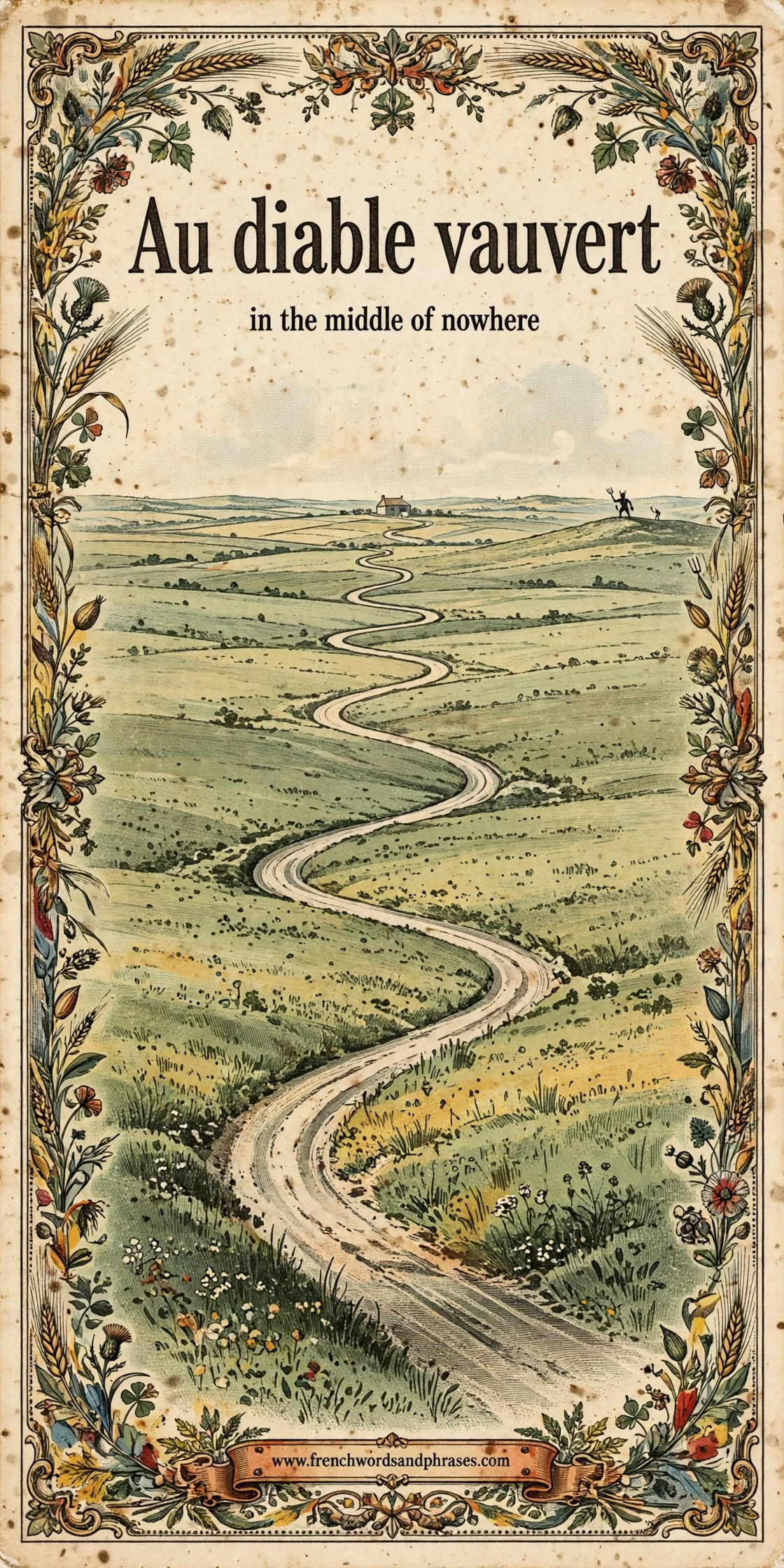
Au diable vauvert means in the middle of nowhere — as far away as far can be.
The delivery driver rings for the third time. ‘Your parcel is at the depot.’ ‘Which depot?’ A silence, a keyboard, and then the name of a village so small that the map folds over it. Forty kilometres of lanes, one tractor, no signal. You hang up and announce it to the kitchen: « C’est au diable vauvert. »
Let’s explore how au diable vauvert works in French, beginning with the whole phrase on one card.
Understanding the French Phrase Au diable vauvert
Au diable vauvert is a French idiomatic expression built from au (to the), diable (devil) and Vauvert — a place name that became legendary. A château at Vauvert, south of Paris where the Jardin des Plantes now stands, was said in the Middle Ages to be haunted by the devil himself; a place that far and that cursed became the address of the back of beyond.
It means in the middle of nowhere — very far away, at the end of the world, in a place nobody can find on the first try. It also works as a sending: envoyer quelqu’un au diable vauvert is to tell someone to get lost, to send them packing to the furthest address imagination keeps. Distance and dismissal in one phrase.
Type: Idiomatic expression — remoteness (au + diable + Vauvert, a legendary place)
Answers the need: Saying a place is extremely far, lost in the middle of nowhere
Register: Neutral to informal — vivid everyday speech, a little old-fashioned charm
Strength: Maximum — not just far, but devilishly, hopelessly far
One important usage detail: vauvert never changes and never takes an article — c’est au diable vauvert, il habite au diable vauvert. The devil of the phrase is a tenant, not the point: the phrase is about distance, not damnation, and it is said about villages, depots and in-laws’ holiday cottages, never about actual hell.
Experience the Word
Au diable vauvert is the address French gives to every place the map seems to have forgotten.
Imagine the medieval Parisians crossing themselves as they passed the ruined château beyond the city walls, where lights moved at night and no tenant ever stayed. The devil had an address, and it was just far enough to be frightening. Six centuries later, the fear has become a joke — but the distance remains exactly the same.
Every language keeps a capital city of far away. France’s is a haunted village, and the devil is its oldest resident.
How to Use Au diable vauvert in French: Complete Guide
Let’s explore how au diable vauvert works in French, beginning with the whole phrase on one card.
Au diable vauvert at a Glance
The Whole Phrase on One Card
Real meaning, literal picture, English twin and register — au diable vauvert in five lines.
| Point | Au diable vauvert |
|---|---|
| What it really means | in the middle of nowhere — extremely far away |
| Word for word | at the devil Vauvert’s — the devil’s legendary far-off address |
| English equivalent | in the middle of nowhere / at the back of beyond / miles from anywhere |
| Register | neutral to informal — vivid, a touch old-fashioned |
| Use it for | remote villages, lost depots, and sending people packing |
Example
Son village est au diable vauvert, à deux heures de la gare.
His village is in the middle of nowhere, two hours from the station.
Word by Word: Building the Back of Beyond
Three small pieces — take them one by one and the road gets longer.
| Word | Literal meaning | Its job in the phrase |
|---|---|---|
| au | to the, at the | the address word — you are placing something on the map |
| diable | the devil | the legendary tenant whose remoteness measures the distance |
| vauvert | Vauvert | a real place name turned legend — the haunted château beyond Paris, and a village in the Gard |
Example
Le diable lui-même trouverait le chemin long jusqu’au diable vauvert.
Even the devil would find the road long to the middle of nowhere.
Quick Quiz 1
Who or what is Vauvert in the phrase?
Reveal the answer
A place — a château near Paris said to be haunted by the devil, whose name became the word for the far end of the world.
Ne cherche pas, c’est au diable vauvert.
Don’t bother looking, it’s in the middle of nowhere.
When You Say It: The Far-Away Moments
Au diable vauvert fires at moments like these — the map runs out, the signal dies.
| Situation | Example |
|---|---|
| A remote village | ils habitent au diable vauvert — they live in the middle of nowhere |
| A lost depot | le colis est dans un dépôt au diable vauvert — the parcel is in a depot miles from anywhere |
| A long journey | on a roulé jusqu’au diable vauvert — we drove to the back of beyond |
| Sending someone away | va au diable vauvert ! — go to the devil, get lost! |
| Exaggerating for fun | tu as garé la voiture au diable vauvert — you parked the car miles away |
Example
Pour un litre de lait, il faut aller au diable vauvert.
For a litre of milk, you have to go to the middle of nowhere.
Make It Yours: The Address for Every Distance
The phrase is a fixed address — verbs of place and motion do the travelling.
| Form | French | In English |
|---|---|---|
| To be there | c’est au diable vauvert | it’s in the middle of nowhere |
| To live there | habiter au diable vauvert | to live at the back of beyond |
| To go there | aller au diable vauvert | to go miles from anywhere |
| To send someone there | envoyer quelqu’un au diable vauvert | to tell someone to get lost |
| To be sent there | se faire envoyer au diable vauvert | to be told to get lost |
Example
Elle l’a envoyé au diable vauvert, et il y est allé.
She told him to get lost, and off he went.
Quick Quiz 2
Does au diable vauvert describe a place, or damn someone to hell?
Reveal the answer
A place — remoteness is the meaning; the devil is only the legendary landlord of far away.
Leur maison de campagne est au diable vauvert.
Their country house is in the middle of nowhere.
Everyday Expressions: Building on the Distance
Au diable vauvert slots into these everyday frames — each one ready to use as it stands.
| Frame | In English |
|---|---|
| au diable vauvert | in the middle of nowhere |
| envoyer quelqu’un au diable vauvert | to send someone packing, to tell them to get lost |
| au bout du monde | at the end of the world — the poetic twin |
| à l’autre bout de la France | at the other end of France — measurable far |
| paumé | lost, in the sticks — modern slang for the same remoteness |
Example
Un village paumé, au diable vauvert, sans un seul café.
A lost village, in the middle of nowhere, without a single café.
Close Cousins: The Other Far-Away Phrases
French has a whole shelf of distance phrases — vauvert is the legendary one; its cousins are poetic, modern or simply lost.
| Expression | The difference |
|---|---|
| au diable vauvert | in the middle of nowhere — legendary, devilish, with old-fashioned charm |
| au bout du monde | at the end of the world — poetic, can even sound romantic |
| dans un trou perdu | in a godforsaken hole — a lost little place, said with a grimace |
| au fin fond de la campagne | in the depths of the countryside — far, green and quiet |
| à Perpète-les-Oies | in the back of beyond — a joking, invented village name, pure comedy |
Example
Ce n’est pas le bout du monde, c’est carrément le diable vauvert.
It’s not the end of the world, it’s flat-out the middle of nowhere.
Quick Quiz 3
You want to romanticise a faraway cottage, not mock it. Au diable vauvert or au bout du monde?
Reveal the answer
Au bout du monde — the end of the world can be a dream; the devil’s address is always a complaint or a joke.
Une petite maison au bout du monde, face à la mer.
A little house at the end of the world, facing the sea.
Au diable vauvert and Its Neighbours
The distance shelf around the phrase — devils, ends of worlds and lost villages.
| French | In English |
|---|---|
| le diable | the devil |
| au bout du monde | at the end of the world |
| un trou perdu | a godforsaken hole |
| paumé | lost, in the sticks |
| loin de tout | far from everything — the plain description |
| se perdre | to get lost — what happens on the way there |
Example
Loin de tout, paumé au diable vauvert : voilà son adresse.
Far from everything, lost in the middle of nowhere: that’s his address.
Watch Out: The Traps Around Au diable vauvert
The traps: a real village, a devil who is only a landlord, and a capital letter that does the work.
| Trap | The truth |
|---|---|
| Vauvert exists | Vauvert is a real village in the Gard — its inhabitants forgive the phrase; the legend comes from the Paris château of the same name |
| not about religion | nobody is damning anybody — the devil measures distance here, nothing more |
| no article, no change | it is always au diable vauvert, frozen — never ‘au diable le vauvert’ or a plural |
| sending is stronger | être au diable vauvert describes a place; envoyer quelqu’un au diable vauvert tells a person to get lost — mind which one you fire |
Example
Le village de Vauvert n’est pas au diable vauvert, il a même une gare.
The village of Vauvert is not in the middle of nowhere, it even has a station.
Quick Quiz 4
True or false: envoyer quelqu’un au diable vauvert is travel advice.
Reveal the answer
False — it is a dismissal: it tells the person to get lost, as far away as possible.
Elle en a eu assez et l’a envoyé au diable vauvert.
She’d had enough and told him to get lost.
Au diable vauvert in Everyday French: Real-Life Examples
Now that you know the word, let’s see how au diable vauvert appears in everyday French.
Example 1 — The depot
Le dépôt est au diable vauvert, à quarante kilomètres d’ici.
The depot is in the middle of nowhere, forty kilometres from here.
Example 2 — The in-laws’ cottage
Leur maison de campagne est au diable vauvert, sans réseau.
Their country house is in the middle of nowhere, with no signal.
Example 3 — The parking
Tu as trouvé une place, mais au diable vauvert !
You found a space, but miles away!
Example 4 — The dismissal
Il m’a envoyé au diable vauvert quand je lui ai demandé une augmentation.
He told me to get lost when I asked him for a raise.
Example 5 — The journey
On a roulé trois heures pour arriver dans ce village au diable vauvert.
We drove three hours to reach this village in the middle of nowhere.
Example 6 — The delivery
Le livreur a laissé le colis au diable vauvert, chez un voisin inconnu.
The driver left the parcel in the middle of nowhere, with an unknown neighbour.
Beyond Translation: The Meaning of Au diable vauvert
Every nation invents its own far away. English goes to the back of beyond, or sends people to Timbuktu. France, characteristically, gives its remoteness a landlord and a legend: a haunted château, a devil in residence, and an address everyone knows and nobody wants.
Au diable vauvert is distance with a story attached.
That is why it survives its own century: GPS can measure kilometres, but only the devil can measure despair at a forty-minute drive for a litre of milk.
How to Remember the French Phrase Au diable vauvert
Remember it this way: Au diable vauvert is the devil’s own address — the haunted château beyond the city, so far away that only he would live there.
- You picture the haunted château — Vauvert, the devil’s legendary home outside Paris, became the name of far away itself.
- You keep the phrase frozen — always au diable vauvert, no article, no plural, no changes.
- You mind the two jobs — places are au diable vauvert; people get sent there when you tell them to get lost.
The key idea is au diable vauvert means in the middle of nowhere — at the devil’s own far-off address.
Test Your Knowledge of Au diable vauvert
Let’s see how much you’ve learned. Try answering these questions before revealing the answers.
Question 1
What does au diable vauvert mean?
Reveal the answer
In the middle of nowhere — extremely far away, at the back of beyond.
Question 2
What is Vauvert?
Reveal the answer
A place name turned legend — a château near Paris said to be haunted by the devil; also a real village in the Gard.
Question 3
How do you say ‘they live in the middle of nowhere’?
Reveal the answer
Ils habitent au diable vauvert — the phrase never changes its form.
Question 4
What does envoyer quelqu’un au diable vauvert mean?
Reveal the answer
To tell someone to get lost — to send them packing to the furthest address there is.
Question 5
Complete the sentence:
Son village est au diable ______. (His village is in the middle of nowhere.)
Reveal the answer
vauvert
Son village est au diable vauvert.
His village is in the middle of nowhere.
Your Final Challenge
Can You Use It?
How would you say this in French?
“Their new house is in the middle of nowhere.”
Reveal the answer
Leur nouvelle maison est au diable vauvert.
Their new house is in the middle of nowhere.
A little French. A little curiosity. A richer everyday life.
LEARN FRENCH ONE WORD AT A TIME