A French Word to Live By
How to Conjugate Se affliger in French
/sa.fli.ʒe/
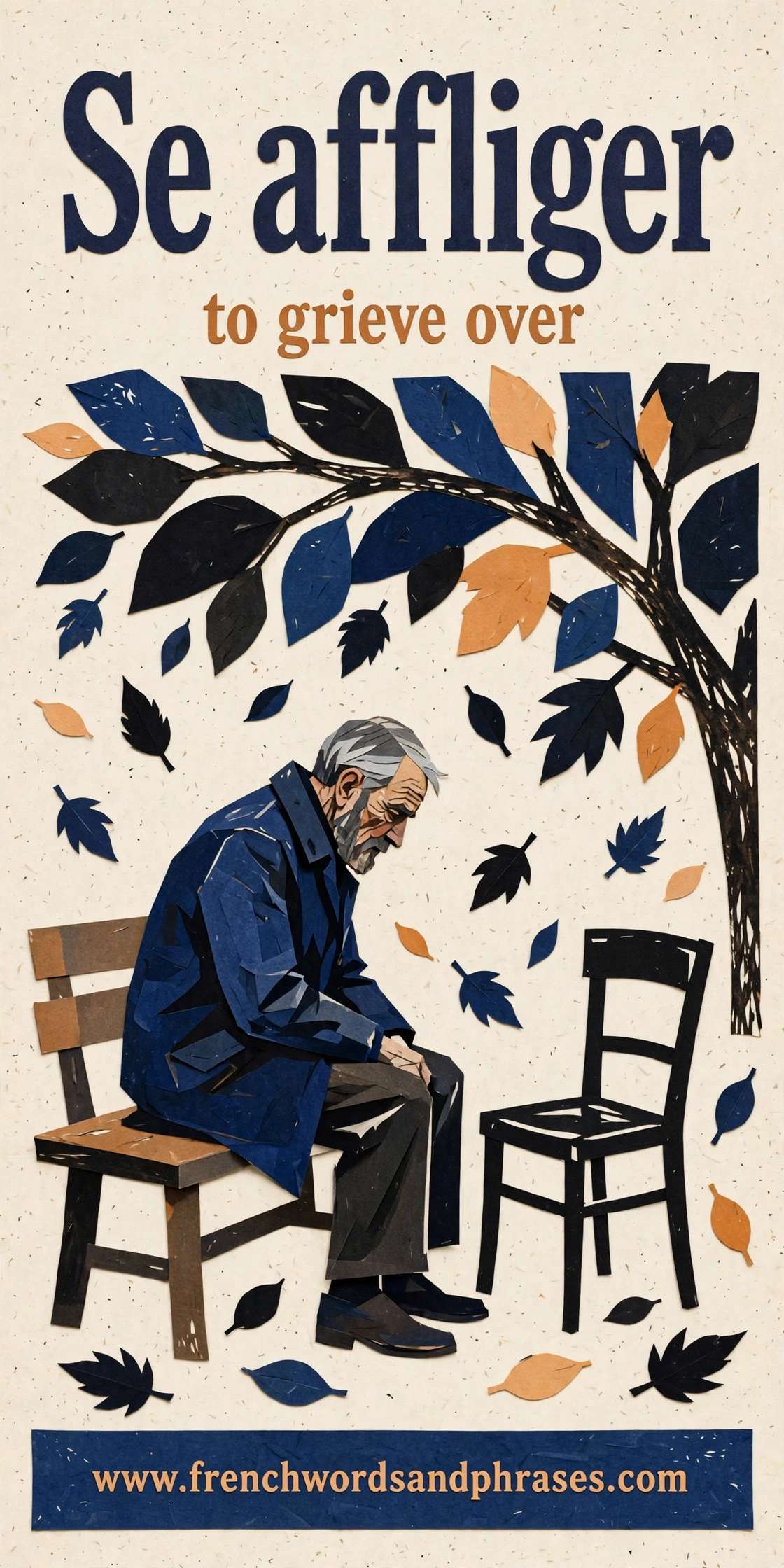
Se affliger means to grieve over — to take a loss or a sorrow to heart and carry it, turned inward, as your own.
An old man who cannot pass the harbour without thinking of the boat he lost, a friend who still blames herself years after a quarrel — se affliger is grief as a personal act: where affliger is the blow, se affliger is the heart taking it in and keeping it.
In this guide, you’ll learn how to conjugate se affliger in all the major French tenses and moods. Explore complete conjugation tables, French examples, English translations, and practice quizzes.
Understanding the French Verb Se affliger
Se affliger is a regular French verb belonging to the first group of verbs, those ending in-er.
It means to grieve over. It is commonly used of people who take sorrows personally and lastingly — the friend who s’afflige de tout, who is distressed by everything, is a recognisable character in every family. Where affliger describes what the world does to a person, se affliger describes what the person does with it: dwell, mourn, and sometimes, in gentle advice, be told to stop — ne t’afflige pas ainsi.
Verb classification: First group (-er), reflexive
Auxiliary verb: Être
Past participle: affligé
Present participle: affligeant
English equivalents: To grieve over, to be distressed by; se affliger de la perte de quelqu’un — to grieve over the loss of someone; se affliger de peu — to be distressed by very little; ne t’afflige pas de cela — do not grieve over that; il s’afflige de tout — he takes everything to heart.
One important detail: se affliger always names its sorrow with the preposition de — one grieves de a loss, a departure, a failure: elle s’afflige de la mort de son chien, il s’afflige de son échec. Like its parent affliger, it is a -ger verb and keeps the protective e before a and o: nous nous affligeons, je m’affligeais, en s’affligeant. Being reflexive, it takes être in every compound tense and the participle agrees: elle s’est affligée, ils se sont affligés. The tu imperative tucks the pronoun behind the verb: afflige-toi — usually in the negative, ne t’afflige pas.
Experience the Word
Se affliger is the verb of the inward wound — grief not as an event, but as a companion one carries from room to room.
Imagine a retired fisherman whose boat was sold years ago. Others have forgotten her; he has not. On stormy nights he lies awake and s’afflige de sa perte, hearing her timbers in the wind. His family, kindly and a little helplessly, repeat the only sentence they have: ne t’afflige pas ainsi, papa.
The boat is gone, the sea is calm. He grieves on — affligé de sa perte, faithful to a sorrow that has become part of him.
How to Conjugate Se affliger: Complete French Conjugation Guide
Let’s explore every major conjugation of se affliger, beginning with the indicative mood.
How to Conjugate Se affliger in the Indicative Mood
The indicative mood is used to express facts, observations, actions, and events.
How to Conjugate Se affliger in the Present Tense (Présent)
Used for actions happening now, habitual actions, and general truths.
| Subject | Conjugation |
|---|---|
| je | m’afflige |
| tu | t’affliges |
| il / elle | s’afflige |
| nous | nous affligeons |
| vous | vous affligez |
| ils / elles | s’affligent |
Example
Elle s’afflige de la moindre remarque.
She is distressed by the slightest remark.
Quick Quiz 1
Complete the sentence:
Nous nous ______ de cette nouvelle.
Reveal the answer
affligeons
Nous nous affligeons de cette nouvelle.
We are grieved by this news — note the protective e of the -ger verbs.
How to Conjugate Se affliger in the Passé Composé
Used for completed actions in the past. Se affliger takes the auxiliary verb être.
| Subject | Conjugation |
|---|---|
| je | me suis affligé / me suis affligée |
| tu | t’es affligé / t’es affligée |
| il / elle | s’est affligé / s’est affligée |
| nous | nous sommes affligés / nous sommes affligées |
| vous | vous êtes affligés / vous êtes affligées / vous êtes affligé / vous êtes affligée |
| ils / elles | se sont affligés / se sont affligées |
Example
Il s’est affligé de la mort de son chien.
He grieved over the death of his dog.
How to Conjugate Se affliger in the Imparfait (Imperfect Tense)
Used for habitual past actions, descriptions, and ongoing situations in the past.
| Subject | Conjugation |
|---|---|
| je | m’affligeais |
| tu | t’affligeais |
| il / elle | s’affligeait |
| nous | nous affligions |
| vous | vous affligiez |
| ils / elles | s’affligeaient |
Example
Elle s’affligeait de tout, même des petites choses.
She used to take everything to heart, even little things.
Quick Quiz 2
Choose the correct form:
She grieved over his departure.
Elle ______ de son départ. (s’est affligée / a affligé)
Reveal the answer
s’est affligée
Elle s’est affligée de son départ.
Se affliger is reflexive, takes être, and the participle agrees: affligée.
How to Conjugate Se affliger in the Plus-que-parfait
Used to describe an action that had already been completed before another past event.
| Subject | Conjugation |
|---|---|
| je | m’étais affligé / m’étais affligée |
| tu | t’étais affligé / t’étais affligée |
| il / elle | s’était affligé / s’était affligée |
| nous | nous étions affligés / nous étions affligées |
| vous | vous étiez affligés / vous étiez affligées / vous étiez affligé / vous étiez affligée |
| ils / elles | s’étaient affligés / s’étaient affligées |
Example
Il s’était affligé longtemps de cet échec.
He had grieved over that failure for a long time.
How to Conjugate Se affliger in the Passé Simple
Primarily used in formal writing, literature, and historical narratives. It is rarely used in everyday conversation.
| Subject | Conjugation |
|---|---|
| je | m’affligeai |
| tu | t’affligeas |
| il / elle | s’affligea |
| nous | nous affligeâmes |
| vous | vous affligeâtes |
| ils / elles | s’affligeèrent |
Example
La veuve s’affligea en silence pendant des mois.
The widow grieved in silence for months.
How to Conjugate Se affliger in the Passé Antérieur
A literary tense used to express an action completed immediately before another past action, generally in the passé simple.
| Subject | Conjugation |
|---|---|
| je | me fus affligé / me fus affligée |
| tu | te fus affligé / te fus affligée |
| il / elle | se fut affligé / se fut affligée |
| nous | nous fûmes affligés / nous fûmes affligées |
| vous | vous fûtes affligés / vous fûtes affligées / vous fûtes affligé / vous fûtes affligée |
| ils / elles | se furent affligés / se furent affligées |
Example
Quand il se fut affligé assez longtemps, il reprit son travail.
When he had grieved long enough, he took up his work again.
How to Conjugate Se affliger in the Future Tense (Futur Simple)
Used to describe actions that will take place in the future.
| Subject | Conjugation |
|---|---|
| je | m’affligerai |
| tu | t’affligeras |
| il / elle | s’affligera |
| nous | nous affligerons |
| vous | vous affligerez |
| ils / elles | s’affligeront |
Example
Tu t’affligeras moins avec le temps.
You will grieve less with time.
How to Conjugate Se affliger in the Futur Antérieur (Future Perfect)
Used for an action that will have been completed before a particular point in the future.
| Subject | Conjugation |
|---|---|
| je | me serai affligé / me serai affligée |
| tu | te seras affligé / te seras affligée |
| il / elle | se sera affligé / se sera affligée |
| nous | nous serons affligés / nous serons affligées |
| vous | vous serez affligés / vous serez affligées / vous serez affligé / vous serez affligée |
| ils / elles | se seront affligés / se seront affligées |
Example
À la fin de l’hiver, elle se sera affligée cent jours de suite.
By the end of winter, she will have grieved a hundred days in a row.
How to Conjugate Se affliger in the Near Future (Futur Proche)
Used to describe something that is going to happen soon. Formed with aller + infinitive.
| Subject | Conjugation |
|---|---|
| je | vais m’affliger |
| tu | vas t’affliger |
| il / elle | va s’affliger |
| nous | allons nous affliger |
| vous | allez vous affliger |
| ils / elles | vont s’affliger |
Example
Ne pars pas, il va s’affliger de ton départ.
Do not leave, he is going to grieve over your departure.
How to Conjugate Se affliger in the Conditional Mood
The conditional mood expresses what would happen under certain circumstances. It is also frequently used to make polite requests or express wishes.
How to Conjugate Se affliger in the Present Conditional
| Subject | Conjugation |
|---|---|
| je | m’affligerais |
| tu | t’affligerais |
| il / elle | s’affligerait |
| nous | nous affligerions |
| vous | vous affligeriez |
| ils / elles | s’affligeraient |
Example
À ta place, je ne m’affligerais pas de si peu.
In your place, I would not be distressed by so little.
How to Conjugate Se affliger in the Past Conditional
| Subject | Conjugation |
|---|---|
| je | me serais affligé / me serais affligée |
| tu | te serais affligé / te serais affligée |
| il / elle | se serait affligé / se serait affligée |
| nous | nous serions affligés / nous serions affligées |
| vous | vous seriez affligés / vous seriez affligées / vous seriez affligé / vous seriez affligée |
| ils / elles | se seraient affligés / se seraient affligées |
Example
Elle se serait affligée davantage sans ses amis.
She would have grieved more without her friends.
Se affliger in the Literary Past Conditional Form
This less common literary form uses the imperfect subjunctive of être.
| Subject | Conjugation |
|---|---|
| je | me fusse affligé / me fusse affligée |
| tu | te fusses affligé / te fusses affligée |
| il / elle | se fût affligé / se fût affligée |
| nous | nous fussions affligés / nous fussions affligées |
| vous | vous fussiez affligés / vous fussiez affligées / vous fussiez affligé / vous fussiez affligée |
| ils / elles | se fussent affligés / se fussent affligées |
Example
Il se fût affligé de cette perte sans sa foi.
He would have grieved over this loss without his faith.
How to Conjugate Se affliger in the Subjunctive Mood
The subjunctive is used to express wishes, emotions, doubts, necessity, and uncertainty. It frequently follows expressions such as il faut que (it is necessary that) or bien que (although).
How to Conjugate Se affliger in the Present Subjunctive
| Subject | Conjugation |
|---|---|
| que je | m’afflige |
| que tu | t’affliges |
| qu’il / qu’elle | s’afflige |
| que nous | nous affligions |
| que vous | vous affligiez |
| qu’ils / qu’elles | s’affligent |
Example
Il est dommage qu’elle s’afflige de si peu.
It is a pity she is distressed by so little.
Quick Quiz 3
Complete the sentence using the subjunctive:
Il est dommage que vous vous ______ de si peu.
Reveal the answer
affligiez
Il est dommage que vous vous affligiez de si peu.
It is a pity you are distressed by so little.
How to Conjugate Se affliger in the Imperfect Subjunctive
A literary tense, rarely encountered in modern spoken French.
| Subject | Conjugation |
|---|---|
| que je | m’affligasse |
| que tu | t’affligasses |
| qu’il / qu’elle | s’affligât |
| que nous | nous affligassions |
| que vous | vous affligassiez |
| qu’ils / qu’elles | s’affligassent |
Example
On craignait qu’il s’affligeât de la nouvelle.
They feared he might grieve over the news.
How to Conjugate Se affliger in the Pluperfect Subjunctive
A literary construction used to express an action completed before another past action.
| Subject | Conjugation |
|---|---|
| que je | me fusse affligé / me fusse affligée |
| que tu | te fusses affligé / te fusses affligée |
| qu’il / qu’elle | se fût affligé / se fût affligée |
| que nous | nous fussions affligés / nous fussions affligées |
| que vous | vous fussiez affligés / vous fussiez affligées / vous fussiez affligé / vous fussiez affligée |
| qu’ils / qu’elles | se fussent affligés / se fussent affligées |
Example
On racontait qu’elle se fût affligée des années durant.
People said she had grieved for years on end.
How to Conjugate Se affliger in the Past Subjunctive
| Subject | Conjugation |
|---|---|
| que je | me sois affligé / me sois affligée |
| que tu | te sois affligé / te sois affligée |
| qu’il / qu’elle | se soit affligé / se soit affligée |
| que nous | nous soyons affligés / nous soyons affligées |
| que vous | vous soyez affligés / vous soyez affligées / vous soyez affligé / vous soyez affligée |
| qu’ils / qu’elles | se soient affligés / se soient affligées |
Example
Je regrette que tu te sois affligé de mes paroles.
I am sorry you were distressed by my words.
How to Conjugate Se affliger in the Imperative
The imperative is used to give commands, instructions, invitations, or suggestions. Subject pronouns are omitted.
How to Conjugate Se affliger in the Present Imperative
| Person | Conjugation |
|---|---|
| (tu) | afflige-toi |
| (nous) | affligeons-nous |
| (vous) | affligez-vous |
Example
Ne t’afflige pas de cela, ce n’est rien !
Do not grieve over that, it is nothing!
Quick Quiz 4
How would you say Do not grieve over that (tu form)?
Reveal the answer
Ne t’afflige pas de cela !
French Participles of Se affliger
Participles are verb forms that can be used in compound tenses and other grammatical constructions.
Present Participle of Se affliger
affligeant
En s’affligeant ainsi, elle se rend malade.
By grieving like this, she is making herself ill.
Past Participle of Se affliger
affligé
Affligés de cette perte, les enfants sont restés silencieux.
Grieved by this loss, the children remained silent.
Se affliger in Everyday French: Real-Life Examples
Now that you know the conjugations, let’s see how se affliger appears in everyday French.
Example 1 — Present
Elle s’afflige de la moindre remarque.
She is distressed by the slightest remark.
Example 2 — Passé composé
Il s’est affligé de la mort de son chien.
He grieved over the death of his dog.
Example 3 — Imparfait
Elle s’affligeait de tout.
She used to take everything to heart.
Example 4 — Future
Tu t’affligeras moins avec le temps.
You will grieve less with time.
Example 5 — Conditional
Je ne m’affligerais pas de si peu.
I would not be distressed by so little.
Example 6 — Imperative
Ne t’afflige pas de cela !
Do not grieve over that!
Beyond Translation: The Meaning of Se affliger
English to grieve over is the close match, but French se affliger insists on the mirror: the sorrow is something the heart does to itself, with the world merely supplying the cause.
Between affliger and se affliger stands the whole philosophy of grief.
Affliger is the letter arriving; se affliger is the year that follows. The little preposition de names the cause — de sa perte, de son échec, de ton départ — and the reflexive pronoun carries the weight.
How to Remember the French Verb Se affliger
Remember it this way: Se affliger is about the old fisherman lying awake, grieving for his sold boat.
- The sorrow is always named with de: se affliger de la perte, de son échec, de ton départ.
- A -ger reflexive: nous nous affligeons, je m’affligeais — keep the protective e.
- Always reflexive: être in compound tenses, participle agreeing — elle s’est affligée.
The key idea is the old fisherman lying awake, grieving for his sold boat.
Test Your Knowledge of Se affliger
Let’s see how much you’ve learned. Try answering these questions before revealing the answers.
Question 1
Which preposition names the cause after se affliger?
Reveal the answer
De — se affliger de la perte, de son échec, de ton départ.
Question 2
How do you say He grieved over the death of his dog in French?
Reveal the answer
Il s’est affligé de la mort de son chien.
Question 3
Translate: Do not grieve over that, it is nothing!
Reveal the answer
Ne t’afflige pas de cela, ce n’est rien !
Question 4
What is the past participle of se affliger, and how does it agree?
Reveal the answer
Affligé — agreeing with the subject: affligée, affligés, affligées.
Question 5
Complete the sentence:
Je regrette que tu te ______ affligé de mes paroles.
Reveal the answer
sois
Je regrette que tu te sois affligé de mes paroles.
I am sorry you were distressed by my words.
Your Final Challenge
Can You Use It?
How would you say this in French?
He grieves over the loss of his boat, but every morning the sea offers him a new horizon.
Reveal the answer
Il s’afflige de la perte de son bateau, mais la mer, chaque matin, lui offre un nouvel horizon.
He grieves over the loss of his boat, but every morning the sea offers him a new horizon.
A little French. A little curiosity. A richer everyday life.
LEARN FRENCH ONE WORD AT A TIME