A French Word to Live By
How to Conjugate Affiler in French
/a.fi.le/
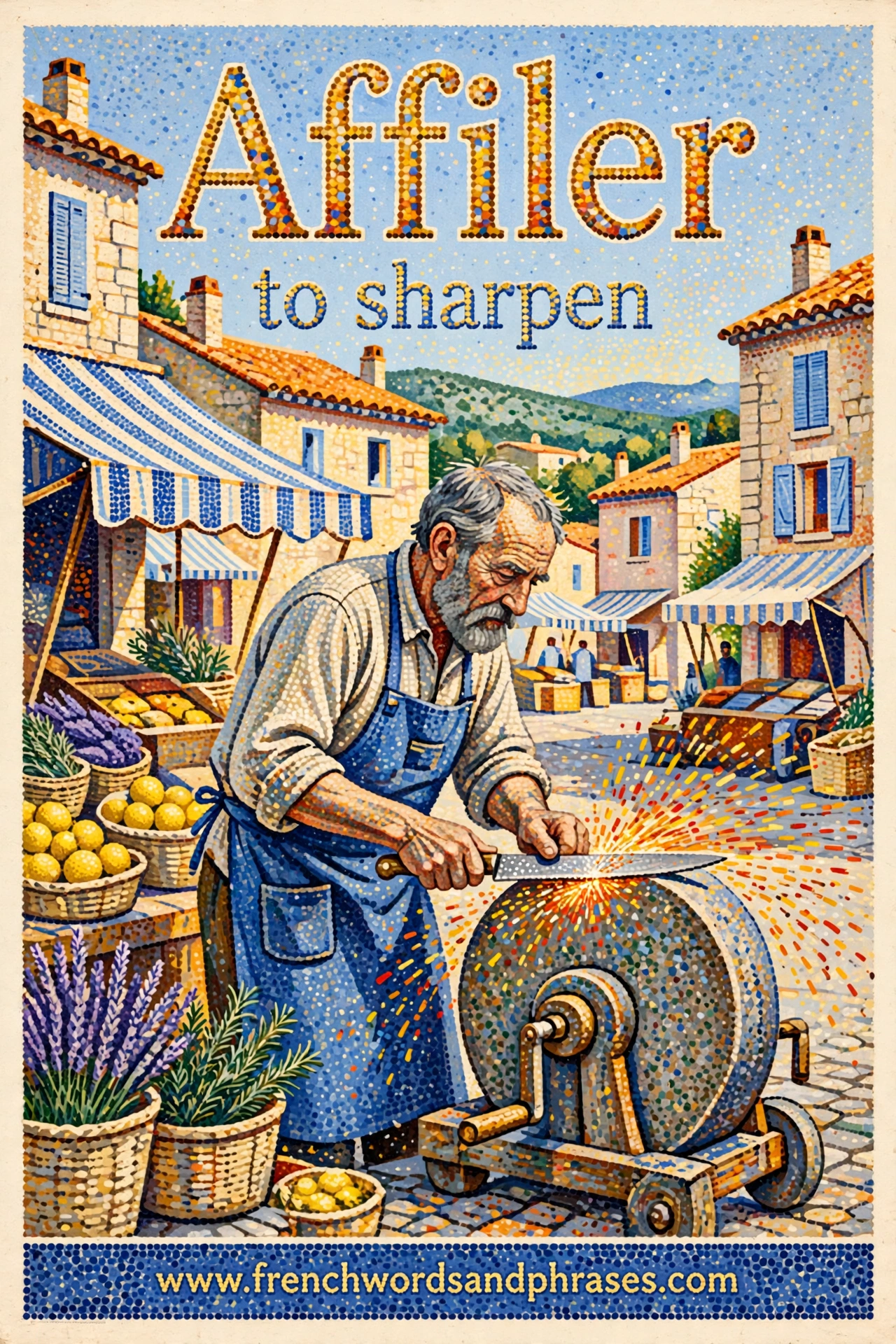
Affiler means to sharpen — to give a blade its fine, keen edge, the last touch that makes a knife truly cut.
A butcher drawing his knife along the steel with quick, ringing strokes, a cook testing the edge on a tomato skin — affiler is the verb of the final sharpening: not grinding a ruined blade back to life, but honing a good one until it sings.
In this guide, you’ll learn how to conjugate affiler in all the major French tenses and moods. Explore complete conjugation tables, French examples, English translations, and practice quizzes.
Understanding the French Verb Affiler
Affiler is a regular French verb belonging to the first group of verbs, those ending in-er.
It means to sharpen. It is commonly used in kitchens and workshops for knives, razors and scissors, and it lives close to the noun le fil — donner du fil à un couteau is to put an edge on it. Figuratively it stays rare; French prefers aiguiser for wit and appetite (aiguiser l’appétit), while affiler keeps its feet on the chopping board.
Verb classification: First group (-er)
Auxiliary verb: Avoir
Past participle: affilé
Present participle: affilant
English equivalents: To sharpen, to hone; affiler un couteau — to sharpen a knife; affiler une lame — to hone a blade; affiler des ciseaux — to sharpen scissors; le fil du couteau — the edge of the knife.
One important detail: affiler is built on le fil, the thread — and the cutting edge of a blade is exactly that, a thread of steel: le fil du couteau. To affiler is to restore that thread, usually with a sharpening steel (un fusil) or a fine stone. Do not confuse it with its stronger cousin affûter, which sharpens tools and blades from dull — affiler is the finer, finishing touch, the honing a good cook gives a knife before every service. The verb itself is perfectly regular: j’affile, nous affilons, ils affilent.
Experience the Word
Affiler is the verb of the last ten seconds before the real work — the quick, expert passes that turn a good knife into a ready one.
Imagine a boucherie at seven in the morning. Before the first customer arrives, the butcher takes down his longest knife, spits on the steel — no, he simply draws the blade along it, left, right, left, right, a bright metallic song. Il affile son couteau, tests it on a sheet of paper, and nods: the day can begin.
The knife was never blunt. It has been honed — affilé, edged, made eager for the work.
How to Conjugate Affiler: Complete French Conjugation Guide
Let’s explore every major conjugation of affiler, beginning with the indicative mood.
How to Conjugate Affiler in the Indicative Mood
The indicative mood is used to express facts, observations, actions, and events.
How to Conjugate Affiler in the Present Tense (Présent)
Used for actions happening now, habitual actions, and general truths.
| Subject | Conjugation |
|---|---|
| je | affile |
| tu | affiles |
| il / elle | affile |
| nous | affilons |
| vous | affilez |
| ils / elles | affilent |
Le boucher affile son couteau avant d’ouvrir la boutique.
The butcher sharpens his knife before opening the shop.
Quick Quiz 1
Complete the sentence:
Nous ______ les couteaux avant le service.
Reveal the answer
affilons
Nous affilons les couteaux avant le service.
We sharpen the knives before service.
How to Conjugate Affiler in the Passé Composé
Used for completed actions in the past. Affiler takes the auxiliary verb avoir.
| Subject | Conjugation |
|---|---|
| j’ | ai affilé |
| tu | as affilé |
| il / elle | a affilé |
| nous | avons affilé |
| vous | avez affilé |
| ils / elles | ont affilé |
Example
Elle a affilé tous les couteaux de la cuisine.
She sharpened all the kitchen knives.
How to Conjugate Affiler in the Imparfait (Imperfect Tense)
Used for habitual past actions, descriptions, and ongoing situations in the past.
| Subject | Conjugation |
|---|---|
| je | affilais |
| tu | affilais |
| il / elle | affilait |
| nous | affilions |
| vous | affiliez |
| ils / elles | affilaient |
Example
Chaque matin, le cuisinier affilait ses lames sur le fusil.
Every morning, the cook would hone his blades on the steel.
Quick Quiz 2
Choose the correct form:
She sharpened the scissors.
Elle ______ les ciseaux. (a affilé / est affilée)
Reveal the answer
a affilé
Elle a affilé les ciseaux.
Affiler takes avoir.
How to Conjugate Affiler in the Plus-que-parfait
Used to describe an action that had already been completed before another past event.
| Subject | Conjugation |
|---|---|
| j’ | avais affilé |
| tu | avais affilé |
| il / elle | avait affilé |
| nous | avions affilé |
| vous | aviez affilé |
| ils / elles | avaient affilé |
Example
Il avait affilé les ciseaux avant de couper le tissu.
He had sharpened the scissors before cutting the fabric.
How to Conjugate Affiler in the Passé Simple
Primarily used in formal writing, literature, and historical narratives. It is rarely used in everyday conversation.
| Subject | Conjugation |
|---|---|
| je | affilai |
| tu | affilas |
| il / elle | affila |
| nous | affilâmes |
| vous | affilâtes |
| ils / elles | affilèrent |
Example
Le rémouleur affila les couteaux de tout le village.
The knife-grinder sharpened the knives of the whole village.
How to Conjugate Affiler in the Passé Antérieur
A literary tense used to express an action completed immediately before another past action, generally in the passé simple.
| Subject | Conjugation |
|---|---|
| j’ | eus affilé |
| tu | eus affilé |
| il / elle | eut affilé |
| nous | eûmes affilé |
| vous | eûtes affilé |
| ils / elles | eurent affilé |
Example
Quand il eut affilé sa lame, le barbier commença le rasage.
When he had honed his blade, the barber began the shave.
How to Conjugate Affiler in the Future Tense (Futur Simple)
Used to describe actions that will take place in the future.
| Subject | Conjugation |
|---|---|
| je | affilerai |
| tu | affileras |
| il / elle | affilera |
| nous | affilerons |
| vous | affilerez |
| ils / elles | affileront |
Example
Demain, j’affilerai le grand couteau de cuisine.
Tomorrow, I will sharpen the big kitchen knife.
How to Conjugate Affiler in the Futur Antérieur (Future Perfect)
Used for an action that will have been completed before a particular point in the future.
| Subject | Conjugation |
|---|---|
| j’ | aurai affilé |
| tu | auras affilé |
| il / elle | aura affilé |
| nous | aurons affilé |
| vous | aurez affilé |
| ils / elles | auront affilé |
Example
À l’ouverture, le boucher aura affilé toutes ses lames.
By opening time, the butcher will have honed all his blades.
How to Conjugate Affiler in the Near Future (Futur Proche)
Used to describe something that is going to happen soon. Formed with aller + infinitive.
| Subject | Conjugation |
|---|---|
| je | vais affiler |
| tu | vas affiler |
| il / elle | va affiler |
| nous | allons affiler |
| vous | allez affiler |
| ils / elles | vont affiler |
Example
Attends, je vais affiler ce couteau avant de couper le rôti.
Wait, I am going to sharpen this knife before carving the roast.
How to Conjugate Affiler in the Conditional Mood
The conditional mood expresses what would happen under certain circumstances. It is also frequently used to make polite requests or express wishes.
How to Conjugate Affiler in the Present Conditional
| Subject | Conjugation |
|---|---|
| je | affilerais |
| tu | affilerais |
| il / elle | affilerait |
| nous | affilerions |
| vous | affileriez |
| ils / elles | affileraient |
Example
Avec un bon fusil, tu affilerais ce couteau en dix secondes.
With a good steel, you would sharpen this knife in ten seconds.
How to Conjugate Affiler in the Past Conditional
| Subject | Conjugation |
|---|---|
| j’ | aurais affilé |
| tu | aurais affilé |
| il / elle | aurait affilé |
| nous | aurions affilé |
| vous | auriez affilé |
| ils / elles | auraient affilé |
Example
Il aurait affilé les ciseaux s’il avait trouvé la pierre.
He would have sharpened the scissors if he had found the stone.
Affiler in the Literary Past Conditional Form
This less common literary form uses the imperfect subjunctive of avoir.
| Subject | Conjugation |
|---|---|
| j’ | eusse affilé |
| tu | eusses affilé |
| il / elle | eût affilé |
| nous | eussions affilé |
| vous | eussiez affilé |
| ils / elles | eussent affilé |
Example
Le barbier eût affilé son rasoir avant l’arrivée du client.
The barber would have honed his razor before the client’s arrival.
How to Conjugate Affiler in the Subjunctive Mood
The subjunctive is used to express wishes, emotions, doubts, necessity, and uncertainty. It frequently follows expressions such as il faut que (it is necessary that) or bien que (although).
How to Conjugate Affiler in the Present Subjunctive
| Subject | Conjugation |
|---|---|
| que je | affile |
| que tu | affiles |
| qu’il / qu’elle | affile |
| que nous | affilions |
| que vous | affiliez |
| qu’ils / qu’elles | affilent |
Example
Il faut que tu affiles ce couteau avant de t’en servir.
You must sharpen this knife before using it.
Quick Quiz 3
Complete the sentence using the subjunctive:
Il faut que vous ______ les lames ce soir.
Reveal the answer
affiliez
Il faut que vous affiliez les lames ce soir.
You must sharpen the blades this evening.
How to Conjugate Affiler in the Imperfect Subjunctive
A literary tense, rarely encountered in modern spoken French.
| Subject | Conjugation |
|---|---|
| que je | affilasse |
| que tu | affilasses |
| qu’il / qu’elle | affilât |
| que nous | affilassions |
| que vous | affilassiez |
| qu’ils / qu’elles | affilassent |
Example
Elle cherchait quelqu’un qui affilât les lames du moulin.
She was looking for someone who could sharpen the mill’s blades.
How to Conjugate Affiler in the Pluperfect Subjunctive
A literary construction used to express an action completed before another past action.
| Subject | Conjugation |
|---|---|
| que j’ | eusse affilé |
| que tu | eusses affilé |
| qu’il / qu’elle | eût affilé |
| que nous | eussions affilé |
| que vous | eussiez affilé |
| qu’ils / qu’elles | eussent affilé |
Example
On raconte qu’il eût affilé sa faux avant l’aube.
They say he had sharpened his scythe before dawn.
How to Conjugate Affiler in the Past Subjunctive
| Subject | Conjugation |
|---|---|
| que j’ | aie affilé |
| que tu | aies affilé |
| qu’il / qu’elle | ait affilé |
| que nous | ayons affilé |
| que vous | ayez affilé |
| qu’ils / qu’elles | aient affilé |
Example
Je suis content qu’elle ait affilé les couteaux à temps.
I am glad she sharpened the knives in time.
How to Conjugate Affiler in the Imperative
The imperative is used to give commands, instructions, invitations, or suggestions. Subject pronouns are omitted.
How to Conjugate Affiler in the Present Imperative
| Person | Conjugation |
|---|---|
| (tu) | affile |
| (nous) | affilons |
| (vous) | affilez |
Example
Affile le couteau, il ne coupe plus rien !
Sharpen the knife, it cuts nothing any more!
Quick Quiz 4
How would you say Sharpen the knife (tu form)?
Reveal the answer
Affile le couteau !
French Participles of Affiler
Participles are verb forms that can be used in compound tenses and other grammatical constructions.
Present Participle of Affiler
affilant
En affilant sa lame chaque jour, le cuisinier la garde parfaite.
By honing his blade every day, the cook keeps it perfect.
Past Participle of Affiler
affilé
Affilée avec soin, la lame tranche le papier sans effort.
Carefully honed, the blade slices the paper effortlessly.
Affiler in Everyday French: Real-Life Examples
Now that you know the conjugations, let’s see how affiler appears in everyday French.
Example 1 — Present
Le boucher affile son couteau.
The butcher sharpens his knife.
Example 2 — Passé composé
Elle a affilé les ciseaux.
She sharpened the scissors.
Example 3 — Imparfait
Il affilait ses lames chaque matin.
He used to hone his blades every morning.
Example 4 — Future
J’affilerai le grand couteau demain.
I will sharpen the big knife tomorrow.
Example 5 — Conditional
Tu affilerais mieux avec un fusil neuf.
You would sharpen better with a new steel.
Example 6 — Imperative
Affile ce couteau avant le dîner !
Sharpen this knife before dinner!
Beyond Translation: The Meaning of Affiler
English edge does the same work as fil: a knife’s edge, to be on edge. French affiler keeps the image of the thread — a perfect edge is so fine it is almost a line of silk.
A whole trade once lived by this verb.
The rémouleur, the travelling knife-grinder with his wheel and his cry in the street, affilait the knives and scissors of every household — a vanished sound of old French towns, preserved in this one small verb.
How to Remember the French Verb Affiler
Remember it this way: Affiler is about the butcher’s knife singing along the steel.
- Think of le fil, a thread: the edge of a blade is a thread of steel, and affiler restores it.
- Affiler is the fine finishing touch with a steel; affûter is the heavier sharpening of tools.
- Regular -er: j’affile, nous affilons, past participle affilé.
The key idea is the butcher’s knife singing along the steel.
Test Your Knowledge of Affiler
Let’s see how much you’ve learned. Try answering these questions before revealing the answers.
Question 1
What is le fil, and why does it explain affiler?
Reveal the answer
Le fil is the cutting edge of a blade — literally a thread of steel; affiler means putting that fine edge back on.
Question 2
How do you say The butcher sharpens his knife in French?
Reveal the answer
Le boucher affile son couteau.
Question 3
Translate: She sharpened all the kitchen knives.
Reveal the answer
Elle a affilé tous les couteaux de la cuisine.
Question 4
What is the past participle of affiler?
Reveal the answer
Affilé.
Question 5
Complete the sentence:
Il faut que tu ______ ce couteau avant de t’en servir.
Reveal the answer
affiles
Il faut que tu affiles ce couteau avant de t’en servir.
You must sharpen this knife before using it.
Your Final Challenge
Can You Use It?
How would you say this in French?
The butcher sharpens his knife, and the repeated gesture becomes a little morning music.
Reveal the answer
Le boucher affile son couteau, et le geste répété devient une petite musique du matin.
The butcher sharpens his knife, and the repeated gesture becomes a little morning music.
A little French. A little curiosity. A richer everyday life.
LEARN FRENCH ONE WORD AT A TIME