A French Word to Live By
How to Conjugate Afficher in French
/a.fi.ʃe/
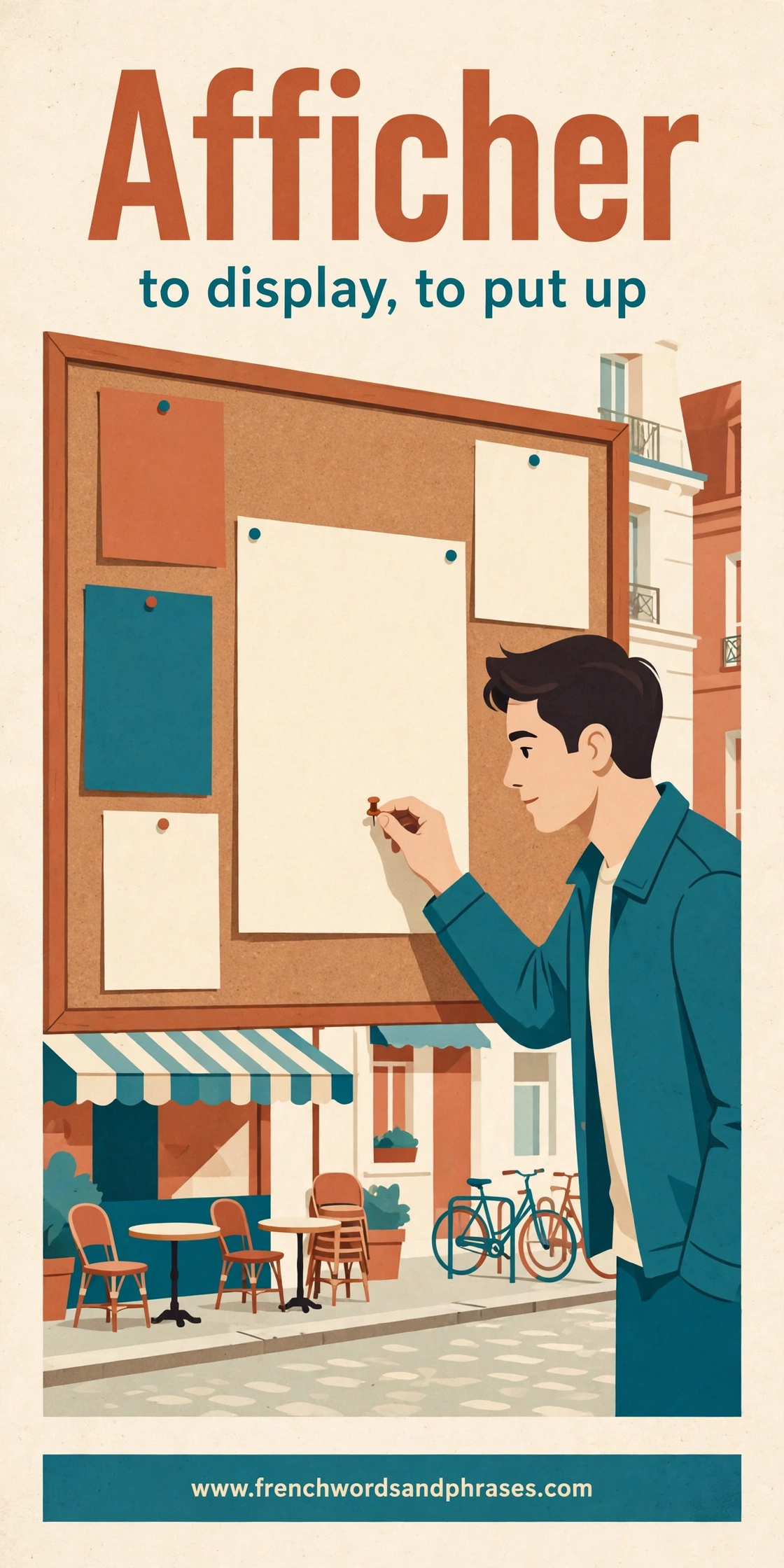
Afficher means to display, to put up — to fix a notice where everyone can see it, and by extension to show anything openly: prices, results, or even a smile.
A town hall door covered in official notices, exam results pinned up in a school hall, prices in a shop window — afficher is the verb of public display: what is affiché is up on the wall, for everyone to read.
In this guide, you’ll learn how to conjugate afficher in all the major French tenses and moods. Explore complete conjugation tables, French examples, English translations, and practice quizzes.
Understanding the French Verb Afficher
Afficher is a regular French verb belonging to the first group of verbs, those ending in-er.
It means to display, to put up. It is the everyday verb for notices, posters, prices and results all over France — afficher les notes, afficher les horaires — and the standard word for what screens do: l’écran affiche l’heure. In show business, afficher complet is the happiest sentence a theatre can print: every seat sold.
Verb classification: First group (-er)
Auxiliary verb: Avoir
Past participle: affiché
Present participle: affichant
English equivalents: To display, to put up, to post; afficher une annonce — to put up a notice; afficher les résultats — to post the results; afficher complet — to be sold out (a full house displayed); afficher un sourire — to display a smile; les prix sont affichés — prices are displayed.
One important detail: afficher begins with the noun une affiche, a poster — to afficher is to poster something up. From the wall it spreads to every kind of open display: a screen affiche the time, a theatre affiche complet (displays ‘full house’ — sold out), and a face can afficher un sourire or afficher son mépris. The verb is perfectly regular: j’affiche, nous affichons, ils affichent, past participle affiché.
Experience the Word
Afficher is the verb of the wall and the window — whatever France wants everyone to know, France affiche it.
Imagine the morning the baccalauréat results come out. A crowd of teenagers presses against the school gates as a teacher pins up the lists: les résultats sont affichés, and a hundred faces search the same sheet of paper at once.
Nothing has been announced or whispered. It has been posted — affiché, on the wall, for everyone at once.
How to Conjugate Afficher: Complete French Conjugation Guide
Let’s explore every major conjugation of afficher, beginning with the indicative mood.
How to Conjugate Afficher in the Indicative Mood
The indicative mood is used to express facts, observations, actions, and events.
How to Conjugate Afficher in the Present Tense (Présent)
Used for actions happening now, habitual actions, and general truths.
| Subject | Conjugation |
|---|---|
| je | affiche |
| tu | affiches |
| il / elle | affiche |
| nous | affichons |
| vous | affichez |
| ils / elles | affichent |
Le musée affiche les horaires à l’entrée.
The museum displays the opening hours at the entrance.
Quick Quiz 1
Complete the sentence:
Nous ______ les horaires à l’entrée.
Reveal the answer
affichons
Nous affichons les horaires à l’entrée.
We display the opening hours at the entrance.
How to Conjugate Afficher in the Passé Composé
Used for completed actions in the past. Afficher takes the auxiliary verb avoir.
| Subject | Conjugation |
|---|---|
| j’ | ai affiché |
| tu | as affiché |
| il / elle | a affiché |
| nous | avons affiché |
| vous | avez affiché |
| ils / elles | ont affiché |
Example
Ils ont affiché les résultats dans le hall.
They posted the results in the hall.
How to Conjugate Afficher in the Imparfait (Imperfect Tense)
Used for habitual past actions, descriptions, and ongoing situations in the past.
| Subject | Conjugation |
|---|---|
| je | affichais |
| tu | affichais |
| il / elle | affichait |
| nous | affichions |
| vous | affichiez |
| ils / elles | affichaient |
Example
Le théâtre affichait complet tous les soirs.
The theatre was sold out every evening.
Quick Quiz 2
Choose the correct form:
They posted the results in the hall.
Ils ______ les résultats dans le hall. (ont affiché / sont affichés)
Reveal the answer
ont affiché
Ils ont affiché les résultats dans le hall.
Afficher takes avoir.
How to Conjugate Afficher in the Plus-que-parfait
Used to describe an action that had already been completed before another past event.
| Subject | Conjugation |
|---|---|
| j’ | avais affiché |
| tu | avais affiché |
| il / elle | avait affiché |
| nous | avions affiché |
| vous | aviez affiché |
| ils / elles | avaient affiché |
Example
Elle avait affiché les photos dans sa chambre.
She had put the photos up in her room.
How to Conjugate Afficher in the Passé Simple
Primarily used in formal writing, literature, and historical narratives. It is rarely used in everyday conversation.
| Subject | Conjugation |
|---|---|
| je | affichai |
| tu | affichas |
| il / elle | afficha |
| nous | affichâmes |
| vous | affichâtes |
| ils / elles | affichèrent |
Example
La mairie afficha l’avis sur la porte.
The town hall posted the notice on the door.
How to Conjugate Afficher in the Passé Antérieur
A literary tense used to express an action completed immediately before another past action, generally in the passé simple.
| Subject | Conjugation |
|---|---|
| j’ | eus affiché |
| tu | eus affiché |
| il / elle | eut affiché |
| nous | eûmes affiché |
| vous | eûtes affiché |
| ils / elles | eurent affiché |
Example
Quand on eut affiché les listes, les candidats se pressèrent.
When the lists had been posted, the candidates crowded round.
How to Conjugate Afficher in the Future Tense (Futur Simple)
Used to describe actions that will take place in the future.
| Subject | Conjugation |
|---|---|
| je | afficherai |
| tu | afficheras |
| il / elle | affichera |
| nous | afficherons |
| vous | afficherez |
| ils / elles | afficheront |
Example
On affichera les prix en vitrine dès demain.
Prices will be displayed in the window from tomorrow.
How to Conjugate Afficher in the Futur Antérieur (Future Perfect)
Used for an action that will have been completed before a particular point in the future.
| Subject | Conjugation |
|---|---|
| j’ | aurai affiché |
| tu | auras affiché |
| il / elle | aura affiché |
| nous | aurons affiché |
| vous | aurez affiché |
| ils / elles | auront affiché |
Example
À midi, ils auront affiché toutes les annonces.
By noon, they will have put up all the notices.
How to Conjugate Afficher in the Near Future (Futur Proche)
Used to describe something that is going to happen soon. Formed with aller + infinitive.
| Subject | Conjugation |
|---|---|
| je | vais afficher |
| tu | vas afficher |
| il / elle | va afficher |
| nous | allons afficher |
| vous | allez afficher |
| ils / elles | vont afficher |
Example
Le professeur va afficher les notes sur le panneau.
The teacher is going to post the marks on the board.
How to Conjugate Afficher in the Conditional Mood
The conditional mood expresses what would happen under certain circumstances. It is also frequently used to make polite requests or express wishes.
How to Conjugate Afficher in the Present Conditional
| Subject | Conjugation |
|---|---|
| je | afficherais |
| tu | afficherais |
| il / elle | afficherait |
| nous | afficherions |
| vous | afficheriez |
| ils / elles | afficheraient |
Example
Sans autorisation, on n’afficherait rien sur ce mur.
Without permission, nothing would be posted on this wall.
How to Conjugate Afficher in the Past Conditional
| Subject | Conjugation |
|---|---|
| j’ | aurais affiché |
| tu | aurais affiché |
| il / elle | aurait affiché |
| nous | aurions affiché |
| vous | auriez affiché |
| ils / elles | auraient affiché |
Example
Il aurait affiché un grand sourire en apprenant la nouvelle.
He would have displayed a big smile on hearing the news.
Afficher in the Literary Past Conditional Form
This less common literary form uses the imperfect subjunctive of avoir.
| Subject | Conjugation |
|---|---|
| j’ | eusse affiché |
| tu | eusses affiché |
| il / elle | eût affiché |
| nous | eussions affiché |
| vous | eussiez affiché |
| ils / elles | eussent affiché |
Example
Elle eût affiché un air serein devant la foule.
She would have displayed a serene air before the crowd.
How to Conjugate Afficher in the Subjunctive Mood
The subjunctive is used to express wishes, emotions, doubts, necessity, and uncertainty. It frequently follows expressions such as il faut que (it is necessary that) or bien que (although).
How to Conjugate Afficher in the Present Subjunctive
| Subject | Conjugation |
|---|---|
| que je | affiche |
| que tu | affiches |
| qu’il / qu’elle | affiche |
| que nous | affichions |
| que vous | affichiez |
| qu’ils / qu’elles | affichent |
Example
Il faut que tu affiches l’annonce bien en vue.
You must put the notice up where it can be clearly seen.
Quick Quiz 3
Complete the sentence using the subjunctive:
Il faut que vous ______ les consignes partout.
Reveal the answer
affichiez
Il faut que vous affichiez les consignes partout.
You must post the instructions everywhere.
How to Conjugate Afficher in the Imperfect Subjunctive
A literary tense, rarely encountered in modern spoken French.
| Subject | Conjugation |
|---|---|
| que je | affichasse |
| que tu | affichasses |
| qu’il / qu’elle | affichât |
| que nous | affichassions |
| que vous | affichassiez |
| qu’ils / qu’elles | affichassent |
Example
Le directeur voulait qu’on affichât les consignes partout.
The headteacher wanted the instructions posted everywhere.
How to Conjugate Afficher in the Pluperfect Subjunctive
A literary construction used to express an action completed before another past action.
| Subject | Conjugation |
|---|---|
| que j’ | eusse affiché |
| que tu | eusses affiché |
| qu’il / qu’elle | eût affiché |
| que nous | eussions affiché |
| que vous | eussiez affiché |
| qu’ils / qu’elles | eussent affiché |
Example
On disait qu’il eût affiché son mépris ouvertement.
It was said he had displayed his contempt openly.
How to Conjugate Afficher in the Past Subjunctive
| Subject | Conjugation |
|---|---|
| que j’ | aie affiché |
| que tu | aies affiché |
| qu’il / qu’elle | ait affiché |
| que nous | ayons affiché |
| que vous | ayez affiché |
| qu’ils / qu’elles | aient affiché |
Example
Je suis content que le magasin ait affiché les soldes.
I am glad the shop has put up the sale notices.
How to Conjugate Afficher in the Imperative
The imperative is used to give commands, instructions, invitations, or suggestions. Subject pronouns are omitted.
How to Conjugate Afficher in the Present Imperative
| Person | Conjugation |
|---|---|
| (tu) | affiche |
| (nous) | affichons |
| (vous) | affichez |
Example
Affiche le plan près de la porte !
Put the map up near the door!
Quick Quiz 4
How would you say Put the map up near the door (tu form)?
Reveal the answer
Affiche le plan près de la porte !
French Participles of Afficher
Participles are verb forms that can be used in compound tenses and other grammatical constructions.
Present Participle of Afficher
affichant
En affichant complet, le cinéma a refusé des spectateurs.
Displaying ‘sold out’, the cinema turned spectators away.
Past Participle of Afficher
affiché
Affichée partout en ville, l’annonce a attiré la foule.
Posted all over town, the notice drew the crowds.
Afficher in Everyday French: Real-Life Examples
Now that you know the conjugations, let’s see how afficher appears in everyday French.
Example 1 — Present
Le musée affiche les horaires à l’entrée.
The museum displays the opening hours at the entrance.
Example 2 — Passé composé
Ils ont affiché les résultats dans le hall.
They posted the results in the hall.
Example 3 — Imparfait
Le théâtre affichait complet tous les soirs.
The theatre was sold out every evening.
Example 4 — Future
On affichera les prix en vitrine demain.
Prices will be displayed in the window tomorrow.
Example 5 — Conditional
On n’afficherait rien sur ce mur sans autorisation.
Nothing would be posted on this wall without permission.
Example 6 — Imperative
Affiche le plan près de la porte !
Put the map up near the door!
Beyond Translation: The Meaning of Afficher
English to post a notice is close, but afficher has marched further — from the paper affiche on the wall to the screen in your pocket, which affiche the time, your messages and your train.
And it has one theatrical jewel.
Afficher complet — to display ‘full’ — is how French theatres announce a sold-out triumph: the best notice a poster can ever carry.
How to Remember the French Verb Afficher
Remember it this way: Afficher is about the results list pinned up while a hundred faces search it.
- Une affiche is a poster; afficher is to poster something up — notices, prices, results.
- Afficher complet means sold out: the theatre displays ‘full house’.
- Regular -er with avoir: j’affiche, nous affichons, past participle affiché.
The key idea is the results list pinned up while a hundred faces search it.
Test Your Knowledge of Afficher
Let’s see how much you’ve learned. Try answering these questions before revealing the answers.
Question 1
What does a theatre mean when it affiche complet?
Reveal the answer
It is sold out — the house displays ‘full’: every seat has been taken.
Question 2
How do you say They posted the results in the hall in French?
Reveal the answer
Ils ont affiché les résultats dans le hall.
Question 3
Translate: The museum displays the opening hours at the entrance.
Reveal the answer
Le musée affiche les horaires à l’entrée.
Question 4
What is the past participle of afficher?
Reveal the answer
Affiché — and une affiche is a poster.
Question 5
Complete the sentence:
Il faut que tu ______ l’annonce bien en vue.
Reveal the answer
affiches
Il faut que tu affiches l’annonce bien en vue.
You must put the notice up where it can be clearly seen.
Your Final Challenge
Can You Use It?
How would you say this in French?
The town hall posts the banns on its door, and the whole village knows the spring weddings.
Reveal the answer
La mairie affiche les bans sur sa porte, et tout le village connaît les mariages du printemps.
The town hall posts the banns on its door, and the whole village knows the spring weddings.
A little French. A little curiosity. A richer everyday life.
LEARN FRENCH ONE WORD AT A TIME