A French Word to Live By
How to Conjugate Affecter in French
/a.fɛk.te/
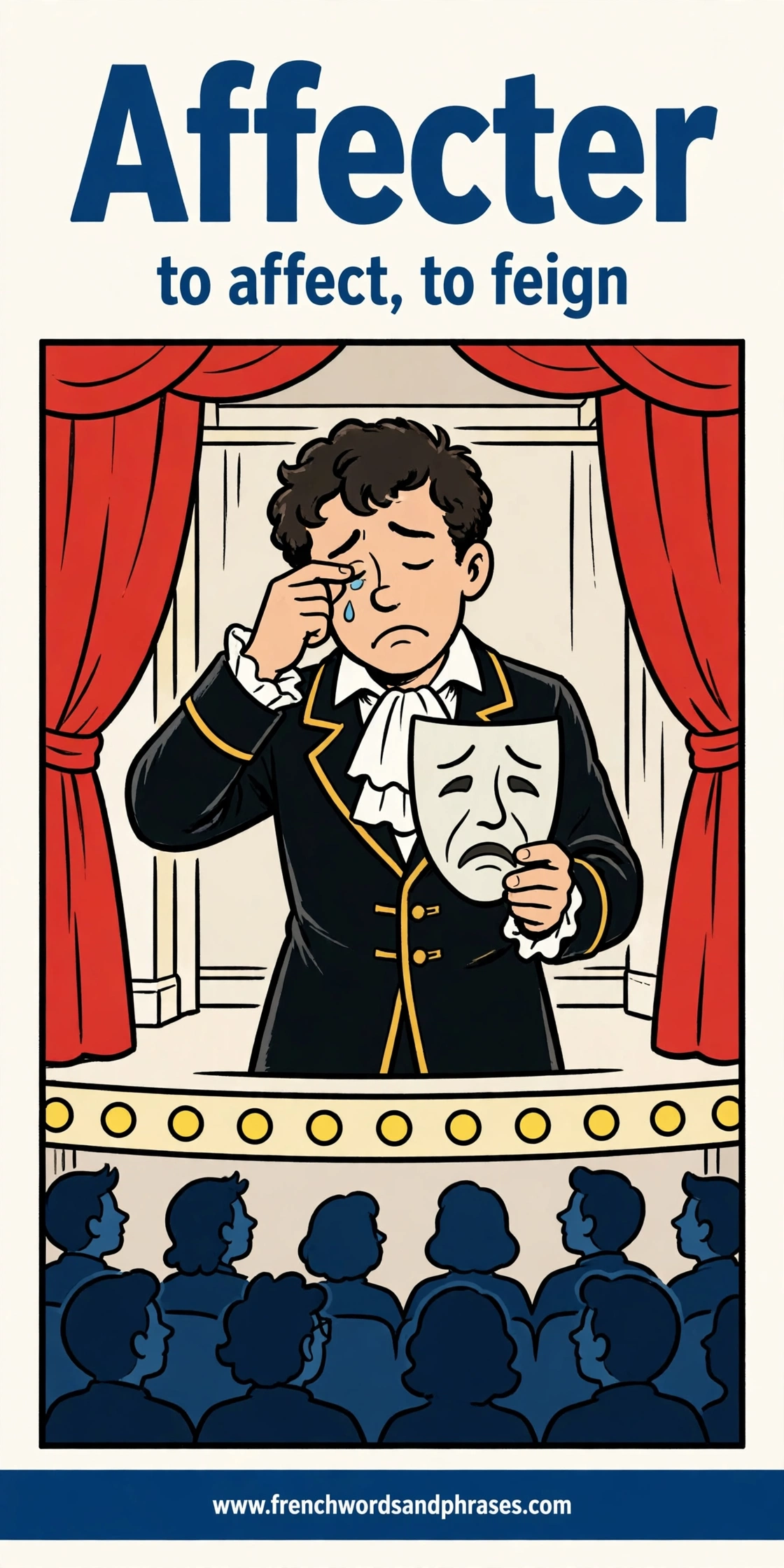
Affecter means to affect, to feign — to have an effect on someone or something, and, with a quite different face, to put on an air that is not real.
A piece of news that leaves a friend pale, an actor putting on a bored expression he does not feel, a clerk assigning funds to a project — affecter lives three lives: to affect deeply, to feign a manner, and, with the preposition à, to assign people and money to their posts.
In this guide, you’ll learn how to conjugate affecter in all the major French tenses and moods. Explore complete conjugation tables, French examples, English translations, and practice quizzes.
Understanding the French Verb Affecter
Affecter is a regular French verb belonging to the first group of verbs, those ending in-er.
It means to affect, to feign. It is commonly used in medicine and the news for effects on health, crops and markets; in literature for assumed manners — affecter un sourire, affecter l’indifférence; and in every French office and ministry for postings and budgets, where une affectation is an official assignment and affecter à is the daily verb of human resources.
Verb classification: First group (-er)
Auxiliary verb: Avoir
Past participle: affecté
Present participle: affectant
English equivalents: To affect, to feign; affecter la santé — to affect one’s health; la nouvelle l’a affecté — the news affected him deeply; affecter un air indifférent — to feign an indifferent air; affecter quelqu’un à un poste — to assign someone to a post; affecter une somme à un projet — to allocate a sum to a project.
One important detail: watch the construction affecter quelqu’un ou quelque chose à — with à, affecter stops meaning to influence and becomes the administrator’s verb: on l’a affecté à un nouveau poste (he was assigned to a new post), affecter des fonds à la rénovation (to allocate funds to the renovation). The other two senses take a direct object: la crise affecte les récoltes, and for feigning, affecter un air calme, affecter de ne pas entendre. The verb itself is perfectly regular: j’affecte, nous affectons, ils affectent.
Experience the Word
Affecter is the verb of effects and of appearances — what truly touches you, what you only pretend, and where the administration decides to put you.
Imagine a young teacher opening an official envelope in July. Inside, one line decides her next three years: affectée au collège de Brest. She has not been influenced or moved by the ministry — she has been assigned, posted, affectée à a school by the sea.
One little preposition did all the work. With à, affecter assigns — she has been posted, affectée, to Brest.
How to Conjugate Affecter: Complete French Conjugation Guide
Let’s explore every major conjugation of affecter, beginning with the indicative mood.
How to Conjugate Affecter in the Indicative Mood
The indicative mood is used to express facts, observations, actions, and events.
How to Conjugate Affecter in the Present Tense (Présent)
Used for actions happening now, habitual actions, and general truths.
| Subject | Conjugation |
|---|---|
| je | affecte |
| tu | affectes |
| il / elle | affecte |
| nous | affectons |
| vous | affectez |
| ils / elles | affectent |
Example
La sécheresse affecte les récoltes de toute la région.
The drought is affecting the harvests of the whole region.
Quick Quiz 1
Complete the sentence:
Nous ______ deux employés au nouvel entrepôt.
Reveal the answer
affectons
Nous affectons deux employés au nouvel entrepôt.
We are assigning two employees to the new warehouse.
How to Conjugate Affecter in the Passé Composé
Used for completed actions in the past. Affecter takes the auxiliary verb avoir.
| Subject | Conjugation |
|---|---|
| j’ | ai affecté |
| tu | as affecté |
| il / elle | a affecté |
| nous | avons affecté |
| vous | avez affecté |
| ils / elles | ont affecté |
Example
Cette nouvelle l’a profondément affecté.
This news affected him deeply.
How to Conjugate Affecter in the Imparfait (Imperfect Tense)
Used for habitual past actions, descriptions, and ongoing situations in the past.
| Subject | Conjugation |
|---|---|
| je | affectais |
| tu | affectais |
| il / elle | affectait |
| nous | affections |
| vous | affectiez |
| ils / elles | affectaient |
Example
Il affectait une indifférence totale.
He used to feign complete indifference.
Quick Quiz 2
Choose the correct form:
This news affected him deeply.
Cette nouvelle l’______ profondément. (a affecté / est affecté)
Reveal the answer
a affecté
Cette nouvelle l’a profondément affecté.
Affecter takes avoir.
How to Conjugate Affecter in the Plus-que-parfait
Used to describe an action that had already been completed before another past event.
| Subject | Conjugation |
|---|---|
| j’ | avais affecté |
| tu | avais affecté |
| il / elle | avait affecté |
| nous | avions affecté |
| vous | aviez affecté |
| ils / elles | avaient affecté |
Example
Le directeur avait affecté deux employés au nouvel entrepôt.
The manager had assigned two employees to the new warehouse.
How to Conjugate Affecter in the Passé Simple
Primarily used in formal writing, literature, and historical narratives. It is rarely used in everyday conversation.
| Subject | Conjugation |
|---|---|
| je | affectai |
| tu | affectas |
| il / elle | affecta |
| nous | affectâmes |
| vous | affectâtes |
| ils / elles | affectèrent |
Example
La maladie affecta surtout les plus âgés.
The illness affected the oldest most of all.
How to Conjugate Affecter in the Passé Antérieur
A literary tense used to express an action completed immediately before another past action, generally in the passé simple.
| Subject | Conjugation |
|---|---|
| j’ | eus affecté |
| tu | eus affecté |
| il / elle | eut affecté |
| nous | eûmes affecté |
| vous | eûtes affecté |
| ils / elles | eurent affecté |
Example
Quand il eut affecté les fonds au projet, les travaux commencèrent.
When he had allocated the funds to the project, the work began.
How to Conjugate Affecter in the Future Tense (Futur Simple)
Used to describe actions that will take place in the future.
| Subject | Conjugation |
|---|---|
| je | affecterai |
| tu | affecteras |
| il / elle | affectera |
| nous | affecterons |
| vous | affecterez |
| ils / elles | affecteront |
Example
On affectera un budget spécial à la rénovation.
A special budget will be allocated to the renovation.
How to Conjugate Affecter in the Futur Antérieur (Future Perfect)
Used for an action that will have been completed before a particular point in the future.
| Subject | Conjugation |
|---|---|
| j’ | aurai affecté |
| tu | auras affecté |
| il / elle | aura affecté |
| nous | aurons affecté |
| vous | aurez affecté |
| ils / elles | auront affecté |
Example
À la rentrée, on aura affecté chaque professeur à sa classe.
By the start of term, every teacher will have been assigned to their class.
How to Conjugate Affecter in the Near Future (Futur Proche)
Used to describe something that is going to happen soon. Formed with aller + infinitive.
| Subject | Conjugation |
|---|---|
| je | vais affecter |
| tu | vas affecter |
| il / elle | va affecter |
| nous | allons affecter |
| vous | allez affecter |
| ils / elles | vont affecter |
Example
Ce scandale va affecter sa réputation.
This scandal is going to affect his reputation.
How to Conjugate Affecter in the Conditional Mood
The conditional mood expresses what would happen under certain circumstances. It is also frequently used to make polite requests or express wishes.
How to Conjugate Affecter in the Present Conditional
| Subject | Conjugation |
|---|---|
| je | affecterais |
| tu | affecterais |
| il / elle | affecterait |
| nous | affecterions |
| vous | affecteriez |
| ils / elles | affecteraient |
Example
Une telle mesure affecterait les petites entreprises.
Such a measure would affect small businesses.
How to Conjugate Affecter in the Past Conditional
| Subject | Conjugation |
|---|---|
| j’ | aurais affecté |
| tu | aurais affecté |
| il / elle | aurait affecté |
| nous | aurions affecté |
| vous | auriez affecté |
| ils / elles | auraient affecté |
Example
Sans aide, la crise aurait affecté tout le secteur.
Without help, the crisis would have affected the whole sector.
Affecter in the Literary Past Conditional Form
This less common literary form uses the imperfect subjunctive of avoir.
| Subject | Conjugation |
|---|---|
| j’ | eusse affecté |
| tu | eusses affecté |
| il / elle | eût affecté |
| nous | eussions affecté |
| vous | eussiez affecté |
| ils / elles | eussent affecté |
Example
Il eût affecté un air détaché devant les juges.
He would have feigned a detached air before the judges.
How to Conjugate Affecter in the Subjunctive Mood
The subjunctive is used to express wishes, emotions, doubts, necessity, and uncertainty. It frequently follows expressions such as il faut que (it is necessary that) or bien que (although).
How to Conjugate Affecter in the Present Subjunctive
| Subject | Conjugation |
|---|---|
| que je | affecte |
| que tu | affectes |
| qu’il / qu’elle | affecte |
| que nous | affections |
| que vous | affectiez |
| qu’ils / qu’elles | affectent |
Example
Il faut que ce médicament n’affecte pas le cœur.
This medicine must not affect the heart.
Quick Quiz 3
Complete the sentence using the subjunctive:
Il faut que vous ______ ce budget à la formation.
Reveal the answer
affectiez
Il faut que vous affectiez ce budget à la formation.
You must allocate this budget to training.
How to Conjugate Affecter in the Imperfect Subjunctive
A literary tense, rarely encountered in modern spoken French.
| Subject | Conjugation |
|---|---|
| que je | affectasse |
| que tu | affectasses |
| qu’il / qu’elle | affectât |
| que nous | affectassions |
| que vous | affectassiez |
| qu’ils / qu’elles | affectassent |
Example
Elle ne voulait pas qu’on l’affectât à un poste si loin.
She did not want to be assigned to a post so far away.
How to Conjugate Affecter in the Pluperfect Subjunctive
A literary construction used to express an action completed before another past action.
| Subject | Conjugation |
|---|---|
| que j’ | eusse affecté |
| que tu | eusses affecté |
| qu’il / qu’elle | eût affecté |
| que nous | eussions affecté |
| que vous | eussiez affecté |
| qu’ils / qu’elles | eussent affecté |
Example
On regrettait qu’il eût affecté tant d’argent à ce projet.
People regretted that he had allocated so much money to this project.
How to Conjugate Affecter in the Past Subjunctive
| Subject | Conjugation |
|---|---|
| que j’ | aie affecté |
| que tu | aies affecté |
| qu’il / qu’elle | ait affecté |
| que nous | ayons affecté |
| que vous | ayez affecté |
| qu’ils / qu’elles | aient affecté |
Example
Je suis touché que cela t’ait autant affecté.
I am touched that it affected you so much.
How to Conjugate Affecter in the Imperative
The imperative is used to give commands, instructions, invitations, or suggestions. Subject pronouns are omitted.
How to Conjugate Affecter in the Present Imperative
| Person | Conjugation |
|---|---|
| (tu) | affecte |
| (nous) | affectons |
| (vous) | affectez |
Example
Affecte ces crédits à la formation, pas aux bureaux !
Allocate these funds to training, not to offices!
Quick Quiz 4
How would you say Allocate these funds to training (tu form)?
Reveal the answer
Affecte ces crédits à la formation !
French Participles of Affecter
Participles are verb forms that can be used in compound tenses and other grammatical constructions.
Present Participle of Affecter
affectant
En affectant un air calme, il a trompé tout le monde.
By feigning a calm air, he fooled everyone.
Past Participle of Affecter
affecté
Affectée par la nouvelle, elle a quitté la pièce.
Affected by the news, she left the room.
Affecter in Everyday French: Real-Life Examples
Now that you know the conjugations, let’s see how affecter appears in everyday French.
Example 1 — Present
La sécheresse affecte les récoltes.
The drought is affecting the harvests.
Example 2 — Passé composé
Cette nouvelle l’a profondément affecté.
This news affected him deeply.
Example 3 — Imparfait
Il affectait une indifférence totale.
He used to feign complete indifference.
Example 4 — Future
On affectera un budget à la rénovation.
A budget will be allocated to the renovation.
Example 5 — Conditional
Cette mesure affecterait les petites entreprises.
This measure would affect small businesses.
Example 6 — Imperative
Affecte ces crédits à la formation !
Allocate these funds to training!
Beyond Translation: The Meaning of Affecter
English affect covers two of the three lives — to influence, and an affected manner — but the third is purely French administration: affecter à is how teachers, soldiers and civil servants receive their postings.
One verb, three faces.
La nouvelle l’a affecté (it moved him), il affecte un air blasé (he puts on a blasé air), on l’a affecté à Lyon (he has been posted to Lyon) — the little à changes everything.
How to Remember the French Verb Affecter
Remember it this way: Affecter is about the teacher opening the envelope: affectée à Brest.
- Three senses: to affect (la crise affecte), to feign (affecter un air), and with à, to assign (affecter quelqu’un à un poste).
- The construction affecter à is the administrator’s verb: funds and people are affectés à projects and posts.
- Regular -er with avoir: j’affecte, nous affectons, past participle affecté.
The key idea is the teacher opening the envelope: affectée à Brest.
Test Your Knowledge of Affecter
Let’s see how much you’ve learned. Try answering these questions before revealing the answers.
Question 1
What does affecter mean when it is followed by à?
Reveal the answer
To assign or allocate — affecter un professeur à une école, affecter des fonds à un projet.
Question 2
How do you say The news affected him deeply in French?
Reveal the answer
Cette nouvelle l’a profondément affecté.
Question 3
Translate: He feigns an indifferent air.
Reveal the answer
Il affecte un air indifférent.
Question 4
What is the past participle of affecter?
Reveal the answer
Affecté — also the noun’s cousin: une affectation is an official posting.
Question 5
Complete the sentence:
Il faut que ce médicament n’______ pas le cœur.
Reveal the answer
affecte
Il faut que ce médicament n’affecte pas le cœur.
This medicine must not affect the heart.
Your Final Challenge
Can You Use It?
How would you say this in French?
The news affected him more than he wants to admit, but he puts on a smile and pours the coffee.
Reveal the answer
La nouvelle l’a affecté plus qu’il ne veut l’admettre, mais il affecte un sourire et sert le café.
The news affected him more than he wants to admit, but he puts on a smile and pours the coffee.
A little French. A little curiosity. A richer everyday life.
LEARN FRENCH ONE WORD AT A TIME