A French Word to Live By
How to Conjugate Affaler in French
/a.fa.le/
Affaler means to lower, to let drop — a sailor’s verb for bringing a sail down, or letting a load down on its rope.
On the deck of a sailing ship, the wind rising, the order rings out: affalez la voile ! Affaler is the seaman’s verb for lowering — a sail hauled down, a crate let down gently on its rope into the hold.
In this guide, you’ll learn how to conjugate affaler in all the major French tenses and moods. Explore complete conjugation tables, French examples, English translations, and practice quizzes.
Understanding the French Verb Affaler
Affaler is a regular French verb belonging to the first group of verbs, those ending in-er.
It means to lower, to let drop. It is used by sailors for sails and by dockers and crane drivers for loads lowered on a rope, and it survives in harbour French everywhere. Its living relative is the reflexive se affaler, the flop into a chair; the plain verb itself stays nautical and technical.
Verb classification: First group (-er)
Auxiliary verb: Avoir
Past participle: affalé
Present participle: affalant
English equivalents: To lower, to let drop; affaler une voile — to lower a sail; affaler un fardeau — to let a load down; affaler la cargaison — to lower the cargo; le vent affale — the wind drops (sailors’ talk).
One important detail: affaler belongs to the sea. Its home is the sailing ship, where one affale une voile — lowers a sail by its halyard — and it is perfectly regular: j’affale, nous affalons, ils affalent. Do not confuse it with its reflexive twin se affaler, which means to flop down into an armchair; the plain verb always has hands on a rope and something heavy or canvas coming down.
Experience the Word
Affaler is the verb of controlled descent — nothing is dropped, everything is lowered, hand over hand, on a rope.
Imagine a fishing boat coming into port as the sky darkens. The skipper shouts, two sailors haul on the halyard, and la grand-voile descend — affalée in good order, folded before the squall can catch it.
The sail has not fallen or been cut away. It has been lowered — affalée, deliberately, by men who respect the wind.
How to Conjugate Affaler: Complete French Conjugation Guide
Let’s explore every major conjugation of affaler, beginning with the indicative mood.
How to Conjugate Affaler in the Indicative Mood
The indicative mood is used to express facts, observations, actions, and events.
How to Conjugate Affaler in the Present Tense (Présent)
Used for actions happening now, habitual actions, and general truths.
| Subject | Conjugation |
|---|---|
| je | affale |
| tu | affales |
| il / elle | affale |
| nous | affalons |
| vous | affalez |
| ils / elles | affalent |
Example
Les marins affalent la grand-voile avant l’orage.
The sailors lower the mainsail before the storm.
Quick Quiz 1
Complete the sentence:
Nous ______ la voile dès l’entrée du port.
Reveal the answer
affalons
Nous affalons la voile dès l’entrée du port.
We lower the sail as soon as we enter the harbour.
How to Conjugate Affaler in the Passé Composé
Used for completed actions in the past. Affaler takes the auxiliary verb avoir.
| Subject | Conjugation |
|---|---|
| j’ | ai affalé |
| tu | as affalé |
| il / elle | a affalé |
| nous | avons affalé |
| vous | avez affalé |
| ils / elles | ont affalé |
Example
Il a affalé la voile en quelques secondes.
He lowered the sail in a few seconds.
How to Conjugate Affaler in the Imparfait (Imperfect Tense)
Used for habitual past actions, descriptions, and ongoing situations in the past.
| Subject | Conjugation |
|---|---|
| je | affalais |
| tu | affalais |
| il / elle | affalait |
| nous | affalions |
| vous | affaliez |
| ils / elles | affalaient |
Example
Le grutier affalait les caisses avec précaution.
The crane operator used to lower the crates carefully.
Quick Quiz 2
Choose the correct form:
He lowered the sail.
Il ______ la voile. (a affalé / est affalé)
Reveal the answer
a affalé
Il a affalé la voile.
Affaler takes avoir.
How to Conjugate Affaler in the Plus-que-parfait
Used to describe an action that had already been completed before another past event.
| Subject | Conjugation |
|---|---|
| j’ | avais affalé |
| tu | avais affalé |
| il / elle | avait affalé |
| nous | avions affalé |
| vous | aviez affalé |
| ils / elles | avaient affalé |
Example
Ils avaient affalé les voiles avant la nuit.
They had lowered the sails before nightfall.
How to Conjugate Affaler in the Passé Simple
Primarily used in formal writing, literature, and historical narratives. It is rarely used in everyday conversation.
| Subject | Conjugation |
|---|---|
| je | affalai |
| tu | affalas |
| il / elle | affala |
| nous | affalâmes |
| vous | affalâtes |
| ils / elles | affalèrent |
Example
Le capitaine affala la voile et jeta l’ancre.
The captain lowered the sail and dropped anchor.
How to Conjugate Affaler in the Passé Antérieur
A literary tense used to express an action completed immediately before another past action, generally in the passé simple.
| Subject | Conjugation |
|---|---|
| j’ | eus affalé |
| tu | eus affalé |
| il / elle | eut affalé |
| nous | eûmes affalé |
| vous | eûtes affalé |
| ils / elles | eurent affalé |
Example
Quand l’équipage eut affalé les caisses sur le quai, le navire repartit.
When the crew had lowered the crates onto the quay, the ship set off again.
How to Conjugate Affaler in the Future Tense (Futur Simple)
Used to describe actions that will take place in the future.
| Subject | Conjugation |
|---|---|
| je | affalerai |
| tu | affaleras |
| il / elle | affalera |
| nous | affalerons |
| vous | affalerez |
| ils / elles | affaleront |
Example
Nous affalerons la voile dès l’entrée du port.
We shall lower the sail as soon as we enter the harbour.
How to Conjugate Affaler in the Futur Antérieur (Future Perfect)
Used for an action that will have been completed before a particular point in the future.
| Subject | Conjugation |
|---|---|
| j’ | aurai affalé |
| tu | auras affalé |
| il / elle | aura affalé |
| nous | aurons affalé |
| vous | aurez affalé |
| ils / elles | auront affalé |
Example
À midi, ils auront affalé toutes les voiles.
By noon, they will have lowered all the sails.
How to Conjugate Affaler in the Near Future (Futur Proche)
Used to describe something that is going to happen soon. Formed with aller + infinitive.
| Subject | Conjugation |
|---|---|
| je | vais affaler |
| tu | vas affaler |
| il / elle | va affaler |
| nous | allons affaler |
| vous | allez affaler |
| ils / elles | vont affaler |
Example
Le vent monte, on va affaler la voile.
The wind is rising, we are going to lower the sail.
How to Conjugate Affaler in the Conditional Mood
The conditional mood expresses what would happen under certain circumstances. It is also frequently used to make polite requests or express wishes.
How to Conjugate Affaler in the Present Conditional
| Subject | Conjugation |
|---|---|
| je | affalerais |
| tu | affalerais |
| il / elle | affalerait |
| nous | affalerions |
| vous | affaleriez |
| ils / elles | affaleraient |
Example
Sans la drisse, on affalerait la voile à la main.
Without the halyard, we would lower the sail by hand.
How to Conjugate Affaler in the Past Conditional
| Subject | Conjugation |
|---|---|
| j’ | aurais affalé |
| tu | aurais affalé |
| il / elle | aurait affalé |
| nous | aurions affalé |
| vous | auriez affalé |
| ils / elles | auraient affalé |
Example
Il aurait affalé la voile plus tôt sans le vent contraire.
He would have lowered the sail earlier without the headwind.
Affaler in the Literary Past Conditional Form
This less common literary form uses the imperfect subjunctive of avoir.
| Subject | Conjugation |
|---|---|
| j’ | eusse affalé |
| tu | eusses affalé |
| il / elle | eût affalé |
| nous | eussions affalé |
| vous | eussiez affalé |
| ils / elles | eussent affalé |
Example
Le marin eût affalé la voile avant la bourrasque.
The sailor would have lowered the sail before the squall.
How to Conjugate Affaler in the Subjunctive Mood
The subjunctive is used to express wishes, emotions, doubts, necessity, and uncertainty. It frequently follows expressions such as il faut que (it is necessary that) or bien que (although).
How to Conjugate Affaler in the Present Subjunctive
| Subject | Conjugation |
|---|---|
| que je | affale |
| que tu | affales |
| qu’il / qu’elle | affale |
| que nous | affalions |
| que vous | affaliez |
| qu’ils / qu’elles | affalent |
Example
Il faut que tu affales cette voile tout de suite.
You must lower this sail at once.
Quick Quiz 3
Complete the sentence using the subjunctive:
Il faut que vous ______ la voile avant l’orage.
Reveal the answer
affaliez
Il faut que vous affaliez la voile avant l’orage.
You must lower the sail before the storm.
How to Conjugate Affaler in the Imperfect Subjunctive
A literary tense, rarely encountered in modern spoken French.
| Subject | Conjugation |
|---|---|
| que je | affalasse |
| que tu | affalasses |
| qu’il / qu’elle | affalât |
| que nous | affalassions |
| que vous | affalassiez |
| qu’ils / qu’elles | affalassent |
Example
Le capitaine voulait que l’équipage affalât la voile.
The captain wanted the crew to lower the sail.
How to Conjugate Affaler in the Pluperfect Subjunctive
A literary construction used to express an action completed before another past action.
| Subject | Conjugation |
|---|---|
| que j’ | eusse affalé |
| que tu | eusses affalé |
| qu’il / qu’elle | eût affalé |
| que nous | eussions affalé |
| que vous | eussiez affalé |
| qu’ils / qu’elles | eussent affalé |
Example
On racontait qu’ils eussent affalé les voiles avant minuit.
It was said they had lowered the sails before midnight.
How to Conjugate Affaler in the Past Subjunctive
| Subject | Conjugation |
|---|---|
| que j’ | aie affalé |
| que tu | aies affalé |
| qu’il / qu’elle | ait affalé |
| que nous | ayons affalé |
| que vous | ayez affalé |
| qu’ils / qu’elles | aient affalé |
Example
Je suis content qu’ils aient affalé la voile à temps.
I am glad they lowered the sail in time.
How to Conjugate Affaler in the Imperative
The imperative is used to give commands, instructions, invitations, or suggestions. Subject pronouns are omitted.
How to Conjugate Affaler in the Present Imperative
| Person | Conjugation |
|---|---|
| (tu) | affale |
| (nous) | affalons |
| (vous) | affalez |
Example
Affale la voile, le vent tourne !
Lower the sail, the wind is shifting!
Quick Quiz 4
How would you say Lower the sail (tu form)?
Reveal the answer
Affale la voile !
French Participles of Affaler
Participles are verb forms that can be used in compound tenses and other grammatical constructions.
Present Participle of Affaler
affalant
En affalant la voile, il a glissé sur le pont mouillé.
While lowering the sail, he slipped on the wet deck.
Past Participle of Affaler
affalé
Affalée en hâte, la voile battait contre le mât.
Lowered in haste, the sail flapped against the mast.
Affaler in Everyday French: Real-Life Examples
Now that you know the conjugations, let’s see how affaler appears in everyday French.
Example 1 — Present
Les marins affalent la voile.
The sailors lower the sail.
Example 2 — Passé composé
Il a affalé la voile en quelques secondes.
He lowered the sail in a few seconds.
Example 3 — Imparfait
Le grutier affalait les caisses avec précaution.
The crane operator used to lower the crates carefully.
Example 4 — Future
Nous affalerons la voile à l’entrée du port.
We shall lower the sail at the harbour entrance.
Example 5 — Conditional
On affalerait la voile à la main sans la drisse.
We would lower the sail by hand without the halyard.
Example 6 — Imperative
Affale la voile, le vent tourne !
Lower the sail, the wind is shifting!
Beyond Translation: The Meaning of Affaler
English has no single everyday verb for this — sailors say to lower away or to haul down; French affaler does it in one word, born on the decks of sailing ships.
Its second life is funnier.
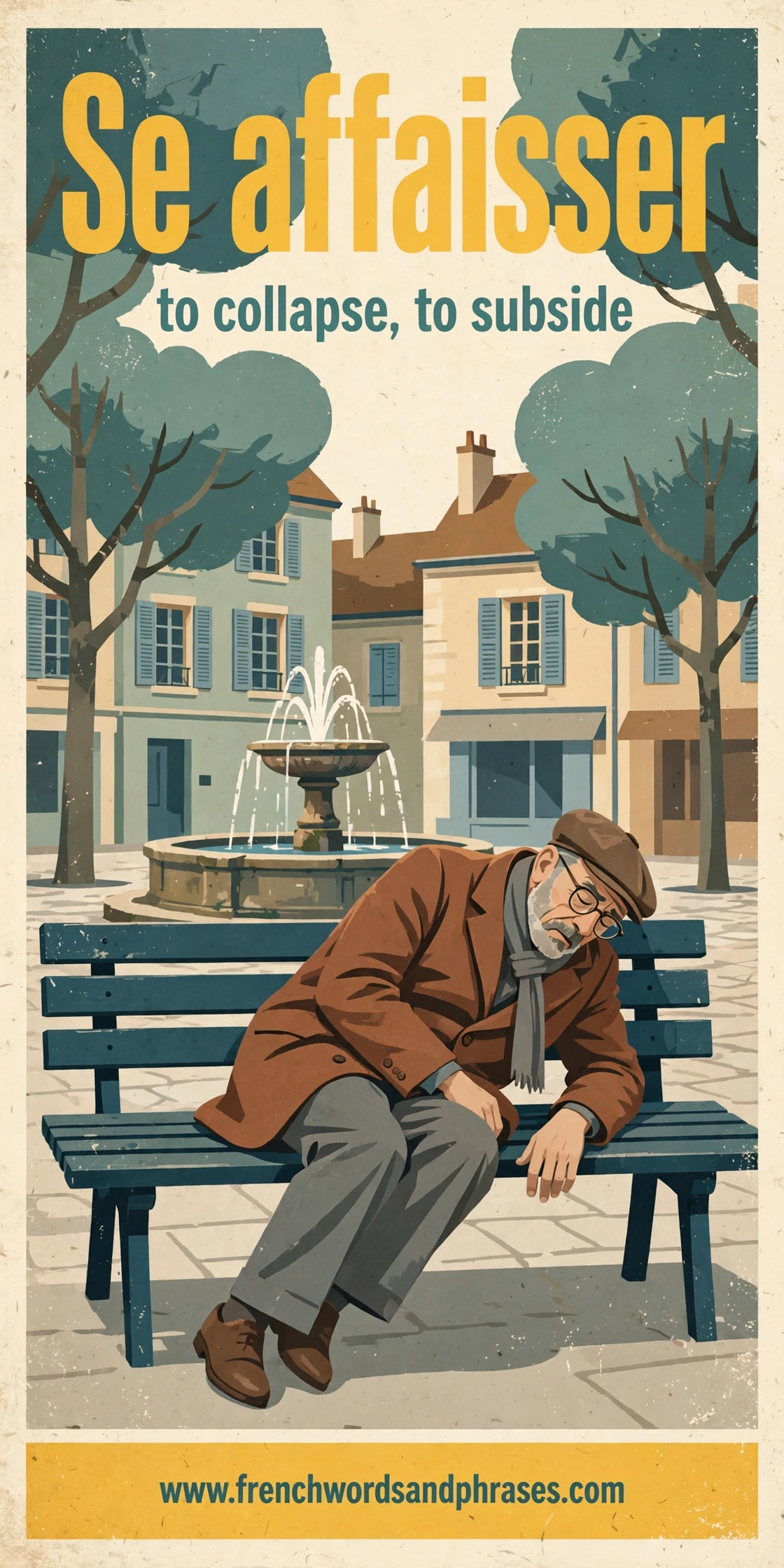
Add the reflexive pronoun and the sail becomes a tired body: se affaler dans un fauteuil — to flop down into an armchair — the same downward surrender, without the rope.
How to Remember the French Verb Affaler
Remember it this way: Affaler is about sailors hauling the mainsail down before the storm.
- A sailor’s verb: affaler une voile, to lower a sail — always with avoir.
- Regular -er: j’affale, nous affalons, past participle affalé.
- Keep it apart from se affaler (to flop into a chair): the plain verb lowers sails and loads.
The key idea is sailors hauling the mainsail down before the storm.
Test Your Knowledge of Affaler
Let’s see how much you’ve learned. Try answering these questions before revealing the answers.
Question 1
In what world does affaler live, and what is lowered there?
Reveal the answer
At sea — one affale une voile, lowers a sail, or lets a load down on its rope.
Question 2
How do you say The sailors lower the mainsail in French?
Reveal the answer
Les marins affalent la grand-voile.
Question 3
Translate: He lowered the sail in a few seconds.
Reveal the answer
Il a affalé la voile en quelques secondes.
Question 4
What is the past participle of affaler?
Reveal the answer
Affalé.
Question 5
Complete the sentence:
Il faut que tu ______ cette voile tout de suite.
Reveal the answer
affales
Il faut que tu affales cette voile tout de suite.
You must lower this sail at once.
Your Final Challenge
Can You Use It?
How would you say this in French?
The wind is rising over the harbour, and the sailors lower the sails without a wasted word.
Reveal the answer
Le vent monte sur le port, et les marins affalent les voiles sans un mot de trop.
The wind is rising over the harbour, and the sailors lower the sails without a wasted word.
A little French. A little curiosity. A richer everyday life.
LEARN FRENCH ONE WORD AT A TIME