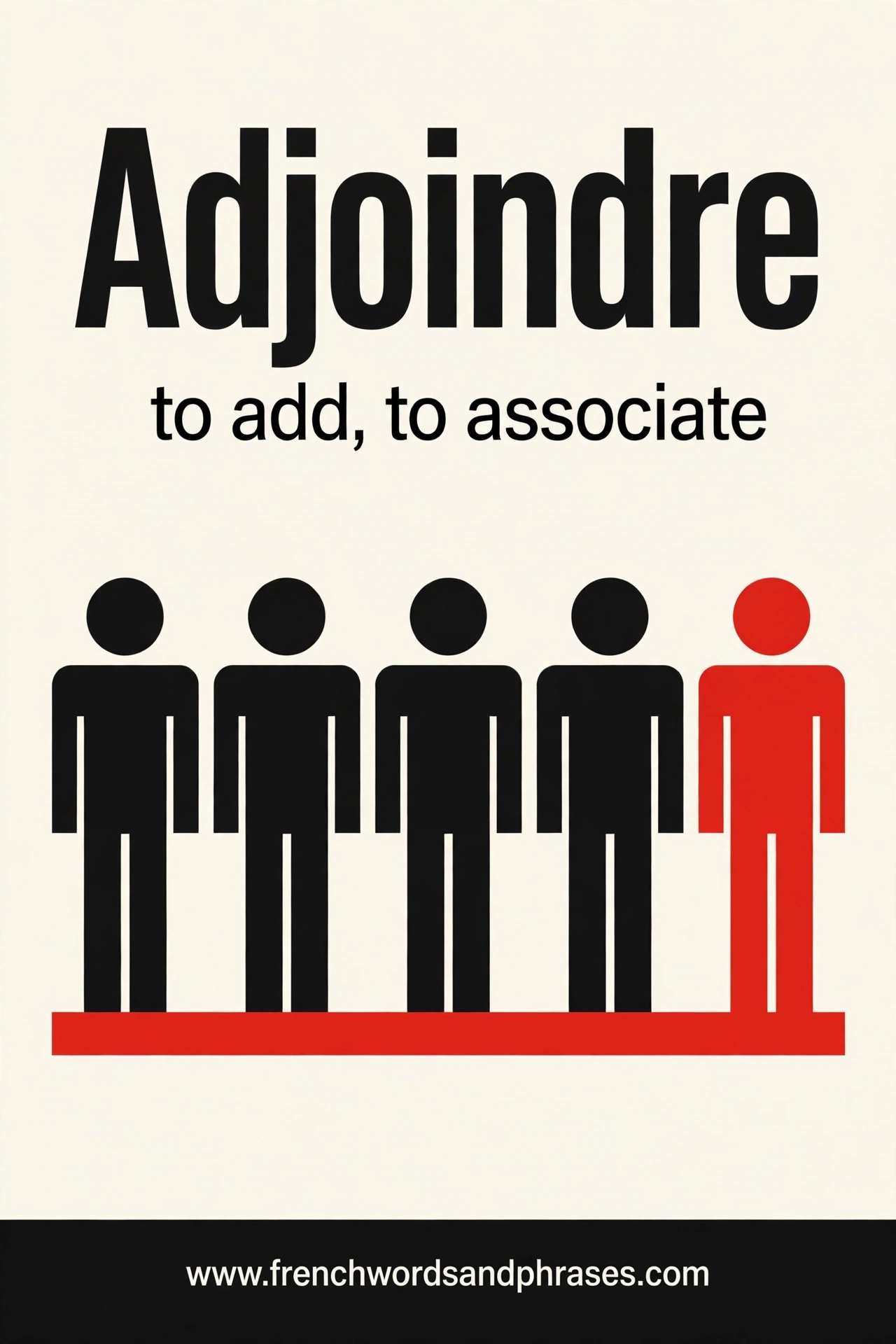
A French Word to Live By
How to Conjugate Se adjoindre in French
/sad.ʒwɛ̃dʁ/
Se adjoindre means to join up with — to attach yourself to a team, a group or an expedition, offering your hands to a work already under way.
A young interpreter walking into a delegation and asking where she can help, a student attaching himself to a research team for the summer — s’adjoindre is the verb of volunteering one’s attachment: you are not founding anything, you are joining what exists and making it stronger.
In this guide, you’ll learn how to conjugate se adjoindre in all the major French tenses and moods. Explore complete conjugation tables, French examples, English translations, and practice quizzes.
Understanding the French Verb Se adjoindre
Se adjoindre is an irregular French verb ending in -re, conjugated like joindre.
It means to join up with. It is a formal verb, at home in reports, minutes and official announcements, for people formally joining teams, committees, delegations and expeditions — the reflexive mirror of adjoindre, seen from the joiner’s side instead of the manager’s.
Verb classification: Irregular (-re, like joindre), reflexive
Auxiliary verb: Être
Past participle: adjoint
Present participle: adjoignant
English equivalents: To join up with, to attach oneself to; s’adjoindre à une équipe — to join a team; s’adjoindre à un groupe — to join up with a group; s’adjoindre à une expédition — to join an expedition; s’adjoindre les services de quelqu’un — to enlist someone’s services.
One important detail: s’adjoindre keeps the whole joindre pattern — je m’adjoins, nous nous adjoignons, ils s’adjoignent, past participle adjoint — and its partner is the preposition à: s’adjoindre à une équipe, à un groupe, à une expédition. Being reflexive, it takes être in compound tenses, and the participle agrees with the subject: elle s’est adjointe à l’équipe, ils se sont adjoints au comité. A close cousin worth knowing: s’adjoindre les services de quelqu’un means to take someone on, to enlist their help.
Experience the Word
Se adjoindre is the verb of the volunteer who knocks — the moment a person stops watching a team and becomes part of it.
Imagine an archaeological dig in Provence. A young draughtswoman arrives with her pencils, presents herself to the director and s’adjoint à l’équipe — by the end of the week her drawings are in the site report and nobody remembers the team without her.
She founded nothing and replaced nobody. She joined — adjointe à l’équipe — and the work grew by one pair of hands.
How to Conjugate Se adjoindre: Complete French Conjugation Guide
Let’s explore every major conjugation of se adjoindre, beginning with the indicative mood.
How to Conjugate Se adjoindre in the Indicative Mood
The indicative mood is used to express facts, observations, actions, and events.
How to Conjugate Se adjoindre in the Present Tense (Présent)
Used for actions happening now, habitual actions, and general truths.
| Subject | Conjugation |
|---|---|
| je | m’adjoins |
| tu | t’adjoins |
| il / elle | s’adjoint |
| nous | nous adjoignons |
| vous | vous adjoignez |
| ils / elles | s’adjoignent |
Example
Deux étudiants s’adjoignent à notre groupe de travail.
Two students are joining our work group.
Quick Quiz 1
Complete the sentence:
Nous nous ______ à votre groupe avec plaisir.
Reveal the answer
adjoignons
Nous nous adjoignons à votre groupe avec plaisir.
We are gladly joining your group.
How to Conjugate Se adjoindre in the Passé Composé
Used for completed actions in the past. Se adjoindre takes the auxiliary verb être.
| Subject | Conjugation |
|---|---|
| je | me suis adjoint / me suis adjointe |
| tu | t’es adjoint / t’es adjointe |
| il / elle | s’est adjoint / s’est adjointe |
| nous | nous sommes adjoints / nous sommes adjointes |
| vous | vous êtes adjoints / vous êtes adjointes / vous êtes adjoint / vous êtes adjointe |
| ils / elles | se sont adjoints / se sont adjointes |
Example
Il s’est adjoint à l’équipe dès le premier jour.
He joined the team from the very first day.
How to Conjugate Se adjoindre in the Imparfait (Imperfect Tense)
Used for habitual past actions, descriptions, and ongoing situations in the past.
| Subject | Conjugation |
|---|---|
| je | m’adjoignais |
| tu | t’adjoignais |
| il / elle | s’adjoignait |
| nous | nous adjoignions |
| vous | vous adjoigniez |
| ils / elles | s’adjoignaient |
Example
Chaque printemps, des volontaires s’adjoignaient aux vendangeurs.
Every spring, volunteers used to join the grape-pickers.
Quick Quiz 2
Choose the correct form:
She joined the committee.
Elle ______ au comité. (s’est adjointe / a adjoint)
Reveal the answer
s’est adjointe
Elle s’est adjointe au comité.
S’adjoindre is reflexive, takes être, and the participle agrees: adjointe.
How to Conjugate Se adjoindre in the Plus-que-parfait
Used to describe an action that had already been completed before another past event.
| Subject | Conjugation |
|---|---|
| je | m’étais adjoint / m’étais adjointe |
| tu | t’étais adjoint / t’étais adjointe |
| il / elle | s’était adjoint / s’était adjointe |
| nous | nous étions adjoints / nous étions adjointes |
| vous | vous étiez adjoints / vous étiez adjointes / vous étiez adjoint / vous étiez adjointe |
| ils / elles | s’étaient adjoints / s’étaient adjointes |
Example
Elle s’était adjointe au comité avant les élections.
She had joined the committee before the elections.
How to Conjugate Se adjoindre in the Passé Simple
Primarily used in formal writing, literature, and historical narratives. It is rarely used in everyday conversation.
| Subject | Conjugation |
|---|---|
| je | m’adjoignis |
| tu | t’adjoignis |
| il / elle | s’adjoignit |
| nous | nous adjoignîmes |
| vous | vous adjoignîtes |
| ils / elles | s’adjoignirent |
Example
Le jeune avocat s’adjoignit au cabinet de son oncle.
The young lawyer joined his uncle’s practice.
How to Conjugate Se adjoindre in the Passé Antérieur
A literary tense used to express an action completed immediately before another past action, generally in the passé simple.
| Subject | Conjugation |
|---|---|
| je | me fus adjoint / me fus adjointe |
| tu | te fus adjoint / te fus adjointe |
| il / elle | se fut adjoint / se fut adjointe |
| nous | nous fûmes adjoints / nous fûmes adjointes |
| vous | vous fûtes adjoints / vous fûtes adjointes / vous fûtes adjoint / vous fûtes adjointe |
| ils / elles | se furent adjoints / se furent adjointes |
Example
Dès qu’il se fut adjoint à l’expédition, le départ eut lieu.
As soon as he had joined the expedition, the departure took place.
How to Conjugate Se adjoindre in the Future Tense (Futur Simple)
Used to describe actions that will take place in the future.
| Subject | Conjugation |
|---|---|
| je | m’adjoindrai |
| tu | t’adjoindras |
| il / elle | s’adjoindra |
| nous | nous adjoindrons |
| vous | vous adjoindrez |
| ils / elles | s’adjoindront |
Example
Demain, un nouveau membre s’adjoindra à la commission.
Tomorrow, a new member will join the commission.
How to Conjugate Se adjoindre in the Futur Antérieur (Future Perfect)
Used for an action that will have been completed before a particular point in the future.
| Subject | Conjugation |
|---|---|
| je | me serai adjoint / me serai adjointe |
| tu | te seras adjoint / te seras adjointe |
| il / elle | se sera adjoint / se sera adjointe |
| nous | nous serons adjoints / nous serons adjointes |
| vous | vous serez adjoints / vous serez adjointes / vous serez adjoint / vous serez adjointe |
| ils / elles | se seront adjoints / se seront adjointes |
Example
À la fin de la semaine, trois recrues se seront adjointes à l’équipe.
By the end of the week, three recruits will have joined the team.
How to Conjugate Se adjoindre in the Near Future (Futur Proche)
Used to describe something that is going to happen soon. Formed with aller + infinitive.
| Subject | Conjugation |
|---|---|
| je | vais m’adjoindre |
| tu | vas t’adjoindre |
| il / elle | va s’adjoindre |
| nous | allons nous adjoindre |
| vous | allez vous adjoindre |
| ils / elles | vont s’adjoindre |
Example
Tu vas t’adjoindre à quel groupe pour le projet ?
Which group are you going to join for the project?
How to Conjugate Se adjoindre in the Conditional Mood
The conditional mood expresses what would happen under certain circumstances. It is also frequently used to make polite requests or express wishes.
How to Conjugate Se adjoindre in the Present Conditional
| Subject | Conjugation |
|---|---|
| je | m’adjoindrais |
| tu | t’adjoindrais |
| il / elle | s’adjoindrait |
| nous | nous adjoindrions |
| vous | vous adjoindriez |
| ils / elles | s’adjoindraient |
Example
Je m’adjoindrais volontiers à votre équipe.
I would gladly join your team.
How to Conjugate Se adjoindre in the Past Conditional
| Subject | Conjugation |
|---|---|
| je | me serais adjoint / me serais adjointe |
| tu | te serais adjoint / te serais adjointe |
| il / elle | se serait adjoint / se serait adjointe |
| nous | nous serions adjoints / nous serions adjointes |
| vous | vous seriez adjoints / vous seriez adjointes / vous seriez adjoint / vous seriez adjointe |
| ils / elles | se seraient adjoints / se seraient adjointes |
Example
Elle se serait adjointe au groupe si on l’avait invitée.
She would have joined the group if she had been invited.
Se adjoindre in the Literary Past Conditional Form
This less common literary form uses the imperfect subjunctive of être.
| Subject | Conjugation |
|---|---|
| je | me fusse adjoint / me fusse adjointe |
| tu | te fusses adjoint / te fusses adjointe |
| il / elle | se fût adjoint / se fût adjointe |
| nous | nous fussions adjoints / nous fussions adjointes |
| vous | vous fussiez adjoints / vous fussiez adjointes / vous fussiez adjoint / vous fussiez adjointe |
| ils / elles | se fussent adjoints / se fussent adjointes |
Example
Il se fût adjoint aux rebelles sans sa famille.
He would have joined the rebels without his family.
How to Conjugate Se adjoindre in the Subjunctive Mood
The subjunctive is used to express wishes, emotions, doubts, necessity, and uncertainty. It frequently follows expressions such as il faut que (it is necessary that) or bien que (although).
How to Conjugate Se adjoindre in the Present Subjunctive
| Subject | Conjugation |
|---|---|
| que je | m’adjoigne |
| que tu | t’adjoignes |
| qu’il / qu’elle | s’adjoigne |
| que nous | nous adjoignions |
| que vous | vous adjoigniez |
| qu’ils / qu’elles | s’adjoignent |
Example
Il faut que tu t’adjoignes à un groupe sérieux.
You must join a serious group.
Quick Quiz 3
Complete the sentence using the subjunctive:
Il faut que vous vous ______ à la délégation.
Reveal the answer
adjoigniez
Il faut que vous vous adjoigniez à la délégation.
You must join the delegation.
How to Conjugate Se adjoindre in the Imperfect Subjunctive
A literary tense, rarely encountered in modern spoken French.
| Subject | Conjugation |
|---|---|
| que je | m’adjoignisse |
| que tu | t’adjoignisses |
| qu’il / qu’elle | s’adjoignît |
| que nous | nous adjoignissions |
| que vous | vous adjoignissiez |
| qu’ils / qu’elles | s’adjoignissent |
Example
Je souhaitais qu’il s’adjoignît à notre délégation.
I wished he would join our delegation.
How to Conjugate Se adjoindre in the Pluperfect Subjunctive
A literary construction used to express an action completed before another past action.
| Subject | Conjugation |
|---|---|
| que je | me fusse adjoint / me fusse adjointe |
| que tu | te fusses adjoint / te fusses adjointe |
| qu’il / qu’elle | se fût adjoint / se fût adjointe |
| que nous | nous fussions adjoints / nous fussions adjointes |
| que vous | vous fussiez adjoints / vous fussiez adjointes / vous fussiez adjoint / vous fussiez adjointe |
| qu’ils / qu’elles | se fussent adjoints / se fussent adjointes |
Example
On disait qu’elle se fût adjointe aux fondateurs dès 1990.
People said she had joined the founders back in 1990.
How to Conjugate Se adjoindre in the Past Subjunctive
| Subject | Conjugation |
|---|---|
| que je | me sois adjoint / me sois adjointe |
| que tu | te sois adjoint / te sois adjointe |
| qu’il / qu’elle | se soit adjoint / se soit adjointe |
| que nous | nous soyons adjoints / nous soyons adjointes |
| que vous | vous soyez adjoints / vous soyez adjointes / vous soyez adjoint / vous soyez adjointe |
| qu’ils / qu’elles | se soient adjoints / se soient adjointes |
Example
Je suis ravi qu’elle se soit adjointe à notre équipe.
I am delighted she joined our team.
How to Conjugate Se adjoindre in the Imperative
The imperative is used to give commands, instructions, invitations, or suggestions. Subject pronouns are omitted.
How to Conjugate Se adjoindre in the Present Imperative
| Person | Conjugation |
|---|---|
| (tu) | adjoins-toi |
| (nous) | adjoignons-nous |
| (vous) | adjoignez-vous |
Example
Adjoins-toi à nous pour la dernière ligne droite !
Join us for the final stretch!
Quick Quiz 4
How would you say Join us (tu form)?
Reveal the answer
Adjoins-toi à nous !
French Participles of Se adjoindre
Participles are verb forms that can be used in compound tenses and other grammatical constructions.
Present Participle of Se adjoindre
adjoignant
En s’adjoignant à l’association, il a trouvé sa voie.
By joining the association, he found his path.
Past Participle of Se adjoindre
adjoint
Bien adjointes au groupe, les recrues ont vite trouvé leur place.
Well settled into the group, the recruits quickly found their place.
Se adjoindre in Everyday French: Real-Life Examples
Now that you know the conjugations, let’s see how se adjoindre appears in everyday French.
Example 1 — Present
Deux étudiants s’adjoignent à notre groupe.
Two students are joining our group.
Example 2 — Passé composé
Il s’est adjoint à l’équipe dès le premier jour.
He joined the team from the first day.
Example 3 — Imparfait
Des volontaires s’adjoignaient aux vendangeurs.
Volunteers used to join the grape-pickers.
Example 4 — Future
Un nouveau membre s’adjoindra à la commission.
A new member will join the commission.
Example 5 — Conditional
Je m’adjoindrais volontiers à votre équipe.
I would gladly join your team.
Example 6 — Imperative
Adjoins-toi à nous !
Join us!
Beyond Translation: The Meaning of Se adjoindre
English join is broader and breezier; French s’adjoindre keeps the paperwork of adjoindre — it is joining with a signature, the formal attachment of a person to a body that already exists.
It is the joiner’s mirror of the manager’s verb.
The director adjoins an assistant à the team; the assistant, from his side, s’adjoint à the team. Same preposition, same participle — adjoint — and the same quiet sense that French institutions grow by attachment, one pair of hands at a time.
How to Remember the French Verb Se adjoindre
Remember it this way: Se adjoindre is about the draughtswoman knocking at the dig team’s door, pencils in hand.
- Always with à: s’adjoindre à une équipe, à un groupe, à une expédition.
- Être in compound tenses, participle agreeing: elle s’est adjointe, ils se sont adjoints.
- Joindre pattern: je m’adjoins, nous nous adjoignons, ils s’adjoignent.
The key idea is the draughtswoman knocking at the dig team’s door, pencils in hand.
Test Your Knowledge of Se adjoindre
Let’s see how much you’ve learned. Try answering these questions before revealing the answers.
Question 1
Which preposition follows s’adjoindre?
Reveal the answer
À — s’adjoindre à une équipe, s’adjoindre à un groupe.
Question 2
How do you say He joined the team from the first day in French?
Reveal the answer
Il s’est adjoint à l’équipe dès le premier jour.
Question 3
Translate: Join us!
Reveal the answer
Adjoins-toi à nous !
Question 4
What is the past participle of s’adjoindre?
Reveal the answer
Adjoint — agreeing: adjointe, adjoints, adjointes (elle s’est adjointe).
Question 5
Complete the sentence:
Il faut que tu ______ à un groupe sérieux.
Reveal the answer
t’adjoignes
Il faut que tu t’adjoignes à un groupe sérieux.
You must join a serious group.
Your Final Challenge
Can You Use It?
How would you say this in French?
She joins the team at dawn, and her drawings already tell the story of the whole site.
Reveal the answer
Elle s’adjoint à l’équipe dès l’aube, et ses dessins racontent déjà le chantier entier.
She joins the team at dawn, and her drawings already tell the story of the whole site.
A little French. A little curiosity. A richer everyday life.
LEARN FRENCH ONE WORD AT A TIME