A French Word to Live By
How to Conjugate Se activer in French
/sak.ti.ve/
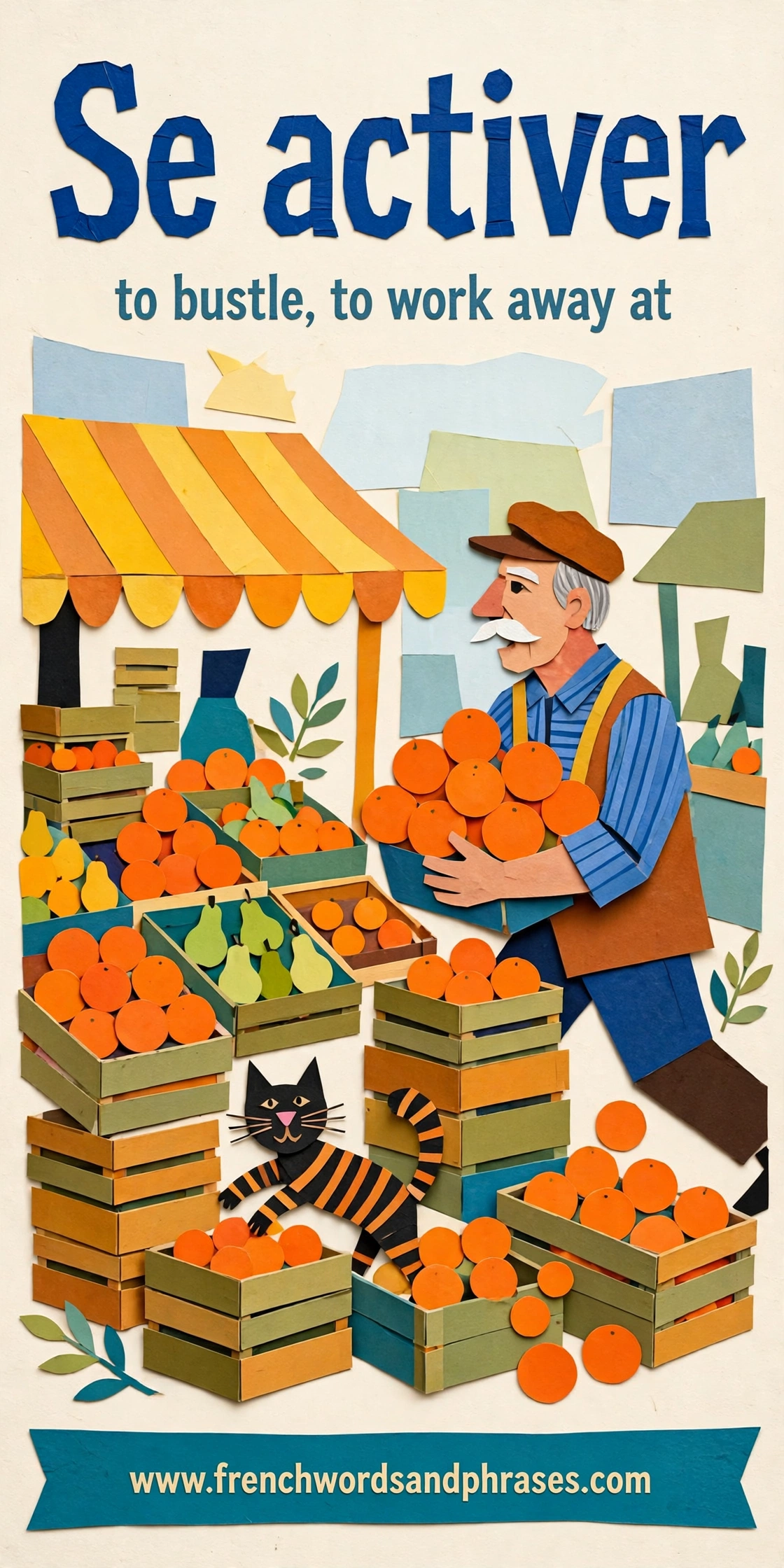
Se activer means to bustle, to work away at — to hurry about getting a job done, sleeves rolled up, when there is a great deal to do and little time to do it.
An hour before the guests arrive, the whole household is in motion: one person lays the table, another chops, another runs to the cellar for chairs — s’activer is the verb of that cheerful scramble, people bustling at a task with a deadline breathing down their necks.
In this guide, you’ll learn how to conjugate se activer in all the major French tenses and moods. Explore complete conjugation tables, French examples, English translations, and practice quizzes.
Understanding the French Verb Se activer
Se activer is a regular French verb belonging to the first group of verbs, those ending in-er.
It means to bustle, to work away at. It is commonly used in kitchens, workshops, gardens and building sites whenever a team throws itself at a job against the clock, and as a friendly reproach — active-toi ! — to anyone moving too slowly. It always suggests useful hurry, never panic.
Verb classification: First group (-er), reflexive
Auxiliary verb: Être
Past participle: activé
Present participle: activant
English equivalents: To bustle about, to get busy, to work away at; s’activer à faire quelque chose — to busy oneself doing something; s’activer à ranger — to bustle about tidying; s’activer en cuisine — to bustle in the kitchen; allez, active-toi ! — come on, get a move on!
One important detail: s’activer is built with the preposition à before what you are bustling at: s’activer à ranger, s’activer à finir le chantier. Being reflexive, it takes être in every compound tense and the participle agrees with the subject: elle s’est activée à tout préparer, ils se sont activés dès l’aube. The tu imperative tucks the pronoun behind the verb: active-toi ! — the standard French shout when someone is dawdling. Do not confuse it with plain activer, which switches things on; people s’activent.
Experience the Word
Se activer is the verb of sleeves rolled up — the moment a household or a team stops talking about the job and starts swarming over it.
Imagine the morning of a village wedding. From seven o’clock, twenty volunteers s’activent: hanging garlands in the hall, carrying tables across the square, peeling mountains of potatoes — everyone bustling at something, and the whole square smelling of coffee and fresh bread.
Nobody gave an order. The day demanded it, and everyone got busy — activés à la tâche, happily, together.
How to Conjugate Se activer: Complete French Conjugation Guide
Let’s explore every major conjugation of se activer, beginning with the indicative mood.
How to Conjugate Se activer in the Indicative Mood
The indicative mood is used to express facts, observations, actions, and events.
How to Conjugate Se activer in the Present Tense (Présent)
Used for actions happening now, habitual actions, and general truths.
| Subject | Conjugation |
|---|---|
| je | m’active |
| tu | t’actives |
| il / elle | s’active |
| nous | nous activons |
| vous | vous activez |
| ils / elles | s’activent |
Example
Depuis l’aube, les ouvriers s’activent à réparer le toit.
Since dawn, the workers have been bustling away at repairing the roof.
Quick Quiz 1
Complete the sentence:
Nous nous ______ à terminer le chantier.
Reveal the answer
activons
Nous nous activons à terminer le chantier.
We are getting busy finishing the building work.
How to Conjugate Se activer in the Passé Composé
Used for completed actions in the past. Se activer takes the auxiliary verb être.
| Subject | Conjugation |
|---|---|
| je | me suis activé / me suis activée |
| tu | t’es activé / t’es activée |
| il / elle | s’est activé / s’est activée |
| nous | nous sommes activés / nous sommes activées |
| vous | vous êtes activés / vous êtes activées / vous êtes activé / vous êtes activée |
| ils / elles | se sont activés / se sont activées |
Example
Elle s’est activée à ranger la cuisine avant l’arrivée des invités.
She bustled about tidying the kitchen before the guests arrived.
How to Conjugate Se activer in the Imparfait (Imperfect Tense)
Used for habitual past actions, descriptions, and ongoing situations in the past.
| Subject | Conjugation |
|---|---|
| je | m’activais |
| tu | t’activais |
| il / elle | s’activait |
| nous | nous activions |
| vous | vous activiez |
| ils / elles | s’activaient |
Example
Toute la famille s’activait à préparer la fête.
The whole family used to bustle about preparing the party.
Quick Quiz 2
Choose the correct form:
She bustled about tidying the kitchen.
Elle ______ à ranger la cuisine. (s’est activée / a activé)
Reveal the answer
s’est activée
Elle s’est activée à ranger la cuisine.
S’activer is reflexive, takes être, and the participle agrees: activée.
How to Conjugate Se activer in the Plus-que-parfait
Used to describe an action that had already been completed before another past event.
| Subject | Conjugation |
|---|---|
| je | m’étais activé / m’étais activée |
| tu | t’étais activé / t’étais activée |
| il / elle | s’était activé / s’était activée |
| nous | nous étions activés / nous étions activées |
| vous | vous étiez activés / vous étiez activées / vous étiez activé / vous étiez activée |
| ils / elles | s’étaient activés / s’étaient activées |
Example
Ils s’étaient activés à finir le déménagement avant la nuit.
They had busied themselves finishing the move before nightfall.
How to Conjugate Se activer in the Passé Simple
Primarily used in formal writing, literature, and historical narratives. It is rarely used in everyday conversation.
| Subject | Conjugation |
|---|---|
| je | m’activai |
| tu | t’activas |
| il / elle | s’activa |
| nous | nous activâmes |
| vous | vous activâtes |
| ils / elles | s’activèrent |
Example
Les voisins s’activèrent à éteindre le feu avec des seaux.
The neighbours set to work putting out the fire with buckets.
How to Conjugate Se activer in the Passé Antérieur
A literary tense used to express an action completed immediately before another past action, generally in the passé simple.
| Subject | Conjugation |
|---|---|
| je | me fus activé / me fus activée |
| tu | te fus activé / te fus activée |
| il / elle | se fut activé / se fut activée |
| nous | nous fûmes activés / nous fûmes activées |
| vous | vous fûtes activés / vous fûtes activées / vous fûtes activé / vous fûtes activée |
| ils / elles | se furent activés / se furent activées |
Example
Dès qu’elle se fut activée à tout ranger, elle put enfin se reposer.
As soon as she had bustled about tidying everything, she could finally rest.
How to Conjugate Se activer in the Future Tense (Futur Simple)
Used to describe actions that will take place in the future.
| Subject | Conjugation |
|---|---|
| je | m’activerai |
| tu | t’activeras |
| il / elle | s’activera |
| nous | nous activerons |
| vous | vous activerez |
| ils / elles | s’activeront |
Example
Demain, nous nous activerons à terminer le chantier.
Tomorrow, we will get busy finishing the building work.
How to Conjugate Se activer in the Futur Antérieur (Future Perfect)
Used for an action that will have been completed before a particular point in the future.
| Subject | Conjugation |
|---|---|
| je | me serai activé / me serai activée |
| tu | te seras activé / te seras activée |
| il / elle | se sera activé / se sera activée |
| nous | nous serons activés / nous serons activées |
| vous | vous serez activés / vous serez activées / vous serez activé / vous serez activée |
| ils / elles | se seront activés / se seront activées |
Example
À midi, ils se seront activés à tout préparer.
By noon, they will have busied themselves preparing everything.
How to Conjugate Se activer in the Near Future (Futur Proche)
Used to describe something that is going to happen soon. Formed with aller + infinitive.
| Subject | Conjugation |
|---|---|
| je | vais m’activer |
| tu | vas t’activer |
| il / elle | va s’activer |
| nous | allons nous activer |
| vous | allez vous activer |
| ils / elles | vont s’activer |
Example
Allez, tout le monde va s’activer à mettre la table !
Come on, everyone is going to bustle about laying the table!
How to Conjugate Se activer in the Conditional Mood
The conditional mood expresses what would happen under certain circumstances. It is also frequently used to make polite requests or express wishes.
How to Conjugate Se activer in the Present Conditional
| Subject | Conjugation |
|---|---|
| je | m’activerais |
| tu | t’activerais |
| il / elle | s’activerait |
| nous | nous activerions |
| vous | vous activeriez |
| ils / elles | s’activeraient |
Example
Sans bruit, les enfants s’activeraient à cacher le cadeau.
Quietly, the children would busy themselves hiding the present.
How to Conjugate Se activer in the Past Conditional
| Subject | Conjugation |
|---|---|
| je | me serais activé / me serais activée |
| tu | te serais activé / te serais activée |
| il / elle | se serait activé / se serait activée |
| nous | nous serions activés / nous serions activées |
| vous | vous seriez activés / vous seriez activées / vous seriez activé / vous seriez activée |
| ils / elles | se seraient activés / se seraient activées |
Example
Elle se serait activée à aider si on l’avait appelée.
She would have bustled about helping if she had been called.
Se activer in the Literary Past Conditional Form
This less common literary form uses the imperfect subjunctive of être.
| Subject | Conjugation |
|---|---|
| je | me fusse activé / me fusse activée |
| tu | te fusses activé / te fusses activée |
| il / elle | se fût activé / se fût activée |
| nous | nous fussions activés / nous fussions activées |
| vous | vous fussiez activés / vous fussiez activées / vous fussiez activé / vous fussiez activée |
| ils / elles | se fussent activés / se fussent activées |
Example
Il se fût activé à réparer la fuite sans l’orage.
He would have set to work repairing the leak without the storm.
How to Conjugate Se activer in the Subjunctive Mood
The subjunctive is used to express wishes, emotions, doubts, necessity, and uncertainty. It frequently follows expressions such as il faut que (it is necessary that) or bien que (although).
How to Conjugate Se activer in the Present Subjunctive
| Subject | Conjugation |
|---|---|
| que je | m’active |
| que tu | t’actives |
| qu’il / qu’elle | s’active |
| que nous | nous activions |
| que vous | vous activiez |
| qu’ils / qu’elles | s’activent |
Example
Il faut que tu t’actives à finir tes devoirs.
You must get busy finishing your homework.
Quick Quiz 3
Complete the sentence using the subjunctive:
Il faut que vous vous ______ à préparer le repas.
Reveal the answer
activiez
Il faut que vous vous activiez à préparer le repas.
You must busy yourselves preparing the meal.
How to Conjugate Se activer in the Imperfect Subjunctive
A literary tense, rarely encountered in modern spoken French.
| Subject | Conjugation |
|---|---|
| que je | m’activasse |
| que tu | t’activasses |
| qu’il / qu’elle | s’activât |
| que nous | nous activassions |
| que vous | vous activassiez |
| qu’ils / qu’elles | s’activassent |
Example
Je souhaitais qu’ils s’activassent à préparer le repas.
I wished they would busy themselves preparing the meal.
How to Conjugate Se activer in the Pluperfect Subjunctive
A literary construction used to express an action completed before another past action.
| Subject | Conjugation |
|---|---|
| que je | me fusse activé / me fusse activée |
| que tu | te fusses activé / te fusses activée |
| qu’il / qu’elle | se fût activé / se fût activée |
| que nous | nous fussions activés / nous fussions activées |
| que vous | vous fussiez activés / vous fussiez activées / vous fussiez activé / vous fussiez activée |
| qu’ils / qu’elles | se fussent activés / se fussent activées |
Example
On disait qu’elle se fût activée à tout organiser seule.
People said she had bustled about organising everything on her own.
How to Conjugate Se activer in the Past Subjunctive
| Subject | Conjugation |
|---|---|
| que je | me sois activé / me sois activée |
| que tu | te sois activé / te sois activée |
| qu’il / qu’elle | se soit activé / se soit activée |
| que nous | nous soyons activés / nous soyons activées |
| que vous | vous soyez activés / vous soyez activées / vous soyez activé / vous soyez activée |
| qu’ils / qu’elles | se soient activés / se soient activées |
Example
Je suis ravi qu’elle se soit activée à nous aider.
I am delighted she bustled about helping us.
How to Conjugate Se activer in the Imperative
The imperative is used to give commands, instructions, invitations, or suggestions. Subject pronouns are omitted.
How to Conjugate Se activer in the Present Imperative
| Person | Conjugation |
|---|---|
| (tu) | active-toi |
| (nous) | activons-nous |
| (vous) | activez-vous |
Example
Active-toi à finir, le train part dans une heure !
Get busy finishing, the train leaves in an hour!
Quick Quiz 4
How would you say Get a move on (tu form)?
Reveal the answer
Active-toi !
French Participles of Se activer
Participles are verb forms that can be used in compound tenses and other grammatical constructions.
Present Participle of Se activer
activant
En s’activant à déménager les cartons, il s’est fait mal au dos.
By bustling about moving the boxes, he hurt his back.
Past Participle of Se activer
activé
Bien activés à nettoyer la salle, les bénévoles ont fini avant midi.
Hard at work cleaning the hall, the volunteers finished before noon.
Se activer in Everyday French: Real-Life Examples
Now that you know the conjugations, let’s see how se activer appears in everyday French.
Example 1 — Present
Les ouvriers s’activent à réparer le toit.
The workers are bustling away at repairing the roof.
Example 2 — Passé composé
Elle s’est activée à ranger la cuisine.
She bustled about tidying the kitchen.
Example 3 — Imparfait
Toute la famille s’activait à préparer la fête.
The whole family used to bustle about preparing the party.
Example 4 — Future
Nous nous activerons à terminer le chantier.
We will get busy finishing the building work.
Example 5 — Conditional
Elle s’activerait à aider avec plaisir.
She would bustle about helping with pleasure.
Example 6 — Imperative
Active-toi, le train part dans une heure !
Get a move on, the train leaves in an hour!
Beyond Translation: The Meaning of Se activer
English bustle comes close, but French s’activer always has a job in its hands — it is bustle with a purpose and usually a deadline.
It is the kindest of hurry-verbs.
Someone who s’active is not panicking or showing off; they are simply getting on with it, and the shout active-toi ! between friends is more encouragement than scolding. It is the reflexive twin of activer: machines are switched on, people s’activent.
How to Remember the French Verb Se activer
Remember it this way: Se activer is about the whole household swarming over the wedding preparations.
- Always with à before the job: s’activer à ranger, s’activer à finir.
- Être in compound tenses, participle agreeing: elle s’est activée, ils se sont activés.
- The friendly shout for a dawdler: active-toi ! — get a move on!
The key idea is the whole household swarming over the wedding preparations.
Test Your Knowledge of Se activer
Let’s see how much you’ve learned. Try answering these questions before revealing the answers.
Question 1
Which preposition follows s’activer before the task?
Reveal the answer
À — s’activer à ranger, s’activer à finir le chantier.
Question 2
How do you say She bustled about tidying the kitchen in French?
Reveal the answer
Elle s’est activée à ranger la cuisine.
Question 3
Translate: Get a move on, the train leaves in an hour!
Reveal the answer
Active-toi, le train part dans une heure !
Question 4
What is the past participle of s’activer?
Reveal the answer
Activé — agreeing: activée, activés, activées (elle s’est activée).
Question 5
Complete the sentence:
Il faut que tu ______ à finir tes devoirs.
Reveal the answer
t’actives
Il faut que tu t’actives à finir tes devoirs.
You must get busy finishing your homework.
Your Final Challenge
Can You Use It?
How would you say this in French?
From dawn, the whole village bustles about preparing the festival, and the square already smells of warm bread.
Reveal the answer
Dès l’aube, tout le village s’active à préparer la fête, et la place sent déjà le pain chaud.
From dawn, the whole village bustles about preparing the festival, and the square already smells of warm bread.
A little French. A little curiosity. A richer everyday life.
LEARN FRENCH ONE WORD AT A TIME