A French Word to Live By
How to Conjugate Actionner in French
/ak.sjɔ.ne/
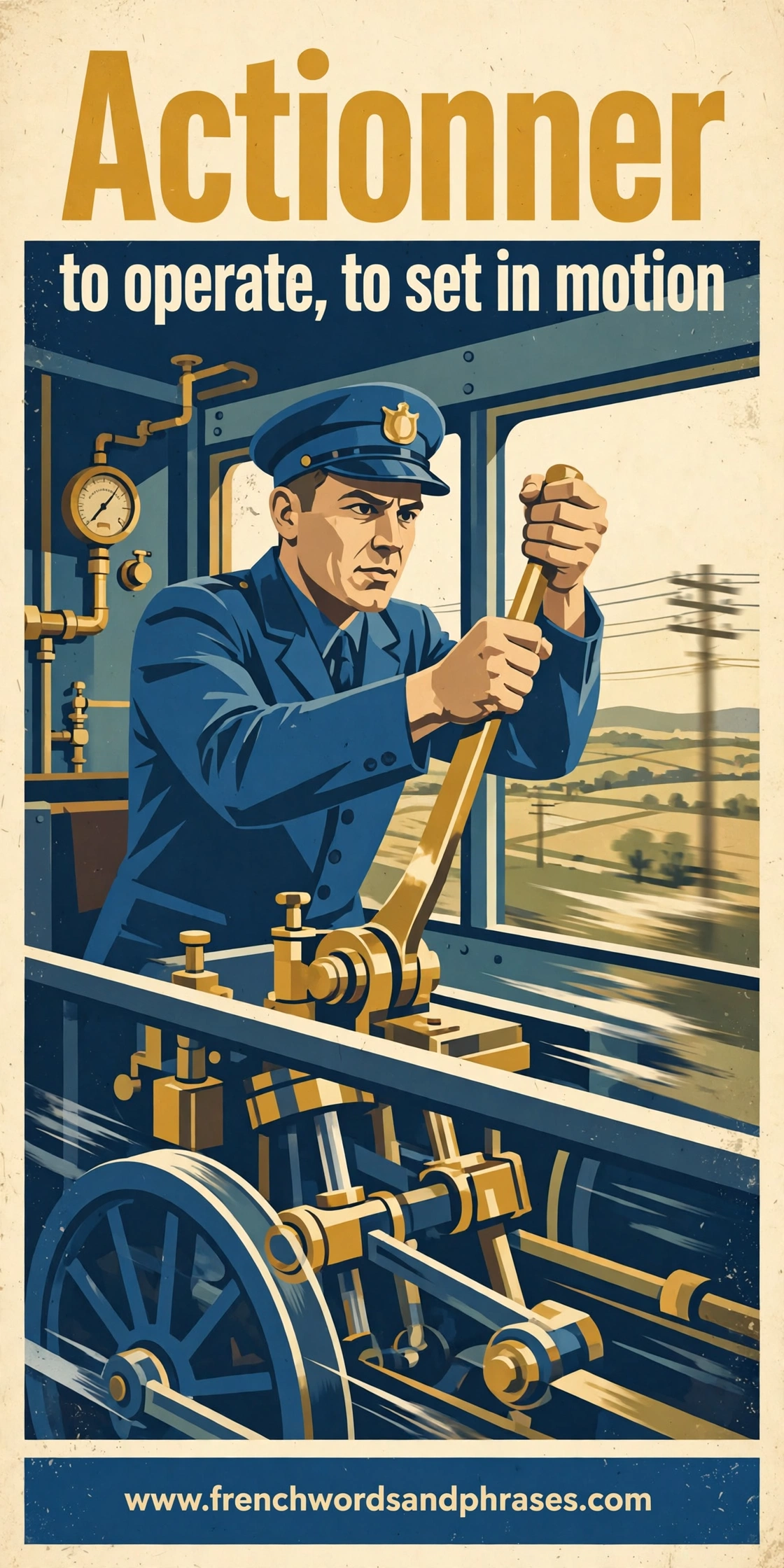
Actionner means to operate, to set in motion — to press, pull or work whatever lever, switch or handle makes a machine start doing its job.
A stationmaster hauling on a heavy lever, a fairground worker pulling the handle that starts the roundabout, a driver pressing the switch that opens the barrier — actionner is the verb of hands on controls: the moment a human gesture wakes a mechanism up.
In this guide, you’ll learn how to conjugate actionner in all the major French tenses and moods. Explore complete conjugation tables, French examples, English translations, and practice quizzes.
Understanding the French Verb Actionner
Actionner is a regular French verb belonging to the first group of verbs, those ending in-er.
It means to operate, to set in motion. It is commonly used in workshops, stations, factories and fairgrounds for the physical working of levers and mechanisms, in driving for brakes and indicators, and in legal French for starting proceedings against someone. Where English says operate, work, apply or trigger, French very often says actionner.
Verb classification: First group (-er)
Auxiliary verb: Avoir
Past participle: actionné
Present participle: actionnant
English equivalents: To operate, to set in motion, to work; actionner un levier — to work a lever; actionner une manette — to pull a control lever; actionner un mécanisme — to set a mechanism going; actionner les freins — to apply the brakes; actionner quelqu’un en justice — to take someone to court.
One important detail: actionner is the verb of the noun une action, and it keeps the double n everywhere: j’actionne, nous actionnons, ils actionnent. It is a perfectly regular -er verb — the only thing to learn is its world: levers, handles, switches, pumps and brakes. Its legal cousin is worth knowing too: actionner quelqu’un en justice means to bring an action against someone, to sue them — the same word, setting the machinery of the courts in motion instead of a machine.
Experience the Word
Actionner is the verb of the hand on the control — the small, deliberate gesture that sets a much bigger machine moving.
Imagine an old level crossing at dawn. The keeper watches the train approach, grips the worn lever with both hands and actionne — chains rattle, the barrier sinks across the road, and tons of steel obey one man’s arms.
He has not pushed the train or lifted the barrier himself. He has worked the lever — actionné — and the mechanism did the rest.
How to Conjugate Actionner: Complete French Conjugation Guide
Let’s explore every major conjugation of actionner, beginning with the indicative mood.
How to Conjugate Actionner in the Indicative Mood
The indicative mood is used to express facts, observations, actions, and events.
How to Conjugate Actionner in the Present Tense (Présent)
Used for actions happening now, habitual actions, and general truths.
| Subject | Conjugation |
|---|---|
| je | actionne |
| tu | actionnes |
| il / elle | actionne |
| nous | actionnons |
| vous | actionnez |
| ils / elles | actionnent |
Example
Le machiniste actionne le levier pour ouvrir la porte du four.
The operator works the lever to open the furnace door.
Quick Quiz 1
Complete the sentence:
Nous ______ la pompe à la main.
Reveal the answer
actionnons
Nous actionnons la pompe à la main.
We work the pump by hand.
How to Conjugate Actionner in the Passé Composé
Used for completed actions in the past. Actionner takes the auxiliary verb avoir.
| Subject | Conjugation |
|---|---|
| j’ | ai actionné |
| tu | as actionné |
| il / elle | a actionné |
| nous | avons actionné |
| vous | avez actionné |
| ils / elles | ont actionné |
Example
Elle a actionné la manette et la machine s’est mise en marche.
She pulled the control lever and the machine started up.
How to Conjugate Actionner in the Imparfait (Imperfect Tense)
Used for habitual past actions, descriptions, and ongoing situations in the past.
| Subject | Conjugation |
|---|---|
| je | actionnais |
| tu | actionnais |
| il / elle | actionnait |
| nous | actionnions |
| vous | actionniez |
| ils / elles | actionnaient |
Example
Chaque matin, il actionnait la pompe à la main.
Every morning, he worked the pump by hand.
Quick Quiz 2
Choose the correct form:
She operated the machine.
Elle ______ la machine. (a actionné / est actionnée)
Reveal the answer
a actionné
Elle a actionné la machine.
Actionner takes avoir.
How to Conjugate Actionner in the Plus-que-parfait
Used to describe an action that had already been completed before another past event.
| Subject | Conjugation |
|---|---|
| j’ | avais actionné |
| tu | avais actionné |
| il / elle | avait actionné |
| nous | avions actionné |
| vous | aviez actionné |
| ils / elles | avaient actionné |
Example
Ils avaient actionné l’alarme avant de quitter l’entrepôt.
They had set off the alarm before leaving the warehouse.
How to Conjugate Actionner in the Passé Simple
Primarily used in formal writing, literature, and historical narratives. It is rarely used in everyday conversation.
| Subject | Conjugation |
|---|---|
| je | actionnai |
| tu | actionnas |
| il / elle | actionna |
| nous | actionnâmes |
| vous | actionnâtes |
| ils / elles | actionnèrent |
Example
Le conducteur actionna le signal d’arrêt d’urgence.
The driver operated the emergency stop signal.
How to Conjugate Actionner in the Passé Antérieur
A literary tense used to express an action completed immediately before another past action, generally in the passé simple.
| Subject | Conjugation |
|---|---|
| j’ | eus actionné |
| tu | eus actionné |
| il / elle | eut actionné |
| nous | eûmes actionné |
| vous | eûtes actionné |
| ils / elles | eurent actionné |
Example
Dès qu’il eut actionné le mécanisme, la grille se leva.
As soon as he had set the mechanism in motion, the gate rose.
How to Conjugate Actionner in the Future Tense (Futur Simple)
Used to describe actions that will take place in the future.
| Subject | Conjugation |
|---|---|
| je | actionnerai |
| tu | actionneras |
| il / elle | actionnera |
| nous | actionnerons |
| vous | actionnerez |
| ils / elles | actionneront |
Example
Un simple bouton actionnera tout le système.
A single button will operate the whole system.
How to Conjugate Actionner in the Futur Antérieur (Future Perfect)
Used for an action that will have been completed before a particular point in the future.
| Subject | Conjugation |
|---|---|
| j’ | aurai actionné |
| tu | auras actionné |
| il / elle | aura actionné |
| nous | aurons actionné |
| vous | aurez actionné |
| ils / elles | auront actionné |
Example
Quand tu auras actionné ce levier, la presse descendra.
When you have worked this lever, the press will come down.
How to Conjugate Actionner in the Near Future (Futur Proche)
Used to describe something that is going to happen soon. Formed with aller + infinitive.
| Subject | Conjugation |
|---|---|
| je | vais actionner |
| tu | vas actionner |
| il / elle | va actionner |
| nous | allons actionner |
| vous | allez actionner |
| ils / elles | vont actionner |
Example
Attention, je vais actionner la scie électrique !
Careful, I am going to switch on the electric saw!
How to Conjugate Actionner in the Conditional Mood
The conditional mood expresses what would happen under certain circumstances. It is also frequently used to make polite requests or express wishes.
How to Conjugate Actionner in the Present Conditional
| Subject | Conjugation |
|---|---|
| je | actionnerais |
| tu | actionnerais |
| il / elle | actionnerait |
| nous | actionnerions |
| vous | actionneriez |
| ils / elles | actionneraient |
Example
Ce bouton actionnerait la porte du garage.
This button would operate the garage door.
How to Conjugate Actionner in the Past Conditional
| Subject | Conjugation |
|---|---|
| j’ | aurais actionné |
| tu | aurais actionné |
| il / elle | aurait actionné |
| nous | aurions actionné |
| vous | auriez actionné |
| ils / elles | auraient actionné |
Example
Sans électricité, le moteur n’aurait actionné aucune pompe.
Without electricity, the motor would not have driven any pump.
Actionner in the Literary Past Conditional Form
This less common literary form uses the imperfect subjunctive of avoir.
| Subject | Conjugation |
|---|---|
| j’ | eusse actionné |
| tu | eusses actionné |
| il / elle | eût actionné |
| nous | eussions actionné |
| vous | eussiez actionné |
| ils / elles | eussent actionné |
Example
Un seul geste eût actionné toute la machinerie.
A single gesture would have set the whole machinery in motion.
How to Conjugate Actionner in the Subjunctive Mood
The subjunctive is used to express wishes, emotions, doubts, necessity, and uncertainty. It frequently follows expressions such as il faut que (it is necessary that) or bien que (although).
How to Conjugate Actionner in the Present Subjunctive
| Subject | Conjugation |
|---|---|
| que je | actionne |
| que tu | actionnes |
| qu’il / qu’elle | actionne |
| que nous | actionnions |
| que vous | actionniez |
| qu’ils / qu’elles | actionnent |
Example
Il faut que tu actionnes le levier doucement.
You must work the lever gently.
Quick Quiz 3
Complete the sentence using the subjunctive:
Il faut que vous ______ le frein avant l’arrêt.
Reveal the answer
actionniez
Il faut que vous actionniez le frein avant l’arrêt.
You must apply the brake before the stop.
How to Conjugate Actionner in the Imperfect Subjunctive
A literary tense, rarely encountered in modern spoken French.
| Subject | Conjugation |
|---|---|
| que je | actionnasse |
| que tu | actionnasses |
| qu’il / qu’elle | actionnât |
| que nous | actionnassions |
| que vous | actionnassiez |
| qu’ils / qu’elles | actionnassent |
Example
Le manuel exigeait qu’on actionnât le frein avant l’arrêt complet.
The manual required the brake to be applied before the full stop.
How to Conjugate Actionner in the Pluperfect Subjunctive
A literary construction used to express an action completed before another past action.
| Subject | Conjugation |
|---|---|
| que j’ | eusse actionné |
| que tu | eusses actionné |
| qu’il / qu’elle | eût actionné |
| que nous | eussions actionné |
| que vous | eussiez actionné |
| qu’ils / qu’elles | eussent actionné |
Example
On vérifia qu’il eût actionné le bon interrupteur.
They checked that he had operated the right switch.
How to Conjugate Actionner in the Past Subjunctive
| Subject | Conjugation |
|---|---|
| que j’ | aie actionné |
| que tu | aies actionné |
| qu’il / qu’elle | ait actionné |
| que nous | ayons actionné |
| que vous | ayez actionné |
| qu’ils / qu’elles | aient actionné |
Example
Je doute qu’il ait actionné la machine tout seul.
I doubt he operated the machine on his own.
How to Conjugate Actionner in the Imperative
The imperative is used to give commands, instructions, invitations, or suggestions. Subject pronouns are omitted.
How to Conjugate Actionner in the Present Imperative
| Person | Conjugation |
|---|---|
| (tu) | actionne |
| (nous) | actionnons |
| (vous) | actionnez |
Example
Actionne le levier, mais lentement !
Work the lever, but slowly!
Quick Quiz 4
How would you say Work the lever (tu form)?
Reveal the answer
Actionne le levier !
French Participles of Actionner
Participles are verb forms that can be used in compound tenses and other grammatical constructions.
Present Participle of Actionner
actionnant
En actionnant la manette, il a déclenché l’alarme.
By pulling the lever, he set off the alarm.
Past Participle of Actionner
actionné
Actionnée par un ressort, la trappe s’ouvre toute seule.
Operated by a spring, the hatch opens by itself.
Actionner in Everyday French: Real-Life Examples
Now that you know the conjugations, let’s see how actionner appears in everyday French.
Example 1 — Present
Il actionne le levier du frein.
He works the brake lever.
Example 2 — Passé composé
Elle a actionné la manette.
She pulled the control lever.
Example 3 — Imparfait
Il actionnait la pompe à la main.
He used to work the pump by hand.
Example 4 — Future
Un bouton actionnera tout le système.
A button will operate the whole system.
Example 5 — Conditional
Ce bouton actionnerait la porte du garage.
This button would operate the garage door.
Example 6 — Imperative
Actionne le levier doucement !
Work the lever gently!
Beyond Translation: The Meaning of Actionner
English has no single everyday verb that covers what actionner covers — operate, work, apply, trigger, set in motion all translate pieces of it.
It is the verb of cause at one remove.
You do not move the barrier, the press or the lawsuit yourself: you actionnez the control, and the mechanism — steel or judicial — does the heavy work. Its family is everywhere in French: une action is both a deed and a share on the stock market, and un actionneur is the technical word for an actuator.
How to Remember the French Verb Actionner
Remember it this way: Actionner is about the keeper’s hand on the level-crossing lever.
- Think of a hand on a lever: to actionner is to work the control that starts the machine.
- Double n everywhere, from the noun action: j’actionne, nous actionnons, actionné.
- Two worlds, one verb: actionner un levier in the workshop, actionner quelqu’un en justice in court.
The key idea is the keeper’s hand on the level-crossing lever.
Test Your Knowledge of Actionner
Let’s see how much you’ve learned. Try answering these questions before revealing the answers.
Question 1
How do you say She pulled the control lever in French?
Reveal the answer
Elle a actionné la manette.
Question 2
What does actionner quelqu’un en justice mean?
Reveal the answer
To take someone to court — to set the machinery of justice in motion against them.
Question 3
Translate: Work the lever gently!
Reveal the answer
Actionne le levier doucement !
Question 4
What is the past participle of actionner?
Reveal the answer
Actionné.
Question 5
Complete the sentence:
Il faut que tu ______ le levier doucement.
Reveal the answer
actionnes
Il faut que tu actionnes le levier doucement.
You must work the lever gently.
Your Final Challenge
Can You Use It?
How would you say this in French?
The keeper works the lever, and the barrier slowly comes down across the deserted road.
Reveal the answer
Le gardien actionne le levier, et la barrière descend lentement sur la route déserte.
The keeper works the lever, and the barrier slowly comes down across the deserted road.
A little French. A little curiosity. A richer everyday life.
LEARN FRENCH ONE WORD AT A TIME