A French Word to Live By
How to Conjugate Acter in French
/ak.te/
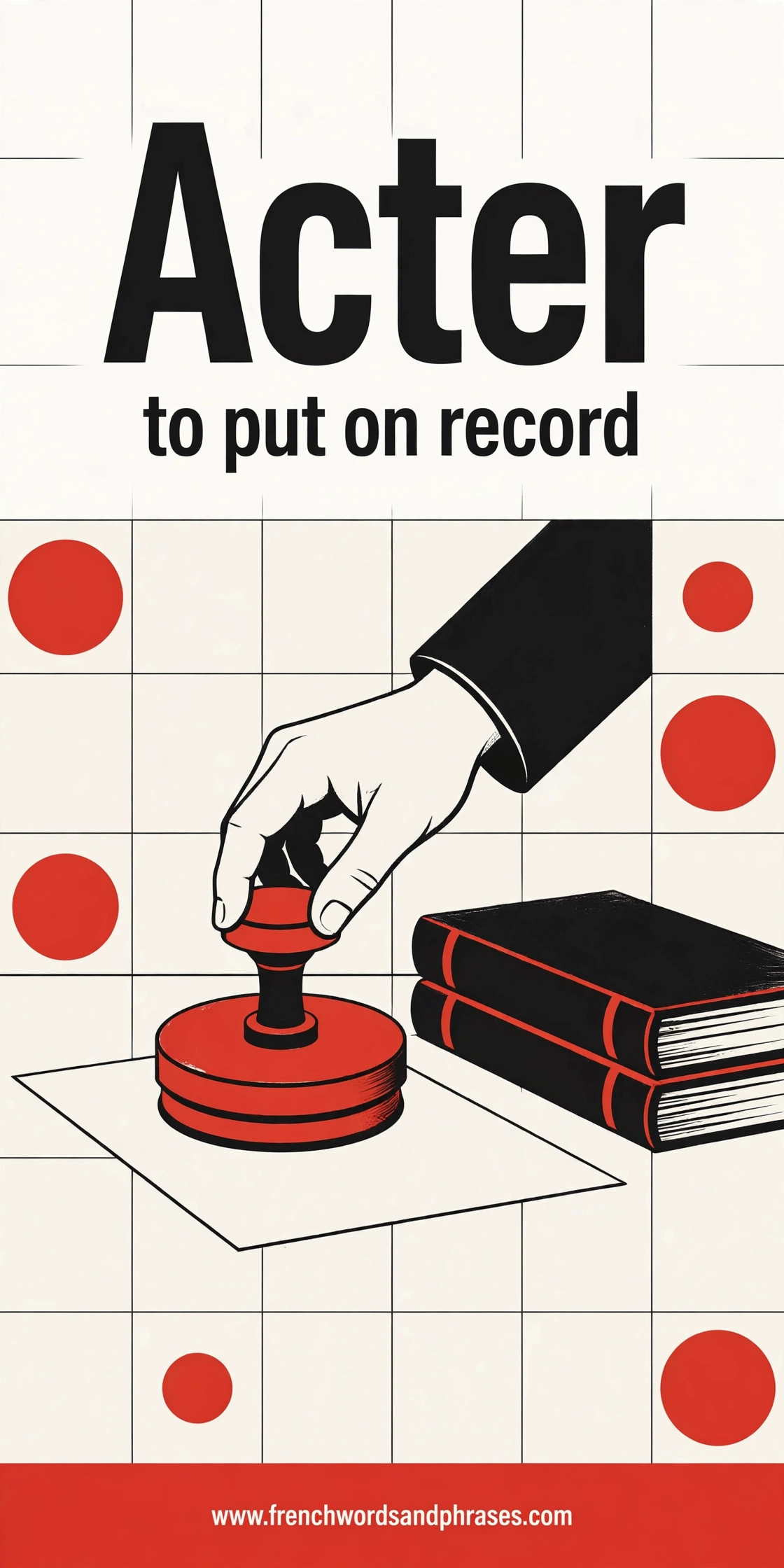
Acter means to put on record — to note a decision formally, so that it stands and cannot be un-said.
A meeting ends, a decision is taken, and the secretary writes it into the minutes in so many words: that writing-down has a modern French verb of its own — acter. It is the formal verb of boardrooms, councils and governments: to record a decision, an agreement or a fact, officially and for good.
In this guide, you’ll learn how to conjugate acter in all the major French tenses and moods. Explore complete conjugation tables, French examples, English translations, and practice quizzes.
Understanding the French Verb Acter
Acter is a regular French verb belonging to the first group of verbs, those ending in-er.
It means to put on record. Acter belongs to administrative, political and business French of the last few decades: councils actent decisions, governments actent reforms, and two parties actent their agreement before signing the details. It is stronger than noter — what is acté has official force — and it usually takes a decision, an agreement, a creation or a fact as its object.
Verb classification: First group (-er)
Auxiliary verb: Avoir
Past participle: acté
Present participle: actant
English equivalents: To put on record, to record formally, to note officially; acter une décision — to record a decision; acter un accord — to formalise an agreement; acter la création d’un poste — to put the creation of a post on record; c’est acté — it is decided and recorded; acter que… — to place on record that…
One important detail: acter is a young verb built on un acte, an official document or deed — to acter something is to make it into an acte, written and binding. It is a regular -er verb: j’acte, nous actons, ils actent, past participle acté. Its favourite modern formula is the short verdict c’est acté — it is recorded, it is done, there is no going back. Do not confuse it with the stage: acting on a stage is jouer, and acter never means performing a role.
Experience the Word
Acter is the verb of the minute-book — the moment a spoken decision becomes a written fact.
Imagine the last item of a town council meeting, late in the evening. The mayor sums up, looks round the table at the nodding councillors, and says the words that close the matter: « Nous actons la création de la médiathèque. » The secretary writes, the stamp comes down — c’est acté — and the library now exists on paper before a single brick is laid.
Nothing has been built and no money has moved. The decision has been put on record — actée — and from now on it is real.
How to Conjugate Acter: Complete French Conjugation Guide
Let’s explore every major conjugation of acter, beginning with the indicative mood.
How to Conjugate Acter in the Indicative Mood
The indicative mood is used to express facts, observations, actions, and events.
How to Conjugate Acter in the Present Tense (Présent)
Used for actions happening now, habitual actions, and general truths.
| Subject | Conjugation |
|---|---|
| je | acte |
| tu | actes |
| il / elle | acte |
| nous | actons |
| vous | actez |
| ils / elles | actent |
Example
Le conseil acte la création d’une nouvelle école.
The council puts the creation of a new school on record.
Quick Quiz 1
Complete the sentence:
Nous ______ la création d’un nouveau poste.
Reveal the answer
actons
Nous actons la création d’un nouveau poste.
We put the creation of a new post on record.
How to Conjugate Acter in the Passé Composé
Used for completed actions in the past. Acter takes the auxiliary verb avoir.
| Subject | Conjugation |
|---|---|
| j’ | ai acté |
| tu | as acté |
| il / elle | a acté |
| nous | avons acté |
| vous | avez acté |
| ils / elles | ont acté |
Example
Les deux parties ont acté leur accord ce matin.
The two parties put their agreement on record this morning.
How to Conjugate Acter in the Imparfait (Imperfect Tense)
Used for habitual past actions, descriptions, and ongoing situations in the past.
| Subject | Conjugation |
|---|---|
| je | actais |
| tu | actais |
| il / elle | actait |
| nous | actions |
| vous | actiez |
| ils / elles | actaient |
Example
Autrefois, la mairie actait chaque décision par un arrêté.
In the old days, the town hall recorded each decision by decree.
Quick Quiz 2
Choose the correct form:
The parties recorded their agreement.
Les parties ______ leur accord. (ont acté / sont actées)
Reveal the answer
ont acté
Les parties ont acté leur accord.
Acter takes avoir.
How to Conjugate Acter in the Plus-que-parfait
Used to describe an action that had already been completed before another past event.
| Subject | Conjugation |
|---|---|
| j’ | avais acté |
| tu | avais acté |
| il / elle | avait acté |
| nous | avions acté |
| vous | aviez acté |
| ils / elles | avaient acté |
Example
Le gouvernement avait acté la réforme avant les élections.
The government had put the reform on record before the elections.
How to Conjugate Acter in the Passé Simple
Primarily used in formal writing, literature, and historical narratives. It is rarely used in everyday conversation.
| Subject | Conjugation |
|---|---|
| je | actai |
| tu | actas |
| il / elle | acta |
| nous | actâmes |
| vous | actâtes |
| ils / elles | actèrent |
Example
L’assemblée acta la dissolution du comité.
The assembly put the dissolution of the committee on record.
How to Conjugate Acter in the Passé Antérieur
A literary tense used to express an action completed immediately before another past action, generally in the passé simple.
| Subject | Conjugation |
|---|---|
| j’ | eus acté |
| tu | eus acté |
| il / elle | eut acté |
| nous | eûmes acté |
| vous | eûtes acté |
| ils / elles | eurent acté |
Example
Quand le notaire eut acté la vente, les clés changèrent de main.
When the notary had recorded the sale, the keys changed hands.
How to Conjugate Acter in the Future Tense (Futur Simple)
Used to describe actions that will take place in the future.
| Subject | Conjugation |
|---|---|
| je | acterai |
| tu | acteras |
| il / elle | actera |
| nous | acterons |
| vous | acterez |
| ils / elles | acteront |
Example
Demain, le conseil actera le budget de l’année prochaine.
Tomorrow, the council will put next year’s budget on record.
How to Conjugate Acter in the Futur Antérieur (Future Perfect)
Used for an action that will have been completed before a particular point in the future.
| Subject | Conjugation |
|---|---|
| j’ | aurai acté |
| tu | auras acté |
| il / elle | aura acté |
| nous | aurons acté |
| vous | aurez acté |
| ils / elles | auront acté |
Example
À la fin de la séance, nous aurons acté toutes les décisions.
By the end of the session, we will have recorded all the decisions.
How to Conjugate Acter in the Near Future (Futur Proche)
Used to describe something that is going to happen soon. Formed with aller + infinitive.
| Subject | Conjugation |
|---|---|
| je | vais acter |
| tu | vas acter |
| il / elle | va acter |
| nous | allons acter |
| vous | allez acter |
| ils / elles | vont acter |
Example
Le président va acter la nomination du nouveau directeur.
The president is going to put the new director’s appointment on record.
How to Conjugate Acter in the Conditional Mood
The conditional mood expresses what would happen under certain circumstances. It is also frequently used to make polite requests or express wishes.
How to Conjugate Acter in the Present Conditional
| Subject | Conjugation |
|---|---|
| je | acterais |
| tu | acterais |
| il / elle | acterait |
| nous | acterions |
| vous | acteriez |
| ils / elles | acteraient |
Example
Sans le vote, le conseil n’acterait rien ce soir.
Without the vote, the council would record nothing tonight.
How to Conjugate Acter in the Past Conditional
| Subject | Conjugation |
|---|---|
| j’ | aurais acté |
| tu | aurais acté |
| il / elle | aurait acté |
| nous | aurions acté |
| vous | auriez acté |
| ils / elles | auraient acté |
Example
Elle aurait acté l’accord si les deux parties avaient signé.
She would have recorded the agreement if both parties had signed.
Acter in the Literary Past Conditional Form
This less common literary form uses the imperfect subjunctive of avoir.
| Subject | Conjugation |
|---|---|
| j’ | eusse acté |
| tu | eusses acté |
| il / elle | eût acté |
| nous | eussions acté |
| vous | eussiez acté |
| ils / elles | eussent acté |
Example
L’assemblée eût acté la réforme sans l’opposition des députés.
The assembly would have put the reform on record without the deputies’ opposition.
How to Conjugate Acter in the Subjunctive Mood
The subjunctive is used to express wishes, emotions, doubts, necessity, and uncertainty. It frequently follows expressions such as il faut que (it is necessary that) or bien que (although).
How to Conjugate Acter in the Present Subjunctive
| Subject | Conjugation |
|---|---|
| que je | acte |
| que tu | actes |
| qu’il / qu’elle | acte |
| que nous | actions |
| que vous | actiez |
| qu’ils / qu’elles | actent |
Example
Il est essentiel que le secrétaire acte chaque décision.
It is essential that the secretary record each decision.
Quick Quiz 3
Complete the sentence using the subjunctive:
Il faut que vous ______ la nomination aujourd’hui.
Reveal the answer
actiez
Il faut que vous actiez la nomination aujourd’hui.
You must put the appointment on record today.
How to Conjugate Acter in the Imperfect Subjunctive
A literary tense, rarely encountered in modern spoken French.
| Subject | Conjugation |
|---|---|
| que je | actasse |
| que tu | actasses |
| qu’il / qu’elle | actât |
| que nous | actassions |
| que vous | actassiez |
| qu’ils / qu’elles | actassent |
Example
Le président voulait que l’on actât la nomination immédiatement.
The president wanted the appointment put on record immediately.
How to Conjugate Acter in the Pluperfect Subjunctive
A literary construction used to express an action completed before another past action.
| Subject | Conjugation |
|---|---|
| que j’ | eusse acté |
| que tu | eusses acté |
| qu’il / qu’elle | eût acté |
| que nous | eussions acté |
| que vous | eussiez acté |
| qu’ils / qu’elles | eussent acté |
Example
On annonça que le conseil eût acté la création du poste.
It was announced that the council had recorded the creation of the post.
How to Conjugate Acter in the Past Subjunctive
| Subject | Conjugation |
|---|---|
| que j’ | aie acté |
| que tu | aies acté |
| qu’il / qu’elle | ait acté |
| que nous | ayons acté |
| que vous | ayez acté |
| qu’ils / qu’elles | aient acté |
Example
Je suis content que la mairie ait acté la rénovation de la place.
I am glad the town hall put the renovation of the square on record.
How to Conjugate Acter in the Imperative
The imperative is used to give commands, instructions, invitations, or suggestions. Subject pronouns are omitted.
How to Conjugate Acter in the Present Imperative
| Person | Conjugation |
|---|---|
| (tu) | acte |
| (nous) | actons |
| (vous) | actez |
Example
Actez cette décision dans le procès-verbal !
Put this decision on record in the minutes!
Quick Quiz 4
How would you say Put the decision on record (tu form)?
Reveal the answer
Acte la décision !
French Participles of Acter
Participles are verb forms that can be used in compound tenses and other grammatical constructions.
Present Participle of Acter
actant
En actant l’accord, les deux parties ferment des mois de négociation.
By putting the agreement on record, the two parties close months of negotiation.
Past Participle of Acter
acté
Actée par le conseil, la création du poste paraît au journal officiel.
Put on record by the council, the creation of the post appears in the official journal.
Acter in Everyday French: Real-Life Examples
Now that you know the conjugations, let’s see how acter appears in everyday French.
Example 1 — Present
Le conseil acte la décision.
The council puts the decision on record.
Example 2 — Passé composé
Les deux parties ont acté leur accord.
The two parties put their agreement on record.
Example 3 — Imparfait
La mairie actait chaque décision par écrit.
The town hall used to record each decision in writing.
Example 4 — Future
Le conseil actera le budget demain.
The council will put the budget on record tomorrow.
Example 5 — Conditional
Sans le vote, on n’acterait rien.
Without the vote, nothing would be recorded.
Example 6 — Imperative
Acte la nomination dans le procès-verbal !
Put the appointment on record in the minutes!
Beyond Translation: The Meaning of Acter
English has no exact everyday twin for acter — to minute and to place on record come closest, while French built the verb straight from un acte, the official deed itself.
A decision becomes real when it is written.
That is the world acter names: councils, boards and governments, where c’est acté has become the modern full stop — decided, recorded, and no longer open for discussion.
How to Remember the French Verb Acter
Remember it this way: Acter is about the secretary’s pen and the stamp — c’est acté, and the library exists.
- Built on un acte, an official document: acter = to turn a decision into an acte, written and binding.
- Its signature formula: c’est acté — it is decided and recorded, no going back.
- Formal and modern: councils, governments and companies acte decisions, agreements and creations — never stage roles.
The key idea is the secretary’s pen and the stamp — c’est acté, and the library exists.
Test Your Knowledge of Acter
Let’s see how much you’ve learned. Try answering these questions before revealing the answers.
Question 1
What does the formula c’est acté tell you?
Reveal the answer
It is decided and on record — the decision has been formally recorded and there is no going back.
Question 2
How do you say The council puts the decision on record in French?
Reveal the answer
Le conseil acte la décision.
Question 3
Translate: The two parties put their agreement on record this morning.
Reveal the answer
Les deux parties ont acté leur accord ce matin.
Question 4
What is the past participle of acter?
Reveal the answer
Acté — as in c’est acté.
Question 5
Complete the sentence:
Il est essentiel que le secrétaire ______ chaque décision.
Reveal the answer
acte
Il est essentiel que le secrétaire acte chaque décision.
It is essential that the secretary record each decision.
Your Final Challenge
Can You Use It?
How would you say this in French?
The mayor looks at the assembly, then puts the decision on record: the media library will see the light of day.
Reveal the answer
Le maire regarde l’assemblée, puis il acte la décision : la médiathèque verra le jour.
The mayor looks at the assembly, then puts the decision on record: the media library will see the light of day.
A little French. A little curiosity. A richer everyday life.
LEARN FRENCH ONE WORD AT A TIME