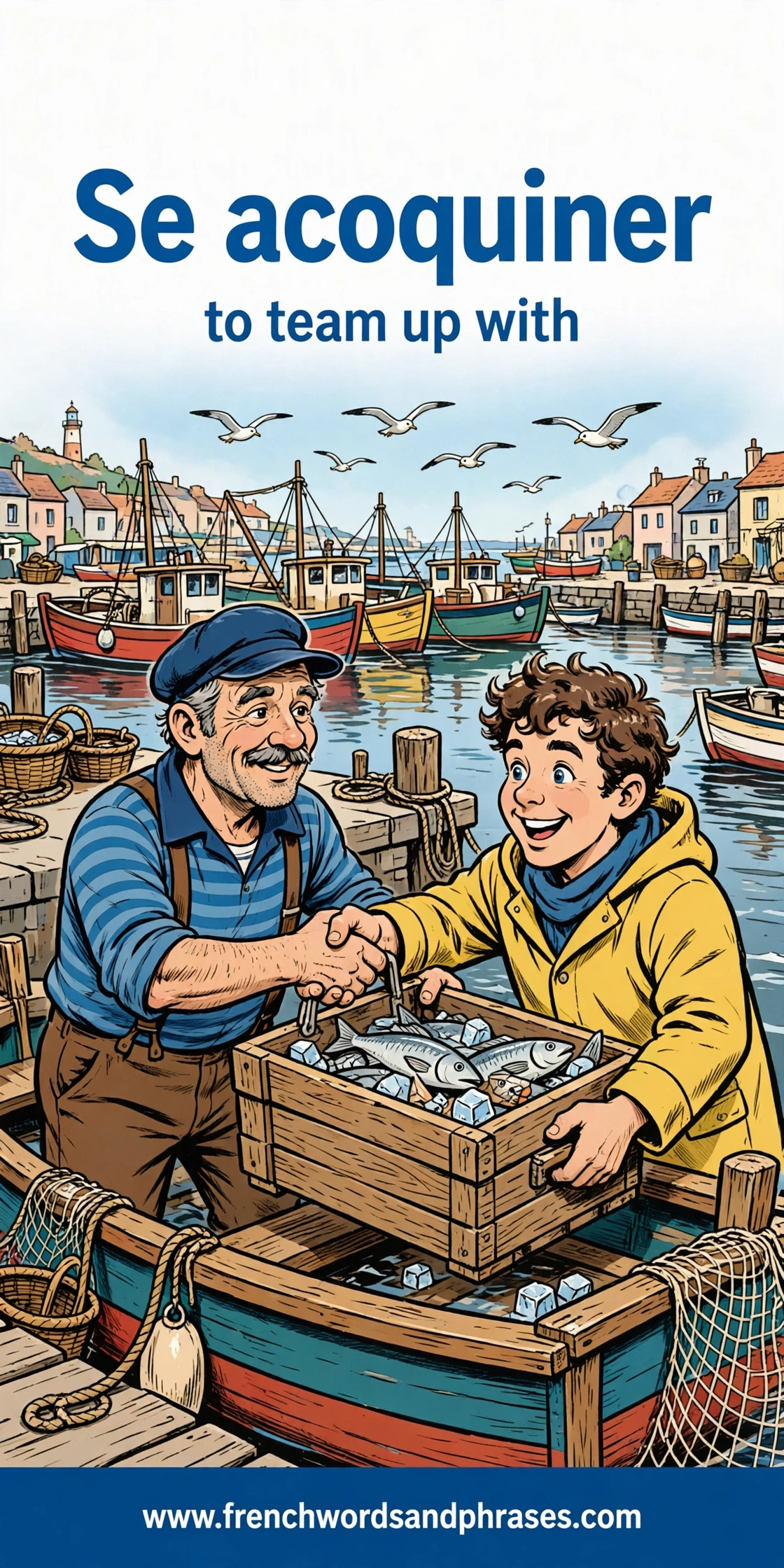
A French Word to Live By
How to Conjugate Se acoquiner in French
/sə a.kɔ.ki.ne/
Se acoquiner means to team up with — to fall in with companions, usually with mischief not far away.
Two schoolboys who should not be friends, a young clerk suddenly thick with the office troublemaker, a cat that has taken up with the neighbour’s dog — se acoquiner is the verb of teaming up with someone, and it carries a raised eyebrow: the company is rarely respectable, and something is probably being plotted.
In this guide, you’ll learn how to conjugate se acoquiner in all the major French tenses and moods. Explore complete conjugation tables, French examples, English translations, and practice quizzes.
Understanding the French Verb Se acoquiner
Se acoquiner is a regular French verb belonging to the first group of verbs, those ending in-er.
It means to team up with. Se acoquiner is familiar, slightly old-fashioned French, used by parents, teachers and narrators about alliances they disapprove of — children teaming up with the wrong friends, politicians with dubious allies. It is never the word for a formal partnership: one s’associe with a business partner, but one s’acoquine with a partner in crime.
Verb classification: First group (-er), reflexive
Auxiliary verb: Être
Past participle: acoquiné
Present participle: acoquinant
English equivalents: To team up with, to fall in with, to pal up with; se acoquiner avec quelqu’un — to team up with someone; se acoquiner avec des voyous — to fall in with louts; s’acoquiner pour un mauvais coup — to team up for a dirty trick; ils se sont acoquinés dès le premier jour — they teamed up from the very first day.
One important detail: se acoquiner exists only as a reflexive — there is no plain acoquiner in real French. It takes être in every compound tense, with the participle agreeing with the subject: elle s’est acoquinée avec lui, ils se sont acoquinés dès l’école. The partner is introduced by avec: se acoquiner avec des camarades douteux. The tu imperative tucks the pronoun behind the verb: acoquine-toi avec qui tu veux, mais pas avec lui ! And keep the tone in mind: the verb always hints that the alliance is disreputable or up to no good.
Experience the Word
Se acoquiner is teaming up with an eyebrow raised — friendship, yes, but the kind adults watch from the doorway.
Imagine the first week of a new school. The quiet boy from the village is spotted at break whispering behind the bicycle shed with the two most famous troublemakers in the class — il s’est acoquiné avec eux — and by Friday the three of them are inseparable, and the teacher is already sighing.
No contract was signed and nothing has happened yet. He has teamed up — acoquiné — and everyone can guess the rest.
How to Conjugate Se acoquiner: Complete French Conjugation Guide
Let’s explore every major conjugation of se acoquiner, beginning with the indicative mood.
How to Conjugate Se acoquiner in the Indicative Mood
The indicative mood is used to express facts, observations, actions, and events.
How to Conjugate Se acoquiner in the Present Tense (Présent)
Used for actions happening now, habitual actions, and general truths.
| Subject | Conjugation |
|---|---|
| je | m’acoquine |
| tu | t’acoquines |
| il / elle | s’acoquine |
| nous | nous acoquinons |
| vous | vous acoquinez |
| ils / elles | s’acoquinent |
Example
Mon fils s’acoquine toujours avec les plus turbulents de la classe.
My son always teams up with the rowdiest boys in the class.
Quick Quiz 1
Complete the sentence:
Nous ______ avec la bande du port.
Reveal the answer
nous acoquinons
Nous nous acoquinons avec la bande du port.
We team up with the harbour gang.
How to Conjugate Se acoquiner in the Passé Composé
Used for completed actions in the past. Se acoquiner takes the auxiliary verb être.
| Subject | Conjugation |
|---|---|
| je | me suis acoquiné / me suis acoquinée |
| tu | t’es acoquiné / t’es acoquinée |
| il / elle | s’est acoquiné / s’est acoquinée |
| nous | nous sommes acoquinés / nous sommes acoquinées |
| vous | vous êtes acoquinés / vous êtes acoquinées / vous êtes acoquiné / vous êtes acoquinée |
| ils / elles | se sont acoquinés / se sont acoquinées |
Example
Elle s’est acoquinée avec deux escrocs et a tout perdu.
She teamed up with two swindlers and lost everything.
How to Conjugate Se acoquiner in the Imparfait (Imperfect Tense)
Used for habitual past actions, descriptions, and ongoing situations in the past.
| Subject | Conjugation |
|---|---|
| je | m’acoquinais |
| tu | t’acoquinais |
| il / elle | s’acoquinait |
| nous | nous acoquinions |
| vous | vous acoquiniez |
| ils / elles | s’acoquinaient |
Example
Au village, il s’acoquinait avec les fils du braconnier.
In the village, he used to pal around with the poacher’s sons.
Quick Quiz 2
Choose the correct form:
She teamed up with a liar.
Elle ______ avec un menteur. (s’est acoquinée / a acoquiné)
Reveal the answer
s’est acoquinée
Elle s’est acoquinée avec un menteur.
Se acoquiner is reflexive, takes être, and the participle agrees: acoquinée.
How to Conjugate Se acoquiner in the Plus-que-parfait
Used to describe an action that had already been completed before another past event.
| Subject | Conjugation |
|---|---|
| je | m’étais acoquiné / m’étais acoquinée |
| tu | t’étais acoquiné / t’étais acoquinée |
| il / elle | s’était acoquiné / s’était acoquinée |
| nous | nous étions acoquinés / nous étions acoquinées |
| vous | vous étiez acoquinés / vous étiez acoquinées / vous étiez acoquiné / vous étiez acoquinée |
| ils / elles | s’étaient acoquinés / s’étaient acoquinées |
Example
Ils s’étaient acoquinés dès le premier jour de caserne.
They had teamed up from the very first day at the barracks.
How to Conjugate Se acoquiner in the Passé Simple
Primarily used in formal writing, literature, and historical narratives. It is rarely used in everyday conversation.
| Subject | Conjugation |
|---|---|
| je | m’acoquinai |
| tu | t’acoquinas |
| il / elle | s’acoquina |
| nous | nous acoquinâmes |
| vous | vous acoquinâtes |
| ils / elles | s’acoquinèrent |
Example
Le jeune commis s’acoquina avec un faussaire de la rue voisine.
The young clerk fell in with a forger from the next street.
How to Conjugate Se acoquiner in the Passé Antérieur
A literary tense used to express an action completed immediately before another past action, generally in the passé simple.
| Subject | Conjugation |
|---|---|
| je | me fus acoquiné / me fus acoquinée |
| tu | te fus acoquiné / te fus acoquinée |
| il / elle | se fut acoquiné / se fut acoquinée |
| nous | nous fûmes acoquinés / nous fûmes acoquinées |
| vous | vous fûtes acoquinés / vous fûtes acoquinées / vous fûtes acoquiné / vous fûtes acoquinée |
| ils / elles | se furent acoquinés / se furent acoquinées |
Example
Dès qu’elle se fut acoquinée avec ce groupe, ses notes chutèrent.
As soon as she had teamed up with that group, her grades fell.
How to Conjugate Se acoquiner in the Future Tense (Futur Simple)
Used to describe actions that will take place in the future.
| Subject | Conjugation |
|---|---|
| je | m’acoquinerai |
| tu | t’acoquineras |
| il / elle | s’acoquinera |
| nous | nous acoquinerons |
| vous | vous acoquinerez |
| ils / elles | s’acoquineront |
Example
Si tu changes d’école, tu t’acoquineras avec les mêmes qu’ici.
If you change schools, you will team up with the same sort as here.
How to Conjugate Se acoquiner in the Futur Antérieur (Future Perfect)
Used for an action that will have been completed before a particular point in the future.
| Subject | Conjugation |
|---|---|
| je | me serai acoquiné / me serai acoquinée |
| tu | te seras acoquiné / te seras acoquinée |
| il / elle | se sera acoquiné / se sera acoquinée |
| nous | nous serons acoquinés / nous serons acoquinées |
| vous | vous serez acoquinés / vous serez acoquinées / vous serez acoquiné / vous serez acoquinée |
| ils / elles | se seront acoquinés / se seront acoquinées |
Example
À la fin de l’été, il se sera acoquiné avec toute la bande du port.
By the end of the summer, he will have teamed up with the whole harbour gang.
How to Conjugate Se acoquiner in the Near Future (Futur Proche)
Used to describe something that is going to happen soon. Formed with aller + infinitive.
| Subject | Conjugation |
|---|---|
| je | vais m’acoquiner |
| tu | vas t’acoquiner |
| il / elle | va s’acoquiner |
| nous | allons nous acoquiner |
| vous | allez vous acoquiner |
| ils / elles | vont s’acoquiner |
Example
Regarde-le, il va encore s’acoquiner avec les voyous du quartier.
Look at him, he is going to fall in with the neighbourhood louts again.
How to Conjugate Se acoquiner in the Conditional Mood
The conditional mood expresses what would happen under certain circumstances. It is also frequently used to make polite requests or express wishes.
How to Conjugate Se acoquiner in the Present Conditional
| Subject | Conjugation |
|---|---|
| je | m’acoquinerais |
| tu | t’acoquinerais |
| il / elle | s’acoquinerait |
| nous | nous acoquinerions |
| vous | vous acoquineriez |
| ils / elles | s’acoquineraient |
Example
Sans ses parents, elle s’acoquinerait avec n’importe qui.
Without her parents, she would team up with just anyone.
How to Conjugate Se acoquiner in the Past Conditional
| Subject | Conjugation |
|---|---|
| je | me serais acoquiné / me serais acoquinée |
| tu | te serais acoquiné / te serais acoquinée |
| il / elle | se serait acoquiné / se serait acoquinée |
| nous | nous serions acoquinés / nous serions acoquinées |
| vous | vous seriez acoquinés / vous seriez acoquinées / vous seriez acoquiné / vous seriez acoquinée |
| ils / elles | se seraient acoquinés / se seraient acoquinées |
Example
Il se serait acoquiné avec des contrebandiers sans son frère aîné.
He would have fallen in with smugglers without his older brother.
Se acoquiner in the Literary Past Conditional Form
This less common literary form uses the imperfect subjunctive of être.
| Subject | Conjugation |
|---|---|
| je | me fusse acoquiné / me fusse acoquinée |
| tu | te fusses acoquiné / te fusses acoquinée |
| il / elle | se fût acoquiné / se fût acoquinée |
| nous | nous fussions acoquinés / nous fussions acoquinées |
| vous | vous fussiez acoquinés / vous fussiez acoquinées / vous fussiez acoquiné / vous fussiez acoquinée |
| ils / elles | se fussent acoquinés / se fussent acoquinées |
Example
Elle se fût acoquinée avec les pires éléments sans l’école.
She would have teamed up with the worst elements without the school.
How to Conjugate Se acoquiner in the Subjunctive Mood
The subjunctive is used to express wishes, emotions, doubts, necessity, and uncertainty. It frequently follows expressions such as il faut que (it is necessary that) or bien que (although).
How to Conjugate Se acoquiner in the Present Subjunctive
| Subject | Conjugation |
|---|---|
| que je | m’acoquine |
| que tu | t’acoquines |
| qu’il / qu’elle | s’acoquine |
| que nous | nous acoquinions |
| que vous | vous acoquiniez |
| qu’ils / qu’elles | s’acoquinent |
Example
Je ne veux pas que tu t’acoquines avec ces garçons.
I do not want you teaming up with those boys.
Quick Quiz 3
Complete the sentence using the subjunctive:
Sa mère craint qu’il ______ avec la bande du port.
Reveal the answer
s’acoquine
Sa mère craint qu’il s’acoquine avec la bande du port.
His mother fears he may fall in with the harbour gang.
How to Conjugate Se acoquiner in the Imperfect Subjunctive
A literary tense, rarely encountered in modern spoken French.
| Subject | Conjugation |
|---|---|
| que je | m’acoquinasse |
| que tu | t’acoquinasses |
| qu’il / qu’elle | s’acoquinât |
| que nous | nous acoquinassions |
| que vous | vous acoquinassiez |
| qu’ils / qu’elles | s’acoquinassent |
Example
Sa mère craignait qu’il s’acoquinât avec la bande du port.
His mother feared he might fall in with the harbour gang.
How to Conjugate Se acoquiner in the Pluperfect Subjunctive
A literary construction used to express an action completed before another past action.
| Subject | Conjugation |
|---|---|
| que je | me fusse acoquiné / me fusse acoquinée |
| que tu | te fusses acoquiné / te fusses acoquinée |
| qu’il / qu’elle | se fût acoquiné / se fût acoquinée |
| que nous | nous fussions acoquinés / nous fussions acoquinées |
| que vous | vous fussiez acoquinés / vous fussiez acoquinées / vous fussiez acoquiné / vous fussiez acoquinée |
| qu’ils / qu’elles | se fussent acoquinés / se fussent acoquinées |
Example
On racontait qu’ils se fussent acoquinés pour un mauvais coup.
People said they had teamed up for a dirty trick.
How to Conjugate Se acoquiner in the Past Subjunctive
| Subject | Conjugation |
|---|---|
| que je | me sois acoquiné / me sois acoquinée |
| que tu | te sois acoquiné / te sois acoquinée |
| qu’il / qu’elle | se soit acoquiné / se soit acoquinée |
| que nous | nous soyons acoquinés / nous soyons acoquinées |
| que vous | vous soyez acoquinés / vous soyez acoquinées / vous soyez acoquiné / vous soyez acoquinée |
| qu’ils / qu’elles | se soient acoquinés / se soient acoquinées |
Example
Je suis surpris qu’elle se soit acoquinée avec ce menteur.
I am surprised she teamed up with that liar.
How to Conjugate Se acoquiner in the Imperative
The imperative is used to give commands, instructions, invitations, or suggestions. Subject pronouns are omitted.
How to Conjugate Se acoquiner in the Present Imperative
| Person | Conjugation |
|---|---|
| (tu) | acoquine-toi |
| (nous) | acoquinons-nous |
| (vous) | acoquinez-vous |
Example
Ne t’acoquine pas avec ces voyous, tu m’entends !
Do not fall in with those louts, do you hear me!
Quick Quiz 4
How would you say Do not fall in with those louts (tu form)?
Reveal the answer
Ne t’acoquine pas avec ces voyous !
French Participles of Se acoquiner
Participles are verb forms that can be used in compound tenses and other grammatical constructions.
Present Participle of Se acoquiner
acoquinant
En s’acoquinant avec des escrocs, il a gâché sa carrière.
By teaming up with swindlers, he ruined his career.
Past Participle of Se acoquiner
acoquiné
Acoquinée avec la bande dès septembre, elle ne venait plus en cours.
Teamed up with the gang since September, she no longer came to class.
Se acoquiner in Everyday French: Real-Life Examples
Now that you know the conjugations, let’s see how se acoquiner appears in everyday French.
Example 1 — Present
Il s’acoquine avec les voyous du quartier.
He teams up with the neighbourhood louts.
Example 2 — Passé composé
Elle s’est acoquinée avec deux escrocs.
She teamed up with two swindlers.
Example 3 — Imparfait
Ils s’acoquinaient dès le premier jour.
They teamed up from the very first day.
Example 4 — Future
Tu t’acoquineras avec les mêmes partout.
You will team up with the same sort everywhere.
Example 5 — Conditional
Sans toi, il s’acoquinerait avec n’importe qui.
Without you, he would team up with just anyone.
Example 6 — Imperative
Ne vous acoquinez pas avec cette bande !
Do not fall in with that gang!
Beyond Translation: The Meaning of Se acoquiner
French se acoquiner is built on coquin, a rascal or rogue — the teaming-up is in the name before anything has even happened.
An alliance with the verdict already in it.
English to fall in with carries the same disapproval, and to pal up with the same schoolyard feel; but only French packs the whole judgement — bad company, worse plans — into a single verb.
How to Remember the French Verb Se acoquiner
Remember it this way: Se acoquiner is about the quiet boy behind the bicycle shed, whispering with the troublemakers.
- Reflexive only, and always avec: se acoquiner avec quelqu’un — there is no plain acoquiner.
- Être in compound tenses, participle agreeing: elle s’est acoquinée, ils se sont acoquinés.
- The word coquin, rascal, is hiding inside it — the alliance is never respectable.
The key idea is the quiet boy behind the bicycle shed, whispering with the troublemakers.
Test Your Knowledge of Se acoquiner
Let’s see how much you’ve learned. Try answering these questions before revealing the answers.
Question 1
Which auxiliary does se acoquiner use, and why?
Reveal the answer
Être — it is a reflexive verb: elle s’est acoquinée avec lui.
Question 2
How do you say He teams up with the neighbourhood louts in French?
Reveal the answer
Il s’acoquine avec les voyous du quartier.
Question 3
Translate: She teamed up with two swindlers.
Reveal the answer
Elle s’est acoquinée avec deux escrocs.
Question 4
What is the past participle of se acoquiner?
Reveal the answer
Acoquiné — agreeing: acoquinée, acoquinés, acoquinées.
Question 5
Complete the sentence:
Je ne veux pas que tu ______ avec ces garçons.
Reveal the answer
t’acoquines
Je ne veux pas que tu t’acoquines avec ces garçons.
I do not want you teaming up with those boys.
Your Final Challenge
Can You Use It?
How would you say this in French?
From the first day of term, the new boy teamed up with the two worst rascals in the class.
Reveal the answer
Dès la rentrée, le nouveau s’est acoquiné avec les deux pires garnements de la classe.
From the first day of term, the new boy teamed up with the two worst rascals in the class.
A little French. A little curiosity. A richer everyday life.
LEARN FRENCH ONE WORD AT A TIME