A French Word to Live By
How to Conjugate Se acharner in French
/sə a.ʃaʁ.ne/
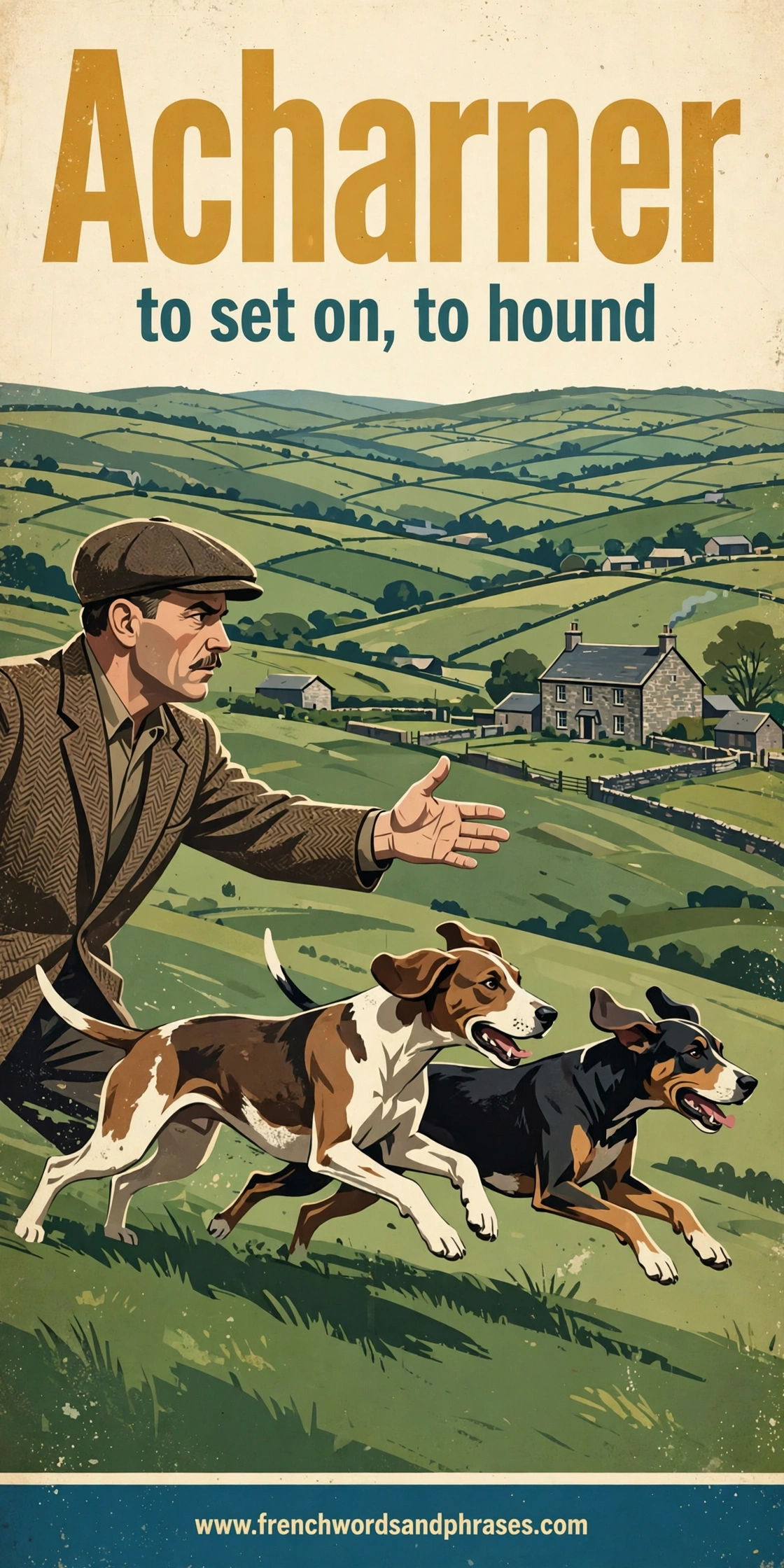
Se acharner means to persist fiercely, to slave at — to attack a task, a problem or an enemy the way a trained hound attacks the trail: without letting go.
A student at a kitchen table at midnight, a climber on the last pitch of a cliff, a lawyer returning to the same locked door of a case — s’acharner is the verb of fierce persistence: refusing, again and again, to let go.
In this guide, you’ll learn how to conjugate se acharner in all the major French tenses and moods. Explore complete conjugation tables, French examples, English translations, and practice quizzes.
Understanding the French Verb Se acharner
Se acharner is a regular French verb belonging to the first group of verbs, those ending in-er.
It means to persist fiercely, to slave at. It is the everyday verb of admirable stubbornness and of cruel stubbornness alike: the surgeon who s’acharne à sauver un malade, fate that s’acharne sur un village, critics who s’acharnent sur un ministre. The construction decides the flavour — à plus infinitive for effort, sur plus noun for attack.
Verb classification: First group (-er), reflexive
Auxiliary verb: Être
Past participle: acharné
Present participle: acharnant
English equivalents: To persist fiercely, to slave at, to keep at; s’acharner à faire quelque chose — to persist stubbornly in doing something; s’acharner sur un problème — to slave away at a problem; s’acharner sur quelqu’un — to hound someone relentlessly; s’acharner au travail — to slave at one’s work.
One important detail: s’acharner is built with à before an infinitive and sur before the thing or person attacked: elle s’acharne à finir son livre — she persists fiercely in finishing her book; ils s’acharnent sur ce problème — they slave away at this problem; le sort s’acharne sur lui — fate keeps hounding him. Being reflexive, it takes être and the participle agrees: elle s’est acharnée, ils se sont acharnés.
Experience the Word
Se acharner is the verb of the locked jaws — hound-trained persistence, applied to homework, mountains and misfortune.
Imagine a young doctor in a country hospital during a storm. The road is cut, the generator coughs, and for six hours elle s’acharne à sauver son malade — trying everything twice, refusing the word impossible each time it is offered to her.
Others would have stopped at the second failure. She persisted — acharnée à son poste, and the patient lived.
How to Conjugate Se acharner: Complete French Conjugation Guide
Let’s explore every major conjugation of se acharner, beginning with the indicative mood.
How to Conjugate Se acharner in the Indicative Mood
The indicative mood is used to express facts, observations, actions, and events.
How to Conjugate Se acharner in the Present Tense (Présent)
Used for actions happening now, habitual actions, and general truths.
| Subject | Conjugation |
|---|---|
| je | m’acharne |
| tu | t’acharnes |
| il / elle | s’acharne |
| nous | nous acharnons |
| vous | vous acharnez |
| ils / elles | s’acharnent |
Example
Elle s’acharne à finir sa thèse avant l’été.
She is slaving away at finishing her thesis before the summer.
Complete the sentence:
Nous nous ______ à reconstruire la maison.
Reveal the answer
acharnons
Nous nous acharnons à reconstruire la maison.
We are slaving away at rebuilding the house.
How to Conjugate Se acharner in the Passé Composé
Used for completed actions in the past. Se acharner takes the auxiliary verb être.
| Subject | Conjugation |
|---|---|
| je | me suis acharné / me suis acharnée |
| tu | t’es acharné / t’es acharnée |
| il / elle | s’est acharné / s’est acharnée |
| nous | nous sommes acharnés / nous sommes acharnées |
| vous | vous êtes acharnés / vous êtes acharnées / vous êtes acharné / vous êtes acharnée |
| ils / elles | se sont acharnés / se sont acharnées |
Example
Ils se sont acharnés sur ce problème pendant des mois.
They slaved away at this problem for months.
How to Conjugate Se acharner in the Imparfait (Imperfect Tense)
Used for habitual past actions, descriptions, and ongoing situations in the past.
| Subject | Conjugation |
|---|---|
| je | m’acharnais |
| tu | t’acharnais |
| il / elle | s’acharnait |
| nous | nous acharnions |
| vous | vous acharniez |
| ils / elles | s’acharnaient |
Example
Le sort s’acharnait sur ce pauvre village.
Fate kept hounding this poor village.
Quick Quiz 2
Choose the correct form:
They slaved at this problem for months.
Ils ______ sur ce problème pendant des mois. (se sont acharnés / ont acharné)
Reveal the answer
se sont acharnés
Ils se sont acharnés sur ce problème pendant des mois.
Se acharner is reflexive and takes être.
How to Conjugate Se acharner in the Plus-que-parfait
Used to describe an action that had already been completed before another past event.
| Subject | Conjugation |
|---|---|
| je | m’étais acharné / m’étais acharnée |
| tu | t’étais acharné / t’étais acharnée |
| il / elle | s’était acharné / s’était acharnée |
| nous | nous étions acharnés / nous étions acharnées |
| vous | vous étiez acharnés / vous étiez acharnées / vous étiez acharné / vous étiez acharnée |
| ils / elles | s’étaient acharnés / s’étaient acharnées |
Example
Elle s’était acharnée à apprendre le piano malgré ses blessures.
She had persisted fiercely in learning the piano despite her injuries.
How to Conjugate Se acharner in the Passé Simple
Primarily used in formal writing, literature, and historical narratives. It is rarely used in everyday conversation.
| Subject | Conjugation |
|---|---|
| je | m’acharnai |
| tu | t’acharnas |
| il / elle | s’acharna |
| nous | nous acharnâmes |
| vous | vous acharnâtes |
| ils / elles | s’acharnèrent |
Example
Les soldats s’acharnèrent à défendre le pont jusqu’au soir.
The soldiers fought fiercely to defend the bridge until evening.
How to Conjugate Se acharner in the Passé Antérieur
A literary tense used to express an action completed immediately before another past action, generally in the passé simple.
| Subject | Conjugation |
|---|---|
| je | me fus acharné / me fus acharnée |
| tu | te fus acharné / te fus acharnée |
| il / elle | se fut acharné / se fut acharnée |
| nous | nous fûmes acharnés / nous fûmes acharnées |
| vous | vous fûtes acharnés / vous fûtes acharnées / vous fûtes acharné / vous fûtes acharnée |
| ils / elles | se furent acharnés / se furent acharnées |
Example
Dès qu’ils se furent acharnés sur la porte, elle céda enfin.
As soon as they had thrown themselves fiercely at the door, it finally gave way.
How to Conjugate Se acharner in the Future Tense (Futur Simple)
Used to describe actions that will take place in the future.
| Subject | Conjugation |
|---|---|
| je | m’acharnerai |
| tu | t’acharneras |
| il / elle | s’acharnera |
| nous | nous acharnerons |
| vous | vous acharnerez |
| ils / elles | s’acharneront |
Example
Demain, elle s’acharnera encore à convaincre le jury.
Tomorrow, she will persist fiercely in convincing the jury.
How to Conjugate Se acharner in the Futur Antérieur (Future Perfect)
Used for an action that will have been completed before a particular point in the future.
| Subject | Conjugation |
|---|---|
| je | me serai acharné / me serai acharnée |
| tu | te seras acharné / te seras acharnée |
| il / elle | se sera acharné / se sera acharnée |
| nous | nous serons acharnés / nous serons acharnées |
| vous | vous serez acharnés / vous serez acharnées / vous serez acharné / vous serez acharnée |
| ils / elles | se seront acharnés / se seront acharnées |
Example
À la fin du mois, ils se seront acharnés trois semaines sur ce dossier.
By the end of the month, they will have slaved three weeks at this file.
How to Conjugate Se acharner in the Near Future (Futur Proche)
Used to describe something that is going to happen soon. Formed with aller + infinitive.
| Subject | Conjugation |
|---|---|
| je | vais m’acharner |
| tu | vas t’acharner |
| il / elle | va s’acharner |
| nous | allons nous acharner |
| vous | allez vous acharner |
| ils / elles | vont s’acharner |
Example
Regarde-la, elle va s’acharner sur cet exercice jusqu’à minuit.
Look at her, she is going to slave at this exercise until midnight.
How to Conjugate Se acharner in the Conditional Mood
The conditional mood expresses what would happen under certain circumstances. It is also frequently used to make polite requests or express wishes.
How to Conjugate Se acharner in the Present Conditional
| Subject | Conjugation |
|---|---|
| je | m’acharnerais |
| tu | t’acharnerais |
| il / elle | s’acharnerait |
| nous | nous acharnerions |
| vous | vous acharneriez |
| ils / elles | s’acharneraient |
Example
À ta place, je ne m’acharnerais pas sur ce détail.
In your place, I would not slave away at this detail.
How to Conjugate Se acharner in the Past Conditional
| Subject | Conjugation |
|---|---|
| je | me serais acharné / me serais acharnée |
| tu | te serais acharné / te serais acharnée |
| il / elle | se serait acharné / se serait acharnée |
| nous | nous serions acharnés / nous serions acharnées |
| vous | vous seriez acharnés / vous seriez acharnées / vous seriez acharné / vous seriez acharnée |
| ils / elles | se seraient acharnés / se seraient acharnées |
Example
Elle se serait acharnée davantage si elle avait eu plus de temps.
She would have persisted even more fiercely if she had had more time.
Se acharner in the Literary Past Conditional Form
This less common literary form uses the imperfect subjunctive of être.
| Subject | Conjugation |
|---|---|
| je | me fusse acharné / me fusse acharnée |
| tu | te fusses acharné / te fusses acharnée |
| il / elle | se fût acharné / se fût acharnée |
| nous | nous fussions acharnés / nous fussions acharnées |
| vous | vous fussiez acharnés / vous fussiez acharnées / vous fussiez acharné / vous fussiez acharnée |
| ils / elles | se fussent acharnés / se fussent acharnées |
Example
Il se fût acharné à défendre la ville jusqu’au dernier homme.
He would have fought fiercely to defend the city to the last man.
How to Conjugate Se acharner in the Subjunctive Mood
The subjunctive is used to express wishes, emotions, doubts, necessity, and uncertainty. It frequently follows expressions such as il faut que (it is necessary that) or bien que (although).
How to Conjugate Se acharner in the Present Subjunctive
| Subject | Conjugation |
|---|---|
| que je | m’acharne |
| que tu | t’acharnes |
| qu’il / qu’elle | s’acharne |
| que nous | nous acharnions |
| que vous | vous acharniez |
| qu’ils / qu’elles | s’acharnent |
Example
J’admire qu’elle s’acharne à sauver ce vieux théâtre.
I admire that she persists fiercely in saving this old theatre.
Quick Quiz 3
Complete the sentence using the subjunctive:
Il est beau que tu ______ à sauver ce théâtre.
Reveal the answer
t’acharnes
Il est beau que tu t’acharnes à sauver ce théâtre.
It is fine that you persist fiercely in saving this theatre.
How to Conjugate Se acharner in the Imperfect Subjunctive
A literary tense, rarely encountered in modern spoken French.
| Subject | Conjugation |
|---|---|
| que je | m’acharnasse |
| que tu | t’acharnasses |
| qu’il / qu’elle | s’acharnât |
| que nous | nous acharnassions |
| que vous | vous acharnassiez |
| qu’ils / qu’elles | s’acharnassent |
Example
Il était beau qu’ils s’acharnassent à reconstruire leur maison.
It was fine that they should slave away at rebuilding their house.
How to Conjugate Se acharner in the Pluperfect Subjunctive
A literary construction used to express an action completed before another past action.
| Subject | Conjugation |
|---|---|
| que je | me fusse acharné / me fusse acharnée |
| que tu | te fusses acharné / te fusses acharnée |
| qu’il / qu’elle | se fût acharné / se fût acharnée |
| que nous | nous fussions acharnés / nous fussions acharnées |
| que vous | vous fussiez acharnés / vous fussiez acharnées / vous fussiez acharné / vous fussiez acharnée |
| qu’ils / qu’elles | se fussent acharnés / se fussent acharnées |
Example
On racontait qu’elle se fût acharnée des années sur cette invention.
People said she had slaved for years at this invention.
How to Conjugate Se acharner in the Past Subjunctive
| Subject | Conjugation |
|---|---|
| que je | me sois acharné / me sois acharnée |
| que tu | te sois acharné / te sois acharnée |
| qu’il / qu’elle | se soit acharné / se soit acharnée |
| que nous | nous soyons acharnés / nous soyons acharnées |
| que vous | vous soyez acharnés / vous soyez acharnées / vous soyez acharné / vous soyez acharnée |
| qu’ils / qu’elles | se soient acharnés / se soient acharnées |
Example
C’est incroyable qu’ils se soient acharnés si longtemps pour si peu.
It is incredible that they persisted so fiercely for so long for so little.
How to Conjugate Se acharner in the Imperative
The imperative is used to give commands, instructions, invitations, or suggestions. Subject pronouns are omitted.
How to Conjugate Se acharner in the Present Imperative
| Person | Conjugation |
|---|---|
| (tu) | acharne-toi |
| (nous) | acharnons-nous |
| (vous) | acharnez-vous |
Example
Ne t’acharne pas sur ce qui est perdu !
Do not slave away at what is lost!
Quick Quiz 4
How would you say Do not slave away at what is lost (tu form)?
Reveal the answer
Ne t’acharne pas sur ce qui est perdu !
French Participles of Se acharner
Participles are verb forms that can be used in compound tenses and other grammatical constructions.
Present Participle of Se acharner
acharnant
En s’acharnant à répéter la scène, l’actrice a fini par la dominer.
By persisting fiercely in rehearsing the scene, the actress finally mastered it.
Past Participle of Se acharner
acharné
Acharnée à son travail, elle n’a pas vu passer l’hiver.
Slaving away at her work, she did not see the winter go by.
Se acharner in Everyday French: Real-Life Examples
Now that you know the conjugations, let’s see how se acharner appears in everyday French.
Example 1 — Present
Elle s’acharne à finir sa thèse.
She is slaving away at finishing her thesis.
Example 2 — Passé composé
Ils se sont acharnés sur ce problème des mois.
They slaved away at this problem for months.
Example 3 — Imparfait
Le sort s’acharnait sur ce village.
Fate kept hounding this village.
Example 4 — Future
Elle s’acharnera encore demain sur ce dossier.
She will slave at this file again tomorrow.
Example 5 — Conditional
Je ne m’acharnerais pas sur ce détail.
I would not slave away at this detail.
Example 6 — Imperative
Ne t’acharne pas sur ce qui est perdu !
Do not slave away at what is lost!
Beyond Translation: The Meaning of Se acharner
The hound is still inside this verb: s’acharner comes from acharner, giving a hunting animal the taste of chair, flesh, so it would never leave the trail.
Modern French has kept the jaws and dropped the hunt.
What the dog did to the stag, the student does to the thesis and fate does to the unlucky: le sort s’acharne is one of the commonest sentences in French newspapers, and it still has teeth.
How to Remember the French Verb Se acharner
Remember it this way: Se acharner is about the hound that will not leave the trail — now a student, a surgeon, fate itself.
- Two constructions: s’acharner à + infinitive (effort) and s’acharner sur + noun (attack).
- Always reflexive: elle s’est acharnée — être, and the participle agrees with the subject.
- Le sort s’acharne sur lui — fate hounds him — is the phrase you will meet everywhere.
The key idea is the hound that will not leave the trail — now a student, a surgeon, fate itself.
Test Your Knowledge of Se acharner
Let’s see how much you’ve learned. Try answering these questions before revealing the answers.
Question 1
Which two prepositions build the constructions of s’acharner?
Reveal the answer
À before an infinitive (s’acharner à finir) and sur before a noun (s’acharner sur un problème).
Question 2
How do you say She is slaving away at finishing her thesis in French?
Reveal the answer
Elle s’acharne à finir sa thèse.
Question 3
Translate: They slaved away at this problem for months.
Reveal the answer
Ils se sont acharnés sur ce problème pendant des mois.
Question 4
What is the past participle of se acharner, for a woman?
Reveal the answer
Acharnée — elle s’est acharnée.
Question 5
Complete the sentence:
J’admire qu’elle ______ à sauver ce vieux théâtre.
Reveal the answer
s’acharne
J’admire qu’elle s’acharne à sauver ce vieux théâtre.
I admire that she persists fiercely in saving this old theatre.
Your Final Challenge
Can You Use It?
How would you say this in French?
She slaves away at finishing her book, one page at a time, the way one climbs a mountain.
Reveal the answer
Elle s’acharne à finir son livre, une page à la fois, comme on gravit une montagne.
She slaves away at finishing her book, one page at a time, the way one climbs a mountain.
A little French. A little curiosity. A richer everyday life.
LEARN FRENCH ONE WORD AT A TIME