A French Word to Live By
How to Conjugate Acharner in French
/a.ʃaʁ.ne/
Acharner means to set on, to hound — originally to train a hound or a falcon onto flesh, and by extension to set any relentless force onto a victim.
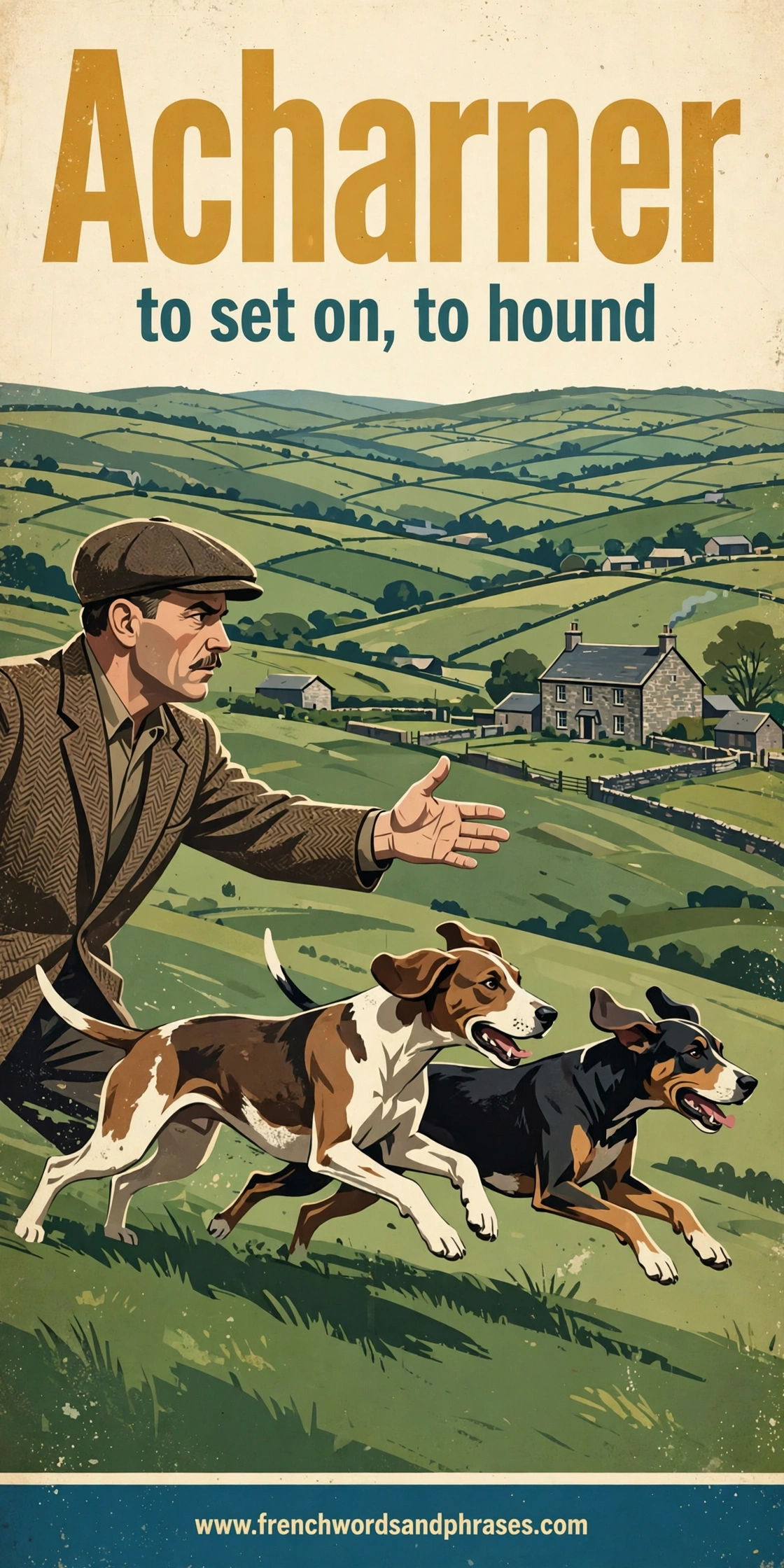
Hounds straining at the leash at the edge of a medieval hunt, a pack that has tasted the scent — acharner is the old hunting verb for putting an animal onto the flesh of the prey, and it still smells of the chase.
In this guide, you’ll learn how to conjugate acharner in all the major French tenses and moods. Explore complete conjugation tables, French examples, English translations, and practice quizzes.
Understanding the French Verb Acharner
Acharner is a regular French verb belonging to the first group of verbs, those ending in-er.
It means to set on, to hound. Outside hunting history it appears in set literary uses — acharner les chiens contre quelqu’un, to set the dogs on someone, figuratively to unleash a campaign against a person — while everyday French reaches for its reflexive and its adjective to speak of any fierce, unrelenting effort or attack.
Verb classification: First group (-er)
Auxiliary verb: Avoir
Past participle: acharné
Present participle: acharnant
English equivalents: To set on, to hound, to train onto flesh; acharner un chien sur le gibier — to set a dog on the game; acharner un faucon — to train a falcon on flesh; l’acharnement — relentlessness, ferocious persistence; un combat acharné — a fierce, relentless fight.
One important detail: acharner itself is a rare, mostly historical verb — the huntsman’s act of giving hounds and falcons their first taste of flesh so they will hunt with appetite. What lives vigorously in modern French is its family: the reflexive s’acharner (to persist fiercely), the adjective acharné (relentless — un travailleur acharné, une lutte acharnée) and the noun l’acharnement. The plain verb is regular: j’acharne, nous acharnons, participle acharné.
Experience the Word
Acharner is the verb of the unleashing — the moment appetite is taught, aimed, and let go at a target.
Imagine a falconer on a windswept hill in the age of kings. For weeks he has acharnered his young falcon on small pieces of meat; today he removes the hood, and the bird rises with a hunger that has been carefully, deliberately educated.
The falcon hunts by nature. But its fierceness has been trained — acharnée, pointed at the prey like a blade.
How to Conjugate Acharner: Complete French Conjugation Guide
Let’s explore every major conjugation of acharner, beginning with the indicative mood.
How to Conjugate Acharner in the Indicative Mood
The indicative mood is used to express facts, observations, actions, and events.
How to Conjugate Acharner in the Present Tense (Présent)
Used for actions happening now, habitual actions, and general truths.
| Subject | Conjugation |
|---|---|
| je | acharne |
| tu | acharnes |
| il / elle | acharne |
| nous | acharnons |
| vous | acharnez |
| ils / elles | acharnent |
Example
Le fauconnier acharne le jeune faucon sur la viande.
The falconer trains the young falcon onto the meat.
Complete the sentence:
Nous ______ les chiens sur la piste.
Reveal the answer
acharnons
Nous acharnons les chiens sur la piste.
We set the dogs on the trail.
How to Conjugate Acharner in the Passé Composé
Used for completed actions in the past. Acharner takes the auxiliary verb avoir.
| Subject | Conjugation |
|---|---|
| j’ | ai acharné |
| tu | as acharné |
| il / elle | a acharné |
| nous | avons acharné |
| vous | avez acharné |
| ils / elles | ont acharné |
Example
Il a acharné ses chiens sur la piste du cerf.
He set his dogs on the stag’s trail.
How to Conjugate Acharner in the Imparfait (Imperfect Tense)
Used for habitual past actions, descriptions, and ongoing situations in the past.
| Subject | Conjugation |
|---|---|
| je | acharnais |
| tu | acharnais |
| il / elle | acharnait |
| nous | acharnions |
| vous | acharniez |
| ils / elles | acharnaient |
Example
Autrefois, on acharnait les chiens avant la chasse.
In the old days, dogs were given the taste of flesh before the hunt.
Quick Quiz 2
Choose the correct form:
He set his dogs on the trail.
Il ______ ses chiens sur la piste. (a acharné / est acharné)
Reveal the answer
a acharné
Il a acharné ses chiens sur la piste.
Acharner takes avoir.
How to Conjugate Acharner in the Plus-que-parfait
Used to describe an action that had already been completed before another past event.
| Subject | Conjugation |
|---|---|
| j’ | avais acharné |
| tu | avais acharné |
| il / elle | avait acharné |
| nous | avions acharné |
| vous | aviez acharné |
| ils / elles | avaient acharné |
Example
Le veneur avait acharné la meute dès l’aube.
The huntsman had set the pack on from dawn.
How to Conjugate Acharner in the Passé Simple
Primarily used in formal writing, literature, and historical narratives. It is rarely used in everyday conversation.
| Subject | Conjugation |
|---|---|
| je | acharnai |
| tu | acharnas |
| il / elle | acharna |
| nous | acharnâmes |
| vous | acharnâtes |
| ils / elles | acharnèrent |
Example
Le roi acharna ses faucons sur les perdrix.
The king set his falcons onto the partridges.
How to Conjugate Acharner in the Passé Antérieur
A literary tense used to express an action completed immediately before another past action, generally in the passé simple.
| Subject | Conjugation |
|---|---|
| j’ | eus acharné |
| tu | eus acharné |
| il / elle | eut acharné |
| nous | eûmes acharné |
| vous | eûtes acharné |
| ils / elles | eurent acharné |
Example
Quand il eut acharné les chiens, il ouvrit la grille.
When he had set the dogs on, he opened the gate.
How to Conjugate Acharner in the Future Tense (Futur Simple)
Used to describe actions that will take place in the future.
| Subject | Conjugation |
|---|---|
| je | acharnerai |
| tu | acharneras |
| il / elle | acharnera |
| nous | acharnerons |
| vous | acharnerez |
| ils / elles | acharneront |
Example
Demain, le fauconnier acharnera l’oiseau nouveau.
Tomorrow, the falconer will train the new bird onto flesh.
How to Conjugate Acharner in the Futur Antérieur (Future Perfect)
Used for an action that will have been completed before a particular point in the future.
| Subject | Conjugation |
|---|---|
| j’ | aurai acharné |
| tu | auras acharné |
| il / elle | aura acharné |
| nous | aurons acharné |
| vous | aurez acharné |
| ils / elles | auront acharné |
Example
À la saison de chasse, ils auront acharné toute la meute.
By the hunting season, they will have trained the whole pack.
How to Conjugate Acharner in the Near Future (Futur Proche)
Used to describe something that is going to happen soon. Formed with aller + infinitive.
| Subject | Conjugation |
|---|---|
| je | vais acharner |
| tu | vas acharner |
| il / elle | va acharner |
| nous | allons acharner |
| vous | allez acharner |
| ils / elles | vont acharner |
Example
Il va acharner les chiens, écartez-vous.
He is going to set the dogs on, stand back.
How to Conjugate Acharner in the Conditional Mood
The conditional mood expresses what would happen under certain circumstances. It is also frequently used to make polite requests or express wishes.
How to Conjugate Acharner in the Present Conditional
| Subject | Conjugation |
|---|---|
| je | acharnerais |
| tu | acharnerais |
| il / elle | acharnerait |
| nous | acharnerions |
| vous | acharneriez |
| ils / elles | acharneraient |
Example
Un bon dresseur acharnerait l’animal sans brutalité.
A good trainer would train the animal on without brutality.
How to Conjugate Acharner in the Past Conditional
| Subject | Conjugation |
|---|---|
| j’ | aurais acharné |
| tu | aurais acharné |
| il / elle | aurait acharné |
| nous | aurions acharné |
| vous | auriez acharné |
| ils / elles | auraient acharné |
Example
Il aurait acharné le faucon si le temps l’avait permis.
He would have trained the falcon on if the weather had allowed it.
Acharner in the Literary Past Conditional Form
This less common literary form uses the imperfect subjunctive of avoir.
| Subject | Conjugation |
|---|---|
| j’ | eusse acharné |
| tu | eusses acharné |
| il / elle | eût acharné |
| nous | eussions acharné |
| vous | eussiez acharné |
| ils / elles | eussent acharné |
Example
Le veneur eût acharné la meute avant la messe.
The huntsman would have set the pack on before mass.
How to Conjugate Acharner in the Subjunctive Mood
The subjunctive is used to express wishes, emotions, doubts, necessity, and uncertainty. It frequently follows expressions such as il faut que (it is necessary that) or bien que (although).
How to Conjugate Acharner in the Present Subjunctive
| Subject | Conjugation |
|---|---|
| que je | acharne |
| que tu | acharnes |
| qu’il / qu’elle | acharne |
| que nous | acharnions |
| que vous | acharniez |
| qu’ils / qu’elles | acharnent |
Example
Il faut que le dresseur acharne le chien progressivement.
The trainer must accustom the dog to flesh gradually.
Quick Quiz 3
Complete the sentence using the subjunctive:
Le roi ordonne que vous ______ les faucons avant la fête.
Reveal the answer
acharniez
Le roi ordonne que vous acharniez les faucons avant la fête.
The king orders you to train the falcons on before the feast.
How to Conjugate Acharner in the Imperfect Subjunctive
A literary tense, rarely encountered in modern spoken French.
| Subject | Conjugation |
|---|---|
| que je | acharnasse |
| que tu | acharnasses |
| qu’il / qu’elle | acharnât |
| que nous | acharnassions |
| que vous | acharnassiez |
| qu’ils / qu’elles | acharnassent |
Example
Le roi ordonna qu’on acharnât les faucons avant la fête.
The king ordered the falcons to be trained on before the feast.
How to Conjugate Acharner in the Pluperfect Subjunctive
A literary construction used to express an action completed before another past action.
| Subject | Conjugation |
|---|---|
| que j’ | eusse acharné |
| que tu | eusses acharné |
| qu’il / qu’elle | eût acharné |
| que nous | eussions acharné |
| que vous | eussiez acharné |
| qu’ils / qu’elles | eussent acharné |
Example
On racontait que le veneur eût acharné des chiens légendaires.
People said the huntsman had trained legendary dogs.
How to Conjugate Acharner in the Past Subjunctive
| Subject | Conjugation |
|---|---|
| que j’ | aie acharné |
| que tu | aies acharné |
| qu’il / qu’elle | ait acharné |
| que nous | ayons acharné |
| que vous | ayez acharné |
| qu’ils / qu’elles | aient acharné |
Example
Je suis surpris qu’il ait acharné la meute si tôt.
I am surprised he set the pack on so early.
How to Conjugate Acharner in the Imperative
The imperative is used to give commands, instructions, invitations, or suggestions. Subject pronouns are omitted.
How to Conjugate Acharner in the Present Imperative
| Person | Conjugation |
|---|---|
| (tu) | acharne |
| (nous) | acharnons |
| (vous) | acharnez |
Example
Acharnez les chiens sur la piste, pas avant !
Set the dogs on the trail, not before!
Quick Quiz 4
How would you say Set the dogs on the trail (tu form)?
Reveal the answer
Acharne les chiens sur la piste !
French Participles of Acharner
Participles are verb forms that can be used in compound tenses and other grammatical constructions.
Present Participle of Acharner
acharnant
En acharnant le faucon, le dresseur lui apprend la chasse.
By training the falcon on flesh, the trainer teaches it to hunt.
Past Participle of Acharner
acharné
Acharnés dès leur jeune âge, ces chiens ne lâchent jamais la piste.
Trained on flesh from their youth, these dogs never leave the trail.
Acharner in Everyday French: Real-Life Examples
Now that you know the conjugations, let’s see how acharner appears in everyday French.
Example 1 — Present
Le fauconnier acharne le jeune faucon.
The falconer trains the young falcon onto flesh.
Example 2 — Passé composé
Il a acharné ses chiens sur la piste du cerf.
He set his dogs on the stag’s trail.
Example 3 — Imparfait
On acharnait les chiens avant la chasse.
Dogs were given the taste of flesh before the hunt.
Example 4 — Future
Le dresseur acharnera l’oiseau nouveau demain.
The trainer will train the new bird onto flesh tomorrow.
Example 5 — Conditional
Un bon dresseur acharnerait l’animal sans brutalité.
A good trainer would train the animal on without brutality.
Example 6 — Imperative
Acharnez les chiens sur la piste !
Set the dogs on the trail!
Beyond Translation: The Meaning of Acharner
Inside acharner sits la chair — flesh. To acharner an animal was literally to put flesh into it: to give the hound or falcon meat so that it would hunt flesh with passion.
The flesh is gone from the modern family, but the appetite remains.
Un ennemi acharné is a relentless enemy, une défense acharnée a fierce defence, and l’acharnement thérapeutique is the medical term for persisting with treatment beyond reason — the hound, centuries later, still will not let go.
How to Remember the French Verb Acharner
Remember it this way: Acharner is about the falconer giving his bird its first taste of flesh.
- Chair — flesh — is inside the word: acharner = to give an animal the taste of flesh.
- The plain verb is rare and historical; its family runs modern French: s’acharner, acharné, l’acharnement.
- Regular -er: j’acharne, nous acharnons, past participle acharné, auxiliary avoir.
The key idea is the falconer giving his bird its first taste of flesh.
Test Your Knowledge of Acharner
Let’s see how much you’ve learned. Try answering these questions before revealing the answers.
Question 1
What word hides inside acharner, and what does it explain?
Reveal the answer
Chair, flesh — to acharner an animal was to give it flesh, so it would hunt with appetite.
Question 2
How do you say He set his dogs on the stag’s trail in French?
Reveal the answer
Il a acharné ses chiens sur la piste du cerf.
Question 3
Translate: The falconer trains the young falcon onto flesh.
Reveal the answer
Le fauconnier acharne le jeune faucon.
Question 4
What is the past participle of acharner?
Reveal the answer
Acharné — also the adjective: un combat acharné, a relentless fight.
Question 5
Complete the sentence:
Il faut que le dresseur ______ le chien progressivement.
Reveal the answer
acharne
Il faut que le dresseur acharne le chien progressivement.
The trainer must accustom the dog to flesh gradually.
Your Final Challenge
Can You Use It?
How would you say this in French?
A falcon is trained onto flesh once; its hunger for the hunt lasts its whole life.
Reveal the answer
On acharne le faucon une fois ; sa faim de chasse dure toute sa vie.
A falcon is trained onto flesh once; its hunger for the hunt lasts its whole life.
A little French. A little curiosity. A richer everyday life.
LEARN FRENCH ONE WORD AT A TIME