A French Word to Live By
How to Conjugate Achalander in French
/a.ʃa.lɑ̃.de/
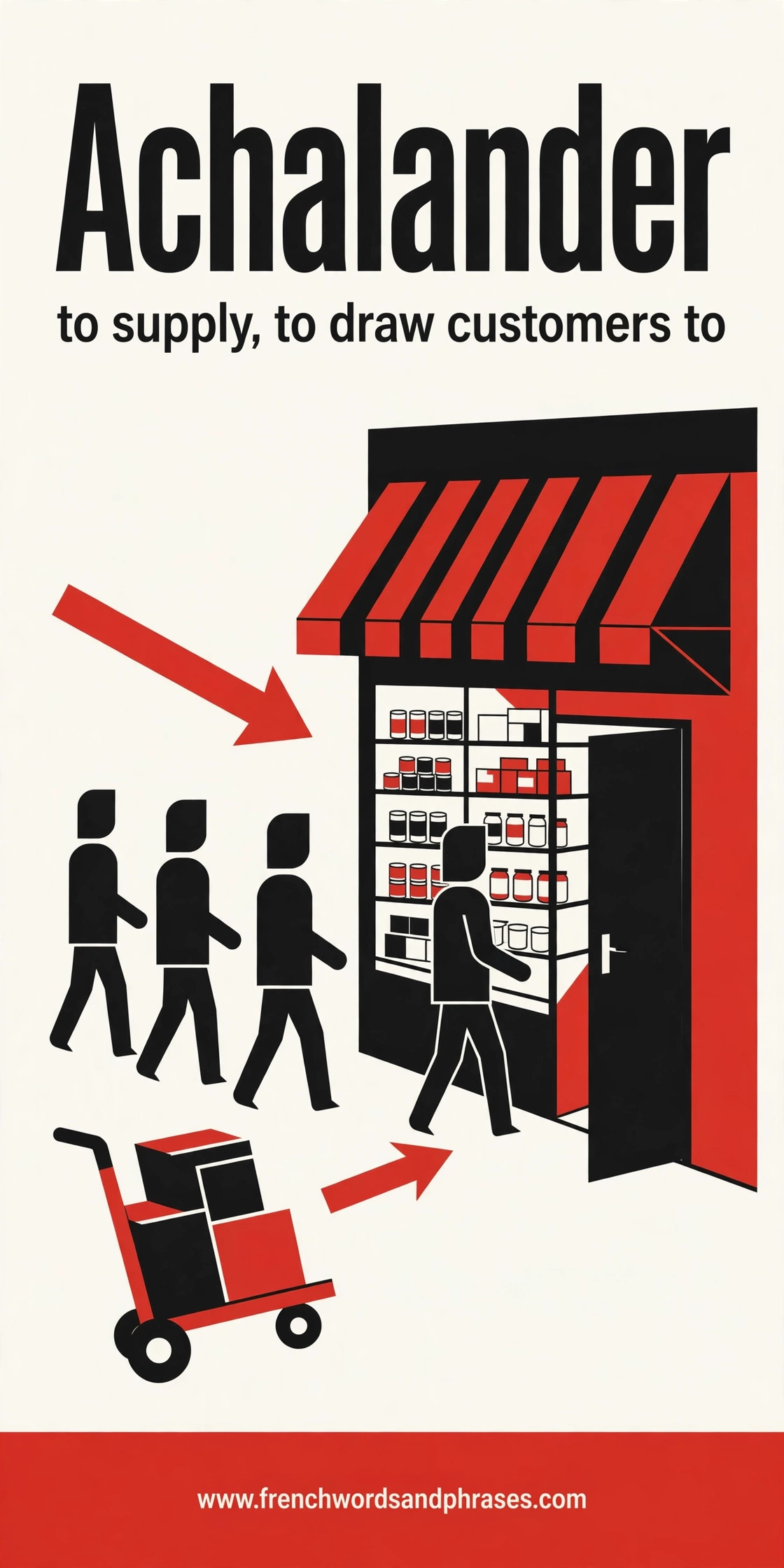
Achalander means to supply, to draw customers to — to stock a shop and fill it with the customers, the chalands, who make it live.
Crates of fruit stacked before dawn, shutters rattling up on a market street — achalander is the shopkeeper’s verb: to fill the shelves and, by filling them well, to fill the shop with buyers.
In this guide, you’ll learn how to conjugate achalander in all the major French tenses and moods. Explore complete conjugation tables, French examples, English translations, and practice quizzes.
Understanding the French Verb Achalander
Achalander is a regular French verb belonging to the first group of verbs, those ending in-er.
It means to supply, to draw customers to. It belongs to the world of retail: wholesalers achalandent the shops they supply, market traders achalandent their stalls at dawn, and estate agents praise a boutique bien achalandée — good stock, good passing trade. Its noun, l’achalandage, is the standard business word for a shop’s customer traffic.
Verb classification: First group (-er)
Auxiliary verb: Avoir
Past participle: achalandé
Present participle: achalandant
English equivalents: To supply, to stock, to draw customers to; achalander un magasin — to stock a shop and build its trade; un magasin bien achalandé — a well-stocked shop with plenty of customers; un rayon mal achalandé — a poorly stocked department; l’achalandage — footfall, customer traffic.
One important detail: achalander is built on the old word chaland — a customer, a regular buyer — and modern French meets the verb mostly in its past participle: un magasin bien achalandé means both well stocked and well patronised, two compliments in one word. A shop that is mal achalandé lacks goods, customers, or both. The verb itself is perfectly regular: j’achalande, nous achalandons, participle achalandé.
Experience the Word
Achalander is the verb of the full shop — full shelves in front, full pavement outside, and a till that keeps singing.
Imagine a grocer in a small town in the Dordogne. Every morning at five he achalande son étal — crates of peaches, pyramids of melons, bunches of herbs — and by eight the queue is at the door: the goods have done their work, and the customers have followed the goods.
An empty shelf never sold anything. The stall has been stocked — achalandé — and the street can smell it.
How to Conjugate Achalander: Complete French Conjugation Guide
Let’s explore every major conjugation of achalander, beginning with the indicative mood.
How to Conjugate Achalander in the Indicative Mood
The indicative mood is used to express facts, observations, actions, and events.
How to Conjugate Achalander in the Present Tense (Présent)
Used for actions happening now, habitual actions, and general truths.
| Subject | Conjugation |
|---|---|
| je | achalande |
| tu | achalandes |
| il / elle | achalande |
| nous | achalandons |
| vous | achalandez |
| ils / elles | achalandent |
Example
Le grossiste achalande les épiceries de la région.
The wholesaler supplies the grocery shops of the region.
Complete the sentence:
Nous ______ le magasin pour la saison.
Reveal the answer
achalandons
Nous achalandons le magasin pour la saison.
We stock the shop for the season.
How to Conjugate Achalander in the Passé Composé
Used for completed actions in the past. Achalander takes the auxiliary verb avoir.
| Subject | Conjugation |
|---|---|
| j’ | ai achalandé |
| tu | as achalandé |
| il / elle | a achalandé |
| nous | avons achalandé |
| vous | avez achalandé |
| ils / elles | ont achalandé |
Example
Elle a achalandé sa boutique avant les fêtes.
She stocked her shop before the holidays.
How to Conjugate Achalander in the Imparfait (Imperfect Tense)
Used for habitual past actions, descriptions, and ongoing situations in the past.
| Subject | Conjugation |
|---|---|
| je | achalandais |
| tu | achalandais |
| il / elle | achalandait |
| nous | achalandions |
| vous | achalandiez |
| ils / elles | achalandaient |
Example
Chaque matin, le maraîcher achalandait son étal avant l’aube.
Every morning, the market gardener stocked his stall before dawn.
Quick Quiz 2
Choose the correct form:
She stocked her shop.
Elle ______ sa boutique. (a achalandé / est achalandée)
Reveal the answer
a achalandé
Elle a achalandé sa boutique.
Achalander takes avoir.
How to Conjugate Achalander in the Plus-que-parfait
Used to describe an action that had already been completed before another past event.
| Subject | Conjugation |
|---|---|
| j’ | avais achalandé |
| tu | avais achalandé |
| il / elle | avait achalandé |
| nous | avions achalandé |
| vous | aviez achalandé |
| ils / elles | avaient achalandé |
Example
Ils avaient achalandé le magasin pour la saison d’été.
They had stocked the shop for the summer season.
How to Conjugate Achalander in the Passé Simple
Primarily used in formal writing, literature, and historical narratives. It is rarely used in everyday conversation.
| Subject | Conjugation |
|---|---|
| je | achalandai |
| tu | achalandas |
| il / elle | achalanda |
| nous | achalandâmes |
| vous | achalandâtes |
| ils / elles | achalandèrent |
Example
Le nouveau propriétaire achalanda la librairie en une semaine.
The new owner stocked the bookshop within a week.
How to Conjugate Achalander in the Passé Antérieur
A literary tense used to express an action completed immediately before another past action, generally in the passé simple.
| Subject | Conjugation |
|---|---|
| j’ | eus achalandé |
| tu | eus achalandé |
| il / elle | eut achalandé |
| nous | eûmes achalandé |
| vous | eûtes achalandé |
| ils / elles | eurent achalandé |
Example
Quand elle eut achalandé son étal, les premiers clients arrivèrent.
When she had stocked her stall, the first customers arrived.
How to Conjugate Achalander in the Future Tense (Futur Simple)
Used to describe actions that will take place in the future.
| Subject | Conjugation |
|---|---|
| je | achalanderai |
| tu | achalanderas |
| il / elle | achalandera |
| nous | achalanderons |
| vous | achalanderez |
| ils / elles | achalanderont |
Example
Demain, nous achalanderons le rayon des fromages.
Tomorrow, we will stock the cheese department.
How to Conjugate Achalander in the Futur Antérieur (Future Perfect)
Used for an action that will have been completed before a particular point in the future.
| Subject | Conjugation |
|---|---|
| j’ | aurai achalandé |
| tu | auras achalandé |
| il / elle | aura achalandé |
| nous | aurons achalandé |
| vous | aurez achalandé |
| ils / elles | auront achalandé |
Example
À l’ouverture, ils auront achalandé tout le magasin.
By opening time, they will have stocked the whole shop.
How to Conjugate Achalander in the Near Future (Futur Proche)
Used to describe something that is going to happen soon. Formed with aller + infinitive.
| Subject | Conjugation |
|---|---|
| je | vais achalander |
| tu | vas achalander |
| il / elle | va achalander |
| nous | allons achalander |
| vous | allez achalander |
| ils / elles | vont achalander |
Example
Le camion arrive, on va achalander le magasin.
The lorry is coming, we are going to stock the shop.
How to Conjugate Achalander in the Conditional Mood
The conditional mood expresses what would happen under certain circumstances. It is also frequently used to make polite requests or express wishes.
How to Conjugate Achalander in the Present Conditional
| Subject | Conjugation |
|---|---|
| je | achalanderais |
| tu | achalanderais |
| il / elle | achalanderait |
| nous | achalanderions |
| vous | achalanderiez |
| ils / elles | achalanderaient |
Example
Avec un meilleur fournisseur, j’achalanderais ma boutique plus vite.
With a better supplier, I would stock my shop faster.
How to Conjugate Achalander in the Past Conditional
| Subject | Conjugation |
|---|---|
| j’ | aurais achalandé |
| tu | aurais achalandé |
| il / elle | aurait achalandé |
| nous | aurions achalandé |
| vous | auriez achalandé |
| ils / elles | auraient achalandé |
Example
Elle aurait achalandé son étal si le marché avait eu lieu.
She would have stocked her stall if the market had taken place.
Achalander in the Literary Past Conditional Form
This less common literary form uses the imperfect subjunctive of avoir.
| Subject | Conjugation |
|---|---|
| j’ | eusse achalandé |
| tu | eusses achalandé |
| il / elle | eût achalandé |
| nous | eussions achalandé |
| vous | eussiez achalandé |
| ils / elles | eussent achalandé |
Example
Le marchand eût achalandé sa boutique avant la foire.
The merchant would have stocked his shop before the fair.
How to Conjugate Achalander in the Subjunctive Mood
The subjunctive is used to express wishes, emotions, doubts, necessity, and uncertainty. It frequently follows expressions such as il faut que (it is necessary that) or bien que (although).
How to Conjugate Achalander in the Present Subjunctive
| Subject | Conjugation |
|---|---|
| que je | achalande |
| que tu | achalandes |
| qu’il / qu’elle | achalande |
| que nous | achalandions |
| que vous | achalandiez |
| qu’ils / qu’elles | achalandent |
Example
Il faut que tu achalandes ton étal avant huit heures.
You must stock your stall before eight o’clock.
Quick Quiz 3
Complete the sentence using the subjunctive:
Le patron veut que vous ______ le rayon dès l’aube.
Reveal the answer
achalandiez
Le patron veut que vous achalandiez le rayon dès l’aube.
The boss wants you to stock the department from dawn.
How to Conjugate Achalander in the Imperfect Subjunctive
A literary tense, rarely encountered in modern spoken French.
| Subject | Conjugation |
|---|---|
| que je | achalandasse |
| que tu | achalandasses |
| qu’il / qu’elle | achalandât |
| que nous | achalandassions |
| que vous | achalandassiez |
| qu’ils / qu’elles | achalandassent |
Example
Le patron voulait que l’équipe achalandât le rayon dès l’aube.
The boss wanted the team to stock the department from dawn.
How to Conjugate Achalander in the Pluperfect Subjunctive
A literary construction used to express an action completed before another past action.
| Subject | Conjugation |
|---|---|
| que j’ | eusse achalandé |
| que tu | eusses achalandé |
| qu’il / qu’elle | eût achalandé |
| que nous | eussions achalandé |
| que vous | eussiez achalandé |
| qu’ils / qu’elles | eussent achalandé |
Example
On disait qu’ils eussent achalandé le magasin en une nuit.
People said they had stocked the shop in a single night.
How to Conjugate Achalander in the Past Subjunctive
| Subject | Conjugation |
|---|---|
| que j’ | aie achalandé |
| que tu | aies achalandé |
| qu’il / qu’elle | ait achalandé |
| que nous | ayons achalandé |
| que vous | ayez achalandé |
| qu’ils / qu’elles | aient achalandé |
Example
Je suis content qu’elle ait achalandé la boutique à temps.
I am glad she stocked the shop in time.
How to Conjugate Achalander in the Imperative
The imperative is used to give commands, instructions, invitations, or suggestions. Subject pronouns are omitted.
How to Conjugate Achalander in the Present Imperative
| Person | Conjugation |
|---|---|
| (tu) | achalande |
| (nous) | achalandons |
| (vous) | achalandez |
Example
Achalande ton étal, les clients arrivent !
Stock your stall, the customers are coming!
Quick Quiz 4
How would you say Stock your stall (tu form)?
Reveal the answer
Achalande ton étal !
French Participles of Achalander
Participles are verb forms that can be used in compound tenses and other grammatical constructions.
Present Participle of Achalander
achalandant
En achalandant bien sa boutique, elle a doublé ses ventes.
By stocking her shop well, she doubled her sales.
Past Participle of Achalander
achalandé
Bien achalandé, le magasin attire tout le quartier.
Well stocked, the shop attracts the whole neighbourhood.
Achalander in Everyday French: Real-Life Examples
Now that you know the conjugations, let’s see how achalander appears in everyday French.
Example 1 — Present
Le grossiste achalande les épiceries du village.
The wholesaler supplies the village grocery shops.
Example 2 — Passé composé
Elle a achalandé sa boutique avant les fêtes.
She stocked her shop before the holidays.
Example 3 — Imparfait
Le maraîcher achalandait son étal avant l’aube.
The market gardener stocked his stall before dawn.
Example 4 — Future
Nous achalanderons le rayon des fromages demain.
We will stock the cheese department tomorrow.
Example 5 — Conditional
Avec plus de place, j’achalanderais mieux ma boutique.
With more room, I would stock my shop better.
Example 6 — Imperative
Achalande ton étal, les clients arrivent !
Stock your stall, the customers are coming!
Beyond Translation: The Meaning of Achalander
Inside the word sleeps chaland — in old French, simply a customer, the person who comes to buy.
So a shop bien achalandé is a shop full of chalands.
French keeps the idea in l’achalandage, the footfall a business is worth: when a shop is sold, what the buyer really purchases is its achalandage — the crowd the stocked shelves have taught to come.
How to Remember the French Verb Achalander
Remember it this way: Achalander is about the grocer’s stall at dawn — full shelves, then a full street.
- Chaland is the old word for a customer: achalander = to fill a shop with goods and customers.
- You will mostly meet the participle: un magasin bien achalandé — well stocked, well patronised.
- Regular -er: j’achalande, nous achalandons, past participle achalandé, auxiliary avoir.
The key idea is the grocer’s stall at dawn — full shelves, then a full street.
Test Your Knowledge of Achalander
Let’s see how much you’ve learned. Try answering these questions before revealing the answers.
Question 1
What is a magasin bien achalandé?
Reveal the answer
A well-stocked shop with plenty of customers — goods on the shelves and chalands at the door.
Question 2
How do you say The wholesaler supplies the village shops in French?
Reveal the answer
Le grossiste achalande les épiceries du village.
Question 3
Translate: She stocked her shop before the holidays.
Reveal the answer
Elle a achalandé sa boutique avant les fêtes.
Question 4
What is the past participle of achalander?
Reveal the answer
Achalandé.
Question 5
Complete the sentence:
Il faut que tu ______ ton étal avant huit heures.
Reveal the answer
achalandes
Il faut que tu achalandes ton étal avant huit heures.
You must stock your stall before eight o’clock.
Your Final Challenge
Can You Use It?
How would you say this in French?
A well-stocked shop does not wait for customers: it brings them in.
Reveal the answer
Un magasin bien achalandé n’attend pas les clients : il les fait venir.
A well-stocked shop does not wait for customers: it brings them in.
A little French. A little curiosity. A richer everyday life.
LEARN FRENCH ONE WORD AT A TIME