A French Word to Live By
How to Conjugate Acérer in French
/a.se.ʁe/
Acérer means to sharpen, to steel — to give a blade the fine, hard edge of steel, and, figuratively, to give a tongue or a pen the same cutting quality.
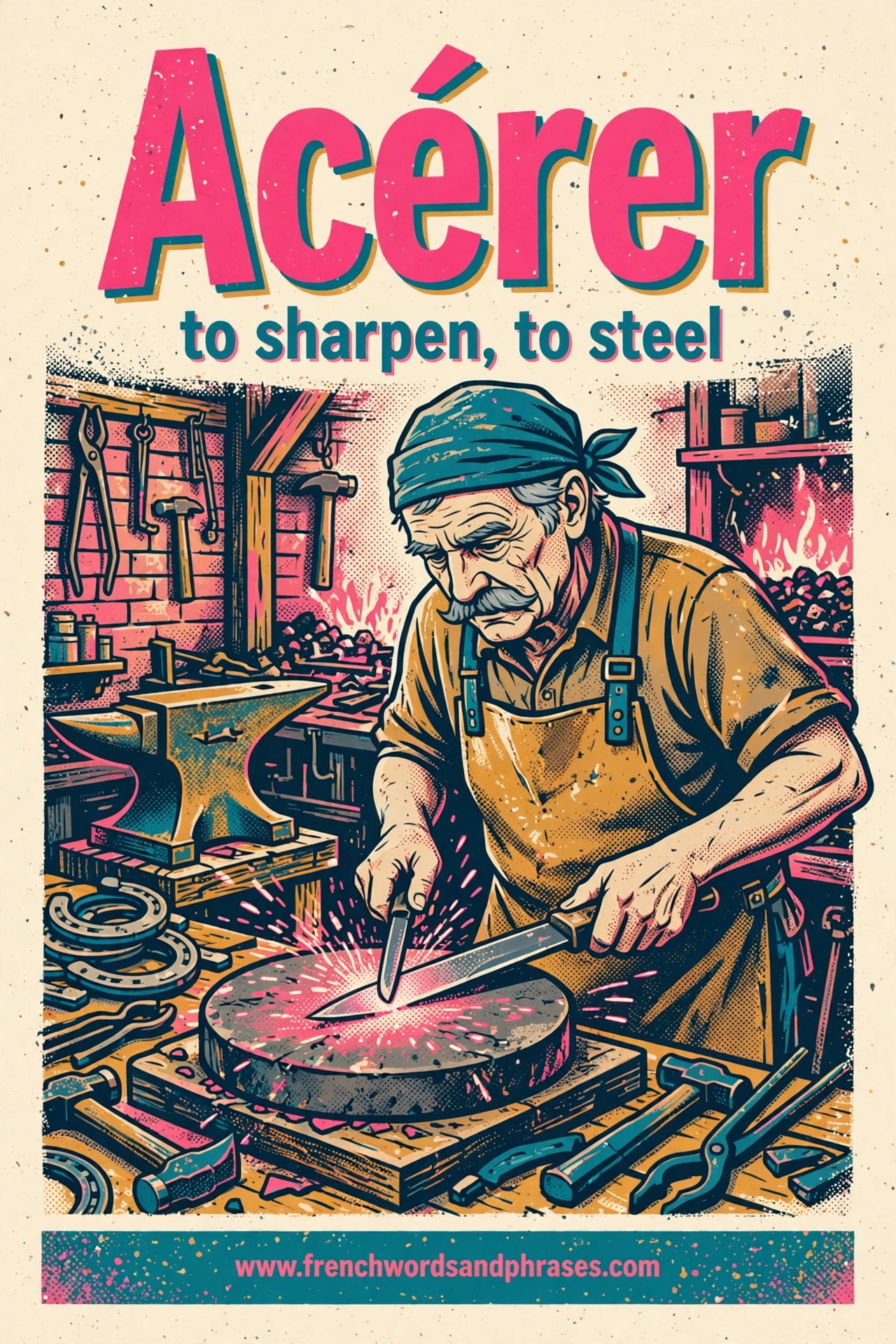
A cutler leaning over his grindstone, sparks flying as a kitchen knife meets the wheel — acérer is the craftsman’s verb for putting a steel edge on a blade, and the writer’s verb for a wit that cuts.
In this guide, you’ll learn how to conjugate acérer in all the major French tenses and moods. Explore complete conjugation tables, French examples, English translations, and practice quizzes.
Understanding the French Verb Acérer
Acérer is a regular French verb belonging to the first group of verbs, those ending in-er.
It means to sharpen, to steel. The literal verb belongs to the cutler’s and the cook’s world — acérer une lame, acérer un fusil à aiguiser — but modern French meets it mostly in the adjective acéré(e): des griffes acérées, sharp claws; une critique acérée, a cutting review; un esprit acéré, a razor mind.
Verb classification: First group (-er)
Auxiliary verb: Avoir
Past participle: acéré
Present participle: acérant
English equivalents: To sharpen, to steel, to put an edge on; acérer une lame — to sharpen a blade; acérer un couteau — to steel a knife; une langue acérée — a sharp, cutting tongue; un regard acéré — a piercing look; un style acéré — a biting style.
One important detail: acérer is a céder-type verb — the é of the stem opens to è wherever the next syllable is mute: j’acère, tu acères, il acère, ils acèrent, and through the whole future and conditional: j’acèrerai, j’acèrerais. The é survives where the ending is sounded: nous acérons, vous acérez, j’acérais, in the infinitive and the participle, acérer, acéré, and in que nous acérions. Its adjective acéré — sharp, cutting — is far commoner than the verb itself: une lame acérée, une plume acérée.
Experience the Word
Acérer is the verb of the edge — the moment dull steel becomes a blade that must be respected.
Imagine the cutler’s workshop in Thiers, France’s knife capital. The old man takes the customer’s blunt kitchen knife, draws it along the steel with a singing sound — il acère la lame — and tests it on a sheet of paper, which parts like water.
Thirty seconds of work. The knife has been steeled — acéré, edged, and quietly dangerous again.
How to Conjugate Acérer: Complete French Conjugation Guide
Let’s explore every major conjugation of acérer, beginning with the indicative mood.
How to Conjugate Acérer in the Indicative Mood
The indicative mood is used to express facts, observations, actions, and events.
How to Conjugate Acérer in the Present Tense (Présent)
Used for actions happening now, habitual actions, and general truths.
| Subject | Conjugation |
|---|---|
| je | acère |
| tu | acères |
| il / elle | acère |
| nous | acérons |
| vous | acérez |
| ils / elles | acèrent |
Example
Le coutelier acère la lame sur la pierre fine.
The cutler sharpens the blade on the fine stone.
Quick Quiz 1
Complete the sentence:
Nous ______ les couteaux avant le service.
Reveal the answer
acérons
Nous acérons les couteaux avant le service.
We steel the knives before the service.
How to Conjugate Acérer in the Passé Composé
Used for completed actions in the past. Acérer takes the auxiliary verb avoir.
| Subject | Conjugation |
|---|---|
| j’ | ai acéré |
| tu | as acéré |
| il / elle | a acéré |
| nous | avons acéré |
| vous | avez acéré |
| ils / elles | ont acéré |
Example
Il a acéré tous les couteaux avant le service.
He steeled all the knives before the service.
How to Conjugate Acérer in the Imparfait (Imperfect Tense)
Used for habitual past actions, descriptions, and ongoing situations in the past.
| Subject | Conjugation |
|---|---|
| je | acérais |
| tu | acérais |
| il / elle | acérait |
| nous | acérions |
| vous | acériez |
| ils / elles | acéraient |
Example
Mon grand-père acérait son rasoir sur un cuir.
My grandfather used to strop his razor on a leather strap.
Quick Quiz 2
Choose the correct form:
He sharpened the axe.
Il ______ la hache. (a acéré / est acéré)
Reveal the answer
a acéré
Il a acéré la hache.
Acérer takes avoir.
How to Conjugate Acérer in the Plus-que-parfait
Used to describe an action that had already been completed before another past event.
| Subject | Conjugation |
|---|---|
| j’ | avais acéré |
| tu | avais acéré |
| il / elle | avait acéré |
| nous | avions acéré |
| vous | aviez acéré |
| ils / elles | avaient acéré |
Example
Elle avait acéré la hache avant de fendre le bois.
She had sharpened the axe before splitting the wood.
How to Conjugate Acérer in the Passé Simple
Primarily used in formal writing, literature, and historical narratives. It is rarely used in everyday conversation.
| Subject | Conjugation |
|---|---|
| je | acérai |
| tu | acéras |
| il / elle | acéra |
| nous | acérâmes |
| vous | acérâtes |
| ils / elles | acérèrent |
Example
Le forgeron acéra le fer de la lance.
The blacksmith steeled the spearhead.
How to Conjugate Acérer in the Passé Antérieur
A literary tense used to express an action completed immediately before another past action, generally in the passé simple.
| Subject | Conjugation |
|---|---|
| j’ | eus acéré |
| tu | eus acéré |
| il / elle | eut acéré |
| nous | eûmes acéré |
| vous | eûtes acéré |
| ils / elles | eurent acéré |
Example
Quand il eut acéré le couteau, il le rangea dans son fourreau.
When he had sharpened the knife, he put it back in its sheath.
How to Conjugate Acérer in the Future Tense (Futur Simple)
Used to describe actions that will take place in the future.
| Subject | Conjugation |
|---|---|
| je | acèrerai |
| tu | acèreras |
| il / elle | acèrera |
| nous | acèrerons |
| vous | acèrerez |
| ils / elles | acèreront |
Example
Demain, j’acèrerai les ciseaux de la cuisine.
Tomorrow, I will sharpen the kitchen scissors.
How to Conjugate Acérer in the Futur Antérieur (Future Perfect)
Used for an action that will have been completed before a particular point in the future.
| Subject | Conjugation |
|---|---|
| j’ | aurai acéré |
| tu | auras acéré |
| il / elle | aura acéré |
| nous | aurons acéré |
| vous | aurez acéré |
| ils / elles | auront acéré |
Example
À midi, le boucher aura acéré ses couteaux deux fois.
By noon, the butcher will have steeled his knives twice.
How to Conjugate Acérer in the Near Future (Futur Proche)
Used to describe something that is going to happen soon. Formed with aller + infinitive.
| Subject | Conjugation |
|---|---|
| je | vais acérer |
| tu | vas acérer |
| il / elle | va acérer |
| nous | allons acérer |
| vous | allez acérer |
| ils / elles | vont acérer |
Example
Attention, il va acérer la lame, ne t’approche pas.
Careful, he is going to sharpen the blade, do not come near.
How to Conjugate Acérer in the Conditional Mood
The conditional mood expresses what would happen under certain circumstances. It is also frequently used to make polite requests or express wishes.
How to Conjugate Acérer in the Present Conditional
| Subject | Conjugation |
|---|---|
| je | acèrerais |
| tu | acèrerais |
| il / elle | acèrerait |
| nous | acèrerions |
| vous | acèreriez |
| ils / elles | acèreraient |
Example
Avec une meilleure pierre, j’acèrerais ce couteau en une minute.
With a better stone, I would sharpen this knife in a minute.
How to Conjugate Acérer in the Past Conditional
| Subject | Conjugation |
|---|---|
| j’ | aurais acéré |
| tu | aurais acéré |
| il / elle | aurait acéré |
| nous | aurions acéré |
| vous | auriez acéré |
| ils / elles | auraient acéré |
Example
Il aurait acéré la hache s’il avait trouvé la pierre.
He would have sharpened the axe if he had found the stone.
Acérer in the Literary Past Conditional Form
This less common literary form uses the imperfect subjunctive of avoir.
| Subject | Conjugation |
|---|---|
| j’ | eusse acéré |
| tu | eusses acéré |
| il / elle | eût acéré |
| nous | eussions acéré |
| vous | eussiez acéré |
| ils / elles | eussent acéré |
Example
Le soldat eût acéré son épée avant l’aube.
The soldier would have sharpened his sword before dawn.
How to Conjugate Acérer in the Subjunctive Mood
The subjunctive is used to express wishes, emotions, doubts, necessity, and uncertainty. It frequently follows expressions such as il faut que (it is necessary that) or bien que (although).
How to Conjugate Acérer in the Present Subjunctive
| Subject | Conjugation |
|---|---|
| que je | acère |
| que tu | acères |
| qu’il / qu’elle | acère |
| que nous | acérions |
| que vous | acériez |
| qu’ils / qu’elles | acèrent |
Example
Il faut que tu acères ce couteau avant de couper le pain.
You must sharpen this knife before cutting the bread.
Quick Quiz 3
Complete the sentence using the subjunctive:
Il faut que vous ______ la lame avec soin.
Reveal the answer
acériez
Il faut que vous acériez la lame avec soin.
You must sharpen the blade carefully.
How to Conjugate Acérer in the Imperfect Subjunctive
A literary tense, rarely encountered in modern spoken French.
| Subject | Conjugation |
|---|---|
| que je | acérasse |
| que tu | acérasses |
| qu’il / qu’elle | acérât |
| que nous | acérassions |
| que vous | acérassiez |
| qu’ils / qu’elles | acérassent |
Example
Le maître exigeait que l’apprenti acérât chaque lame deux fois.
The master required the apprentice to steel each blade twice.
How to Conjugate Acérer in the Pluperfect Subjunctive
A literary construction used to express an action completed before another past action.
| Subject | Conjugation |
|---|---|
| que j’ | eusse acéré |
| que tu | eusses acéré |
| qu’il / qu’elle | eût acéré |
| que nous | eussions acéré |
| que vous | eussiez acéré |
| qu’ils / qu’elles | eussent acéré |
Example
On admirait qu’il eût acéré l’outil avec si peu de moyens.
People admired that he had sharpened the tool with so few means.
How to Conjugate Acérer in the Past Subjunctive
| Subject | Conjugation |
|---|---|
| que j’ | aie acéré |
| que tu | aies acéré |
| qu’il / qu’elle | ait acéré |
| que nous | ayons acéré |
| que vous | ayez acéré |
| qu’ils / qu’elles | aient acéré |
Example
Je suis content qu’elle ait acéré les ciseaux.
I am glad she sharpened the scissors.
How to Conjugate Acérer in the Imperative
The imperative is used to give commands, instructions, invitations, or suggestions. Subject pronouns are omitted.
How to Conjugate Acérer in the Present Imperative
| Person | Conjugation |
|---|---|
| (tu) | acère |
| (nous) | acérons |
| (vous) | acérez |
Example
Acère le couteau avant le dîner !
Sharpen the knife before dinner!
Quick Quiz 4
How would you say Sharpen the knife (tu form)?
Reveal the answer
Acère le couteau !
French Participles of Acérer
Participles are verb forms that can be used in compound tenses and other grammatical constructions.
Present Participle of Acérer
acérant
En acérant la lame, il chantait une vieille chanson.
While sharpening the blade, he sang an old song.
Past Participle of Acérer
acéré
Acérée avec soin, la lame coupait le papier en silence.
Sharpened with care, the blade cut the paper silently.
Acérer in Everyday French: Real-Life Examples
Now that you know the conjugations, let’s see how acérer appears in everyday French.
Example 1 — Present
Le coutelier acère la lame sur la pierre.
The cutler sharpens the blade on the stone.
Example 2 — Passé composé
Il a acéré tous les couteaux ce matin.
He steeled all the knives this morning.
Example 3 — Imparfait
Mon grand-père acérait son rasoir chaque jour.
My grandfather used to strop his razor every day.
Example 4 — Future
J’acèrerai les ciseaux demain.
I will sharpen the scissors tomorrow.
Example 5 — Conditional
Avec une bonne pierre, tu acèrerais mieux cette lame.
With a good stone, you would sharpen this blade better.
Example 6 — Imperative
Acère le couteau avant de t’en servir !
Sharpen the knife before using it!
Beyond Translation: The Meaning of Acérer
The verb is built on acier, steel — itself from the Latin aciarium, the metal of the edge, cousin to aigu, sharp.
In modern French the edge has mostly moved into words about words.
Une langue acérée draws blood in conversation, une plume acérée in print, and un regard acéré pierces without touching: the cutler’s craft survives as a metaphor for everything that cuts cleanly.
How to Remember the French Verb Acérer
Remember it this way: Acérer is about the cutler’s singing steel — and a tongue just as sharp.
- Céder-type spelling: j’acère with è, but nous acérons with é — and j’acèrerai all through the future.
- It is the verb of acier, steel: to acérer a blade is to give it a steel edge.
- You will meet the adjective acéré(e) far more often: une lame acérée, une langue acérée.
The key idea is the cutler’s singing steel — and a tongue just as sharp.
Test Your Knowledge of Acérer
Let’s see how much you’ve learned. Try answering these questions before revealing the answers.
Question 1
Why is it j’acère but nous acérons?
Reveal the answer
The céder-type rule — é opens to è before a mute syllable (j’acère), and stays é where the ending is sounded (nous acérons).
Question 2
How do you say The cutler sharpens the blade in French?
Reveal the answer
Le coutelier acère la lame.
Question 3
Translate: He steeled all the knives this morning.
Reveal the answer
Il a acéré tous les couteaux ce matin.
Question 4
What is the past participle of acérer?
Reveal the answer
Acéré — also the adjective: une lame acérée, a sharp blade.
Question 5
Complete the sentence:
Il faut que tu ______ ce couteau avant de couper le pain.
Reveal the answer
acères
Il faut que tu acères ce couteau avant de couper le pain.
You must sharpen this knife before cutting the bread.
Your Final Challenge
Can You Use It?
How would you say this in French?
He sharpens his blade in the morning, and his tongue does the rest.
Reveal the answer
Il acère sa lame le matin, et sa langue fait le reste.
He sharpens his blade in the morning, and his tongue does the rest.
A little French. A little curiosity. A richer everyday life.
LEARN FRENCH ONE WORD AT A TIME