A French Word to Live By
How to Conjugate Accrocher in French
/a.kʁɔ.ʃe/
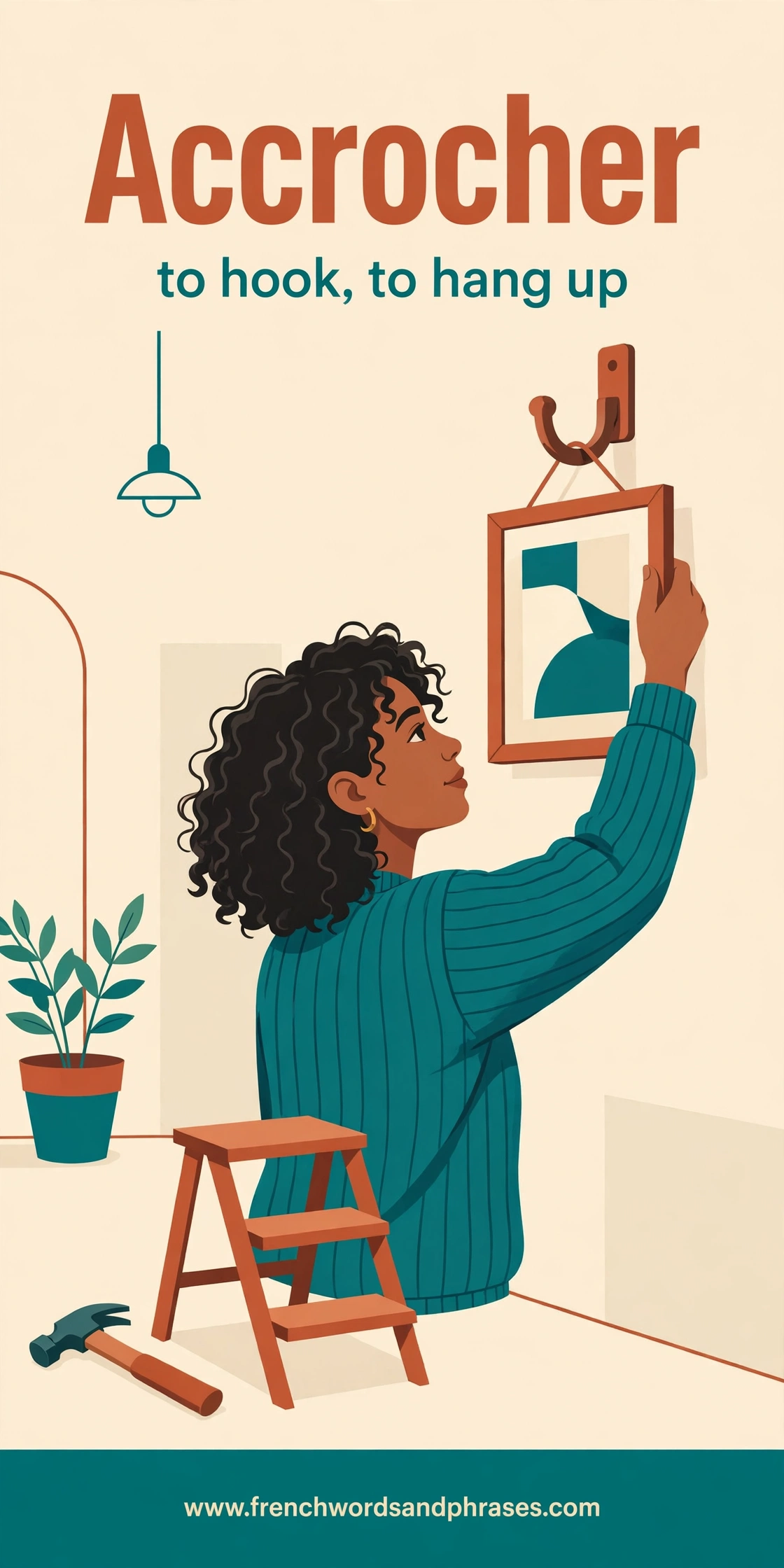
Accrocher means to hook, to hang up — to fix something onto a hook, a nail or a wall so that it holds fast and stays.
A coat lifted onto its peg, a picture raised onto a nail, a railway carriage coupled to the back of a train — accrocher is the everyday verb of hanging and hooking: wherever something is made to hang, grip or hold on, French reaches for this verb.
In this guide, you’ll learn how to conjugate accrocher in all the major French tenses and moods. Explore complete conjugation tables, French examples, English translations, and practice quizzes.
Understanding the French Verb Accrocher
Accrocher is a regular French verb belonging to the first group of verbs, those ending in-er.
It means to hook, to hang up. Beyond coats and pictures, accrocher catches anything that grips: a poster accroche le regard, a slogan accroche l’attention. In the street it has a rougher sense — accrocher une voiture is to clip or scrape another car — and accrocher quelqu’un can mean to buttonhole someone, to grab them for a word.
Verb classification: First group (-er)
Auxiliary verb: Avoir
Past participle: accroché
Present participle: accrochant
English equivalents: To hook, to hang up, to catch; accrocher un tableau au mur — to hang a picture on the wall; accrocher sa veste au portemanteau — to hang one’s jacket on the coat stand; accrocher un wagon au train — to couple a carriage to the train; accrocher l’attention, accrocher le regard — to catch the attention, to catch the eye.
One important detail: accrocher is built on un crochet, a hook, and the hook is the whole idea — a thing accroché is a thing that hangs and holds. It is a perfectly regular -er verb: j’accroche, nous accrochons, ils accrochent. Watch its family: un accroche-regard is an eye-catcher, and un titre accrocheur is a catchy headline. The reflexive twin, s’accrocher, turns the hook on oneself — to hang on, to cling — and has its own page.
Experience the Word
Accrocher is the verb of the hook and the nail — the small, satisfying moment when a thing leaves your hands and stays exactly where you put it.
Imagine a grandmother hanging the family photographs in a newly painted hallway. Each frame is lifted, levelled, let go — and holds. By evening the wall is a gallery: elle a accroché quarante ans de souvenirs, and every single one hangs straight.
The nail is tiny and the frame is heavy. It holds — accroché, hooked fast, and not coming down.
How to Conjugate Accrocher: Complete French Conjugation Guide
Let’s explore every major conjugation of accrocher, beginning with the indicative mood.
How to Conjugate Accrocher in the Indicative Mood
The indicative mood is used to express facts, observations, actions, and events.
How to Conjugate Accrocher in the Present Tense (Présent)
Used for actions happening now, habitual actions, and general truths.
| Subject | Conjugation |
|---|---|
| je | accroche |
| tu | accroches |
| il / elle | accroche |
| nous | accrochons |
| vous | accrochez |
| ils / elles | accrochent |
Example
Elle accroche le tableau au-dessus du canapé.
She is hanging the picture above the sofa.
Quick Quiz 1
Complete the sentence:
Nous ______ les rideaux neufs.
Reveal the answer
accrochons
Nous accrochons les rideaux neufs.
We are hanging the new curtains.
How to Conjugate Accrocher in the Passé Composé
Used for completed actions in the past. Accrocher takes the auxiliary verb avoir.
| Subject | Conjugation |
|---|---|
| j’ | ai accroché |
| tu | as accroché |
| il / elle | a accroché |
| nous | avons accroché |
| vous | avez accroché |
| ils / elles | ont accroché |
Example
Il a accroché sa veste au portemanteau.
He hung his jacket on the coat stand.
How to Conjugate Accrocher in the Imparfait (Imperfect Tense)
Used for habitual past actions, descriptions, and ongoing situations in the past.
| Subject | Conjugation |
|---|---|
| je | accrochais |
| tu | accrochais |
| il / elle | accrochait |
| nous | accrochions |
| vous | accrochiez |
| ils / elles | accrochaient |
Example
Chaque soir, elle accrochait les clés près de la porte.
Every evening, she used to hang the keys by the door.
Quick Quiz 2
Choose the correct form:
He hung his jacket.
Il ______ sa veste. (a accroché / est accroché)
Reveal the answer
a accroché
Il a accroché sa veste.
Accrocher takes avoir.
How to Conjugate Accrocher in the Plus-que-parfait
Used to describe an action that had already been completed before another past event.
| Subject | Conjugation |
|---|---|
| j’ | avais accroché |
| tu | avais accroché |
| il / elle | avait accroché |
| nous | avions accroché |
| vous | aviez accroché |
| ils / elles | avaient accroché |
Example
Nous avions accroché les guirlandes avant la fête.
We had hung the garlands before the party.
How to Conjugate Accrocher in the Passé Simple
Primarily used in formal writing, literature, and historical narratives. It is rarely used in everyday conversation.
| Subject | Conjugation |
|---|---|
| je | accrochai |
| tu | accrochas |
| il / elle | accrocha |
| nous | accrochâmes |
| vous | accrochâtes |
| ils / elles | accrochèrent |
Example
Le cheminot accrocha le dernier wagon au train.
The railwayman coupled the last carriage to the train.
How to Conjugate Accrocher in the Passé Antérieur
A literary tense used to express an action completed immediately before another past action, generally in the passé simple.
| Subject | Conjugation |
|---|---|
| j’ | eus accroché |
| tu | eus accroché |
| il / elle | eut accroché |
| nous | eûmes accroché |
| vous | eûtes accroché |
| ils / elles | eurent accroché |
Example
Quand il eut accroché le wagon, le train repartit.
When he had coupled the carriage, the train set off again.
How to Conjugate Accrocher in the Future Tense (Futur Simple)
Used to describe actions that will take place in the future.
| Subject | Conjugation |
|---|---|
| je | accrocherai |
| tu | accrocheras |
| il / elle | accrochera |
| nous | accrocherons |
| vous | accrocherez |
| ils / elles | accrocheront |
Example
Demain, nous accrocherons les rideaux neufs.
Tomorrow, we will hang the new curtains.
How to Conjugate Accrocher in the Futur Antérieur (Future Perfect)
Used for an action that will have been completed before a particular point in the future.
| Subject | Conjugation |
|---|---|
| j’ | aurai accroché |
| tu | auras accroché |
| il / elle | aura accroché |
| nous | aurons accroché |
| vous | aurez accroché |
| ils / elles | auront accroché |
Example
À midi, elle aura accroché tous les tableaux de l’exposition.
By noon, she will have hung all the pictures in the exhibition.
How to Conjugate Accrocher in the Near Future (Futur Proche)
Used to describe something that is going to happen soon. Formed with aller + infinitive.
| Subject | Conjugation |
|---|---|
| je | vais accrocher |
| tu | vas accrocher |
| il / elle | va accrocher |
| nous | allons accrocher |
| vous | allez accrocher |
| ils / elles | vont accrocher |
Example
Je vais accrocher ton manteau dans l’entrée.
I am going to hang your coat in the hall.
How to Conjugate Accrocher in the Conditional Mood
The conditional mood expresses what would happen under certain circumstances. It is also frequently used to make polite requests or express wishes.
How to Conjugate Accrocher in the Present Conditional
| Subject | Conjugation |
|---|---|
| je | accrocherais |
| tu | accrocherais |
| il / elle | accrocherait |
| nous | accrocherions |
| vous | accrocheriez |
| ils / elles | accrocheraient |
Example
Sans échelle, il n’accrocherait jamais la guirlande si haut.
Without a ladder, he would never hang the garland so high.
How to Conjugate Accrocher in the Past Conditional
| Subject | Conjugation |
|---|---|
| j’ | aurais accroché |
| tu | aurais accroché |
| il / elle | aurait accroché |
| nous | aurions accroché |
| vous | auriez accroché |
| ils / elles | auraient accroché |
Example
Elle aurait accroché le tableau hier sans cette panne de perceuse.
She would have hung the picture yesterday if the drill had not broken down.
Accrocher in the Literary Past Conditional Form
This less common literary form uses the imperfect subjunctive of avoir.
| Subject | Conjugation |
|---|---|
| j’ | eusse accroché |
| tu | eusses accroché |
| il / elle | eût accroché |
| nous | eussions accroché |
| vous | eussiez accroché |
| ils / elles | eussent accroché |
Example
Il eût accroché les décorations dès le matin.
He would have hung the decorations first thing in the morning.
How to Conjugate Accrocher in the Subjunctive Mood
The subjunctive is used to express wishes, emotions, doubts, necessity, and uncertainty. It frequently follows expressions such as il faut que (it is necessary that) or bien que (although).
How to Conjugate Accrocher in the Present Subjunctive
| Subject | Conjugation |
|---|---|
| que je | accroche |
| que tu | accroches |
| qu’il / qu’elle | accroche |
| que nous | accrochions |
| que vous | accrochiez |
| qu’ils / qu’elles | accrochent |
Example
Il faut que tu accroches ta veste, pas que tu la jettes sur une chaise.
You must hang up your jacket, not throw it on a chair.
Quick Quiz 3
Complete the sentence using the subjunctive:
Il faut que vous ______ le tableau bien droit.
Reveal the answer
accrochiez
Il faut que vous accrochiez le tableau bien droit.
You must hang the picture nice and straight.
How to Conjugate Accrocher in the Imperfect Subjunctive
A literary tense, rarely encountered in modern spoken French.
| Subject | Conjugation |
|---|---|
| que je | accrochasse |
| que tu | accrochasses |
| qu’il / qu’elle | accrochât |
| que nous | accrochassions |
| que vous | accrochassiez |
| qu’ils / qu’elles | accrochassent |
Example
Je voulais qu’il accrochât le tableau bien droit.
I wanted him to hang the picture nice and straight.
How to Conjugate Accrocher in the Pluperfect Subjunctive
A literary construction used to express an action completed before another past action.
| Subject | Conjugation |
|---|---|
| que j’ | eusse accroché |
| que tu | eusses accroché |
| qu’il / qu’elle | eût accroché |
| que nous | eussions accroché |
| que vous | eussiez accroché |
| qu’ils / qu’elles | eussent accroché |
Example
On racontait qu’il eût accroché un wagon entier tout seul.
People said he had coupled a whole carriage single-handed.
How to Conjugate Accrocher in the Past Subjunctive
| Subject | Conjugation |
|---|---|
| que j’ | aie accroché |
| que tu | aies accroché |
| qu’il / qu’elle | ait accroché |
| que nous | ayons accroché |
| que vous | ayez accroché |
| qu’ils / qu’elles | aient accroché |
Example
Je suis content que tu aies accroché les photos.
I am glad you hung the photos.
How to Conjugate Accrocher in the Imperative
The imperative is used to give commands, instructions, invitations, or suggestions. Subject pronouns are omitted.
How to Conjugate Accrocher in the Present Imperative
| Person | Conjugation |
|---|---|
| (tu) | accroche |
| (nous) | accrochons |
| (vous) | accrochez |
Example
Accroche ton manteau au portemanteau !
Hang your coat on the coat stand!
Quick Quiz 4
How would you say Hang up your coat (tu form)?
Reveal the answer
Accroche ton manteau !
French Participles of Accrocher
Participles are verb forms that can be used in compound tenses and other grammatical constructions.
Present Participle of Accrocher
accrochant
En accrochant le miroir, il a fissuré le plâtre.
While hanging the mirror, he cracked the plaster.
Past Participle of Accrocher
accroché
Accrochée au mur depuis cent ans, la vieille horloge sonne encore.
Hanging on the wall for a hundred years, the old clock still strikes.
Accrocher in Everyday French: Real-Life Examples
Now that you know the conjugations, let’s see how accrocher appears in everyday French.
Example 1 — Present
Elle accroche le tableau au mur.
She is hanging the picture on the wall.
Example 2 — Passé composé
Il a accroché sa veste au portemanteau.
He hung his jacket on the coat stand.
Example 3 — Imparfait
Elle accrochait les clés près de la porte.
She used to hang the keys by the door.
Example 4 — Future
Nous accrocherons les rideaux demain.
We will hang the curtains tomorrow.
Example 5 — Conditional
Il accrocherait la guirlande avec une échelle.
He would hang the garland with a ladder.
Example 6 — Imperative
Accroche ton manteau !
Hang up your coat!
Beyond Translation: The Meaning of Accrocher
English hook is the plain cousin, but French accrocher hangs more than objects: it hangs attention.
Whatever catches and holds is accroché.
A headline that accroche, a melody you cannot shake off, a car that clips yours in a car park — the hook is everywhere in this family, from un crochet, the hook itself, to un accroche-cœur, a kiss-curl on a forehead.
How to Remember the French Verb Accrocher
Remember it this way: Accrocher is about the coat on its peg and the picture on its nail — hooked, hanging, holding.
- Un crochet is a hook: accrocher is to put something on the hook — a coat, a picture, a railway carriage.
- Accrocher l’attention, accrocher le regard: the hook also catches eyes and minds.
- Regular -er: j’accroche, nous accrochons, past participle accroché, auxiliary avoir.
The key idea is the coat on its peg and the picture on its nail — hooked, hanging, holding.
Test Your Knowledge of Accrocher
Let’s see how much you’ve learned. Try answering these questions before revealing the answers.
Question 1
What everyday object gives accrocher its meaning?
Reveal the answer
Un crochet — a hook: accrocher is to hang something on a hook, a nail or a peg.
Question 2
How do you say He hung his jacket on the coat stand in French?
Reveal the answer
Il a accroché sa veste au portemanteau.
Question 3
Translate: She is hanging the picture above the sofa.
Reveal the answer
Elle accroche le tableau au-dessus du canapé.
Question 4
What is the past participle of accrocher?
Reveal the answer
Accroché.
Question 5
Complete the sentence:
Il faut que tu ______ ta veste au portemanteau.
Reveal the answer
accroches
Il faut que tu accroches ta veste au portemanteau.
You must hang your jacket on the coat stand.
Your Final Challenge
Can You Use It?
How would you say this in French?
She hangs the last picture, steps back two paces, and the wall becomes a gallery.
Reveal the answer
Elle accroche le dernier tableau, recule de deux pas, et le mur devient une galerie.
She hangs the last picture, steps back two paces, and the wall becomes a gallery.
A little French. A little curiosity. A richer everyday life.
LEARN FRENCH ONE WORD AT A TIME