A French Word to Live By
Translate Agenda to English
/a.ʒɛ̃.da/
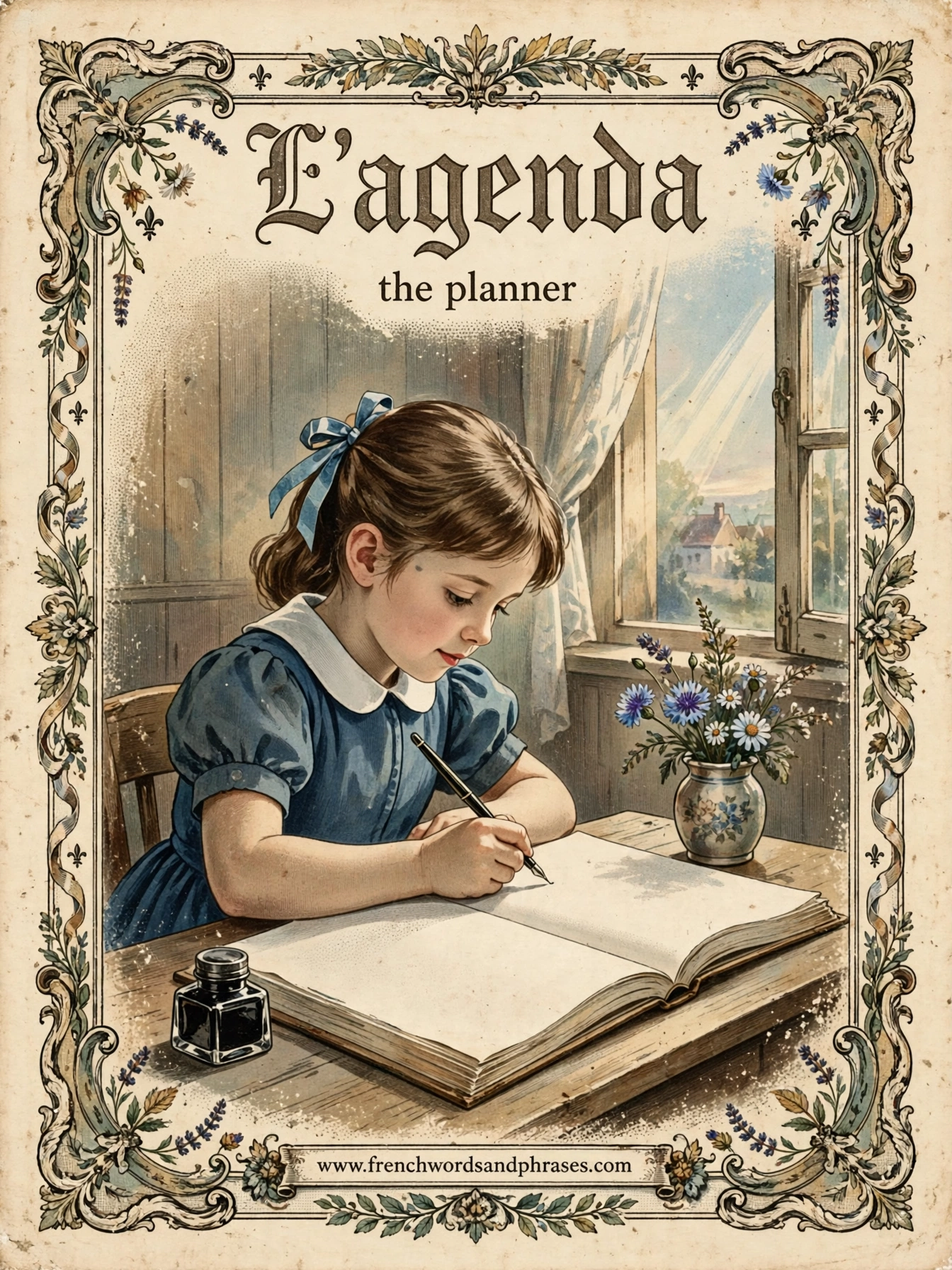
L’agenda means the planner.
Before the first coffee, before the first email, one small ceremony: the book comes out of the bag, the pen uncaps, and the day is read like a map. Dentist at ten, train at six, dinner with Claire. Everything is in l’agenda.
In this guide, you’ll learn what agenda means in English, how to use it with its articles, how to form its plural, and how it appears in everyday French. Explore French examples, English translations, and practice quizzes.
Understanding the French Noun Agenda
Agenda is a masculine French noun. It begins with a vowel, so its article hides: l’agenda, and the indefinite article shows the gender: un agenda. It is your personal planner or diary — the book (or the phone app) where your own appointments live. Beware the false friend: at a French meeting, the agenda of business to discuss is not l’agenda but l’ordre du jour.
It means the planner, the diary — the place where you note les rendez-vous (appointments), les réunions (meetings) and les anniversaires (birthdays). For schoolchildren it is sacred: l’agenda (or le cahier de textes) receives the homework every evening, and parents sign it. For everyone else it is the answer to the great question: « Tu es libre jeudi ? » — « Attends, je regarde mon agenda. »
Gender: Masculine
Definite article: l’ — l’agenda (the planner)
Indefinite article: un — un agenda (a planner)
Plural: les agendas
Key phrases: un agenda chargé (a busy schedule), noter dans son agenda (to note in one’s planner)
English equivalents: The planner, the diary — not a meeting’s agenda (that is l’ordre du jour).
One important usage detail: because agenda starts with a vowel, the possessives mon, ton, son are used just as for a masculine noun — mon agenda — and the demonstrative is cet agenda. And when your week is full, French has the perfect sentence: « Mon agenda est chargé » or, more dramatically, « un agenda de ministre » — a schedule fit for a government minister.
Experience the Word
Agenda is more than a notebook. It is the external memory of a French life — the book that knows your dentist, your deadlines and your mother’s birthday better than you do.
Imagine losing it for one day: the meetings blur, the train times vanish, and Thursday becomes a rumour. Now imagine the calm of the person who simply opens it, pen in hand, and reads the day like a story already written.
You have not just bought a diary. You have given your days a home — l’agenda, gardien du temps.
How to Use Agenda in French: Complete Guide
Let’s explore how agenda works in French, beginning with its articles — l’agenda, un agenda, and the possessive that everyone needs: mon agenda.
Agenda with the Definite Article (L’, Les)
Agenda begins with a vowel, so le shrinks to l’ — l’agenda, the planner you carry every day.
| Form | French |
|---|---|
| Singular | l’agenda |
| Plural | les agendas |
Example
L’agenda est dans mon sac, à côté des clés.
The planner is in my bag, next to the keys.
Agenda with the Indefinite Article (Un, Des)
Used for a planner in general — a new one for the school year, a paper one, an electronic one.
| Form | French |
|---|---|
| Singular | un agenda |
| Plural | des agendas |
Example
Chaque élève reçoit un agenda au mois de septembre.
Every pupil receives a planner in September.
Quantities with Agenda — One per Person, per Year
Agendas do not take the partitive du or de la; they are counted — one per person, one per school year.
| Quantity | French |
|---|---|
| A whole planner | un agenda entier |
| Several planners | plusieurs agendas |
| Every planner | chaque agenda |
| One planner per pupil | un agenda par élève |
| No planner | aucun agenda |
Example
Chaque agenda contient les devoirs de toute l’année.
Every planner contains the homework for the whole year.
Quick Quiz 1
At a meeting in Paris, the boss presents the list of points to discuss. Is that list « l’agenda »?
Reveal the answer
No — the agenda of a meeting is l’ordre du jour. L’agenda is your personal planner or diary.
Le premier point de l’ordre du jour est le budget.
The first item on the agenda is the budget.
The Plural of Agenda
Agenda adds an -s in the plural — les agendas, the planners of a whole class, a whole office, a whole family.
| Number | French |
|---|---|
| Singular | l’agenda |
| Plural | les agendas |
Example
Les agendas des élèves sont vérifiés par les parents.
The pupils’ planners are checked by their parents.
Agenda with Possessive Adjectives (Mon, Ton, Son…)
The possessive everyone uses daily: mon agenda. Agenda is masculine, so the forms are the masculine ones.
| Owner | French |
|---|---|
| my | mon agenda |
| your (tu) | ton agenda |
| his / her | son agenda |
| our | notre agenda |
| your (vous) | votre agenda |
| their | leur agenda |
Example
Attends, je regarde mon agenda pour jeudi.
Wait, I am checking my planner for Thursday.
Quick Quiz 2
Complete the sentence:
Elle note le rendez-vous dans ______ agenda. (her)
Reveal the answer
son
Elle note le rendez-vous dans son agenda.
She notes the appointment in her planner — son, because agenda is masculine.
Agenda with Demonstrative Adjectives (Cet, Ces)
Used to point: cet agenda — cet, not ce, because agenda begins with a vowel.
| Form | French |
|---|---|
| Singular | cet agenda |
| Plural | ces agendas |
Example
Cet agenda contient tous mes rendez-vous de l’année.
This planner contains all my appointments for the year.
Agenda with Adjectives
Adjectives agree with agenda, which is masculine: un agenda chargé, un agenda électronique.
| Adjective | With Agenda |
|---|---|
| chargé (busy, packed) | un agenda chargé |
| électronique (electronic) | un agenda électronique |
| complet (full) | un agenda complet |
| nouveau (new) | un nouvel agenda |
| bien rempli (well filled) | un agenda bien rempli |
Example
Un nouvel agenda tout neuf pour la rentrée !
A brand-new planner for the start of the school year!
Quick Quiz 3
Complete the sentence:
Je ne peux pas vendredi, mon agenda est ______. (packed)
Reveal the answer
chargé
Je ne peux pas vendredi, mon agenda est chargé.
I cannot do Friday; my schedule is packed.
Everyday Expressions with Agenda
Checking, noting and being very busy — the agenda phrases of daily life.
| Expression | In English |
|---|---|
| consulter son agenda | to check one’s planner |
| noter dans son agenda | to note in one’s planner |
| un agenda chargé | a busy schedule |
| un agenda de ministre | an extremely busy schedule (a minister’s diary) |
| tenir un agenda | to keep a planner |
| l’agenda de la semaine | the week’s schedule |
Example
Note la date dans ton agenda pour ne pas l’oublier.
Write the date in your planner so you do not forget it.
Words from the Same Family as Agenda
Appointments, meetings and planning — the words that travel with agenda.
| French | In English |
|---|---|
| le rendez-vous | the appointment, the meeting |
| la réunion | the meeting |
| le calendrier | the calendar |
| l’emploi du temps | the timetable, the schedule |
| noter | to note, to write down |
| le planning | the schedule, the rota |
Example
Mon emploi du temps est dans mon agenda, jour par jour.
My timetable is in my planner, day by day.
Quick Quiz 4
What does « un agenda de ministre » mean?
Reveal the answer
An incredibly busy schedule — as packed as a government minister’s diary. It is a compliment and a complaint at the same time.
Cette semaine, j’ai un agenda de ministre !
This week, my schedule is absolutely packed!
Agenda in Everyday French: Real-Life Examples
Now that you know the word, let’s see how agenda appears in everyday French.
Example 1 — Making plans
Attends, je consulte mon agenda avant de répondre.
Wait, I am checking my planner before I answer.
Example 2 — At school
Les élèves écrivent les devoirs dans leur agenda.
The pupils write their homework in their planners.
Example 3 — A busy week
Cette semaine, son agenda est complètement chargé.
This week, his schedule is completely packed.
Example 4 — A new purchase
Elle achète un agenda en cuir pour la nouvelle année.
She is buying a leather planner for the new year.
Example 5 — On the phone
Je note notre rendez-vous dans mon agenda électronique.
I am putting our appointment in my electronic planner.
Example 6 — Forgetting
J’ai oublié mon agenda à la maison, je suis perdu !
I left my planner at home; I am lost!
Beyond Translation: The Meaning of Agenda
For generations of French schoolchildren, l’agenda is the first serious object of the year: chosen in August, carried every day, filled with homework, doodles and secrets, and signed by parents on Sunday evenings. Grown-ups keep the habit — the paper agenda survives every phone, because writing a rendez-vous by hand feels like a promise. And the busiest compliment in the language is hidden inside it: avoir un agenda de ministre.
To say agenda is to hold your whole week in one hand.
It evokes the pen uncapped at breakfast, the page turned on Sunday night, and a life organised one appointment at a time.
How to Remember the French Noun Agenda
Remember it this way: Agenda is your personal planner — masculine, l’agenda — and never the agenda of a meeting.
- You check your days — mon agenda, je consulte mon agenda.
- You sit in a meeting — the list of business is l’ordre du jour, pas l’agenda.
- You are very busy — un agenda chargé, même un agenda de ministre.
The key idea is mon agenda — the planner; l’ordre du jour — the meeting’s list.
Test Your Knowledge of Agenda
Let’s see how much you’ve learned. Try answering these questions before revealing the answers.
Question 1
Is agenda masculine or feminine?
Reveal the answer
Masculine — l’agenda, un agenda, mon agenda, cet agenda.
Question 2
How do you say « my planner »?
Reveal the answer
Mon agenda — the possessive follows the masculine noun.
Question 3
Translate: I am checking my planner.
Reveal the answer
Je consulte mon agenda. (Or: Je regarde mon agenda.)
Question 4
What is l’ordre du jour?
Reveal the answer
The agenda of a meeting — the list of points to discuss, which is NOT l’agenda.
Question 5
Complete the sentence:
______ agenda contient tous ses rendez-vous. (This)
Reveal the answer
Cet
Cet agenda contient tous ses rendez-vous.
This planner contains all his appointments — cet, because agenda begins with a vowel.
Your Final Challenge
Can You Use It?
How would you say this in French?
“I write all my appointments in my planner.”
Reveal the answer
Je note tous mes rendez-vous dans mon agenda.
I write all my appointments in my planner.
A little French. A little curiosity. A richer everyday life.
LEARN FRENCH ONE WORD AT A TIME