A French Word to Live By
Translate Nombre d’enfants to English
/nɔ̃bʁ dɑ̃.fɑ̃/
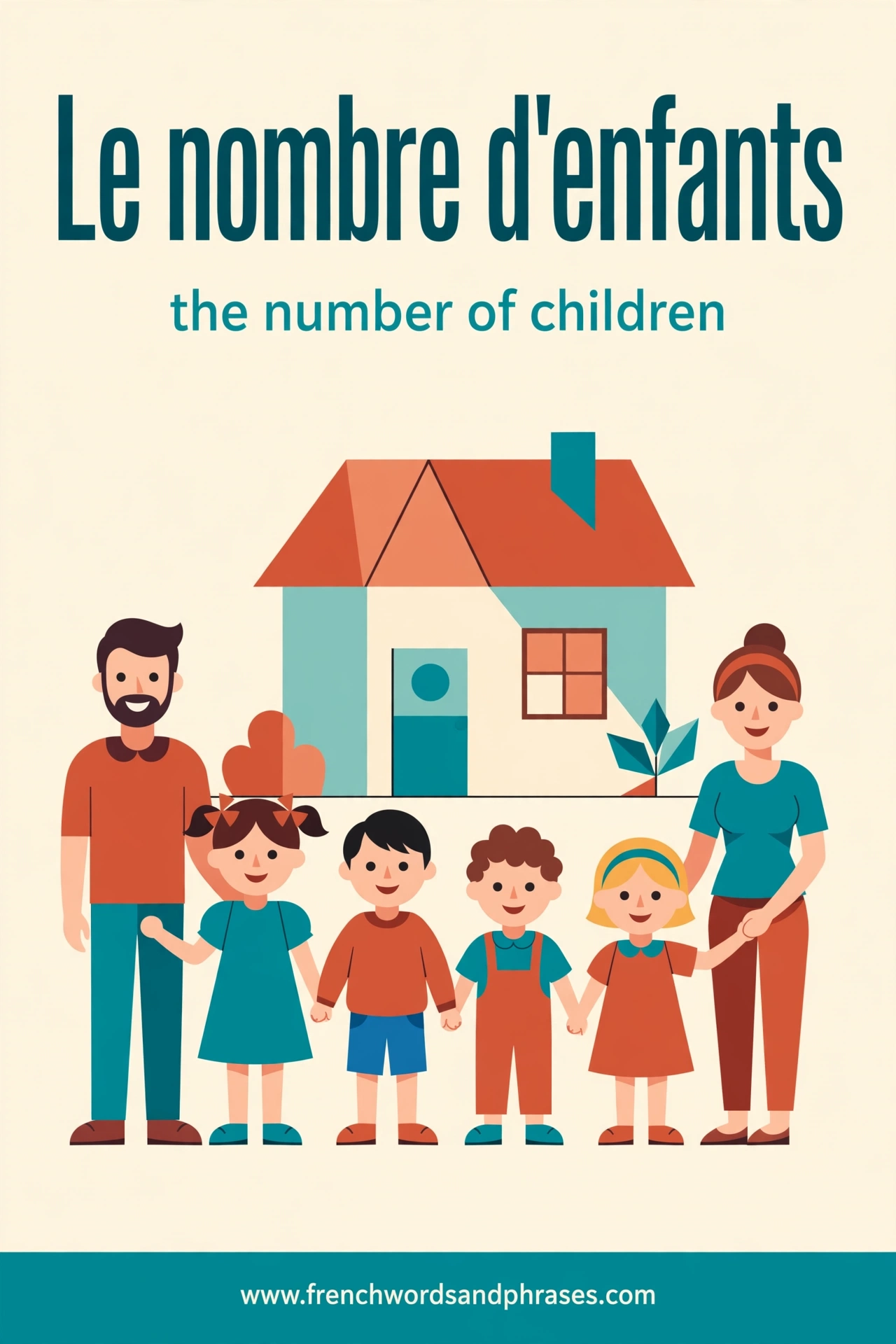
Le nombre d’enfants means the number of children.
The family benefits form wants facts, and it wants them in numbers: « Nombre d’enfants à charge ? » Two? Three? The answer changes the allowances, the tax and the train fares — le nombre d’enfants.
In this guide, you’ll learn what nombre d’enfants means in English, how to use it with its articles, how to form its plural, and how it appears in everyday French. Explore French examples, English translations, and practice quizzes.
Understanding the French Noun Nombre d’enfants
Nombre d’enfants is a masculine French noun phrase, learned with its article: le nombre d’enfants, un nombre d’enfants. The head noun is nombre (the number), and it alone takes the plural: les nombres d’enfants — enfants is already plural and stays exactly as it is.
It means the number of children — how many children a person or a family has, as counted by the administration. The full form version adds two small words that matter enormously: le nombre d’enfants à charge, the number of dependent children — the children you support, which is the figure that drives family benefits and tax allowances.
Gender: Masculine — the head noun nombre is masculine
Definite article: le — le nombre d’enfants (the number of children)
Indefinite article: un — un nombre d’enfants (a number of children)
Plural: les nombres d’enfants — only nombre takes the -s
The full form phrase: le nombre d’enfants à charge — the number of dependent children
English equivalents: The number of children.
One important usage detail: after nombre de, French uses no article before the noun — un nombre d’enfants, never « un nombre des enfants » for counting in general. The article only appears when the children are specific and known: le nombre des enfants inscrits, the number of the children enrolled. And watch the classic pair: le nombre counts, while le chiffre is a figure or a digit.
Experience the Word
Nombre d’enfants is more than a figure. Behind the little number on the form stands a whole household — the shoes by the door, the noise at breakfast, the hands raised at the table.
Imagine the clerk counting heads on the application: one, two, three — and with the third, the family crosses a famous French threshold and becomes une famille nombreuse, with its own card and its own discounts.
You have not just written a number. You have counted your whole world — votre nombre d’enfants.
How to Use Nombre d’enfants in French: Complete Guide
Let’s explore how nombre d’enfants works in French, beginning with its articles — this is the entry where quantities take centre stage.
Nombre d’enfants with the Definite Article (Le, Les)
Used for the specific figure the form is asking for — the number, counted and declared.
| Form | French |
|---|---|
| Singular | le nombre d’enfants |
| Plural | les nombres d’enfants |
Example
Le nombre d’enfants doit être écrit en chiffres et en lettres.
The number of children must be written in figures and in words.
Nombre d’enfants with the Indefinite Article (Un, Des)
Used for a quantity in general — a number of children, without fixing the figure.
| Form | French |
|---|---|
| Singular | un nombre d’enfants |
| Plural | des nombres d’enfants |
Example
Un grand nombre d’enfants prennent le bus scolaire le matin.
A large number of children take the school bus in the morning.
Quantities with Nombre d’enfants: Counting Children
Totals, dependants and none at all — the quantity phrases that surround nombre d’enfants.
| French | In English |
|---|---|
| le nombre d’enfants à charge | the number of dependent children |
| le nombre total d’enfants | the total number of children |
| un grand nombre d’enfants | a large number of children |
| un petit nombre d’enfants | a small number of children |
| le nombre d’enfants par famille | the number of children per family |
| aucun enfant | no children, not a single child |
Example
Le nombre d’enfants à charge décide du montant des allocations.
The number of dependent children decides the amount of the benefits.
Quick Quiz 1
What do the words « à charge » add in « le nombre d’enfants à charge »?
Reveal the answer
Dependent — the children you support financially, which is the figure the benefits and tax offices use.
Elle déclare trois enfants à charge.
She declares three dependent children.
The Plural of Nombre d’enfants
Only the head noun moves: nombre takes an -s, enfants is already plural — les nombres d’enfants.
| Number | French |
|---|---|
| Singular | le nombre d’enfants |
| Plural | les nombres d’enfants |
Example
Les nombres d’enfants varient beaucoup d’une région à l’autre.
The numbers of children vary a lot from one region to another.
Nombre d’enfants with Possessive Adjectives (Mon, Ton, Son…)
Possessives agree with the head noun — nombre is masculine, so mon, ton, son.
| Owner | French |
|---|---|
| my | mon nombre d’enfants |
| your (tu) | ton nombre d’enfants |
| his / her | son nombre d’enfants |
| our | notre nombre d’enfants |
| your (vous) | votre nombre d’enfants |
| their | leur nombre d’enfants |
Example
Leur nombre d’enfants est passé de deux à quatre en cinq ans.
Their number of children went from two to four in five years.
Quick Quiz 2
Complete the sentence:
______ nombre d’enfants à charge est de trois. (Our)
Reveal the answer
Notre
Notre nombre d’enfants à charge est de trois.
Our number of dependent children is three.
Nombre d’enfants with Demonstrative Adjectives (Ce, Ces)
Used to point at one particular figure — this number, on this line of the form.
| Form | French |
|---|---|
| Singular | ce nombre d’enfants |
| Plural | ces nombres d’enfants |
Example
Ce nombre d’enfants donne droit à la carte famille nombreuse.
This number of children gives entitlement to the large family card.
Nombre d’enfants with Adjectives
Adjectives agree with the head noun nombre — masculine: grand, total, exact.
| Adjective | With Nombre d’enfants |
|---|---|
| grand (large, great) | un grand nombre d’enfants |
| total (total) | le nombre total d’enfants |
| exact (exact) | le nombre exact d’enfants |
| moyen (average) | le nombre moyen d’enfants |
| croissant (growing) | un nombre croissant d’enfants |
Example
Le nombre moyen d’enfants par famille baisse doucement en Europe.
The average number of children per family is slowly falling in Europe.
Quick Quiz 3
At what point does a French family become une famille nombreuse — two children, or three?
Reveal the answer
Three — from three children, a family is officially nombreuse and can claim the famous discount card.
Avec trois enfants, ils ont la carte famille nombreuse.
With three children, they have the large family card.
Everyday Expressions with Nombre d’enfants
Benefits, trains and school forms — the nombre d’enfants phrases of family paperwork.
| Expression | In English |
|---|---|
| le nombre d’enfants à charge | the number of dependent children |
| indiquer le nombre d’enfants | to state the number of children |
| la famille nombreuse | the large family (three or more children) |
| la carte famille nombreuse | the large family discount card |
| le nombre d’enfants scolarisés | the number of children in school |
| en nombre | in large numbers, many |
Example
Indiquez le nombre d’enfants à charge dans la case prévue.
State the number of dependent children in the box provided.
Words from the Same Family as Nombre d’enfants
Counting, children and families — the words that travel with this phrase.
| French | In English |
|---|---|
| le nombre | the number (a counted quantity) |
| l’enfant | the child |
| compter | to count |
| nombreux | numerous, many |
| le chiffre | the figure, the digit |
| la famille nombreuse | the large family |
Example
Les enfants nombreux rient dans la cour de l’école.
The many children are laughing in the school playground.
Quick Quiz 4
What is the difference between le nombre and le chiffre?
Reveal the answer
Nombre counts things; chiffre is a figure or digit — le nombre d’enfants counts children, while 3 written on paper is un chiffre.
Le nombre est quatre ; le chiffre est 4.
The number is four; the digit is 4.
Nombre d’enfants in Everyday French: Real-Life Examples
Now that you know the word, let’s see how nombre d’enfants appears in everyday French.
Example 1 — The benefits form
Sur le dossier, j’indique le nombre d’enfants à charge : deux.
On the file, I state the number of dependent children: two.
Example 2 — Booking train tickets
Avec quatre enfants, le nombre d’enfants change le prix des billets.
With four children, the number of children changes the price of the tickets.
Example 3 — A school survey
L’école compte le nombre d’enfants qui mangent à la cantine.
The school counts the number of children who eat in the canteen.
Example 4 — At the town hall
La mairie enregistre le nombre d’enfants de chaque foyer.
The town hall records the number of children in each household.
Example 5 — Small talk
On lui demande souvent le nombre d’enfants avant leur âge.
People often ask her the number of children before their ages.
Example 6 — A statistic
Le nombre d’enfants par classe augmente cette année.
The number of children per class is rising this year.
Beyond Translation: The Meaning of Nombre d’enfants
France counts its children with unusual tenderness — and unusual generosity. The nombre d’enfants on your form is not mere information: it sets your family benefits, lightens your taxes, and at three children unlocks the carte famille nombreuse, the beloved discount card that has cut French train fares for generations. Few countries turn a census figure into a thank-you; France, worried for a century about its birth rate, does exactly that.
To write your nombre d’enfants is to watch the state start counting in your favour.
It evokes the benefits office and the summer train south, a carriage full of children travelling at a discount — arithmetic with a heart.
How to Remember the French Noun Nombre d’enfants
Remember it this way: Nombre d’enfants is the number of children — head noun nombre, masculine, and on forms it wears its full title: le nombre d’enfants à charge.
- You count dependants as — le nombre d’enfants à charge, the form’s full phrase.
- You reach three and become — une famille nombreuse, a large family.
- You keep it apart from — le chiffre, the digit, which is written, not counted.
The key idea is le nombre d’enfants — and à charge on the forms.
Test Your Knowledge of Nombre d’enfants
Let’s see how much you’ve learned. Try answering these questions before revealing the answers.
Question 1
Is nombre d’enfants masculine or feminine?
Reveal the answer
Masculine — the head noun nombre is masculine: le nombre d’enfants.
Question 2
What is the plural of le nombre d’enfants?
Reveal the answer
Les nombres d’enfants — only nombre takes the -s; enfants is already plural.
Question 3
Translate: They have a large number of children.
Reveal the answer
Ils ont un grand nombre d’enfants.
Question 4
What does « à charge » mean in le nombre d’enfants à charge?
Reveal the answer
Dependent — the children you support, the figure used for benefits and tax.
Question 5
Complete the sentence:
Écrivez ______ nombre d’enfants dans la case. (the)
Reveal the answer
le
Écrivez le nombre d’enfants dans la case.
Write the number of children in the box.
Your Final Challenge
Can You Use It?
How would you say this in French?
“Write the number of children in the box.”
Reveal the answer
Écrivez le nombre d’enfants dans la case.
Write the number of children in the box.
A little French. A little curiosity. A richer everyday life.
LEARN FRENCH ONE WORD AT A TIME