A French Word to Live By
Translate Situation familiale to English
/si.ty.a.sjɔ̃ fa.mi.ljal/
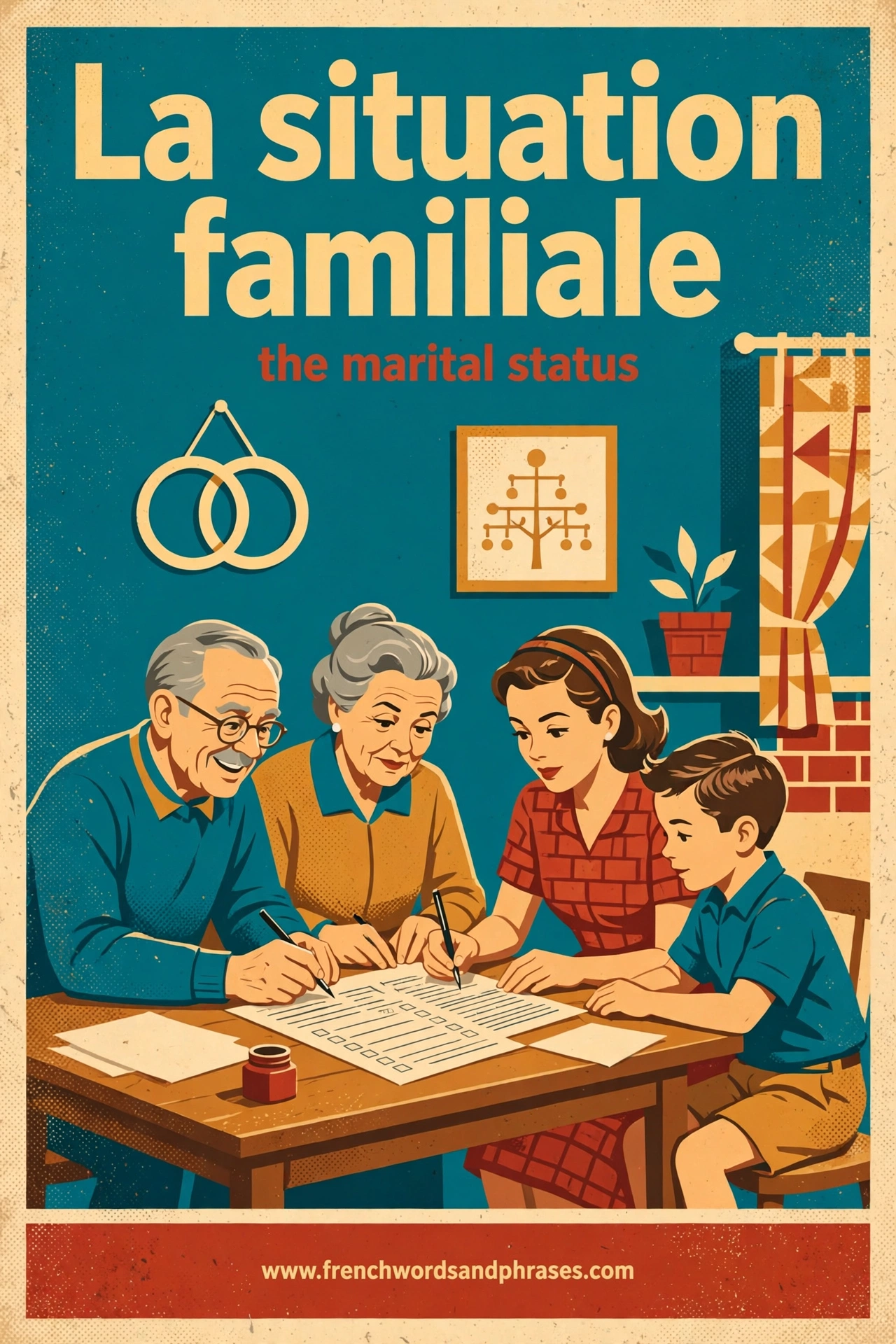
La situation familiale means the marital status.
Halfway down the application form comes the box that sums up a love life in one tick: « Situation familiale : célibataire, marié, pacsé, divorcé, veuf… » One little cross in one little square — la situation familiale.
In this guide, you’ll learn what situation familiale means in English, how to use it with its articles, how to form its plural, and how it appears in everyday French. Explore French examples, English translations, and practice quizzes.
Understanding the French Noun Situation familiale
Situation familiale is a feminine French noun phrase, learned with its article: la situation familiale, une situation familiale. The head noun is situation, feminine, and the adjective familiale agrees with it — in the plural, both words change together: les situations familiales.
It means the marital status — your official family situation as the administration records it: single, married, in a civil partnership, divorced or widowed. It is the form’s way of asking who shares your life and your household, because the answer changes your taxes, your benefits and your rights. The possible answers are adjectives, and they agree with the person: un homme marié, une femme mariée.
Gender: Feminine — the head noun situation is feminine
Definite article: la — la situation familiale (the marital status)
Indefinite article: une — une situation familiale (a marital status)
Plural: les situations familiales — both words take the plural
The classic answers: célibataire, marié(e), pacsé(e), divorcé(e), veuf / veuve
English equivalents: The marital status; the family status.
One important usage detail: the answers to this box are adjectives that agree with you, not with the noun situation. A woman ticks mariée with two e’s, a man ticks marié. The same agreement runs through the list: pacsé / pacsée, divorcé / divorcée — and veuf becomes veuve for a woman. The form is testing your French agreement as much as your love life.
Experience the Word
Situation familiale is more than a box. It is the administration’s shorthand for the biggest chapters of a life — falling in love, signing at the mairie, sometimes separating, sometimes loss — all compressed into one ticked square.
Imagine the young clerk’s form and the older hand that pauses over the boxes: célibataire… marié… veuf. Forty years of life, weighed for a second, then one firm little cross.
You have not just given a status. You have told the state where your heart officially lives.
How to Use Situation familiale in French: Complete Guide
Let’s explore how situation familiale works in French, beginning with its articles — then the famous list of answers the box expects from you.
Situation familiale with the Definite Article (La, Les)
Used for the specific status recorded on a person’s file.
| Form | French |
|---|---|
| Singular | la situation familiale |
| Plural | les situations familiales |
Example
La situation familiale du demandeur figure en première page du dossier.
The applicant’s marital status appears on the first page of the file.
Situation familiale with the Indefinite Article (Une, Des)
Used for a family situation in general — one status among the possible ones.
| Form | French |
|---|---|
| Singular | une situation familiale |
| Plural | des situations familiales |
Example
Chaque situation familiale donne des droits différents.
Each marital status gives different rights.
The Answers to the Box: Célibataire, Marié, Pacsé…
The famous list — the adjectives that answer the situation familiale question, each agreeing with the person.
| French | In English |
|---|---|
| célibataire | single |
| marié / mariée | married |
| pacsé / pacsée | in a civil partnership (PACS) |
| divorcé / divorcée | divorced |
| veuf / veuve | widowed — widower / widow |
| en couple | in a relationship |
Example
Sur le formulaire, elle coche la case « mariée ».
On the form, she ticks the “married” box.
Quick Quiz 1
A woman filling in the form is married. Which box does she tick: « marié » or « mariée »?
Reveal the answer
Mariée — the adjective agrees with the person, and a woman adds the second -e.
Elle est mariée depuis cinq ans.
She has been married for five years.
The Plural of Situation familiale
Both parts of the phrase take the plural together — les situations familiales.
| Number | French |
|---|---|
| Singular | la situation familiale |
| Plural | les situations familiales |
Example
Le guide explique les situations familiales prises en compte par l’administration.
The guide explains the marital statuses recognised by the administration.
Situation familiale with Possessive Adjectives (Ma, Ta, Sa…)
Possessives agree with the noun — situation is feminine, so ma, ta, sa in the singular.
| Owner | French |
|---|---|
| my | ma situation familiale |
| your (tu) | ta situation familiale |
| his / her | sa situation familiale |
| our | notre situation familiale |
| your (vous) | votre situation familiale |
| their | leur situation familiale |
Example
Ma situation familiale a changé l’année dernière.
My marital status changed last year.
Quick Quiz 2
Complete the sentence:
______ situation familiale est « pacsée ». (Her)
Reveal the answer
Sa
Sa situation familiale est « pacsée ».
Her marital status is “in a civil partnership” — sa, because situation is feminine.
Situation familiale with Demonstrative Adjectives (Cette, Ces)
Used to point at one particular status — this situation, in this file.
| Form | French |
|---|---|
| Singular | cette situation familiale |
| Plural | ces situations familiales |
Example
Cette situation familiale ouvre le droit à une aide supplémentaire.
This marital status gives entitlement to extra help.
Situation familiale with Adjectives
Adjectives agree with situation — feminine: actuelle, nouvelle, particulière.
| Adjective | With Situation familiale |
|---|---|
| actuelle (current) | la situation familiale actuelle |
| nouvelle (new) | une nouvelle situation familiale |
| particulière (particular, special) | une situation familiale particulière |
| déclarée (declared) | la situation familiale déclarée |
| officielle (official) | la situation familiale officielle |
Example
Déclarez votre situation familiale actuelle, même si elle a changé récemment.
Declare your current marital status, even if it changed recently.
Quick Quiz 3
What is le PACS, hidden inside the answer « pacsé »?
Reveal the answer
A civil partnership — the pacte civil de solidarité, France’s legal union between marriage and living together, signed at the mairie since 1999.
Ils se sont pacsés au printemps.
They entered into a civil partnership in the spring.
Everyday Expressions with Situation familiale
Weddings, moves and tax returns — the situation familiale phrases of administrative life.
| Expression | In English |
|---|---|
| indiquer sa situation familiale | to state one’s marital status |
| changer de situation familiale | to have a change of marital status |
| en cas de changement de situation familiale | in the event of a change of marital status |
| déclarer sa situation familiale | to declare one’s marital status |
| la situation familiale actuelle | the current marital status |
| justifier sa situation familiale | to provide proof of one’s marital status |
Example
En cas de changement de situation familiale, prévenez la caisse dans le mois.
In the event of a change of marital status, inform the benefits office within the month.
Words from the Same Family as Situation familiale
Families, marriages and partners — the words that travel with this phrase.
| French | In English |
|---|---|
| la situation | the situation, the status |
| la famille | the family |
| familial | family (adjective): of the family |
| le mariage | the marriage, the wedding |
| le conjoint | the spouse, the partner |
| le foyer | the household, the home |
Example
Le mariage change la situation familiale des deux conjoints.
Marriage changes the marital status of both spouses.
Quick Quiz 4
What does « veuve » mean, and what is the masculine form?
Reveal the answer
A widow — and the masculine is veuf, a widower: one of the pairs where the two genders look quite different.
Elle est veuve depuis deux ans.
She has been a widow for two years.
Situation familiale in Everyday French: Real-Life Examples
Now that you know the word, let’s see how situation familiale appears in everyday French.
Example 1 — The application form
À la ligne « situation familiale », il coche la case « célibataire ».
On the “marital status” line, he ticks the “single” box.
Example 2 — After the wedding
Depuis samedi, leur situation familiale est officiellement « mariés ».
Since Saturday, their marital status is officially “married”.
Example 3 — A tax update
Elle déclare son changement de situation familiale aux impôts.
She reports her change of marital status to the tax office.
Example 4 — School enrolment
L’école demande la situation familiale des parents sur le dossier.
The school asks for the parents’ marital status in the file.
Example 5 — A benefits office
Votre situation familiale décide du montant de l’aide.
Your marital status decides the amount of the benefit.
Example 6 — The civil partnership
Ils choisissent « pacsés » comme situation familiale.
They choose “in a civil partnership” as their marital status.
Beyond Translation: The Meaning of Situation familiale
No box on the French form tells a bigger story in a smaller space. Situation familiale is where the Republic quietly records the shapes of love: the célibataire starting out, the couple signing their PACS at the mairie, the married pair filing joint taxes, the veuve carrying on alone. France even invented one of the answers — the PACS, created in 1999, now chosen by nearly as many couples as marriage itself.
To state your situation familiale is to give the state one word for the people you go home to.
It evokes the ticked square and the wedding photograph, the joint tax return and the new name on the door — a whole private life, filed under one polite heading.
How to Remember the French Noun Situation familiale
Remember it this way: Situation familiale is the marital status — the form’s box whose answers agree with you: marié for a man, mariée for a woman.
- You tick single as — célibataire, the same for everyone.
- You tick married as — marié / mariée, agreeing with the person.
- You meet France’s own invention — pacsé / pacsée, the civil partnership.
The key idea is la situation familiale — one box, a whole love life.
Test Your Knowledge of Situation familiale
Let’s see how much you’ve learned. Try answering these questions before revealing the answers.
Question 1
Is situation familiale masculine or feminine?
Reveal the answer
Feminine — the head noun situation is feminine: la situation familiale.
Question 2
What is the plural of la situation familiale?
Reveal the answer
Les situations familiales — both the noun and the adjective take the plural.
Question 3
Translate: Indicate your marital status on the form.
Reveal the answer
Indiquez votre situation familiale sur le formulaire.
Question 4
How does a divorced woman write her status in the box?
Reveal the answer
Divorcée — with the feminine -e: divorcée, just as mariée and pacsée agree with her.
Question 5
Complete the sentence:
______ situation familiale a changé après le mariage. (His)
Reveal the answer
Sa
Sa situation familiale a changé après le mariage.
His marital status changed after the wedding.
Your Final Challenge
Can You Use It?
How would you say this in French?
“Indicate your marital status on the form.”
Reveal the answer
Indiquez votre situation familiale sur le formulaire.
Indicate your marital status on the form.
A little French. A little curiosity. A richer everyday life.
LEARN FRENCH ONE WORD AT A TIME