A French Word to Live By
How to Conjugate Soulever in French
/sul.ve/
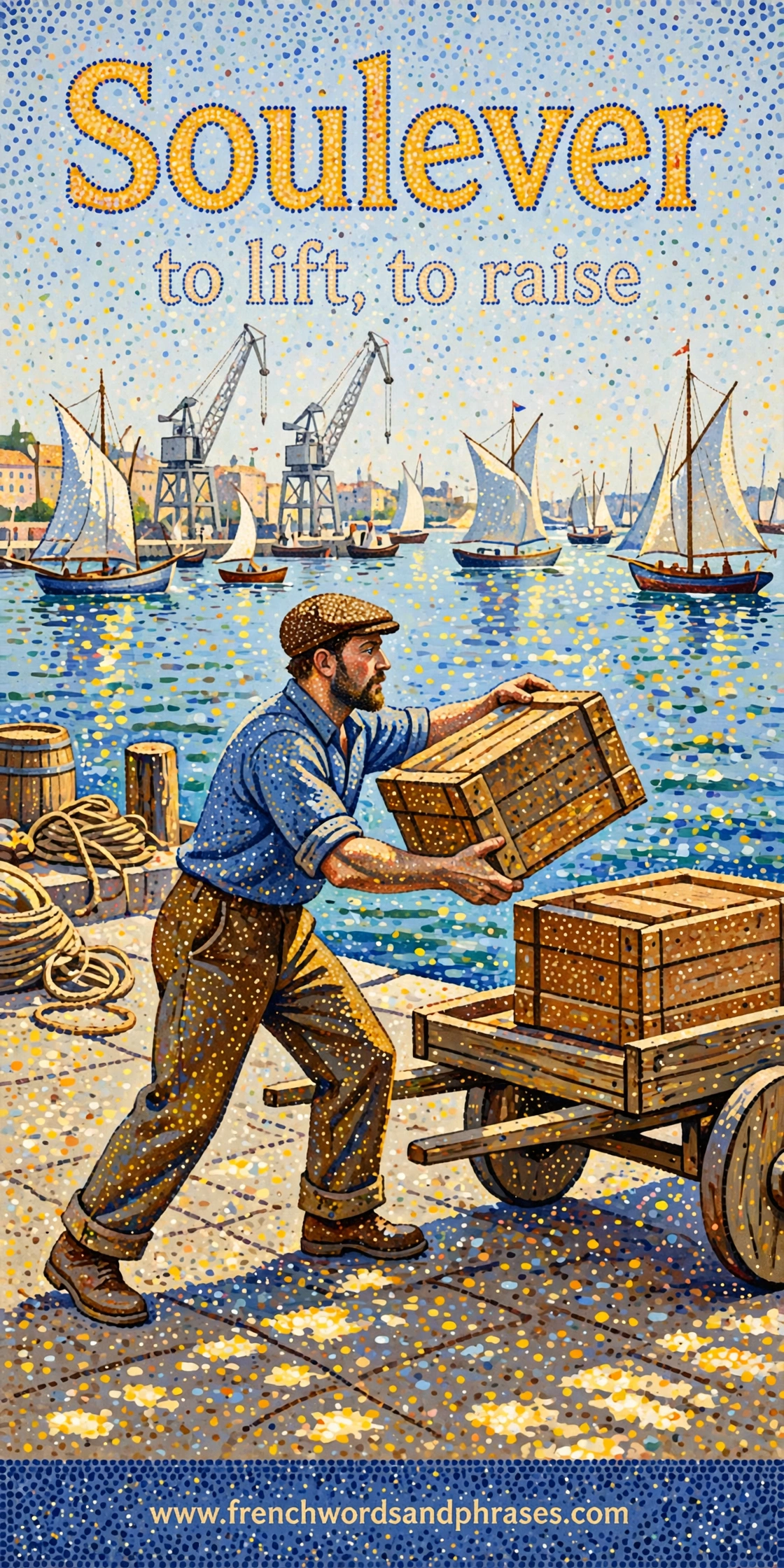
Soulever means to lift, to raise — to take the weight of something and bring it up: a lid, a stone, a crowd’s feelings, or the question nobody dared to ask.
A strongman raising the stone above his head, a cook lifting the lid to taste the sauce, a young deputy standing in the assembly to ask the awkward question — soulever is the verb of lifting: weights, lids, dust, hearts, and above all questions.
In this guide, you’ll learn how to conjugate soulever in all the major French tenses and moods. Explore complete conjugation tables, French examples, English translations, and practice quizzes.
Understanding the French Verb Soulever
Soulever is a regular French verb belonging to the first group of verbs, those ending in-er.
It means to lift, to raise. Physically it lifts anything heavy or hinged — stones, suitcases, lids, curtains of dust. Figuratively it raises what a room would rather leave lying: questions, objections, problems, and also feelings — soulever l’enthousiasme, soulever l’indignation — to stir a crowd up off its seat.
Verb classification: First group (-er)
Auxiliary verb: Avoir
Past participle: soulevé
Present participle: soulevant
English equivalents: To lift, to raise, to lift up; soulever des poids — to lift weights; soulever le couvercle — to lift the lid; soulever une question — to raise a question; soulever la poussière — to raise the dust; soulever l’enthousiasme — to stir up enthusiasm.
One important detail: soulever is a lever-type verb, and its stem vowel changes exactly like lever: the plain e opens to è wherever the next syllable is mute — je soulève, tu soulèves, il soulève, ils soulèvent — and all through the future and conditional: je soulèverai, je soulèverais. It stays plain where the ending is sounded: nous soulevons, vous soulevez, je soulevais, en soulevant. Its flagship construction is soulever une question — to raise a question, an objection, a problem: to lift an awkward matter up where everyone must look at it. Two more gifts: soulever le cœur is to turn one’s stomach, and se soulever is to rise up, in protest or revolt.
Experience the Word
Soulever is the verb of lifting from underneath — hands under the stone, courage under the question.
Imagine a committee room where everyone has been polite for an hour. The figures are bad, the plan is weak, and nobody wants to be the first to say so. Then the youngest person present clears her throat: « Je voudrais soulever une question… » — and the whole meeting changes, because someone has finally lifted the heavy thing into the light.
A question, like a stone, weighs less once it is lifted. Soulevée — raised, and impossible to ignore.
How to Conjugate Soulever: Complete French Conjugation Guide
Let’s explore every major conjugation of soulever, beginning with the indicative mood.
How to Conjugate Soulever in the Indicative Mood
The indicative mood is used to express facts, observations, actions, and events.
How to Conjugate Soulever in the Present Tense (Présent)
Used for actions happening now, habitual actions, and general truths.
| Subject | Conjugation |
|---|---|
| je | soulève |
| tu | soulèves |
| il / elle | soulève |
| nous | soulevons |
| vous | soulevez |
| ils / elles | soulèvent |
Example
Elle soulève la valise sans effort apparent.
She lifts the suitcase without apparent effort.
Quick Quiz 1
Complete the sentence:
Nous ______ la table pour passer l’aspirateur.
Reveal the answer
soulevons
Nous soulevons la table pour passer l’aspirateur.
We are lifting the table to do the vacuuming.
How to Conjugate Soulever in the Passé Composé
Used for completed actions in the past. Soulever takes the auxiliary verb avoir.
| Subject | Conjugation |
|---|---|
| j’ | ai soulevé |
| tu | as soulevé |
| il / elle | a soulevé |
| nous | avons soulevé |
| vous | avez soulevé |
| ils / elles | ont soulevé |
Example
Il a soulevé une question importante pendant la réunion.
He raised an important question during the meeting.
How to Conjugate Soulever in the Imparfait (Imperfect Tense)
Used for habitual past actions, descriptions, and ongoing situations in the past.
| Subject | Conjugation |
|---|---|
| je | soulevais |
| tu | soulevais |
| il / elle | soulevait |
| nous | soulevions |
| vous | souleviez |
| ils / elles | soulevaient |
Example
Le vent soulevait la poussière sur la place du village.
The wind used to raise the dust over the village square.
Quick Quiz 2
Choose the correct form:
She lifts the suitcase easily.
Elle ______ la valise facilement. (soulève / souleve)
Reveal the answer
soulève
Elle soulève la valise facilement.
The stem vowel opens to è before a mute syllable.
How to Conjugate Soulever in the Plus-que-parfait
Used to describe an action that had already been completed before another past event.
| Subject | Conjugation |
|---|---|
| j’ | avais soulevé |
| tu | avais soulevé |
| il / elle | avait soulevé |
| nous | avions soulevé |
| vous | aviez soulevé |
| ils / elles | avaient soulevé |
Example
Personne n’avait soulevé cette objection avant elle.
Nobody had raised this objection before her.
How to Conjugate Soulever in the Passé Simple
Primarily used in formal writing, literature, and historical narratives. It is rarely used in everyday conversation.
| Subject | Conjugation |
|---|---|
| je | soulevai |
| tu | soulevas |
| il / elle | souleva |
| nous | soulevâmes |
| vous | soulevâtes |
| ils / elles | soulevèrent |
Example
Il souleva le couvercle et respira le parfum du ragoût.
He lifted the lid and breathed in the scent of the stew.
How to Conjugate Soulever in the Passé Antérieur
A literary tense used to express an action completed immediately before another past action, generally in the passé simple.
| Subject | Conjugation |
|---|---|
| j’ | eus soulevé |
| tu | eus soulevé |
| il / elle | eut soulevé |
| nous | eûmes soulevé |
| vous | eûtes soulevé |
| ils / elles | eurent soulevé |
Example
Quand elle eut soulevé le problème, le directeur promit d’agir.
When she had raised the problem, the director promised to act.
How to Conjugate Soulever in the Future Tense (Futur Simple)
Used to describe actions that will take place in the future.
| Subject | Conjugation |
|---|---|
| je | soulèverai |
| tu | soulèveras |
| il / elle | soulèvera |
| nous | soulèverons |
| vous | soulèverez |
| ils / elles | soulèveront |
Example
Je soulèverai la question à la prochaine réunion.
I will raise the question at the next meeting.
How to Conjugate Soulever in the Futur Antérieur (Future Perfect)
Used for an action that will have been completed before a particular point in the future.
| Subject | Conjugation |
|---|---|
| j’ | aurai soulevé |
| tu | auras soulevé |
| il / elle | aura soulevé |
| nous | aurons soulevé |
| vous | aurez soulevé |
| ils / elles | auront soulevé |
Example
À la fin du débat, nous aurons soulevé tous les points difficiles.
By the end of the debate, we will have raised all the difficult points.
How to Conjugate Soulever in the Near Future (Futur Proche)
Used to describe something that is going to happen soon. Formed with aller + infinitive.
| Subject | Conjugation |
|---|---|
| je | vais soulever |
| tu | vas soulever |
| il / elle | va soulever |
| nous | allons soulever |
| vous | allez soulever |
| ils / elles | vont soulever |
Example
Attention, tu vas soulever trop lourd pour ton dos.
Careful, you are going to lift too much for your back.
How to Conjugate Soulever in the Conditional Mood
The conditional mood expresses what would happen under certain circumstances. It is also frequently used to make polite requests or express wishes.
How to Conjugate Soulever in the Present Conditional
| Subject | Conjugation |
|---|---|
| je | soulèverais |
| tu | soulèverais |
| il / elle | soulèverait |
| nous | soulèverions |
| vous | soulèveriez |
| ils / elles | soulèveraient |
Example
Je soulèverais la question si j’osais.
I would raise the question if I dared.
How to Conjugate Soulever in the Past Conditional
| Subject | Conjugation |
|---|---|
| j’ | aurais soulevé |
| tu | aurais soulevé |
| il / elle | aurait soulevé |
| nous | aurions soulevé |
| vous | auriez soulevé |
| ils / elles | auraient soulevé |
Example
Sans son aide, je n’aurais jamais soulevé cette armoire.
Without his help, I would never have lifted this wardrobe.
Soulever in the Literary Past Conditional Form
This less common literary form uses the imperfect subjunctive of avoir.
| Subject | Conjugation |
|---|---|
| j’ | eusse soulevé |
| tu | eusses soulevé |
| il / elle | eût soulevé |
| nous | eussions soulevé |
| vous | eussiez soulevé |
| ils / elles | eussent soulevé |
Example
Il eût soulevé la pierre à mains nues, dit la légende.
He would have lifted the stone with his bare hands, so the legend says.
How to Conjugate Soulever in the Subjunctive Mood
The subjunctive is used to express wishes, emotions, doubts, necessity, and uncertainty. It frequently follows expressions such as il faut que (it is necessary that) or bien que (although).
How to Conjugate Soulever in the Present Subjunctive
| Subject | Conjugation |
|---|---|
| que je | soulève |
| que tu | soulèves |
| qu’il / qu’elle | soulève |
| que nous | soulevions |
| que vous | souleviez |
| qu’ils / qu’elles | soulèvent |
Example
Il faut que quelqu’un soulève ce point délicat.
Someone must raise this delicate point.
Quick Quiz 3
Complete the sentence using the subjunctive:
Il faut que tu ______ la question des horaires.
Reveal the answer
soulèves
Il faut que tu soulèves la question des horaires.
You must raise the question of the timetable.
How to Conjugate Soulever in the Imperfect Subjunctive
A literary tense, rarely encountered in modern spoken French.
| Subject | Conjugation |
|---|---|
| que je | soulevasse |
| que tu | soulevasses |
| qu’il / qu’elle | soulevât |
| que nous | soulevassions |
| que vous | soulevassiez |
| qu’ils / qu’elles | soulevassent |
Example
On attendait qu’elle soulevât enfin la question des salaires.
People waited for her to raise the question of wages at last.
How to Conjugate Soulever in the Pluperfect Subjunctive
A literary construction used to express an action completed before another past action.
| Subject | Conjugation |
|---|---|
| que j’ | eusse soulevé |
| que tu | eusses soulevé |
| qu’il / qu’elle | eût soulevé |
| que nous | eussions soulevé |
| que vous | eussiez soulevé |
| qu’ils / qu’elles | eussent soulevé |
Example
On admirait qu’il eût soulevé la question avec tant de tact.
People admired that he had raised the question with such tact.
How to Conjugate Soulever in the Past Subjunctive
| Subject | Conjugation |
|---|---|
| que j’ | aie soulevé |
| que tu | aies soulevé |
| qu’il / qu’elle | ait soulevé |
| que nous | ayons soulevé |
| que vous | ayez soulevé |
| qu’ils / qu’elles | aient soulevé |
Example
Je suis content que tu aies soulevé ce problème.
I am glad you raised this problem.
How to Conjugate Soulever in the Imperative
The imperative is used to give commands, instructions, invitations, or suggestions. Subject pronouns are omitted.
How to Conjugate Soulever in the Present Imperative
| Person | Conjugation |
|---|---|
| (tu) | soulève |
| (nous) | soulevons |
| (vous) | soulevez |
Example
Soulève le couvercle doucement, c’est très chaud !
Lift the lid gently, it is very hot!
Quick Quiz 4
How would you say Lift the lid (tu form)?
Reveal the answer
Soulève le couvercle !
French Participles of Soulever
Participles are verb forms that can be used in compound tenses and other grammatical constructions.
Present Participle of Soulever
soulevant
En soulevant la pierre, il a découvert un nid de fourmis.
Lifting the stone, he discovered an ants’ nest.
Past Participle of Soulever
soulevé
Soulevée par la foule, la question ne pouvait plus être ignorée.
Raised by the crowd, the question could no longer be ignored.
Soulever in Everyday French: Real-Life Examples
Now that you know the conjugations, let’s see how soulever appears in everyday French.
Example 1 — Present
Elle soulève la valise facilement.
She lifts the suitcase easily.
Example 2 — Passé composé
Il a soulevé une question importante.
He raised an important question.
Example 3 — Imparfait
Le vent soulevait la poussière.
The wind raised the dust.
Example 4 — Future
Je soulèverai la question demain.
I will raise the question tomorrow.
Example 5 — Conditional
Je soulèverais le point si j’osais.
I would raise the point if I dared.
Example 6 — Imperative
Soulève le couvercle !
Lift the lid!
Beyond Translation: The Meaning of Soulever
The word itself shows its working: sous (under) + lever (to lift) — soulever is lifting from underneath, getting your hands under the weight.
English raises questions; French lifts them.
Both languages agree that an unasked question is a heavy object lying in the middle of the room. Soulever une objection, soulever un problème, soulever une question — the family is the vocabulary of every honest meeting ever held.
How to Remember the French Verb Soulever
Remember it this way: Soulever is about hands under the heavy stone — and the awkward question lifted into the open.
- Sous + lever: you lift from underneath — je soulève with è, but nous soulevons with the plain stem.
- Its most famous object is not a weight but a question: soulever une question, to raise a question.
- The è runs through the future too: je soulèverai, je soulèverais — look for it in every mute syllable.
The key idea is hands under the heavy stone — and the awkward question lifted into the open.
Test Your Knowledge of Soulever
Let’s see how much you’ve learned. Try answering these questions before revealing the answers.
Question 1
Which forms of soulever take the grave accent è?
Reveal the answer
Je soulève, tu soulèves, il soulève, ils soulèvent — and the whole future and conditional: je soulèverai, je soulèverais. Nous soulevons keeps the plain stem.
Question 2
How do you say He raised an important question during the meeting in French?
Reveal the answer
Il a soulevé une question importante pendant la réunion.
Question 3
Translate: I will raise the question at the next meeting.
Reveal the answer
Je soulèverai la question à la prochaine réunion.
Question 4
What is the past participle of soulever?
Reveal the answer
Soulevé.
Question 5
Complete the sentence:
Il faut que quelqu’un ______ ce point délicat.
Reveal the answer
soulève
Il faut que quelqu’un soulève ce point délicat.
Someone must raise this delicate point.
Your Final Challenge
Can You Use It?
How would you say this in French?
She raises the question everyone was avoiding, and suddenly the room breathes.
Reveal the answer
Elle soulève la question que tout le monde évitait, et soudain la salle respire.
She raises the question everyone was avoiding, and suddenly the room breathes.
A little French. A little curiosity. A richer everyday life.
LEARN FRENCH ONE WORD AT A TIME