A French Word to Live By
How to Conjugate Cacher in French
/ka.ʃe/
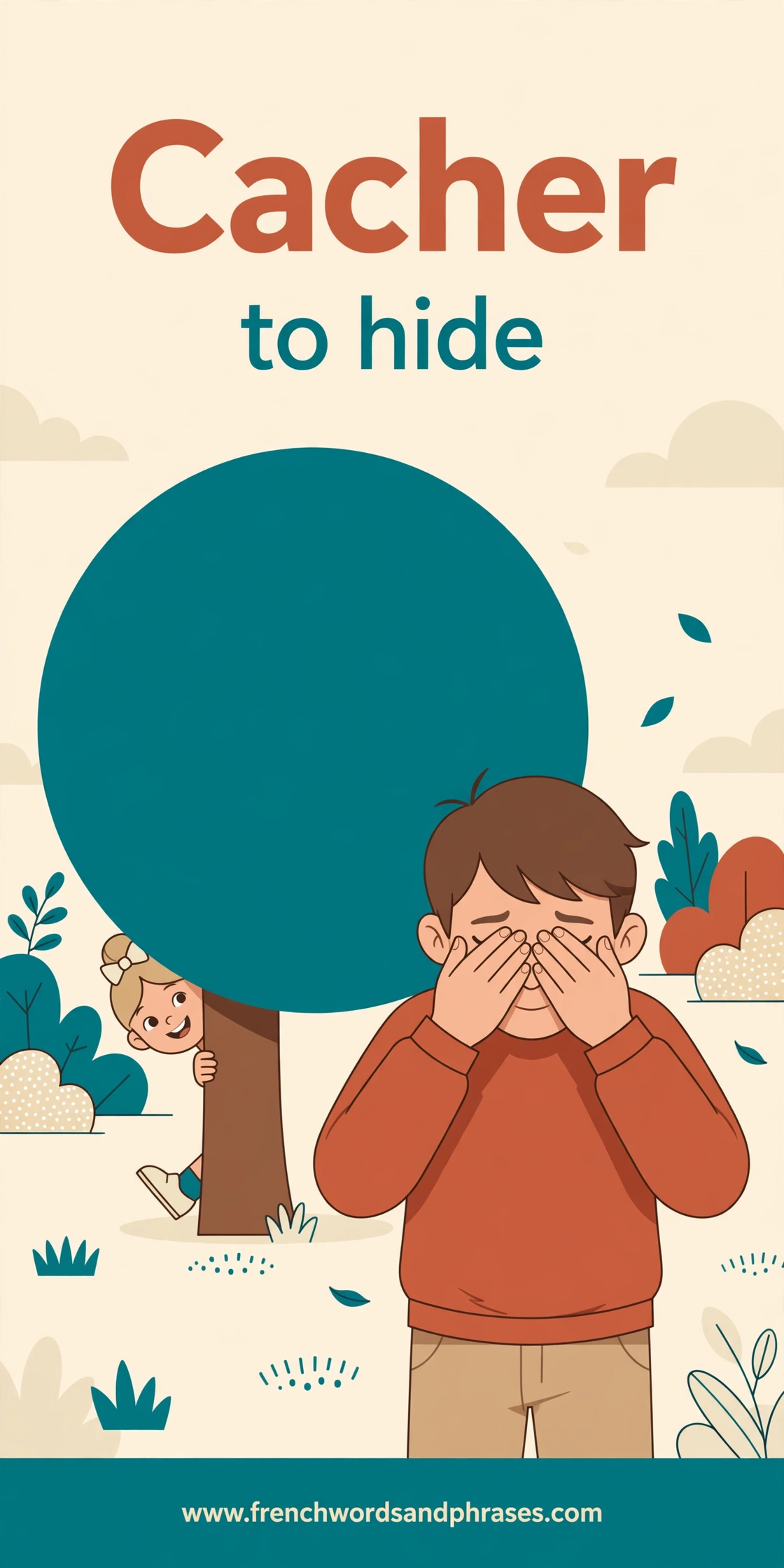
Cacher means to hide — to put something where it will not be seen, or to keep a feeling, a truth or a smile out of sight.
A child slipping the broken vase behind the sofa, a squirrel burying its nuts, a poker player keeping his joy off his face — cacher is the everyday verb of hiding: things behind doors, treasures under floorboards, and feelings behind a smile.
In this guide, you’ll learn how to conjugate cacher in all the major French tenses and moods. Explore complete conjugation tables, French examples, English translations, and practice quizzes.
Understanding the French Verb Cacher
Cacher is a regular French verb belonging to the first group of verbs, those ending in-er.
It means to hide. It is the verb of cache-cache (hide-and-seek), of animals storing food for winter, of birthday presents in wardrobes and of truths kept from children — the warm, everyday end of hiding, far more often playful or protective than guilty.
Verb classification: First group (-er)
Auxiliary verb: Avoir
Past participle: caché
Present participle: cachant
English equivalents: To hide, to conceal; cacher un trésor — to hide a treasure; cacher quelque chose à quelqu’un — to hide something from someone; cacher sa joie — to hide one’s joy; se cacher — to hide oneself; sans rien cacher — without hiding anything.
One important detail: cacher takes à for the person kept in the dark — cacher quelque chose à quelqu’un, to hide something from someone: il a caché la vérité à ses parents. The reflexive se cacher is to hide oneself, the verb of every childhood game. Against its formal cousin dissimuler: cacher is the plain, physical verb — objects, people, hiding places — while dissimuler is deliberate concealment, of feelings, evidence or income. Cacher itself is a regular -er: je cache, nous cachons, ils cachent.
Experience the Word
Cacher is the verb of the hiding place — every cacher promises a discovery later.
Imagine the morning of a birthday in a small flat. The present is too big for any drawer, so it waits behind the shower curtain, wrapped in a towel. All morning the children brush their teeth two metres from the secret, suspecting nothing — maman a caché le cadeau, and the bathroom has become a treasure cave.
The best hiding places are in plain sight. Caché — hidden, and grinning about it.
How to Conjugate Cacher: Complete French Conjugation Guide
Let’s explore every major conjugation of cacher, beginning with the indicative mood.
How to Conjugate Cacher in the Indicative Mood
The indicative mood is used to express facts, observations, actions, and events.
How to Conjugate Cacher in the Present Tense (Présent)
Used for actions happening now, habitual actions, and general truths.
| Subject | Conjugation |
|---|---|
| je | cache |
| tu | caches |
| il / elle | cache |
| nous | cachons |
| vous | cachez |
| ils / elles | cachent |
Example
L’écureuil cache ses noisettes sous les feuilles.
The squirrel hides its hazelnuts under the leaves.
Quick Quiz 1
Complete the sentence:
Nous ______ les œufs de Pâques dans le jardin.
Reveal the answer
cachons
Nous cachons les œufs de Pâques dans le jardin.
We are hiding the Easter eggs in the garden.
How to Conjugate Cacher in the Passé Composé
Used for completed actions in the past. Cacher takes the auxiliary verb avoir.
| Subject | Conjugation |
|---|---|
| j’ | ai caché |
| tu | as caché |
| il / elle | a caché |
| nous | avons caché |
| vous | avez caché |
| ils / elles | ont caché |
Example
Elle a caché les clés derrière le pot de fleurs.
She hid the keys behind the flowerpot.
How to Conjugate Cacher in the Imparfait (Imperfect Tense)
Used for habitual past actions, descriptions, and ongoing situations in the past.
| Subject | Conjugation |
|---|---|
| je | cachais |
| tu | cachais |
| il / elle | cachait |
| nous | cachions |
| vous | cachiez |
| ils / elles | cachaient |
Example
Enfant, je cachais mes bonbons sous le matelas.
As a child, I used to hide my sweets under the mattress.
Quick Quiz 2
Choose the correct form:
He had hidden the letter.
Il ______ la lettre. (avait caché / était caché)
Reveal the answer
avait caché
Il avait caché la lettre.
Cacher takes avoir.
How to Conjugate Cacher in the Plus-que-parfait
Used to describe an action that had already been completed before another past event.
| Subject | Conjugation |
|---|---|
| j’ | avais caché |
| tu | avais caché |
| il / elle | avait caché |
| nous | avions caché |
| vous | aviez caché |
| ils / elles | avaient caché |
Example
Il avait caché la lettre avant l’arrivée de sa mère.
He had hidden the letter before his mother arrived.
How to Conjugate Cacher in the Passé Simple
Primarily used in formal writing, literature, and historical narratives. It is rarely used in everyday conversation.
| Subject | Conjugation |
|---|---|
| je | cachai |
| tu | cachas |
| il / elle | cacha |
| nous | cachâmes |
| vous | cachâtes |
| ils / elles | cachèrent |
Example
Le trésor que le pirate cacha sur l’île ne fut jamais retrouvé.
The treasure the pirate hid on the island was never found again.
How to Conjugate Cacher in the Passé Antérieur
A literary tense used to express an action completed immediately before another past action, generally in the passé simple.
| Subject | Conjugation |
|---|---|
| j’ | eus caché |
| tu | eus caché |
| il / elle | eut caché |
| nous | eûmes caché |
| vous | eûtes caché |
| ils / elles | eurent caché |
Example
Quand il eut caché le cadeau, il appela les enfants.
When he had hidden the present, he called the children.
How to Conjugate Cacher in the Future Tense (Futur Simple)
Used to describe actions that will take place in the future.
| Subject | Conjugation |
|---|---|
| je | cacherai |
| tu | cacheras |
| il / elle | cachera |
| nous | cacherons |
| vous | cacherez |
| ils / elles | cacheront |
Example
Je cacherai les œufs de Pâques dans tout le jardin.
I will hide the Easter eggs all over the garden.
How to Conjugate Cacher in the Futur Antérieur (Future Perfect)
Used for an action that will have been completed before a particular point in the future.
| Subject | Conjugation |
|---|---|
| j’ | aurai caché |
| tu | auras caché |
| il / elle | aura caché |
| nous | aurons caché |
| vous | aurez caché |
| ils / elles | auront caché |
Example
À ton retour, nous aurons caché tous les cadeaux.
By the time you return, we will have hidden all the presents.
How to Conjugate Cacher in the Near Future (Futur Proche)
Used to describe something that is going to happen soon. Formed with aller + infinitive.
| Subject | Conjugation |
|---|---|
| je | vais cacher |
| tu | vas cacher |
| il / elle | va cacher |
| nous | allons cacher |
| vous | allez cacher |
| ils / elles | vont cacher |
Example
Vite, va cacher le gâteau, elle arrive !
Quick, go and hide the cake, she is coming!
How to Conjugate Cacher in the Conditional Mood
The conditional mood expresses what would happen under certain circumstances. It is also frequently used to make polite requests or express wishes.
How to Conjugate Cacher in the Present Conditional
| Subject | Conjugation |
|---|---|
| je | cacherais |
| tu | cacherais |
| il / elle | cacherait |
| nous | cacherions |
| vous | cacheriez |
| ils / elles | cacheraient |
Example
À ta place, je cacherais mieux ces documents.
In your place, I would hide these documents better.
How to Conjugate Cacher in the Past Conditional
| Subject | Conjugation |
|---|---|
| j’ | aurais caché |
| tu | aurais caché |
| il / elle | aurait caché |
| nous | aurions caché |
| vous | auriez caché |
| ils / elles | auraient caché |
Example
Sans ce tiroir secret, elle n’aurait jamais caché la lettre.
Without this secret drawer, she would never have hidden the letter.
Cacher in the Literary Past Conditional Form
This less common literary form uses the imperfect subjunctive of avoir.
| Subject | Conjugation |
|---|---|
| j’ | eusse caché |
| tu | eusses caché |
| il / elle | eût caché |
| nous | eussions caché |
| vous | eussiez caché |
| ils / elles | eussent caché |
Example
Il eût caché son trésor sous les dalles de la chapelle.
He would have hidden his treasure under the chapel flagstones.
How to Conjugate Cacher in the Subjunctive Mood
The subjunctive is used to express wishes, emotions, doubts, necessity, and uncertainty. It frequently follows expressions such as il faut que (it is necessary that) or bien que (although).
How to Conjugate Cacher in the Present Subjunctive
| Subject | Conjugation |
|---|---|
| que je | cache |
| que tu | caches |
| qu’il / qu’elle | cache |
| que nous | cachions |
| que vous | cachiez |
| qu’ils / qu’elles | cachent |
Example
Il faut que tu caches ce cadeau avant son arrivée.
You must hide this present before she arrives.
Quick Quiz 3
Complete the sentence using the subjunctive:
Il faut que vous ______ la vérité aux enfants encore un peu.
Reveal the answer
cachiez
Il faut que vous cachiez la vérité aux enfants encore un peu.
You must hide the truth from the children a little longer.
How to Conjugate Cacher in the Imperfect Subjunctive
A literary tense, rarely encountered in modern spoken French.
| Subject | Conjugation |
|---|---|
| que je | cachasse |
| que tu | cachasses |
| qu’il / qu’elle | cachât |
| que nous | cachassions |
| que vous | cachassiez |
| qu’ils / qu’elles | cachassent |
Example
Elle craignait qu’il cachât quelque chose.
She feared he was hiding something.
How to Conjugate Cacher in the Pluperfect Subjunctive
A literary construction used to express an action completed before another past action.
| Subject | Conjugation |
|---|---|
| que j’ | eusse caché |
| que tu | eusses caché |
| qu’il / qu’elle | eût caché |
| que nous | eussions caché |
| que vous | eussiez caché |
| qu’ils / qu’elles | eussent caché |
Example
On disait qu’elle eût caché des documents importants.
People said she had hidden important documents.
How to Conjugate Cacher in the Past Subjunctive
| Subject | Conjugation |
|---|---|
| que j’ | aie caché |
| que tu | aies caché |
| qu’il / qu’elle | ait caché |
| que nous | ayons caché |
| que vous | ayez caché |
| qu’ils / qu’elles | aient caché |
Example
Je suis étonné qu’il ait caché la vérité si longtemps.
I am surprised he hid the truth for so long.
How to Conjugate Cacher in the Imperative
The imperative is used to give commands, instructions, invitations, or suggestions. Subject pronouns are omitted.
How to Conjugate Cacher in the Present Imperative
| Person | Conjugation |
|---|---|
| (tu) | cache |
| (nous) | cachons |
| (vous) | cachez |
Example
Cache les bonbons, les enfants arrivent !
Hide the sweets, the children are coming!
Quick Quiz 4
How would you say Hide the cake (tu form)?
Reveal the answer
Cache le gâteau !
French Participles of Cacher
Participles are verb forms that can be used in compound tenses and other grammatical constructions.
Present Participle of Cacher
cachant
En cachant son sourire, elle a écouté la nouvelle jusqu’au bout.
Hiding her smile, she listened to the news to the end.
Past Participle of Cacher
caché
Cachée derrière le rideau, la petite fille riait en silence.
Hidden behind the curtain, the little girl laughed silently.
Cacher in Everyday French: Real-Life Examples
Now that you know the conjugations, let’s see how cacher appears in everyday French.
Example 1 — Present
L’écureuil cache ses noisettes.
The squirrel hides its hazelnuts.
Example 2 — Passé composé
Elle a caché les clés.
She hid the keys.
Example 3 — Imparfait
Je cachais mes bonbons sous le matelas.
I used to hide my sweets under the mattress.
Example 4 — Future
Je cacherai les œufs dans le jardin.
I will hide the eggs in the garden.
Example 5 — Conditional
Je cacherais mieux ces documents.
I would hide these documents better.
Example 6 — Imperative
Cache le cadeau, vite !
Hide the present, quick!
Beyond Translation: The Meaning of Cacher
English borrowed this verb outright: a cache of weapons or supplies is a hidden store, from cacher.
Its family is the vocabulary of childhood.
Cache-cache is hide-and-seek, une cachette is a hiding place, and a cache-nez — a nose-hider — is a warm scarf. Where dissimuler belongs to courtrooms and tax offices, cacher belongs to squirrels, birthdays and games in the garden.
How to Remember the French Verb Cacher
Remember it this way: Cacher is about the squirrel burying its nuts where no one will find them.
- Cacher quelque chose à quelqu’un: the person kept in the dark takes à, never de.
- Everyday and physical: keys, eggs, presents, squirrels. Deliberate cover-ups belong to dissimuler.
- Regular -er: je cache, nous cachons, past participle caché.
The key idea is the squirrel burying its nuts where no one will find them.
Test Your Knowledge of Cacher
Let’s see how much you’ve learned. Try answering these questions before revealing the answers.
Question 1
Which preposition introduces the person you hide something from?
Reveal the answer
À — cacher quelque chose à quelqu’un: il a caché la vérité à ses parents.
Question 2
How do you say She hid the keys behind the flowerpot in French?
Reveal the answer
Elle a caché les clés derrière le pot de fleurs.
Question 3
Translate: The squirrel hides its hazelnuts under the leaves.
Reveal the answer
L’écureuil cache ses noisettes sous les feuilles.
Question 4
What is the past participle of cacher?
Reveal the answer
Caché.
Question 5
Complete the sentence:
Il faut que tu ______ ce cadeau avant son arrivée.
Reveal the answer
caches
Il faut que tu caches ce cadeau avant son arrivée.
You must hide this present before she arrives.
Your Final Challenge
Can You Use It?
How would you say this in French?
The squirrel hides its hazelnuts one by one, and winter will not catch it unprepared.
Reveal the answer
L’écureuil cache ses noisettes une à une, et l’hiver ne le prendra pas au dépourvu.
The squirrel hides its hazelnuts one by one, and winter will not catch it unprepared.
A little French. A little curiosity. A richer everyday life.
LEARN FRENCH ONE WORD AT A TIME