A French Word to Live By
How to Conjugate Déboucher in French
/de.bu.ʃe/
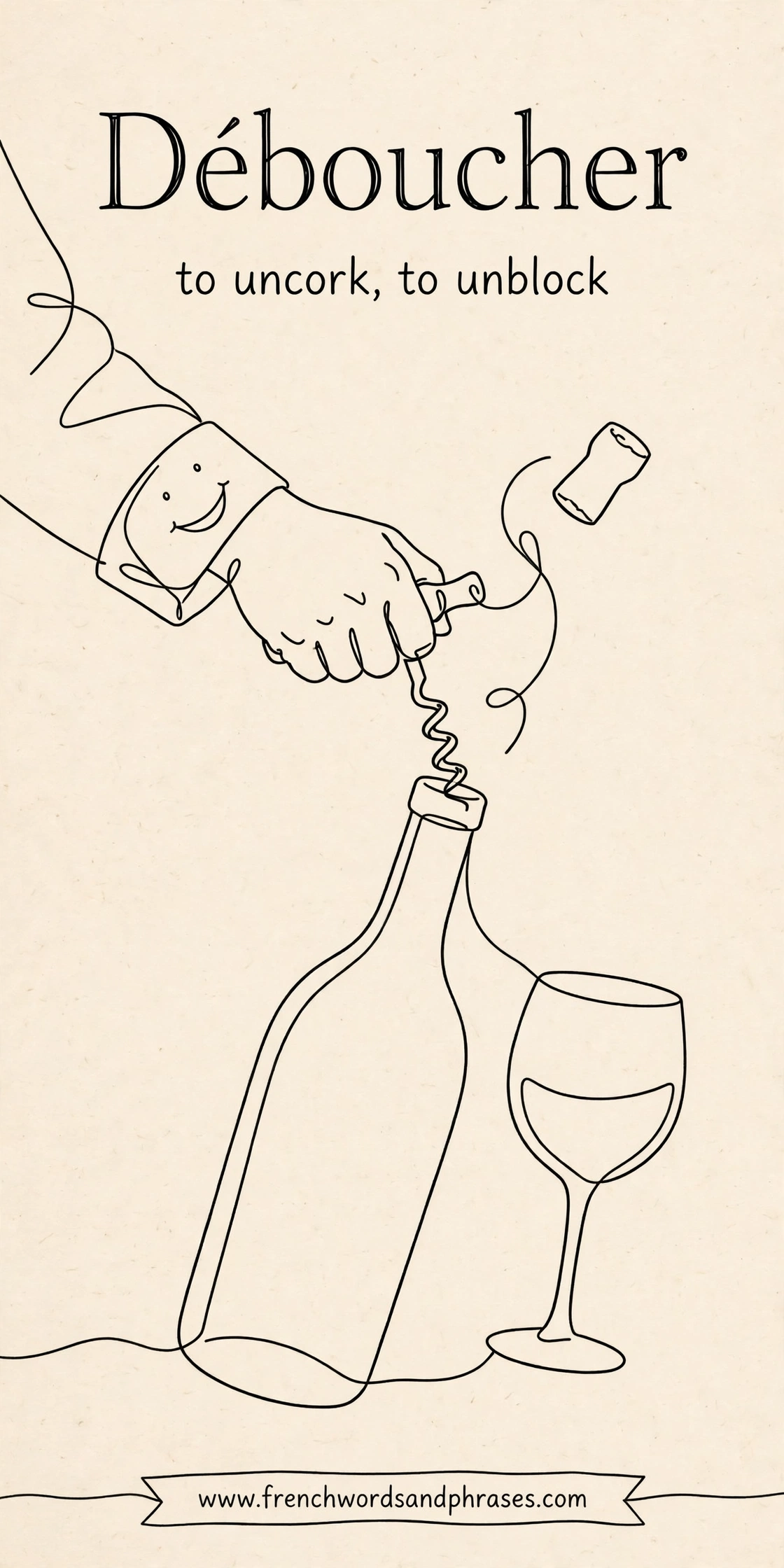
Déboucher means to uncork, to unblock, to lead out — to pull out whatever is plugging a bottle, a pipe or a street, and to come out into the open.
The cork sighing out of a bottle of champagne, the plumber freeing a choked sink, a narrow lane opening suddenly onto a sunlit square — déboucher is the verb of unplugging and emerging: removing the bouchon, the cork or blockage, and letting things flow, or come out.
In this guide, you’ll learn how to conjugate déboucher in all the major French tenses and moods. Explore complete conjugation tables, French examples, English translations, and practice quizzes.
Understanding the French Verb Déboucher
Déboucher is a regular French verb belonging to the first group of verbs, those ending in-er.
It means to uncork, to unblock, to lead out. It is commonly used at the table for bottles, in the house for sinks, pipes and ears, on walks for lanes and valleys that open onto a view, and in the news for negotiations and studies that lead to an outcome — déboucher sur un accord, sur une réforme, sur rien du tout.
Verb classification: First group (-er)
Auxiliary verb: Avoir
Past participle: débouché
Present participle: débouchant
English equivalents: To uncork, to unblock, to clear; déboucher une bouteille — to uncork a bottle; déboucher un évier — to unblock a sink; déboucher sur la place — to lead out onto the square; déboucher sur un accord — to result in an agreement.
One important detail: déboucher is the undoing of boucher, to plug — its heart is un bouchon, a cork, a stopper, any plug. It lives three lives. Transitive, it unplugs things: déboucher une bouteille, déboucher un évier, déboucher une artère. Followed by sur, it is the street or the path that comes out somewhere: la ruelle débouche sur la place. And figuratively, talks and efforts débouchent sur a result: les négociations ont débouché sur un accord. The noun un débouché is an opening or an outlet — in the plural, les débouchés, career prospects.
Experience the Word
Déboucher is the verb of the released flow — the moment the plug comes out and everything moves again.
Imagine New Year’s Eve in a small Paris flat. Midnight approaches, the bottle is ready, and all eyes turn to the host. He twists, he eases, he listens — and the cork leaves with a sigh rather than a bang: il a débouché le champagne like a professional, and the year can begin.
One small cork, held back all evening. Then — débouché — and everything flows.
How to Conjugate Déboucher: Complete French Conjugation Guide
Let’s explore every major conjugation of déboucher, beginning with the indicative mood.
How to Conjugate Déboucher in the Indicative Mood
The indicative mood is used to express facts, observations, actions, and events.
How to Conjugate Déboucher in the Present Tense (Présent)
Used for actions happening now, habitual actions, and general truths.
| Subject | Conjugation |
|---|---|
| je | débouche |
| tu | débouches |
| il / elle | débouche |
| nous | débouchons |
| vous | débouchez |
| ils / elles | débouchent |
Example
Il débouche une bouteille de champagne pour fêter la nouvelle.
He uncorks a bottle of champagne to celebrate the news.
Quick Quiz 1
Complete the sentence:
Nous ______ le champagne à minuit.
Reveal the answer
débouchons
Nous débouchons le champagne à minuit.
We uncork the champagne at midnight.
How to Conjugate Déboucher in the Passé Composé
Used for completed actions in the past. Déboucher takes the auxiliary verb avoir.
| Subject | Conjugation |
|---|---|
| j’ | ai débouché |
| tu | as débouché |
| il / elle | a débouché |
| nous | avons débouché |
| vous | avez débouché |
| ils / elles | ont débouché |
Example
Le plombier a débouché l’évier en dix minutes.
The plumber unblocked the sink in ten minutes.
How to Conjugate Déboucher in the Imparfait (Imperfect Tense)
Used for habitual past actions, descriptions, and ongoing situations in the past.
| Subject | Conjugation |
|---|---|
| je | débouchais |
| tu | débouchais |
| il / elle | débouchait |
| nous | débouchions |
| vous | débouchiez |
| ils / elles | débouchaient |
Example
Cette ruelle débouchait sur un petit jardin caché.
This lane used to lead out onto a little hidden garden.
Quick Quiz 2
Choose the correct form:
The plumber unblocked the sink.
Le plombier ______ l’évier. (a débouché / est débouché)
Reveal the answer
a débouché
Le plombier a débouché l’évier.
Déboucher takes avoir.
How to Conjugate Déboucher in the Plus-que-parfait
Used to describe an action that had already been completed before another past event.
| Subject | Conjugation |
|---|---|
| j’ | avais débouché |
| tu | avais débouché |
| il / elle | avait débouché |
| nous | avions débouché |
| vous | aviez débouché |
| ils / elles | avaient débouché |
Example
Elle avait débouché le tuyau avant l’arrivée des invités.
She had unblocked the pipe before the guests arrived.
How to Conjugate Déboucher in the Passé Simple
Primarily used in formal writing, literature, and historical narratives. It is rarely used in everyday conversation.
| Subject | Conjugation |
|---|---|
| je | débouchai |
| tu | débouchas |
| il / elle | déboucha |
| nous | débouchâmes |
| vous | débouchâtes |
| ils / elles | débouchèrent |
Example
La procession déboucha sur la place au son des cloches.
The procession came out onto the square to the sound of the bells.
How to Conjugate Déboucher in the Passé Antérieur
A literary tense used to express an action completed immediately before another past action, generally in the passé simple.
| Subject | Conjugation |
|---|---|
| j’ | eus débouché |
| tu | eus débouché |
| il / elle | eut débouché |
| nous | eûmes débouché |
| vous | eûtes débouché |
| ils / elles | eurent débouché |
Example
Dès qu’il eut débouché la bouteille, le vin coula dans les verres.
As soon as he had uncorked the bottle, the wine flowed into the glasses.
How to Conjugate Déboucher in the Future Tense (Futur Simple)
Used to describe actions that will take place in the future.
| Subject | Conjugation |
|---|---|
| je | déboucherai |
| tu | déboucheras |
| il / elle | débouchera |
| nous | déboucherons |
| vous | déboucherez |
| ils / elles | déboucheront |
Example
Cette rue débouchera bientôt sur le nouveau boulevard.
This street will soon lead out onto the new boulevard.
How to Conjugate Déboucher in the Futur Antérieur (Future Perfect)
Used for an action that will have been completed before a particular point in the future.
| Subject | Conjugation |
|---|---|
| j’ | aurai débouché |
| tu | auras débouché |
| il / elle | aura débouché |
| nous | aurons débouché |
| vous | aurez débouché |
| ils / elles | auront débouché |
Example
À midi, nous aurons débouché toutes les bouteilles pour le banquet.
By noon, we will have uncorked all the bottles for the banquet.
How to Conjugate Déboucher in the Near Future (Futur Proche)
Used to describe something that is going to happen soon. Formed with aller + infinitive.
| Subject | Conjugation |
|---|---|
| je | vais déboucher |
| tu | vas déboucher |
| il / elle | va déboucher |
| nous | allons déboucher |
| vous | allez déboucher |
| ils / elles | vont déboucher |
Example
Ne secoue pas la bouteille, je vais la déboucher !
Do not shake the bottle, I am going to uncork it!
How to Conjugate Déboucher in the Conditional Mood
The conditional mood expresses what would happen under certain circumstances. It is also frequently used to make polite requests or express wishes.
How to Conjugate Déboucher in the Present Conditional
| Subject | Conjugation |
|---|---|
| je | déboucherais |
| tu | déboucherais |
| il / elle | déboucherait |
| nous | déboucherions |
| vous | déboucheriez |
| ils / elles | déboucheraient |
Example
Ce chemin déboucherait sur la mer si la falaise ne le coupait pas.
This path would lead out to the sea if the cliff did not cut it off.
How to Conjugate Déboucher in the Past Conditional
| Subject | Conjugation |
|---|---|
| j’ | aurais débouché |
| tu | aurais débouché |
| il / elle | aurait débouché |
| nous | aurions débouché |
| vous | auriez débouché |
| ils / elles | auraient débouché |
Example
Sans le plombier, nous n’aurions jamais débouché ce tuyau.
Without the plumber, we would never have unblocked this pipe.
Déboucher in the Literary Past Conditional Form
This less common literary form uses the imperfect subjunctive of avoir.
| Subject | Conjugation |
|---|---|
| j’ | eusse débouché |
| tu | eusses débouché |
| il / elle | eût débouché |
| nous | eussions débouché |
| vous | eussiez débouché |
| ils / elles | eussent débouché |
Example
La foule eût débouché sur la place si les grilles n’avaient pas été fermées.
The crowd would have come out onto the square if the gates had not been closed.
How to Conjugate Déboucher in the Subjunctive Mood
The subjunctive is used to express wishes, emotions, doubts, necessity, and uncertainty. It frequently follows expressions such as il faut que (it is necessary that) or bien que (although).
How to Conjugate Déboucher in the Present Subjunctive
| Subject | Conjugation |
|---|---|
| que je | débouche |
| que tu | débouches |
| qu’il / qu’elle | débouche |
| que nous | débouchions |
| que vous | débouchiez |
| qu’ils / qu’elles | débouchent |
Example
Il faut que tu débouches cette bouteille avec précaution.
You must uncork this bottle carefully.
Quick Quiz 3
Complete the sentence using the subjunctive:
Il faut que vous ______ la bouteille doucement.
Reveal the answer
débouchiez
Il faut que vous débouchiez la bouteille doucement.
You must uncork the bottle gently.
How to Conjugate Déboucher in the Imperfect Subjunctive
A literary tense, rarely encountered in modern spoken French.
| Subject | Conjugation |
|---|---|
| que je | débouchasse |
| que tu | débouchasses |
| qu’il / qu’elle | débouchât |
| que nous | débouchassions |
| que vous | débouchassiez |
| qu’ils / qu’elles | débouchassent |
Example
On attendait que la rue débouchât enfin sur la place.
People waited for the street to lead out onto the square at last.
How to Conjugate Déboucher in the Pluperfect Subjunctive
A literary construction used to express an action completed before another past action.
| Subject | Conjugation |
|---|---|
| que j’ | eusse débouché |
| que tu | eusses débouché |
| qu’il / qu’elle | eût débouché |
| que nous | eussions débouché |
| que vous | eussiez débouché |
| qu’ils / qu’elles | eussent débouché |
Example
On espérait que les négociations eussent débouché sur un accord.
People hoped the negotiations had resulted in an agreement.
How to Conjugate Déboucher in the Past Subjunctive
| Subject | Conjugation |
|---|---|
| que j’ | aie débouché |
| que tu | aies débouché |
| qu’il / qu’elle | ait débouché |
| que nous | ayons débouché |
| que vous | ayez débouché |
| qu’ils / qu’elles | aient débouché |
Example
Je suis content que le plombier ait débouché l’évier.
I am glad the plumber unblocked the sink.
How to Conjugate Déboucher in the Imperative
The imperative is used to give commands, instructions, invitations, or suggestions. Subject pronouns are omitted.
How to Conjugate Déboucher in the Present Imperative
| Person | Conjugation |
|---|---|
| (tu) | débouche |
| (nous) | débouchons |
| (vous) | débouchez |
Example
Débouche le vin, les invités arrivent !
Uncork the wine, the guests are coming!
Quick Quiz 4
How would you say Uncork the wine (tu form)?
Reveal the answer
Débouche le vin !
French Participles of Déboucher
Participles are verb forms that can be used in compound tenses and other grammatical constructions.
Present Participle of Déboucher
débouchant
En débouchant sur la vallée, le sentier offre une vue magnifique.
As it comes out onto the valley, the path offers a magnificent view.
Past Participle of Déboucher
débouché
Débouchée avec soin, la bouteille n’a pas perdu une goutte.
Uncorked with care, the bottle did not lose a drop.
Déboucher in Everyday French: Real-Life Examples
Now that you know the conjugations, let’s see how déboucher appears in everyday French.
Example 1 — Present
Il débouche une bouteille de vin.
He uncorks a bottle of wine.
Example 2 — Passé composé
Le plombier a débouché l’évier.
The plumber unblocked the sink.
Example 3 — Imparfait
La ruelle débouchait sur un jardin.
The lane led out onto a garden.
Example 4 — Future
Cette rue débouchera sur la place.
This street will lead out onto the square.
Example 5 — Conditional
Les négociations déboucheraient sur un accord.
The negotiations would result in an agreement.
Example 6 — Imperative
Débouche le champagne !
Uncork the champagne!
Beyond Translation: The Meaning of Déboucher
English keeps a rare military cousin, debouch — troops debouch from a valley onto a plain — and French déboucher is that same emergence, put to work in the kitchen and the bathroom.
Everything turns on the bouchon.
Boucher plugs it, déboucher frees it — and the same bouchon is also a traffic jam, the plug of cars on the motorway that everyone wishes someone could déboucher.
How to Remember the French Verb Déboucher
Remember it this way: Déboucher is about the cork popping out — and the lane opening onto the square.
- Un bouchon is a cork or a plug; déboucher takes it out — of a bottle, a sink, a street.
- With sur, it emerges: la rue débouche sur la place; les négociations débouchent sur un accord.
- Regular -er: je débouche, nous débouchons, past participle débouché.
The key idea is the cork popping out — and the lane opening onto the square.
Test Your Knowledge of Déboucher
Let’s see how much you’ve learned. Try answering these questions before revealing the answers.
Question 1
What are the three lives of déboucher?
Reveal the answer
Uncorking a bottle, unblocking a pipe, and leading out — déboucher sur la place, déboucher sur un accord.
Question 2
How do you say The plumber unblocked the sink in French?
Reveal the answer
Le plombier a débouché l’évier.
Question 3
Translate: This lane leads out onto a little hidden garden.
Reveal the answer
Cette ruelle débouche sur un petit jardin caché.
Question 4
What is the past participle of déboucher?
Reveal the answer
Débouché.
Question 5
Complete the sentence:
Il faut que tu ______ cette bouteille avec précaution.
Reveal the answer
débouches
Il faut que tu débouches cette bouteille avec précaution.
You must uncork this bottle carefully.
Your Final Challenge
Can You Use It?
How would you say this in French?
At the end of the lane that leads out to the sea, we uncorked a bottle to watch the evening fall.
Reveal the answer
Au bout de la ruelle qui débouche sur la mer, on a débouché une bouteille pour regarder le soir tomber.
At the end of the lane that leads out to the sea, we uncorked a bottle to watch the evening fall.
A little French. A little curiosity. A richer everyday life.
LEARN FRENCH ONE WORD AT A TIME