A French Word to Live By
How to Conjugate Haïr in French
/a.iʁ/
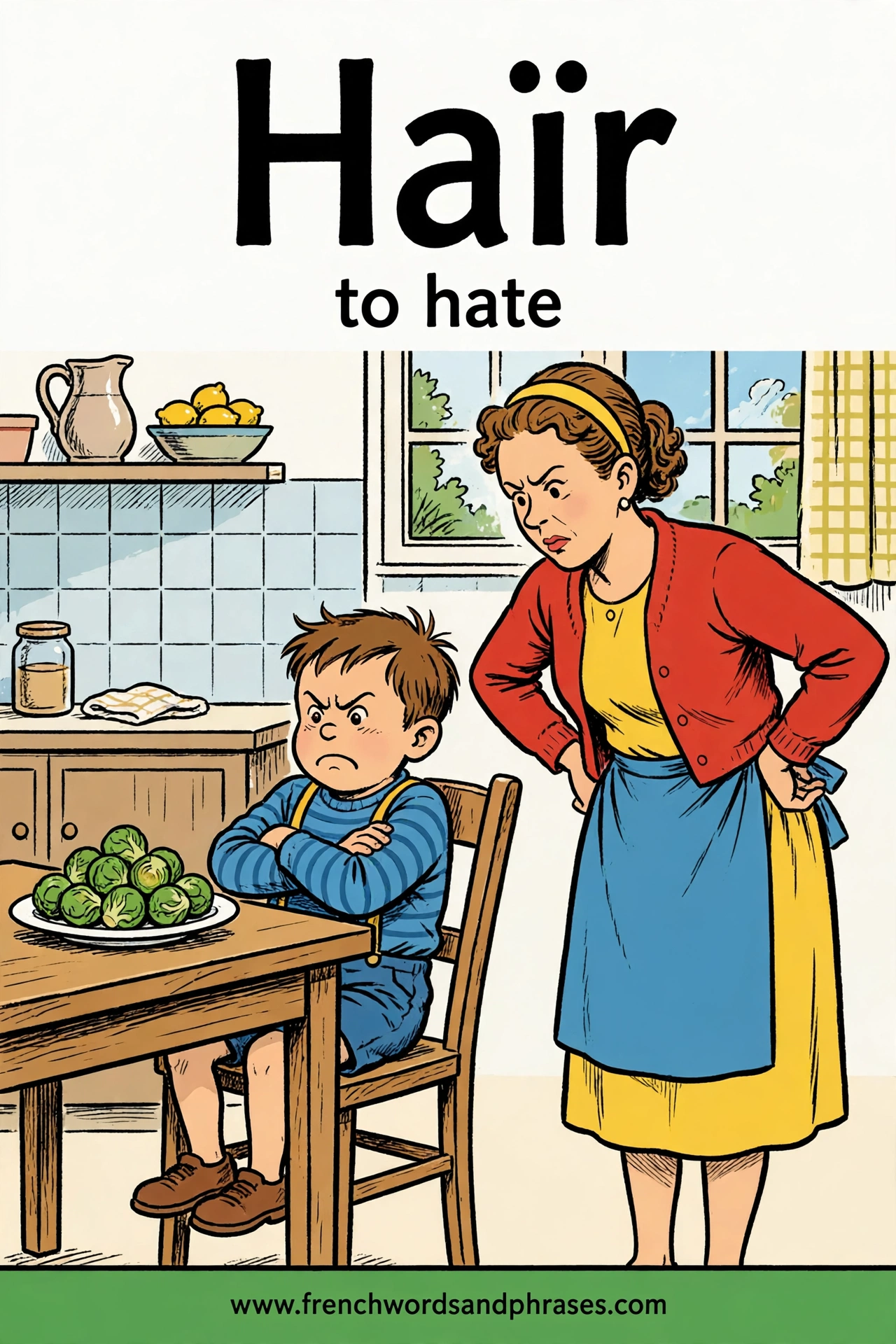
Haïr means to hate — the full, literary weight of hatred, heavier on the page than détester is in the street.
Two brothers divided by an inheritance, an old soldier who cannot forgive, a village feud older than anyone alive — haïr is the verb of deep, settled hatred: not a passing dislike but a feeling that moves in, unpacks, and stays for years.
In this guide, you’ll learn how to conjugate haïr in all the major French tenses and moods. Explore complete conjugation tables, French examples, English translations, and practice quizzes.
Understanding the French Verb Haïr
Haïr is an irregular French verb ending in -ir, famous for its tréma — the ï keeps its two dots everywhere except the three singular forms of the present (je hais, tu hais, il hait).
It means to hate. It is the verb of hatred as a state, not a reaction: feuds, enemies, injustice, betrayal. Where détester handles Brussels sprouts and Monday mornings, haïr handles what poisons a life — and French speakers feel the difference instantly, which is why the verb must be used sparingly and meant completely.
Verb classification: Irregular (-ir)
Auxiliary verb: Avoir
Past participle: haï
Present participle: haïssant
English equivalents: To hate, to detest; haïr quelqu’un — to hate someone; haïr l’injustice — to hate injustice; haïr faire quelque chose — to hate doing something; se faire haïr — to make oneself hated.
One important detail: haïr wears a tréma — the two dots on the ï — in almost every form: nous haïssons, je haïssais, haïssant. The dots vanish in exactly three places, the singular of the present: je hais, tu hais, il hait, and in the tu imperative hais. Without the tréma the word would be misread; with it, every syllable keeps its own sound: ha-ïr, two clean beats. And be honest about its register: haïr is stronger than détester, above all in writing — everyday speech reaches for détester or even ne pas pouvoir supporter, while haïr belongs to novels, speeches and truly serious hatred.
Experience the Word
Haïr is hatred with roots — a feeling that has stopped shouting and started building a house.
Imagine two brothers in a farming village who have not spoken in thirty years. Nobody remembers the exact words of the quarrel; what remains is the silence at funerals, the eyes turned away at the market — il le hait, quietly, completely, the way one hates in books.
No scene, no shouting. He hates him — haï, settled, permanent, like weather.
How to Conjugate Haïr: Complete French Conjugation Guide
Let’s explore every major conjugation of haïr, beginning with the indicative mood.
How to Conjugate Haïr in the Indicative Mood
The indicative mood is used to express facts, observations, actions, and events.
How to Conjugate Haïr in the Present Tense (Présent)
Used for actions happening now, habitual actions, and general truths.
| Subject | Conjugation |
|---|---|
| je | hais |
| tu | hais |
| il / elle | hait |
| nous | haïssons |
| vous | haïssez |
| ils / elles | haïssent |
Example
Il hait l’injustice plus que tout au monde.
He hates injustice more than anything in the world.
Quick Quiz 1
Complete the sentence:
Nous ______ les mensonges.
Reveal the answer
haïssons
Nous haïssons les mensonges.
We hate lies.
How to Conjugate Haïr in the Passé Composé
Used for completed actions in the past. Haïr takes the auxiliary verb avoir.
| Subject | Conjugation |
|---|---|
| j’ | ai haï |
| tu | as haï |
| il / elle | a haï |
| nous | avons haï |
| vous | avez haï |
| ils / elles | ont haï |
Example
Elle a haï son travail dès la première semaine.
She hated her job from the very first week.
How to Conjugate Haïr in the Imparfait (Imperfect Tense)
Used for habitual past actions, descriptions, and ongoing situations in the past.
| Subject | Conjugation |
|---|---|
| je | haïssais |
| tu | haïssais |
| il / elle | haïssait |
| nous | haïssions |
| vous | haïssiez |
| ils / elles | haïssaient |
Example
Nous haïssions les devoirs du dimanche soir.
We used to hate Sunday-evening homework.
Quick Quiz 2
Choose the correct form:
He hates injustice.
Il ______ l’injustice. (hait / haït)
Reveal the answer
hait
Il hait l’injustice.
The present singular drops the tréma: je hais, tu hais, il hait.
How to Conjugate Haïr in the Plus-que-parfait
Used to describe an action that had already been completed before another past event.
| Subject | Conjugation |
|---|---|
| j’ | avais haï |
| tu | avais haï |
| il / elle | avait haï |
| nous | avions haï |
| vous | aviez haï |
| ils / elles | avaient haï |
Example
Il avait haï ce quartier avant de le connaître.
He had hated this neighbourhood before getting to know it.
How to Conjugate Haïr in the Passé Simple
Primarily used in formal writing, literature, and historical narratives. It is rarely used in everyday conversation.
| Subject | Conjugation |
|---|---|
| je | haïs |
| tu | haïs |
| il / elle | haït |
| nous | haïmes |
| vous | haïtes |
| ils / elles | haïrent |
Example
Elle le haït pendant des années sans jamais le dire.
She hated him for years without ever saying so.
How to Conjugate Haïr in the Passé Antérieur
A literary tense used to express an action completed immediately before another past action, generally in the passé simple.
| Subject | Conjugation |
|---|---|
| j’ | eus haï |
| tu | eus haï |
| il / elle | eut haï |
| nous | eûmes haï |
| vous | eûtes haï |
| ils / elles | eurent haï |
Example
Quand il eut haï son rival assez longtemps, il finit par l’oublier.
When he had hated his rival long enough, he ended up forgetting him.
How to Conjugate Haïr in the Future Tense (Futur Simple)
Used to describe actions that will take place in the future.
| Subject | Conjugation |
|---|---|
| je | haïrai |
| tu | haïras |
| il / elle | haïra |
| nous | haïrons |
| vous | haïrez |
| ils / elles | haïront |
Example
Tu ne haïras plus les épinards quand tu auras goûté cette recette.
You will not hate spinach any more once you have tasted this recipe.
How to Conjugate Haïr in the Futur Antérieur (Future Perfect)
Used for an action that will have been completed before a particular point in the future.
| Subject | Conjugation |
|---|---|
| j’ | aurai haï |
| tu | auras haï |
| il / elle | aura haï |
| nous | aurons haï |
| vous | aurez haï |
| ils / elles | auront haï |
Example
Quand tu auras haï assez longtemps, tu comprendras que cela ne sert à rien.
When you have hated long enough, you will understand that it does no good.
How to Conjugate Haïr in the Near Future (Futur Proche)
Used to describe something that is going to happen soon. Formed with aller + infinitive.
| Subject | Conjugation |
|---|---|
| je | vais haïr |
| tu | vas haïr |
| il / elle | va haïr |
| nous | allons haïr |
| vous | allez haïr |
| ils / elles | vont haïr |
Example
Attention, tu vas haïr ce que je vais te montrer.
Careful, you are going to hate what I am about to show you.
How to Conjugate Haïr in the Conditional Mood
The conditional mood expresses what would happen under certain circumstances. It is also frequently used to make polite requests or express wishes.
How to Conjugate Haïr in the Present Conditional
| Subject | Conjugation |
|---|---|
| je | haïrais |
| tu | haïrais |
| il / elle | haïrait |
| nous | haïrions |
| vous | haïriez |
| ils / elles | haïraient |
Example
Sans cette vieille rancune, elle haïrait beaucoup moins de gens.
Without that old grudge, she would hate far fewer people.
How to Conjugate Haïr in the Past Conditional
| Subject | Conjugation |
|---|---|
| j’ | aurais haï |
| tu | aurais haï |
| il / elle | aurait haï |
| nous | aurions haï |
| vous | auriez haï |
| ils / elles | auraient haï |
Example
Il aurait haï ce repas s’il avait goûté les huîtres.
He would have hated this meal if he had tasted the oysters.
Haïr in the Literary Past Conditional Form
This less common literary form uses the imperfect subjunctive of avoir.
| Subject | Conjugation |
|---|---|
| j’ | eusse haï |
| tu | eusses haï |
| il / elle | eût haï |
| nous | eussions haï |
| vous | eussiez haï |
| ils / elles | eussent haï |
Example
Elle eût haï cette ville sans ses amis.
She would have hated this town without her friends.
How to Conjugate Haïr in the Subjunctive Mood
The subjunctive is used to express wishes, emotions, doubts, necessity, and uncertainty. It frequently follows expressions such as il faut que (it is necessary that) or bien que (although).
How to Conjugate Haïr in the Present Subjunctive
| Subject | Conjugation |
|---|---|
| que je | haïsse |
| que tu | haïsses |
| qu’il / qu’elle | haïsse |
| que nous | haïssions |
| que vous | haïssiez |
| qu’ils / qu’elles | haïssent |
Example
Je comprends que tu haïsses les mensonges.
I understand that you hate lies.
Quick Quiz 3
Complete the sentence using the subjunctive:
Je comprends que vous ______ la violence.
Reveal the answer
haïssiez
Je comprends que vous haïssiez la violence.
I understand that you hate violence.
How to Conjugate Haïr in the Imperfect Subjunctive
A literary tense, rarely encountered in modern spoken French.
| Subject | Conjugation |
|---|---|
| que je | haïsse |
| que tu | haïsses |
| qu’il / qu’elle | haït |
| que nous | haïssions |
| que vous | haïssiez |
| qu’ils / qu’elles | haïssent |
Example
Il fallait qu’elle haït son ennemi pour agir ainsi.
She had to hate her enemy to act like that.
How to Conjugate Haïr in the Pluperfect Subjunctive
A literary construction used to express an action completed before another past action.
| Subject | Conjugation |
|---|---|
| que j’ | eusse haï |
| que tu | eusses haï |
| qu’il / qu’elle | eût haï |
| que nous | eussions haï |
| que vous | eussiez haï |
| qu’ils / qu’elles | eussent haï |
Example
On craignait qu’il eût haï son frère toute sa vie.
People feared he had hated his brother all his life.
How to Conjugate Haïr in the Past Subjunctive
| Subject | Conjugation |
|---|---|
| que j’ | aie haï |
| que tu | aies haï |
| qu’il / qu’elle | ait haï |
| que nous | ayons haï |
| que vous | ayez haï |
| qu’ils / qu’elles | aient haï |
Example
Je regrette que tu aies haï ce cadeau.
I am sorry you hated this present.
How to Conjugate Haïr in the Imperative
The imperative is used to give commands, instructions, invitations, or suggestions. Subject pronouns are omitted.
How to Conjugate Haïr in the Present Imperative
| Person | Conjugation |
|---|---|
| (tu) | hais |
| (nous) | haïssons |
| (vous) | haïssez |
Example
Ne hais personne : la haine fatigue celui qui la porte.
Hate no one: hatred tires the one who carries it.
Quick Quiz 4
How would you say Hate no one (tu form)?
Reveal the answer
Ne hais personne !
French Participles of Haïr
Participles are verb forms that can be used in compound tenses and other grammatical constructions.
Present Participle of Haïr
haïssant
En haïssant tout le monde, il a fini seul.
By hating everybody, he ended up alone.
Past Participle of Haïr
haï
Haï de ses voisins, le vieux monsieur vivait seul.
Hated by his neighbours, the old gentleman lived alone.
Haïr in Everyday French: Real-Life Examples
Now that you know the conjugations, let’s see how haïr appears in everyday French.
Example 1 — Present
Il hait l’injustice.
He hates injustice.
Example 2 — Passé composé
Elle a haï ce travail.
She hated that job.
Example 3 — Imparfait
Nous haïssions les lundis.
We used to hate Mondays.
Example 4 — Future
Tu ne haïras plus les épinards.
You will not hate spinach any more.
Example 5 — Conditional
Elle haïrait moins sans cette rancune.
She would hate less without that grudge.
Example 6 — Imperative
Ne hais personne !
Hate no one!
Beyond Translation: The Meaning of Haïr
English hate and French haïr are distant cousins, both from Germanic roots, but they have divided the work differently: English hate does everything, from spinach to enemies, while French keeps détester for daily use and haïr for the real thing.
Its noun, la haine, is one of the heavy words of French.
La haine de l’autre, la haine de soi — hatred of others, hatred of oneself — and the verb behind it carries that same weight every time it appears.
How to Remember the French Verb Haïr
Remember it this way: Haïr is about the two dots standing guard — dropped only in je hais, tu hais, il hait.
- The tréma is everywhere except je hais, tu hais, il hait — the three present singulars drop the dots.
- Stronger than détester, especially in writing: save haïr for real hatred, not for spinach — unless you are joking.
- Avoir throughout: j’ai haï, nous avons haï, past participle haï, present participle haïssant.
The key idea is the two dots standing guard — dropped only in je hais, tu hais, il hait.
Test Your Knowledge of Haïr
Let’s see how much you’ve learned. Try answering these questions before revealing the answers.
Question 1
In which three forms does haïr lose its tréma?
Reveal the answer
Je hais, tu hais, il hait — the singular of the present indicative (and the tu imperative hais).
Question 2
How do you say He hates injustice in French?
Reveal the answer
Il hait l’injustice.
Question 3
Translate: She hated her job.
Reveal the answer
Elle a haï son travail.
Question 4
What is the past participle of haïr?
Reveal the answer
Haï — agreeing: haïe, haïs, haïes.
Question 5
Complete the sentence:
Je comprends que tu ______ les mensonges.
Reveal the answer
haïsses
Je comprends que tu haïsses les mensonges.
I understand that you hate lies.
Your Final Challenge
Can You Use It?
How would you say this in French?
He hates war, he who knew it too closely.
Reveal the answer
Il hait la guerre, lui qui l’a connue de trop près.
He hates war, he who knew it too closely.
A little French. A little curiosity. A richer everyday life.
LEARN FRENCH ONE WORD AT A TIME