A French Word to Live By
How to Conjugate Emboquer in French
/ɑ̃.bɔ.ke/
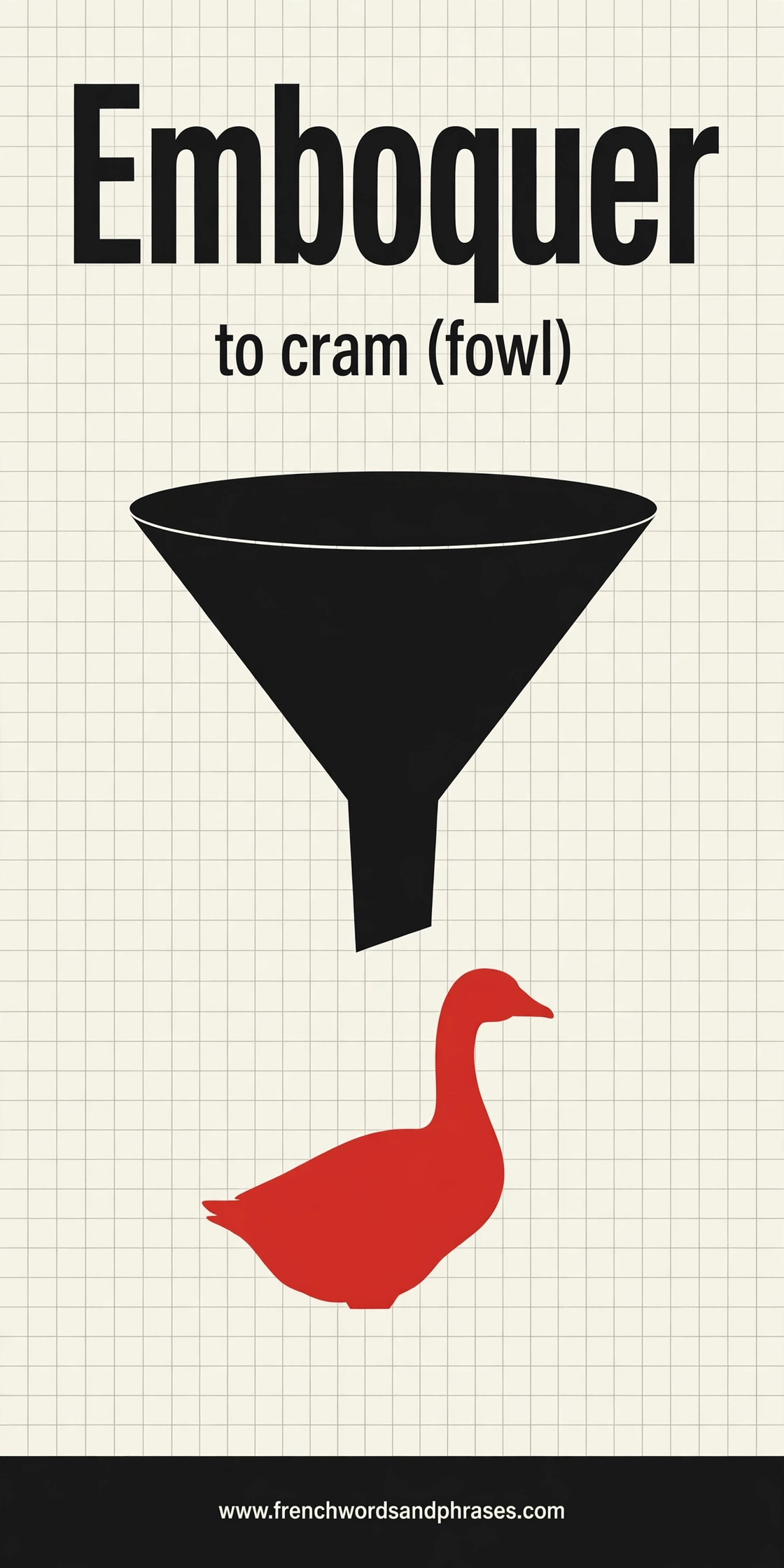
Emboquer means to cram (fowl) — to force-feed geese and ducks by funnel so they fatten for the table.
A farmyard in the Périgord at dawn, a row of geese waiting in their pens, a wooden funnel and a bucket of maize porridge — emboquer is the old farm verb for cramming poultry: feeding the birds by hand and funnel, meal after meal, until they are fat enough for market.
In this guide, you’ll learn how to conjugate emboquer in all the major French tenses and moods. Explore complete conjugation tables, French examples, English translations, and practice quizzes.
Understanding the French Verb Emboquer
Emboquer is a regular French verb belonging to the first group of verbs, those ending in-er.
It means to cram (fowl). It is used only of poultry being fattened by hand-feeding — never of people at table, where French would reach for gaver or bourrer instead. Its home is the traditional goose and duck farms of the south-west, and the literature that describes them.
Verb classification: First group (-er)
Auxiliary verb: Avoir
Past participle: emboqué
Present participle: emboquant
English equivalents: To cram, to force-feed (poultry); emboquer les oies — to cram the geese; emboquer un canard — to force-feed a duck; l’emboquage — cramming, force-feeding of fowl; un emboqueur — a feeder on a poultry farm. Farm vocabulary, close cousin of gaver.
One important detail: emboquer is farm vocabulary, and its world is the foie gras farm — the birds are geese and ducks, the tool is a funnel (un entonnoir, or the tube called un emboque), and the food is maize. The commoner modern word for the same work is gaver and le gavage; emboquer is the older, regional term you will meet in farm memoirs and older dictionaries. Spelling is uneventful — the qu keeps the hard c sound before e and i: je emboque, nous emboquons, que je emboque.
Experience the Word
Emboquer is the verb of the dawn round on the goose farm — funnel, porridge, patience, and forty birds waiting their turn.
Imagine a farmyard in the Dordogne a century ago. The farmer’s wife sits on a low stool, a goose held calmly between her knees, the wooden funnel ready. One bird, then the next, then the next — elle emboque ses oies as her mother did, in the grey light, while the farm wakes around her.
It is slow, skilled, unglamorous work. The geese have been crammed — emboquées, fed for the Christmas market.
How to Conjugate Emboquer: Complete French Conjugation Guide
Let’s explore every major conjugation of emboquer, beginning with the indicative mood.
How to Conjugate Emboquer in the Indicative Mood
The indicative mood is used to express facts, observations, actions, and events.
How to Conjugate Emboquer in the Present Tense (Présent)
Used for actions happening now, habitual actions, and general truths.
| Subject | Conjugation |
|---|---|
| je | emboque |
| tu | emboques |
| il / elle | emboque |
| nous | emboquons |
| vous | emboquez |
| ils / elles | emboquent |
Example
La fermière emboque les oies trois fois par jour.
The farmer’s wife crams the geese three times a day.
Quick Quiz 1
Complete the sentence:
Nous ______ les canards à six heures.
Reveal the answer
emboquons
Nous emboquons les canards à six heures.
We cram the ducks at six o’clock.
How to Conjugate Emboquer in the Passé Composé
Used for completed actions in the past. Emboquer takes the auxiliary verb avoir.
| Subject | Conjugation |
|---|---|
| j’ | ai emboqué |
| tu | as emboqué |
| il / elle | a emboqué |
| nous | avons emboqué |
| vous | avez emboqué |
| ils / elles | ont emboqué |
Example
Il a emboqué ses canards pendant tout le mois de novembre.
He crammed his ducks throughout the month of November.
How to Conjugate Emboquer in the Imparfait (Imperfect Tense)
Used for habitual past actions, descriptions, and ongoing situations in the past.
| Subject | Conjugation |
|---|---|
| je | emboquais |
| tu | emboquais |
| il / elle | emboquait |
| nous | emboquions |
| vous | emboquiez |
| ils / elles | emboquaient |
Example
Autrefois, on emboquait les oies avec un entonnoir en bois.
In the old days, geese were crammed with a wooden funnel.
Quick Quiz 2
Choose the correct form:
He crammed his ducks.
Il ______ ses canards. (a emboqué / est emboqué)
Reveal the answer
a emboqué
Il a emboqué ses canards.
Emboquer takes avoir.
How to Conjugate Emboquer in the Plus-que-parfait
Used to describe an action that had already been completed before another past event.
| Subject | Conjugation |
|---|---|
| j’ | avais emboqué |
| tu | avais emboqué |
| il / elle | avait emboqué |
| nous | avions emboqué |
| vous | aviez emboqué |
| ils / elles | avaient emboqué |
Example
Elle avait emboqué toutes les volailles avant la tombée de la nuit.
She had crammed all the poultry before nightfall.
How to Conjugate Emboquer in the Passé Simple
Primarily used in formal writing, literature, and historical narratives. It is rarely used in everyday conversation.
| Subject | Conjugation |
|---|---|
| je | emboquai |
| tu | emboquas |
| il / elle | emboqua |
| nous | emboquâmes |
| vous | emboquâtes |
| ils / elles | emboquèrent |
Example
Le fermier emboqua ses oies dès l’aube, comme chaque matin.
The farmer crammed his geese from dawn, as every morning.
How to Conjugate Emboquer in the Passé Antérieur
A literary tense used to express an action completed immediately before another past action, generally in the passé simple.
| Subject | Conjugation |
|---|---|
| j’ | eus emboqué |
| tu | eus emboqué |
| il / elle | eut emboqué |
| nous | eûmes emboqué |
| vous | eûtes emboqué |
| ils / elles | eurent emboqué |
Example
Quand il eut emboqué la dernière oie, il nettoya l’entonnoir et le seau.
When he had crammed the last goose, he cleaned the funnel and the bucket.
How to Conjugate Emboquer in the Future Tense (Futur Simple)
Used to describe actions that will take place in the future.
| Subject | Conjugation |
|---|---|
| je | emboquerai |
| tu | emboqueras |
| il / elle | emboquera |
| nous | emboquerons |
| vous | emboquerez |
| ils / elles | emboqueront |
Example
Demain, nous emboquerons les canards à six heures précises.
Tomorrow, we will cram the ducks at six o’clock sharp.
How to Conjugate Emboquer in the Futur Antérieur (Future Perfect)
Used for an action that will have been completed before a particular point in the future.
| Subject | Conjugation |
|---|---|
| j’ | aurai emboqué |
| tu | auras emboqué |
| il / elle | aura emboqué |
| nous | aurons emboqué |
| vous | aurez emboqué |
| ils / elles | auront emboqué |
Example
À la fin de la semaine, elle aura emboqué tout le troupeau deux fois par jour.
By the end of the week, she will have crammed the whole flock twice a day.
How to Conjugate Emboquer in the Near Future (Futur Proche)
Used to describe something that is going to happen soon. Formed with aller + infinitive.
| Subject | Conjugation |
|---|---|
| je | vais emboquer |
| tu | vas emboquer |
| il / elle | va emboquer |
| nous | allons emboquer |
| vous | allez emboquer |
| ils / elles | vont emboquer |
Example
Tu vas emboquer les oies avant de partir au marché.
You are going to cram the geese before leaving for the market.
How to Conjugate Emboquer in the Conditional Mood
The conditional mood expresses what would happen under certain circumstances. It is also frequently used to make polite requests or express wishes.
How to Conjugate Emboquer in the Present Conditional
| Subject | Conjugation |
|---|---|
| je | emboquerais |
| tu | emboquerais |
| il / elle | emboquerait |
| nous | emboquerions |
| vous | emboqueriez |
| ils / elles | emboqueraient |
Example
Sans aide, il emboquerait ses oies jusqu’à midi passé.
Without help, he would be cramming his geese until past noon.
How to Conjugate Emboquer in the Past Conditional
| Subject | Conjugation |
|---|---|
| j’ | aurais emboqué |
| tu | aurais emboqué |
| il / elle | aurait emboqué |
| nous | aurions emboqué |
| vous | auriez emboqué |
| ils / elles | auraient emboqué |
Example
Elle aurait emboqué les canards plus tôt sans cette pluie.
She would have crammed the ducks earlier without that rain.
Emboquer in the Literary Past Conditional Form
This less common literary form uses the imperfect subjunctive of avoir.
| Subject | Conjugation |
|---|---|
| j’ | eusse emboqué |
| tu | eusses emboqué |
| il / elle | eût emboqué |
| nous | eussions emboqué |
| vous | eussiez emboqué |
| ils / elles | eussent emboqué |
Example
Il eût emboqué ses oies avant l’aube, comme son père.
He would have crammed his geese before dawn, like his father.
How to Conjugate Emboquer in the Subjunctive Mood
The subjunctive is used to express wishes, emotions, doubts, necessity, and uncertainty. It frequently follows expressions such as il faut que (it is necessary that) or bien que (although).
How to Conjugate Emboquer in the Present Subjunctive
| Subject | Conjugation |
|---|---|
| que je | emboque |
| que tu | emboques |
| qu’il / qu’elle | emboque |
| que nous | emboquions |
| que vous | emboquiez |
| qu’ils / qu’elles | emboquent |
Example
Il faut que tu emboques les oies doucement, sans les brusquer.
You must cram the geese gently, without rushing them.
Quick Quiz 3
Complete the sentence using the subjunctive:
Il faut que vous ______ les oies doucement.
Reveal the answer
emboquiez
Il faut que vous emboquiez les oies doucement.
You must cram the geese gently.
How to Conjugate Emboquer in the Imperfect Subjunctive
A literary tense, rarely encountered in modern spoken French.
| Subject | Conjugation |
|---|---|
| que je | emboquasse |
| que tu | emboquasses |
| qu’il / qu’elle | emboquât |
| que nous | emboquassions |
| que vous | emboquassiez |
| qu’ils / qu’elles | emboquassent |
Example
Le patron voulait que l’ouvrier emboquât les volailles tout seul.
The boss wanted the worker to cram the poultry all on his own.
How to Conjugate Emboquer in the Pluperfect Subjunctive
A literary construction used to express an action completed before another past action.
| Subject | Conjugation |
|---|---|
| que j’ | eusse emboqué |
| que tu | eusses emboqué |
| qu’il / qu’elle | eût emboqué |
| que nous | eussions emboqué |
| que vous | eussiez emboqué |
| qu’ils / qu’elles | eussent emboqué |
Example
On disait qu’elle eût emboqué des centaines d’oies dans sa vie.
People said she had crammed hundreds of geese in her lifetime.
How to Conjugate Emboquer in the Past Subjunctive
| Subject | Conjugation |
|---|---|
| que j’ | aie emboqué |
| que tu | aies emboqué |
| qu’il / qu’elle | ait emboqué |
| que nous | ayons emboqué |
| que vous | ayez emboqué |
| qu’ils / qu’elles | aient emboqué |
Example
Je suis étonné qu’il ait emboqué les oies si vite ce matin.
I am surprised he crammed the geese so quickly this morning.
How to Conjugate Emboquer in the Imperative
The imperative is used to give commands, instructions, invitations, or suggestions. Subject pronouns are omitted.
How to Conjugate Emboquer in the Present Imperative
| Person | Conjugation |
|---|---|
| (tu) | emboque |
| (nous) | emboquons |
| (vous) | emboquez |
Example
Emboque les oies sans les brusquer !
Cram the geese without rushing them!
Quick Quiz 4
How would you say Cram the geese gently (tu form)?
Reveal the answer
Emboque les oies doucement !
French Participles of Emboquer
Participles are verb forms that can be used in compound tenses and other grammatical constructions.
Present Participle of Emboquer
emboquant
En emboquant les oies, il faut garder un geste lent et régulier.
When cramming geese, you must keep a slow, regular movement.
Past Participle of Emboquer
emboqué
Emboquées matin et soir, les oies engraissent en quelques semaines.
Crammed morning and evening, the geese fatten within a few weeks.
Emboquer in Everyday French: Real-Life Examples
Now that you know the conjugations, let’s see how emboquer appears in everyday French.
Example 1 — Present
La fermière emboque les oies trois fois par jour.
The farmer’s wife crams the geese three times a day.
Example 2 — Passé composé
Il a emboqué ses canards en novembre.
He crammed his ducks in November.
Example 3 — Imparfait
On emboquait les oies à l’entonnoir en bois.
Geese were crammed with a wooden funnel.
Example 4 — Future
Nous emboquerons les canards à six heures.
We will cram the ducks at six o’clock.
Example 5 — Conditional
Sans aide, il emboquerait jusqu’à midi.
Without help, he would be cramming until noon.
Example 6 — Imperative
Emboque les oies doucement !
Cram the geese gently!
Beyond Translation: The Meaning of Emboquer
English farming once said cramming for exactly this work, and French emboquer is its twin — a word from the days when fattening poultry was handwork, not machinery.
Its modern rival is gaver.
Le gavage is the word on today’s foie gras farms and in today’s debates; emboquer survives in the older countryside and its books, smelling of maize porridge and wooden funnels — a verb that remembers how the work felt at dawn.
How to Remember the French Verb Emboquer
Remember it this way: Emboquer is about the goose farm at dawn — funnel, porridge, and forty patient birds.
- Farm vocabulary only: geese and ducks, a funnel, and maize — never people at table.
- Its modern synonym is gaver (le gavage); emboquer is the older farm word.
- Regular -er, with qu guarding the hard c: je emboque, nous emboquons, past participle emboqué.
The key idea is the goose farm at dawn — funnel, porridge, and forty patient birds.
Test Your Knowledge of Emboquer
Let’s see how much you’ve learned. Try answering these questions before revealing the answers.
Question 1
Which birds does emboquer apply to, and with what tool?
Reveal the answer
Geese and ducks, force-fed by hand with a funnel (un entonnoir) so they fatten.
Question 2
How do you say The farmer’s wife crams the geese three times a day in French?
Reveal the answer
La fermière emboque les oies trois fois par jour.
Question 3
Translate: He crammed his ducks in November.
Reveal the answer
Il a emboqué ses canards en novembre.
Question 4
What is the past participle of emboquer?
Reveal the answer
Emboqué.
Question 5
Complete the sentence:
Il faut que tu ______ les oies doucement.
Reveal the answer
emboques
Il faut que tu emboques les oies doucement.
You must cram the geese gently.
Your Final Challenge
Can You Use It?
How would you say this in French?
She crams her geese at dawn, like her mother and her grandmother before her.
Reveal the answer
Elle emboque ses oies à l’aube, comme sa mère et sa grand-mère avant elle.
She crams her geese at dawn, like her mother and her grandmother before her.
A little French. A little curiosity. A richer everyday life.
LEARN FRENCH ONE WORD AT A TIME