A French Word to Live By
How to Conjugate Emblaver in French
/ɑ̃.bla.ve/
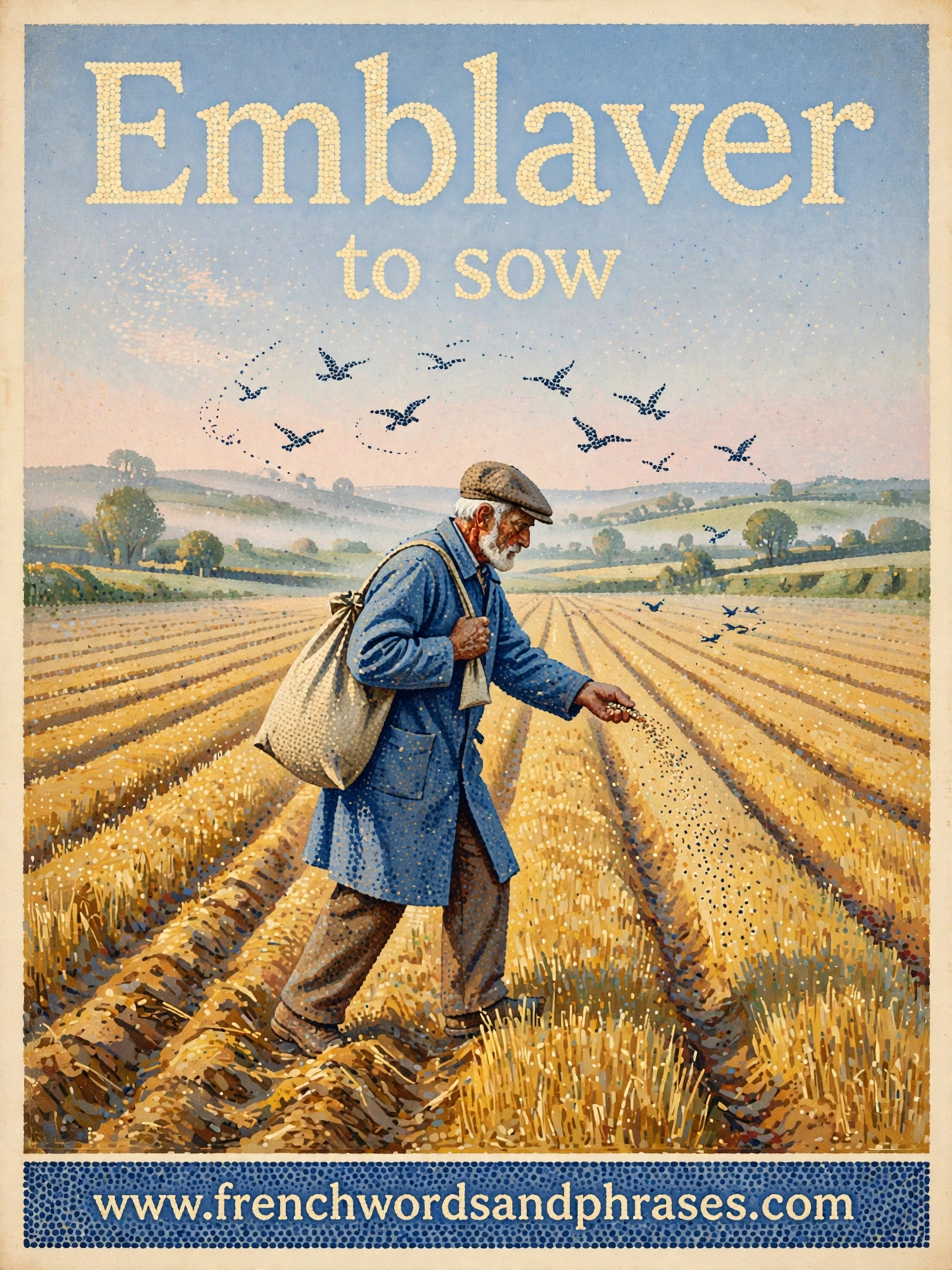
Emblaver means to sow — to put a field under seed, above all under wheat and the other cereals.
A tractor crossing a brown field in October, a seed drill rattling behind it, winter wheat going into the earth row by row — emblaver is the farmer’s precise verb for sowing a field with grain: not scattering seed anywhere, but committing a whole piece of land to a crop.
In this guide, you’ll learn how to conjugate emblaver in all the major French tenses and moods. Explore complete conjugation tables, French examples, English translations, and practice quizzes.
Understanding the French Verb Emblaver
Emblaver is a regular French verb belonging to the first group of verbs, those ending in-er.
It means to sow. It is commonly used by farmers, in farming journalism and in harvest forecasts, almost always of cereals — wheat, barley, oats, maize. For the vegetable garden and for flowers, French prefers semer; emblaver belongs to the open field and the wide acre.
Verb classification: First group (-er)
Auxiliary verb: Avoir
Past participle: emblavé
Present participle: emblavant
English equivalents: To sow (land, with cereals); emblaver un champ de blé — to sow a field with wheat; emblaver une terre en orge — to put a field down to barley; les emblavures — the sown acreage, the land under cereals; une terre emblavée — sown land.
One important detail: emblaver takes the land as its object, where semer can take the seed or the land. One sème du blé (one sows wheat) but one emblave un champ (one sows a field) — the crop is added with de or en: emblaver une plaine de blé, emblaver en orge. It belongs to the vocabulary of cereal farming and of agricultural statistics, where les emblavures are the total acres put under grain. The verb itself is a plain regular -er: je emblave, nous emblavons, ils emblavent.
Experience the Word
Emblaver is the verb of the year’s great wager — a whole field committed to one crop, and the weather left to decide.
Imagine a Beauce farm in late October. The soil is ready, dark and fine, and for three days the tractor goes up and down, up and down, emblavant the plain with winter wheat. When the last row is done, the field looks empty — but everything has been decided, months in advance.
The field is bare, the work invisible. It has been sown — emblavé — and now the winter must do its part.
How to Conjugate Emblaver: Complete French Conjugation Guide
Let’s explore every major conjugation of emblaver, beginning with the indicative mood.
How to Conjugate Emblaver in the Indicative Mood
The indicative mood is used to express facts, observations, actions, and events.
How to Conjugate Emblaver in the Present Tense (Présent)
Used for actions happening now, habitual actions, and general truths.
| Subject | Conjugation |
|---|---|
| je | emblave |
| tu | emblaves |
| il / elle | emblave |
| nous | emblavons |
| vous | emblavez |
| ils / elles | emblavent |
Example
En octobre, le fermier emblave ses champs de blé.
In October, the farmer sows his fields with wheat.
Quick Quiz 1
Complete the sentence:
Nous ______ nos terres de blé.
Reveal the answer
emblavons
Nous emblavons nos terres de blé.
We sow our land with wheat.
How to Conjugate Emblaver in the Passé Composé
Used for completed actions in the past. Emblaver takes the auxiliary verb avoir.
| Subject | Conjugation |
|---|---|
| j’ | ai emblavé |
| tu | as emblavé |
| il / elle | a emblavé |
| nous | avons emblavé |
| vous | avez emblavé |
| ils / elles | ont emblavé |
Example
Ils ont emblavé vingt hectares cette année.
They have sown twenty hectares this year.
How to Conjugate Emblaver in the Imparfait (Imperfect Tense)
Used for habitual past actions, descriptions, and ongoing situations in the past.
| Subject | Conjugation |
|---|---|
| je | emblavais |
| tu | emblavais |
| il / elle | emblavait |
| nous | emblavions |
| vous | emblaviez |
| ils / elles | emblavaient |
Example
Autrefois, on emblavait les terres à la main, le sac en bandoulière.
In the old days, people sowed the land by hand, the bag slung over the shoulder.
Quick Quiz 2
Choose the correct form:
They sowed twenty hectares.
Ils ______ vingt hectares. (ont emblavé / sont emblavés)
Reveal the answer
ont emblavé
Ils ont emblavé vingt hectares.
Emblaver takes avoir.
How to Conjugate Emblaver in the Plus-que-parfait
Used to describe an action that had already been completed before another past event.
| Subject | Conjugation |
|---|---|
| j’ | avais emblavé |
| tu | avais emblavé |
| il / elle | avait emblavé |
| nous | avions emblavé |
| vous | aviez emblavé |
| ils / elles | avaient emblavé |
Example
Il avait emblavé la parcelle avant les premières gelées.
He had sown the plot before the first frosts.
How to Conjugate Emblaver in the Passé Simple
Primarily used in formal writing, literature, and historical narratives. It is rarely used in everyday conversation.
| Subject | Conjugation |
|---|---|
| je | emblavai |
| tu | emblavas |
| il / elle | emblava |
| nous | emblavâmes |
| vous | emblavâtes |
| ils / elles | emblavèrent |
Example
Le métayer emblava la grande plaine en trois jours.
The tenant farmer sowed the great plain in three days.
How to Conjugate Emblaver in the Passé Antérieur
A literary tense used to express an action completed immediately before another past action, generally in the passé simple.
| Subject | Conjugation |
|---|---|
| j’ | eus emblavé |
| tu | eus emblavé |
| il / elle | eut emblavé |
| nous | eûmes emblavé |
| vous | eûtes emblavé |
| ils / elles | eurent emblavé |
Example
Quand il eut emblavé le dernier sillon, il rentra fourbu à la ferme.
When he had sown the last furrow, he went back to the farm exhausted.
How to Conjugate Emblaver in the Future Tense (Futur Simple)
Used to describe actions that will take place in the future.
| Subject | Conjugation |
|---|---|
| je | emblaverai |
| tu | emblaveras |
| il / elle | emblavera |
| nous | emblaverons |
| vous | emblaverez |
| ils / elles | emblaveront |
Example
Nous emblaverons le champ du bas au printemps.
We will sow the lower field in spring.
How to Conjugate Emblaver in the Futur Antérieur (Future Perfect)
Used for an action that will have been completed before a particular point in the future.
| Subject | Conjugation |
|---|---|
| j’ | aurai emblavé |
| tu | auras emblavé |
| il / elle | aura emblavé |
| nous | aurons emblavé |
| vous | aurez emblavé |
| ils / elles | auront emblavé |
Example
À la fin du mois, ils auront emblavé toutes leurs terres.
By the end of the month, they will have sown all their land.
How to Conjugate Emblaver in the Near Future (Futur Proche)
Used to describe something that is going to happen soon. Formed with aller + infinitive.
| Subject | Conjugation |
|---|---|
| je | vais emblaver |
| tu | vas emblaver |
| il / elle | va emblaver |
| nous | allons emblaver |
| vous | allez emblaver |
| ils / elles | vont emblaver |
Example
Le tracteur va emblaver la plaine demain matin.
The tractor is going to sow the plain tomorrow morning.
How to Conjugate Emblaver in the Conditional Mood
The conditional mood expresses what would happen under certain circumstances. It is also frequently used to make polite requests or express wishes.
How to Conjugate Emblaver in the Present Conditional
| Subject | Conjugation |
|---|---|
| je | emblaverais |
| tu | emblaverais |
| il / elle | emblaverait |
| nous | emblaverions |
| vous | emblaveriez |
| ils / elles | emblaveraient |
Example
Avec un sol plus riche, on emblaverait davantage de terres.
With richer soil, we would sow more land.
How to Conjugate Emblaver in the Past Conditional
| Subject | Conjugation |
|---|---|
| j’ | aurais emblavé |
| tu | aurais emblavé |
| il / elle | aurait emblavé |
| nous | aurions emblavé |
| vous | auriez emblavé |
| ils / elles | auraient emblavé |
Example
Sans la pluie, ils auraient emblavé une semaine plus tôt.
Without the rain, they would have sown a week earlier.
Emblaver in the Literary Past Conditional Form
This less common literary form uses the imperfect subjunctive of avoir.
| Subject | Conjugation |
|---|---|
| j’ | eusse emblavé |
| tu | eusses emblavé |
| il / elle | eût emblavé |
| nous | eussions emblavé |
| vous | eussiez emblavé |
| ils / elles | eussent emblavé |
Example
Le fermier eût emblavé ses terres sans la sécheresse.
The farmer would have sown his land without the drought.
How to Conjugate Emblaver in the Subjunctive Mood
The subjunctive is used to express wishes, emotions, doubts, necessity, and uncertainty. It frequently follows expressions such as il faut que (it is necessary that) or bien que (although).
How to Conjugate Emblaver in the Present Subjunctive
| Subject | Conjugation |
|---|---|
| que je | emblave |
| que tu | emblaves |
| qu’il / qu’elle | emblave |
| que nous | emblavions |
| que vous | emblaviez |
| qu’ils / qu’elles | emblavent |
Example
Il faut que tu emblaves ce champ avant la pluie.
You must sow this field before the rain.
Quick Quiz 3
Complete the sentence using the subjunctive:
Il faut que vous ______ avant les gelées.
Reveal the answer
emblaviez
Il faut que vous emblaviez avant les gelées.
You must sow before the frosts.
How to Conjugate Emblaver in the Imperfect Subjunctive
A literary tense, rarely encountered in modern spoken French.
| Subject | Conjugation |
|---|---|
| que je | emblavasse |
| que tu | emblavasses |
| qu’il / qu’elle | emblavât |
| que nous | emblavassions |
| que vous | emblavassiez |
| qu’ils / qu’elles | emblavassent |
Example
Il voulait que son fils emblavât la parcelle du haut.
He wanted his son to sow the upper plot.
How to Conjugate Emblaver in the Pluperfect Subjunctive
A literary construction used to express an action completed before another past action.
| Subject | Conjugation |
|---|---|
| que j’ | eusse emblavé |
| que tu | eusses emblavé |
| qu’il / qu’elle | eût emblavé |
| que nous | eussions emblavé |
| que vous | eussiez emblavé |
| qu’ils / qu’elles | eussent emblavé |
Example
On racontait qu’il eût emblavé cent hectares à lui tout seul.
People said he had sown a hundred hectares all by himself.
How to Conjugate Emblaver in the Past Subjunctive
| Subject | Conjugation |
|---|---|
| que j’ | aie emblavé |
| que tu | aies emblavé |
| qu’il / qu’elle | ait emblavé |
| que nous | ayons emblavé |
| que vous | ayez emblavé |
| qu’ils / qu’elles | aient emblavé |
Example
Je suis content que vous ayez emblavé à temps.
I am glad you sowed in time.
How to Conjugate Emblaver in the Imperative
The imperative is used to give commands, instructions, invitations, or suggestions. Subject pronouns are omitted.
How to Conjugate Emblaver in the Present Imperative
| Person | Conjugation |
|---|---|
| (tu) | emblave |
| (nous) | emblavons |
| (vous) | emblavez |
Example
Emblave le champ du bas avant la fin de la semaine !
Sow the lower field before the end of the week!
Quick Quiz 4
How would you say Sow this field before the rain (tu form)?
Reveal the answer
Emblave ce champ avant la pluie !
French Participles of Emblaver
Participles are verb forms that can be used in compound tenses and other grammatical constructions.
Present Participle of Emblaver
emblavant
En emblavant tôt, on assure une belle récolte.
By sowing early, you ensure a fine harvest.
Past Participle of Emblaver
emblavé
Emblavée en octobre, la plaine verdira au printemps.
Sown in October, the plain will turn green in spring.
Emblaver in Everyday French: Real-Life Examples
Now that you know the conjugations, let’s see how emblaver appears in everyday French.
Example 1 — Present
Le fermier emblave ses champs de blé.
The farmer sows his fields with wheat.
Example 2 — Passé composé
Ils ont emblavé vingt hectares.
They sowed twenty hectares.
Example 3 — Imparfait
On emblavait les terres à la main.
People used to sow the land by hand.
Example 4 — Future
Nous emblaverons au printemps.
We will sow in spring.
Example 5 — Conditional
On emblaverait plus de terres avec un meilleur sol.
We would sow more land with better soil.
Example 6 — Imperative
Emblave ce champ avant la pluie !
Sow this field before the rain!
Beyond Translation: The Meaning of Emblaver
English sow covers everything; French splits the work — semer for the seed and the garden, emblaver for the field and the farm.
It is a word from the world of wheat.
Its root is blé, wheat, hiding inside the verb: to emblaver is, at heart, to wheat a field. That is why the official harvest reports count les emblavures — the nation’s acreage under grain — and why the verb smells of October soil and winter wheat.
How to Remember the French Verb Emblaver
Remember it this way: Emblaver is about the tractor in October, putting the whole plain under wheat.
- Blé (wheat) hides inside the word: emblaver is to put a field under grain.
- The object is the land, not the seed: emblaver un champ de blé — semer takes the seed.
- Regular -er: je emblave, nous emblavons, past participle emblavé.
The key idea is the tractor in October, putting the whole plain under wheat.
Test Your Knowledge of Emblaver
Let’s see how much you’ve learned. Try answering these questions before revealing the answers.
Question 1
What is the difference between emblaver and semer?
Reveal the answer
The object — one emblave a field (emblaver un champ de blé), one sème the seed or the crop (semer du blé).
Question 2
How do you say The farmer sows his fields with wheat in French?
Reveal the answer
Le fermier emblave ses champs de blé.
Question 3
Translate: They sowed twenty hectares this year.
Reveal the answer
Ils ont emblavé vingt hectares cette année.
Question 4
What is the past participle of emblaver?
Reveal the answer
Emblavé.
Question 5
Complete the sentence:
Il faut que tu ______ ce champ avant la pluie.
Reveal the answer
emblaves
Il faut que tu emblaves ce champ avant la pluie.
You must sow this field before the rain.
Your Final Challenge
Can You Use It?
How would you say this in French?
He sows the plain in October, and the plain answers him in June.
Reveal the answer
Il emblave la plaine en octobre, et la plaine lui répond en juin.
He sows the plain in October, and the plain answers him in June.
A little French. A little curiosity. A richer everyday life.
LEARN FRENCH ONE WORD AT A TIME