A French Word to Live By
How to Conjugate Emballer in French
/ɑ̃.ba.le/
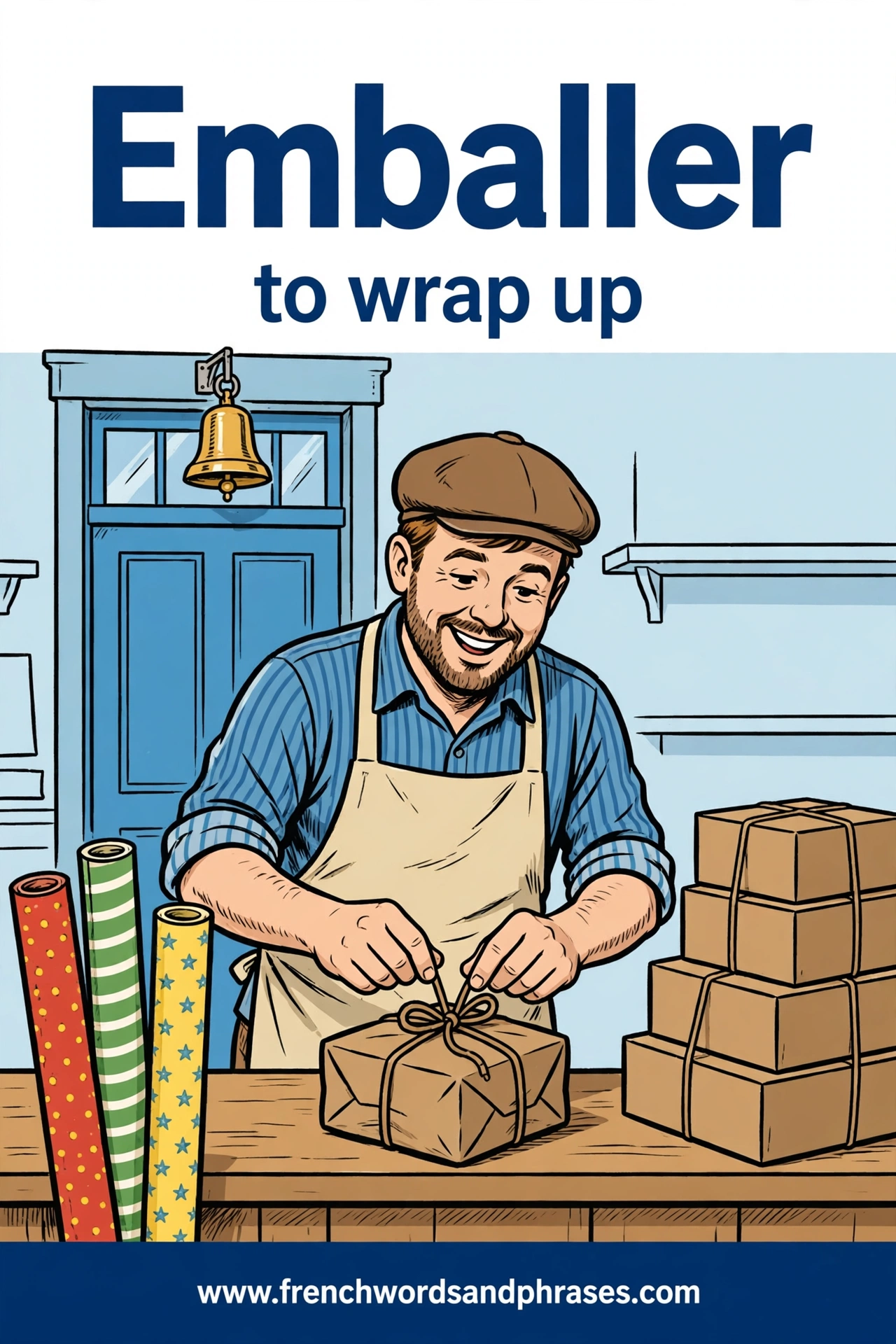
Emballer means to wrap up — to fold paper, cloth or cardboard around a thing until it is a parcel, ready to carry, post or give.
A bookshop counter at Christmas, a removal van being loaded plate by plate, a market stall at closing time — emballer is the verb of the careful hands: tissue, paper, string, and the object disappears into its parcel.
In this guide, you’ll learn how to conjugate emballer in all the major French tenses and moods. Explore complete conjugation tables, French examples, English translations, and practice quizzes.
Understanding the French Verb Emballer
Emballer is a regular French verb belonging to the first group of verbs, those ending in-er.
It means to wrap up. It is the everyday verb of shops, removals and kitchens: presents are wrapped, dishes and books are packed, leftovers are wrapped for the fridge. In a shop, c’est pour offrir ? — je vous l’emballe ? (Shall I wrap it for you?) is the classic offer of gift-wrapping at the till.
Verb classification: First group (-er)
Auxiliary verb: Avoir
Past participle: emballé
Present participle: emballant
English equivalents: To wrap up, to pack up; emballer un cadeau — to wrap a present; emballer la vaisselle — to pack up the dishes; du papier d’emballage — wrapping paper; emballer des livres dans un carton — to pack books in a box; faire emballer — to have something wrapped.
One important detail: emballer is built on une balle — not a ball for games, but a bale, a big packed bundle of goods. To emballer is to turn loose objects into such a bundle: emballer un cadeau, emballer des assiettes. Its reflexive twin s’emballer (the horse that bolts, the enthusiast carried away) lives on its own page. The verb is regular: j’emballe, nous emballons, past participle emballé.
Experience the Word
Emballer is the verb of the last two minutes before a gift is a gift — paper, folds, a ribbon, and the secret is sealed.
Imagine a small bookshop on Christmas Eve. The bookseller works without looking up: a sheet of paper, two folds, a corner tucked like a bedsheet, a length of string — elle emballe chaque livre en trente secondes, and the queue moves forward wrapped in rustling paper.
The book has not changed. It has been wrapped — emballé — and is now a present, not a purchase.
How to Conjugate Emballer: Complete French Conjugation Guide
Let’s explore every major conjugation of emballer, beginning with the indicative mood.
How to Conjugate Emballer in the Indicative Mood
The indicative mood is used to express facts, observations, actions, and events.
How to Conjugate Emballer in the Present Tense (Présent)
Used for actions happening now, habitual actions, and general truths.
| Subject | Conjugation |
|---|---|
| je | emballe |
| tu | emballes |
| il / elle | emballe |
| nous | emballons |
| vous | emballez |
| ils / elles | emballent |
Example
La libraire emballe les livres dans du papier kraft.
The bookseller wraps the books in brown paper.
Quick Quiz 1
Complete the sentence:
Nous ______ les cartons pour le déménagement.
Reveal the answer
emballons
Nous emballons les cartons pour le déménagement.
We are packing the boxes for the move.
How to Conjugate Emballer in the Passé Composé
Used for completed actions in the past. Emballer takes the auxiliary verb avoir.
| Subject | Conjugation |
|---|---|
| j’ | ai emballé |
| tu | as emballé |
| il / elle | a emballé |
| nous | avons emballé |
| vous | avez emballé |
| ils / elles | ont emballé |
Example
Nous avons emballé toute la vaisselle avant le déménagement.
We packed up all the dishes before the move.
How to Conjugate Emballer in the Imparfait (Imperfect Tense)
Used for habitual past actions, descriptions, and ongoing situations in the past.
| Subject | Conjugation |
|---|---|
| je | emballais |
| tu | emballais |
| il / elle | emballait |
| nous | emballions |
| vous | emballiez |
| ils / elles | emballaient |
Example
Ma grand-mère emballait les cadeaux dès le mois de novembre.
My grandmother used to wrap the presents as early as November.
Quick Quiz 2
Choose the correct form:
We packed up the dishes.
Nous ______ la vaisselle. (avons emballé / sommes emballés)
Reveal the answer
avons emballé
Nous avons emballé la vaisselle.
Emballer takes avoir.
How to Conjugate Emballer in the Plus-que-parfait
Used to describe an action that had already been completed before another past event.
| Subject | Conjugation |
|---|---|
| j’ | avais emballé |
| tu | avais emballé |
| il / elle | avait emballé |
| nous | avions emballé |
| vous | aviez emballé |
| ils / elles | avaient emballé |
Example
Elle avait emballé le vase dans trois couches de papier journal.
She had wrapped the vase in three layers of newspaper.
How to Conjugate Emballer in the Passé Simple
Primarily used in formal writing, literature, and historical narratives. It is rarely used in everyday conversation.
| Subject | Conjugation |
|---|---|
| je | emballai |
| tu | emballas |
| il / elle | emballa |
| nous | emballâmes |
| vous | emballâtes |
| ils / elles | emballèrent |
Example
Le marchand emballa le fromage et le tendit au client.
The merchant wrapped the cheese and handed it to the customer.
How to Conjugate Emballer in the Passé Antérieur
A literary tense used to express an action completed immediately before another past action, generally in the passé simple.
| Subject | Conjugation |
|---|---|
| j’ | eus emballé |
| tu | eus emballé |
| il / elle | eut emballé |
| nous | eûmes emballé |
| vous | eûtes emballé |
| ils / elles | eurent emballé |
Example
Quand ils eurent emballé les cartons, le camion arriva.
When they had packed the boxes, the lorry arrived.
How to Conjugate Emballer in the Future Tense (Futur Simple)
Used to describe actions that will take place in the future.
| Subject | Conjugation |
|---|---|
| je | emballerai |
| tu | emballeras |
| il / elle | emballera |
| nous | emballerons |
| vous | emballerez |
| ils / elles | emballeront |
Example
Demain, nous emballerons les affaires des enfants.
Tomorrow, we will pack up the children’s things.
How to Conjugate Emballer in the Futur Antérieur (Future Perfect)
Used for an action that will have been completed before a particular point in the future.
| Subject | Conjugation |
|---|---|
| j’ | aurai emballé |
| tu | auras emballé |
| il / elle | aura emballé |
| nous | aurons emballé |
| vous | aurez emballé |
| ils / elles | auront emballé |
Example
À Noël, elle aura emballé une centaine de cadeaux.
By Christmas, she will have wrapped a hundred presents.
How to Conjugate Emballer in the Near Future (Futur Proche)
Used to describe something that is going to happen soon. Formed with aller + infinitive.
| Subject | Conjugation |
|---|---|
| je | vais emballer |
| tu | vas emballer |
| il / elle | va emballer |
| nous | allons emballer |
| vous | allez emballer |
| ils / elles | vont emballer |
Example
Attends, je vais emballer ce livre, c’est un cadeau.
Wait, I am going to wrap this book, it is a present.
How to Conjugate Emballer in the Conditional Mood
The conditional mood expresses what would happen under certain circumstances. It is also frequently used to make polite requests or express wishes.
How to Conjugate Emballer in the Present Conditional
| Subject | Conjugation |
|---|---|
| je | emballerais |
| tu | emballerais |
| il / elle | emballerait |
| nous | emballerions |
| vous | emballeriez |
| ils / elles | emballeraient |
Example
Avec du beau papier, j’emballerais ce vase moi-même.
With nice paper, I would wrap this vase myself.
How to Conjugate Emballer in the Past Conditional
| Subject | Conjugation |
|---|---|
| j’ | aurais emballé |
| tu | aurais emballé |
| il / elle | aurait emballé |
| nous | aurions emballé |
| vous | auriez emballé |
| ils / elles | auraient emballé |
Example
Il aurait emballé les verres séparément s’il avait eu le temps.
He would have wrapped the glasses separately if he had had time.
Emballer in the Literary Past Conditional Form
This less common literary form uses the imperfect subjunctive of avoir.
| Subject | Conjugation |
|---|---|
| j’ | eusse emballé |
| tu | eusses emballé |
| il / elle | eût emballé |
| nous | eussions emballé |
| vous | eussiez emballé |
| ils / elles | eussent emballé |
Example
Le boutiquier eût emballé le paquet sans la cohue du soir.
The shopkeeper would have wrapped the parcel without the evening crush.
How to Conjugate Emballer in the Subjunctive Mood
The subjunctive is used to express wishes, emotions, doubts, necessity, and uncertainty. It frequently follows expressions such as il faut que (it is necessary that) or bien que (although).
How to Conjugate Emballer in the Present Subjunctive
| Subject | Conjugation |
|---|---|
| que je | emballe |
| que tu | emballes |
| qu’il / qu’elle | emballe |
| que nous | emballions |
| que vous | emballiez |
| qu’ils / qu’elles | emballent |
Example
Il faut que tu emballes les assiettes une à une.
You must wrap the plates one by one.
Quick Quiz 3
Complete the sentence using the subjunctive:
Il faut que vous ______ les miroirs avec soin.
Reveal the answer
emballiez
Il faut que vous emballiez les miroirs avec soin.
You must wrap the mirrors carefully.
How to Conjugate Emballer in the Imperfect Subjunctive
A literary tense, rarely encountered in modern spoken French.
| Subject | Conjugation |
|---|---|
| que je | emballasse |
| que tu | emballasses |
| qu’il / qu’elle | emballât |
| que nous | emballassions |
| que vous | emballassiez |
| qu’ils / qu’elles | emballassent |
Example
Elle demandait que l’on emballât les cadeaux avec soin.
She asked for the presents to be wrapped with care.
How to Conjugate Emballer in the Pluperfect Subjunctive
A literary construction used to express an action completed before another past action.
| Subject | Conjugation |
|---|---|
| que j’ | eusse emballé |
| que tu | eusses emballé |
| qu’il / qu’elle | eût emballé |
| que nous | eussions emballé |
| que vous | eussiez emballé |
| qu’ils / qu’elles | eussent emballé |
Example
On vérifia que les déménageurs eussent emballé les miroirs.
They checked that the removal men had wrapped the mirrors.
How to Conjugate Emballer in the Past Subjunctive
| Subject | Conjugation |
|---|---|
| que j’ | aie emballé |
| que tu | aies emballé |
| qu’il / qu’elle | ait emballé |
| que nous | ayons emballé |
| que vous | ayez emballé |
| qu’ils / qu’elles | aient emballé |
Example
Je suis content que tu aies emballé le vase à part.
I am glad you wrapped the vase separately.
How to Conjugate Emballer in the Imperative
The imperative is used to give commands, instructions, invitations, or suggestions. Subject pronouns are omitted.
How to Conjugate Emballer in the Present Imperative
| Person | Conjugation |
|---|---|
| (tu) | emballe |
| (nous) | emballons |
| (vous) | emballez |
Example
Emballe ce cadeau et n’oublie pas le ruban !
Wrap this present and do not forget the ribbon!
Quick Quiz 4
How would you say Wrap this present (tu form)?
Reveal the answer
Emballe ce cadeau !
French Participles of Emballer
Participles are verb forms that can be used in compound tenses and other grammatical constructions.
Present Participle of Emballer
emballant
En emballant les verres dans du papier, elle évite la casse.
By wrapping the glasses in paper, she avoids breakages.
Past Participle of Emballer
emballé
Emballés dans du linge, les verres ont survécu au voyage.
Wrapped in cloth, the glasses survived the journey.
Emballer in Everyday French: Real-Life Examples
Now that you know the conjugations, let’s see how emballer appears in everyday French.
Example 1 — Present
La libraire emballe les livres à la caisse.
The bookseller wraps the books at the till.
Example 2 — Passé composé
Nous avons emballé la vaisselle hier.
We packed up the dishes yesterday.
Example 3 — Imparfait
Ma grand-mère emballait les cadeaux en novembre.
My grandmother used to wrap the presents in November.
Example 4 — Future
Nous emballerons les cartons demain.
We will pack the boxes tomorrow.
Example 5 — Conditional
J’emballerais ce vase avec du beau papier.
I would wrap this vase with nice paper.
Example 6 — Imperative
Emballe ce cadeau, vite !
Wrap this present, quickly!
Beyond Translation: The Meaning of Emballer
French emballer grows out of une balle, a bale — the great compressed bundle in which cloth, hay and merchandise once travelled.
Every parcel is a little bale.
The word family still shows it: l’emballage is packaging, un emballeur is a packer, and the opposite journey is déballer — to unwrap, unpack, and in slang to spill everything out at once.
How to Remember the French Verb Emballer
Remember it this way: Emballer is about the bookseller at Christmas — thirty seconds of paper and string per gift.
- Think une balle, a bale: emballer turns loose things into one packed bundle — cadeaux, vaisselle, cartons.
- In a shop, je vous l’emballe ? means Shall I wrap it for you? — the gift-wrap offer.
- Regular -er: j’emballe, nous emballons, past participle emballé.
The key idea is the bookseller at Christmas — thirty seconds of paper and string per gift.
Test Your Knowledge of Emballer
Let’s see how much you’ve learned. Try answering these questions before revealing the answers.
Question 1
What noun is emballer built on, and what does it mean?
Reveal the answer
Une balle — a bale, a big packed bundle of goods; emballer makes a bundle of things.
Question 2
How do you say We packed up all the dishes in French?
Reveal the answer
Nous avons emballé toute la vaisselle.
Question 3
Translate: Shall I wrap it for you?
Reveal the answer
Je vous l’emballe ?
Question 4
What is the past participle of emballer?
Reveal the answer
Emballé.
Question 5
Complete the sentence:
Il faut que tu ______ les assiettes une à une.
Reveal the answer
emballes
Il faut que tu emballes les assiettes une à une.
You must wrap the plates one by one.
Your Final Challenge
Can You Use It?
How would you say this in French?
She wraps every present like a secret, and the paper keeps the silence to the very end.
Reveal the answer
Elle emballe chaque cadeau comme un secret, et le papier garde le silence jusqu’au bout.
She wraps every present like a secret, and the paper keeps the silence to the very end.
A little French. A little curiosity. A richer everyday life.
LEARN FRENCH ONE WORD AT A TIME